Sodium Thiosulfate Pentahydrate
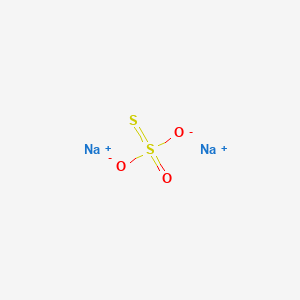
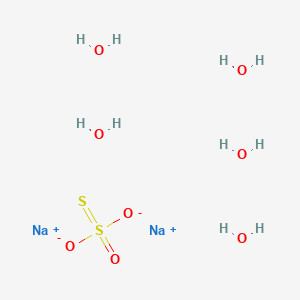
Sodium thiosulfate pentahydrate is a hydrate consisting of sodium thiosulfate with 5 mol eq. of water. It has a role as a nephroprotective agent, an antifungal drug and an antidote to cyanide poisoning. It contains a sodium thiosulfate. — ChEBI
- Nom IUPAC
- disodium;dioxido-oxo-sulfanylidene-lambda6-sulfane;pentahydrate
- Formule moléculaire
- H10Na2O8S2
- Masse moléculaire
- 248.19 g/mol
- Masse exacte
- 247.96124818 Da
- Surface polaire topologique
- 109,0 Ų
- Donneurs de liaisons hydrogène
- 5
- Accepteurs de liaisons hydrogène
- 9
- Unités covalentes
- 8
- Stéréocentres définis
- 0
Également connu sous le nom de
16 autres noms signalés
Identifiants de bases de données externes
- ChEBI:CHEBI:32150
- ChEMBL:CHEMBL2096650
- EPA DTXSID:DTXSID6044197
Preuves issues de bases de données scientifiques complémentaires
EMBL-EBI ChEBI
sodium thiosulfate pentahydrate
A hydrate consisting of sodium thiosulfate with 5 mol eq. of water.
- Formule
- 5H2O.2Na.O3S2
- Masse moyenne
- 248.186 g/mol
- Masse monoisotopique
- 247.96125 Da
- Charge formelle
- 0
- hydrate — is a (CHEBI:35505)
- antidote to cyanide poisoning — has role (CHEBI:90749)
- nephroprotective agent — has role (CHEBI:76595)
- antifungal drug — has role (CHEBI:86327)
- sodium thiosulfate — has part (CHEBI:132112)
- antidote to cyanide poisoning — has role (CHEBI:90749)
- nephroprotective agent — has role (CHEBI:76595)
- antifungal drug — has role (CHEBI:86327)
- hydrate — is a (CHEBI:35505)
Noms supplémentaires validés
Références croisées de cette source
- CAS: 10102-17-7 — KEGG COMPOUND
- CAS: 10102-17-7 — ChemIDplus
- MANUAL_X_REF: D01091 — KEGG DRUG
- MANUAL_X_REF: DBSALT002505 — DrugBank
Mis en correspondance par: Exact CAS cross-reference in the ChEBI compound record. Source mise à jour le: 2024-05-17. Récupéré le: 2026-08-31. Ouvrir la fiche source
NIH PubChem PUG-View
Attributed physical-property, hazard, environmental and use annotations.
- Density: 1.69 @25 °C Source: PAC Chemical Database, U.S. Department of Energy
- Melting Point: 48 °C Source: PAC Chemical Database, U.S. Department of Energy
- Physical Description: Large Crystals; Dry Powder; Other Solid Source: EPA Chemical Data Reporting (CDR)
- Physical Description: Odorless solid; Deliquesces slightly in moist air; [Merck Index] Colorless odorless crystalline solid; [Sigma-Aldrich MSDS] Source: Haz-Map, Information on Hazardous Chemicals and Occupational Diseases
- Note: This chemical does not meet GHS hazard criteria for 98.6% (277 of 281) of all reports. Source: European Chemicals Agency (ECHA)
- GHS Hazard Statements: Not Classified; Reported as not meeting GHS hazard criteria by 277 of 281 companies (only 1.4% companies provided GHS information). For more detailed information, please visit ECHA C&L website. Source: European Chemicals Agency (ECHA)
- ECHA C&L Notifications Summary: Aggregated GHS information provided per 281 reports by companies from 6 notifications to the ECHA C&L Inventory.; Reported as not meeting GHS hazard criteria per 277 of 281 reports by companies.; There are 4 notifications provided by 4 of 281 reports by companies with hazard statement code(s).; Information may vary between notifications depending on impurities, additives, and other factors. The percentage value in parenthesis indicates the notified classification ratio from companies that provide hazard codes. Only hazard codes with percentage values above 10% are shown. For more detailed information, please visit ECHA C&L website. Source: European Chemicals Agency (ECHA)
- Consumer Uses: Not Known or Reasonably Ascertainable Source: EPA Chemical Data Reporting (CDR)
- Industry Uses: Laboratory chemicals; Reducing agent; Not Known or Reasonably Ascertainable; Cleaning agent; Dehydrating agent (desiccant); Processing aids not otherwise specified; Tanning agents not otherwise specified Source: EPA Chemical Data Reporting (CDR)
- Sources/Uses: Used to remove chlorine from solutions; to bleach paper, bone, straw, and ivory; as a fixer in photography; to extract silver from ores; as mordant in dyeing and printing textiles; in leather manufacturing; in pharmaceutical production (antioxidant), and as an antidote for cyanide poisoning; [Merck Index] Permitted for use as an inert ingredient in non-food pesticide products; [EPA] Source: Haz-Map, Information on Hazardous Chemicals and Occupational Diseases
- Industrial Processes with risk of exposure: Pulp and Paper Processing [Category: Industry]; Leather Tanning and Processing [Category: Industry]; Photographic Processing [Category: Other]; Textiles (Printing, Dyeing, or Finishing) [Category: Industry]; Metal Extraction and Refining [Category: Industry] Source: Haz-Map, Information on Hazardous Chemicals and Occupational Diseases
Mis en correspondance par: Existing checksum-valid CAS to unique PubChem CID match. Récupéré le: 2026-08-31. Ouvrir la fiche source
Les classifications scientifiques et les annotations de danger apportent du contexte et ne remplacent pas la décision réglementaire propre au marché indiquée ci-dessus.
Couverture des sources complémentaires et état des correspondances
| Source | Résultat | Vérifié |
|---|---|---|
| EMBL-EBI ChEBI | Correspondance exacte | 2026-08-31 |
| NIH PubChem PUG-View | Correspondance exacte | 2026-08-31 |
Une absence de correspondance enregistrée est une preuve utile que la source a été vérifiée ; ce n’est pas l’affirmation que la substance n’existe pas ailleurs.
Récupéré depuis NIH PubChem le 2026-08-31 par correspondance CAS à somme de contrôle valide. Les propriétés chimiques ne remplacent pas la décision réglementaire de cette page.