
Nom officiel d’étiquetage de l’UEEntrée 26674 du glossaire
SODIUM HYDROXIDE
Cette fiche confirme une dénomination commune officielle d’ingrédient pour l’étiquetage des produits cosmétiques de l’UE. Elle ne confirme pas à elle seule que la substance est autorisée, non restreinte ou sûre.
Aperçu des preuves mondiales
L’identité résolue présente des preuves réglementaires correspondantes dans 1 des 13 jeux de données de marchés indexés : 1 fiches de pays et 0 fiches d’annexes de l’UE. Chaque résultat et chaque lacune de preuves sont énumérés ci-dessous.
Marchés vérifiés
13
Marchés avec preuves
1
Lacunes de preuves
12
Identifiants résolus
2
Identité résolue de la substance
CAS:1310-73-2
EC:215-185-5
Fiches de l’index des ingrédients :
SODIUM HYDROXIDE
Nom Ph. Eur. : natrii hydroxidum
Fonctions cosmétiques : BUFFERING, DENATURANT
Sodium hydroxide
Note de restriction de l’inventaire : III/15a
4 noms correspondants ou signalés
SODIUM HYDROXIDEsodium hydroxidenatrii hydroxidumPotassium or sodium hydroxide
Preuves réglementaires dans les 13 marchés
Ouvrez chaque fiche correspondante pour connaître son champ d’application, sa concentration, ses conditions, ses avertissements et la version de la source officielle.
Balayez ou faites défiler horizontalement pour voir la couverture des jeux de données et les actions suivantes.
| Marché | Résultat | Fiches | Jeu de données | Signification / action suivante |
|---|---|---|---|---|
| European Union EU | Aucune correspondance trouvée | 0 | Complete annex dataset Regulation (EC) 1223/2009 consolidated to 1 May 2026 | No annex match only means that these five annexes did not return a match; CosIng identity data and other EU obligations still need review. |
| Great Britain GB | Aucune correspondance trouvée | 0 | Complete consolidated annex dataset GB retained Regulation 1223/2009 schedules, effective 15 August 2026 | No annex match is not approval and does not cover Northern Ireland, which follows the applicable EU framework. |
| Canada CA | Aucune correspondance trouvée | 0 | Complete Hotlist snapshot Health Canada Cosmetic Ingredient Hotlist, 13 August 2025 | The Hotlist is an administrative compliance tool, not an exhaustive safety approval list. |
| New Zealand NZ | Restricted | 1Ouvrir la fiche 1 | Complete schedules dataset Cosmetic Products Group Standard schedules effective 1 January 2026 | Examinez chaque fiche associée et ses conditions exactes. |
| ASEAN ASEAN | Aucune correspondance trouvée | 0 | Complete regional annex dataset ASEAN Cosmetic Directive annexes 2026-1, 22 June 2026 | Regional annex coverage does not replace member-state implementation dates, notifications or national deviations. |
| China CN | Aucune correspondance trouvée | 0 | Complete prohibited catalogues plus official-source workflow NMPA 2021 banned catalogues plus dynamic IECIC List I/List II system current since 2025 | IECIC listing is not blanket approval; absence may require the new cosmetic ingredient route, and restrictions are checked separately. |
| Japan JP | Aucune correspondance trouvée | 0 | Complete Standards appendices dataset MHLW Standards for Cosmetics official English source and Japanese amendments checked for the imported snapshot | The Japanese text and subsequent notices are canonical; no local match is not a product-compliance conclusion. |
| South Korea KR | Aucune correspondance trouvée | 0 | Complete current appendix dataset MFDS Notice 2026-19, effective 18 March 2026 | Korean source wording is canonical and other positive lists/notices may still apply to the formulation. |
| United States US | Aucune correspondance trouvée | 0 | Complete enumerated federal ingredient rules eCFR Title 21 issue date 27 August 2026 | FDA has no general approved-cosmetic-ingredient catalogue; absence from these sections is not approval or proof of safety. |
| Australia AU | Aucune correspondance trouvée | 0 | Complete cosmetic-relevant Poisons Standard subset plus official workflow Therapeutic Goods (Poisons Standard—June 2026) Instrument 2026 | An AICIS Inventory match is not cosmetic approval; no Inventory match can indicate a new, exempted, reported or confidential introduction. |
| Brazil BR | Aucune correspondance trouvée | 0 | Complete prohibited dataset plus current restricted-list workflow ANVISA RDC 1.029/2026 and RDC 1.030/2026, published 15 June 2026 | RDC 1.030/2026 amends rather than replaces the prohibited baseline, and the second restricted-list revision was still under consultation in July 2026. |
| India IN | Aucune correspondance trouvée | 0 | Complete current Part 2 dataset plus official workflow for Parts 1, 3 and 4 Cosmetics Rules 2020 plus current BIS IS 4707 parts (1:2020, 2:2025, 3:2025, 4:2022) | The standards are separate controlled publications; absence from a locally indexed excerpt is not permission. |
| Saudi Arabia SA | Aucune correspondance trouvée | 0 | Complete official list index SFDA live prohibited/restricted lists, snapshot 30 August 2026 | No list match is not permission; Gulf/SFDA product, claim, notification and technical requirements still apply. |
Aucune ligne de marché ne correspond à ce filtre.
Fiches de marché correspondantes et conditions
Identité et propriétés chimiques
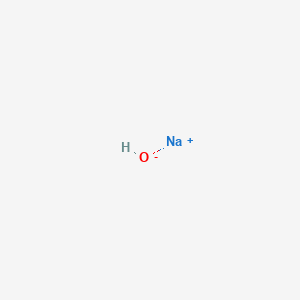
CAS 1310-73-2PubChem CID 14798
Sodium Hydroxide
Sodium hydroxide is an alkali metal hydroxide. — ChEBI
- Nom IUPAC
- sodium hydroxide
- Formule moléculaire
- HNaO
- Masse moléculaire
- 39.997 g/mol
- Masse exacte
- 39.99250893 Da
- Surface polaire topologique
- 1,0 Ų
- Donneurs de liaisons hydrogène
- 1
- Accepteurs de liaisons hydrogène
- 1
- Unités covalentes
- 2
- Stéréocentres définis
- 0
Également connu sous le nom de
Caustic sodaSodium hydrateAetznatronSoda lyeWhite causticSoda, causticNatriumhydroxidRohrputz
16 autres noms signalés
PlungCollo-GrillreinCollo-TapettaFuers RohrRohrreiniger RofixHydroxyde de sodiumSodium hydroxide (Na(OH))NatriumhydroxydeSoda, hydrateSodium hydroxide dimerNatrium causticumSoda, kaustischeLewis-red devil lyeSodio(idrossido di)Sodium hydroxide (Na2(OH)2)Stamperprep
Identifiants de bases de données externes
- ChEBI:CHEBI:32145
- ChEMBL:CHEMBL2105794
- EPA DTXSID:DTXSID0029634
- PubMed:38202631
- PubMed:33358762
- PubMed:30365877
- PubMed:29953848
- PubMed:29893927
- PubMed:27258892
- PubMed:27206134
- PubMed:22363499
- PubMed:19433192
- PubMed:16756599
- PubMed:15965962
- PubMed:15302423
Preuves issues de bases de données scientifiques complémentaires
NIH PubChem PUG-View
Correspondance exacte d’identifiant14798
Attributed physical-property, hazard, environmental and use annotations.
- Autoignition Temperature: Not flammable (USCG, 1999) Source: CAMEO Chemicals
- Boiling Point: greater than 266 °F at 760 mmHg (USCG, 1999) Source: CAMEO Chemicals
- Boiling Point: Very high (USCG, 1999) Source: CAMEO Chemicals
- Boiling Point: 1388 Source: DrugBank
- Boiling Point: 1388 °C Source: Hazardous Substances Data Bank (HSDB)
- Boiling Point: 1388 °C Source: ILO-WHO International Chemical Safety Cards (ICSCs)
- Boiling Point: 2534 °F Source: Occupational Safety and Health Administration (OSHA)
- Boiling Point: 1388 °C @760 [mm Hg] Source: PAC Chemical Database, U.S. Department of Energy
- Boiling Point: 2534 °F Source: The National Institute for Occupational Safety and Health (NIOSH)
- Color/Form: White, orthogonal crystals Source: Hazardous Substances Data Bank (HSDB)
- Color/Form: Colorless to white ... solid (flakes, beads, granular form). Source: Hazardous Substances Data Bank (HSDB)
- Color/Form: Brittle, white, translucent crystalline solid Source: Hazardous Substances Data Bank (HSDB)
- Density: 1.5 at 68 °F (USCG, 1999) - Denser than water; will sink Source: CAMEO Chemicals
- Density: 2.13 at 68 °F (USCG, 1999) - Denser than water; will sink Source: CAMEO Chemicals
- Density: 2.13 g/cu cm 25 °C Source: Hazardous Substances Data Bank (HSDB)
- Density: 70-73 % solution: MP 62 °C; Density = 2.0 at 15.5 °C Source: Hazardous Substances Data Bank (HSDB)
- Density: 2.1 g/cm³ Source: ILO-WHO International Chemical Safety Cards (ICSCs)
- Density: 2.13 Source: Occupational Safety and Health Administration (OSHA)
- Density: 2.13 @25 °C Source: PAC Chemical Database, U.S. Department of Energy
- Density: 2.13 Source: The National Institute for Occupational Safety and Health (NIOSH)
- Dissociation Constants: SRP4: Completely dissociated Source: Hazardous Substances Data Bank (HSDB)
- Melting Point: 604 °F (USCG, 1999) Source: CAMEO Chemicals
- Melting Point: 323 Source: DrugBank
- Melting Point: 323 °C Source: Hazardous Substances Data Bank (HSDB)
- Melting Point: 318 °C Source: ILO-WHO International Chemical Safety Cards (ICSCs)
- Melting Point: 605 °F Source: Occupational Safety and Health Administration (OSHA)
- Melting Point: 323 °C Source: PAC Chemical Database, U.S. Department of Energy
- Melting Point: 605 °F Source: The National Institute for Occupational Safety and Health (NIOSH)
- Odor: ... Odorless ... Source: Hazardous Substances Data Bank (HSDB)
- Physical Description: Sodium hydroxide solution appears as a colorless liquid. More dense than water. Contact may severely irritate skin, eyes, and mucous membranes. Toxic by ingestion. Corrosive to metals and tissue. Source: CAMEO Chemicals
- Physical Description: Sodium hydroxide, solid appears as a white solid. Corrosive to metals and tissue. Used in chemical manufacturing, petroleum refining, cleaning compounds, drain cleaners. Source: CAMEO Chemicals
- Physical Description: Other Solid; Dry Powder; Liquid; Other Solid; CBI; Large Crystals; Dry Powder; Liquid; Large Crystals; Liquid; Liquid Source: EPA Chemical Data Reporting (CDR)
- Physical Description: White or nearly white pellets, flakes, sticks, fused masses or other forms. Solutions are clear or slightly turbid, colourless or slightly coloured, strongly caustic and hygroscopic and when exposed to the air they absorb carbon dioxide, forming sodium carbonate Source: EU Food Improvement Agents
- Physical Description: Colorless to white, odorless solid (flakes, beads, granular form); [NIOSH] Deliquescent; [CHEMINFO] Source: Haz-Map, Information on Hazardous Chemicals and Occupational Diseases
- Physical Description: WHITE HYGROSCOPIC SOLID IN VARIOUS FORMS. Source: ILO-WHO International Chemical Safety Cards (ICSCs)
- Physical Description: Colorless to white, odorless solid (flakes, beads, granular form). Source: Occupational Safety and Health Administration (OSHA)
- Physical Description: Colorless to white, odorless solid (flakes, beads, granular form). Source: The National Institute for Occupational Safety and Health (NIOSH)
- Refractive Index: Refractive index at 589.4 nm: 1.433 at 320 °C; 1.421 at 420 °C Source: Hazardous Substances Data Bank (HSDB)
- Solubility: 111 % (NIOSH, 2024) Source: CAMEO Chemicals
- Solubility: easily soluble in cold water, hot water Source: DrugBank
- Solubility: Very soluble in water. Freely soluble in ethanol Source: EU Food Improvement Agents
- Solubility: 1 g dissolves in 7.2 mL absolute alcohol, 4.2 mL methanol; also soluble in glycerol Source: Hazardous Substances Data Bank (HSDB)
- Solubility: 1 g dissolves in 0.9 mL water, 0.3 mL boiling water Source: Hazardous Substances Data Bank (HSDB)
- Solubility: Solubility in water, g/100ml at 20 °C: 109 (very good) Source: ILO-WHO International Chemical Safety Cards (ICSCs)
- Solubility: 111% Source: The National Institute for Occupational Safety and Health (NIOSH)
- Vapor Pressure: 0 mmHg (approx) (NIOSH, 2024) Source: CAMEO Chemicals
- Vapor Pressure: VP: 1 Pa at 513 °C; 10 Pa at 605 °C; 100 Pa at 722 °C; 1kPa at 874 °C; 10 kPa at 1080 °C; 100 kPa at 1377 °C Source: Hazardous Substances Data Bank (HSDB)
- Vapor Pressure: 1.82X10⁻²¹ mm Hg at 25 °C /extrapolated/ Source: Hazardous Substances Data Bank (HSDB)
- Vapor Pressure: 0 mmHg (approx) Source: Occupational Safety and Health Administration (OSHA)
- Vapor Pressure: 0 mmHg (approx) Source: The National Institute for Occupational Safety and Health (NIOSH)
- Viscosity: 4.0 cP at 350 °C Source: Hazardous Substances Data Bank (HSDB)
- pH: Strongly alkaline (1 % solution) Source: EU Food Improvement Agents
- pH: pH of a 0.05% wt/wt solution about 12; 0.5% solution about 13; 5% solution about 14 Source: Hazardous Substances Data Bank (HSDB)
- Exposure Routes: Serious local effects by all routes of exposure. Source: ILO-WHO International Chemical Safety Cards (ICSCs)
- Exposure Routes: inhalation, ingestion, skin and/or eye contact Source: The National Institute for Occupational Safety and Health (NIOSH)
- First Aid: (Act quickly); EYES: flush with water at once for at least 15 min.; SKIN: flush with water, then rinse with dilute vinegar (acetic acid).; INGESTION: give water and milk. Do NOT induce vomiting. Call physician at once, even when injury seems to be slight. (USCG, 1999) Source: CAMEO Chemicals
- First Aid: Excerpt from NIOSH Pocket Guide for Sodium hydroxide:; Eye: IRRIGATE IMMEDIATELY - If this chemical contacts the eyes, immediately wash (irrigate) the eyes with large amounts of water, occasionally lifting the lower and upper lids. Get medical attention immediately.; Skin: WATER FLUSH IMMEDIATELY - If this chemical contacts the skin, immediately flush the contaminated skin with water. If this chemical penetrates the clothing, immediately remove the clothing and flush the skin with water. Get medical attention promptly.; Breathing: RESPIRATORY SUPPORT - If a person breathes large amounts of this chemical, move the exposed person to fresh air at once. If breathing has stopped, perform artificial respiration. Keep the affected person warm and at rest. Get medical attention as soon as possible.; Swallow: MEDICAL ATTENTION IMMEDIATELY - If this chemical has been swallowed, get medical attention immediately. (NIOSH, 2024) Source: CAMEO Chemicals
- ERG2024, Guide 154 (Sodium hydroxide, solution; Sodium hydroxide, solid): General First Aid:; · Call 911 or emergency medical service.; · Ensure that medical personnel are aware of the material(s) involved, take precautions to protect themselves and avoid contamination.; · Move victim to fresh air if it can be done safely.; · Administer oxygen if breathing is difficult.; · If victim is not breathing:; -- DO NOT perform mouth-to-mouth resuscitation; the victim may have ingested or inhaled the substance.; -- If equipped and pulse detected, wash face and mouth, then give artificial respiration using a proper respiratory medical device (bag-valve mask, pocket mask equipped with a one-way valve or other device).; -- If no pulse detected or no respiratory medical device available, provide continuous compressions. Conduct a pulse check every two minutes or monitor for any signs of spontaneous respirations.; · Remove and isolate contaminated clothing and shoes.; · For minor skin contact, avoid spreading material on unaffected skin.; · In case of contact with substance, remove immediately by flushing skin or eyes with running water for at least 20 minutes.; · For severe burns, immediate medical attention is required.; · Effects of exposure (inhalation, ingestion, Source: Emergency Response Guidebook (ERG)
- ERG2024, Guide 154 (Caustic soda, solid; Caustic soda, solution): General First Aid:; · Call 911 or emergency medical service.; · Ensure that medical personnel are aware of the material(s) involved, take precautions to protect themselves and avoid contamination.; · Move victim to fresh air if it can be done safely.; · Administer oxygen if breathing is difficult.; · If victim is not breathing:; -- DO NOT perform mouth-to-mouth resuscitation; the victim may have ingested or inhaled the substance.; -- If equipped and pulse detected, wash face and mouth, then give artificial respiration using a proper respiratory medical device (bag-valve mask, pocket mask equipped with a one-way valve or other device).; -- If no pulse detected or no respiratory medical device available, provide continuous compressions. Conduct a pulse check every two minutes or monitor for any signs of spontaneous respirations.; · Remove and isolate contaminated clothing and shoes.; · For minor skin contact, avoid spreading material on unaffected skin.; · In case of contact with substance, remove immediately by flushing skin or eyes with running water for at least 20 minutes.; · For severe burns, immediate medical attention is required.; · Effects of exposure (inhalation, ingestion, Source: Emergency Response Guidebook (ERG)
- First Aid: (General first aid procedures); Eye: Irrigate immediately - If this chemical contacts the eyes, immediately wash (irrigate) the eyes with large amounts of water, occasionally lifting the lower and upper lids. Get medical attention immediately.; Skin: Water flush immediately - If this chemical contacts the skin, immediately flush the contaminated skin with water. If this chemical penetrates the clothing, immediately remove the clothing and flush the skin with water. Get medical attention promptly.; Breathing: Respiratory support; Swallow: Medical attention immediately - If this chemical has been swallowed, get medical attention immediately. Source: The National Institute for Occupational Safety and Health (NIOSH)
- Signal: Danger Source: Regulation (EC) No 1272/2008 of the European Parliament and of the Council
- GHS Hazard Statements: H314: Causes severe skin burns and eye damage [Danger Skin corrosion/irritation] Source: Regulation (EC) No 1272/2008 of the European Parliament and of the Council
- Precautionary Statement Codes: P260, P264, P280, P301+P330+P331, P302+P361+P354, P304+P340, P305+P354+P338, P316, P321, P363, P405, and P501 (click each P-code to see the statement) Source: Regulation (EC) No 1272/2008 of the European Parliament and of the Council
- Note: This chemical does not meet GHS hazard criteria for < 0.1% (4 of 6949) of reports. Source: European Chemicals Agency (ECHA)
- Signal: Danger Source: European Chemicals Agency (ECHA)
- GHS Hazard Statements: H290 (47.5%): May be corrosive to metals [Warning Corrosive to Metals]; H314 (> 99.9%): Causes severe skin burns and eye damage [Danger Skin corrosion/irritation]; H315 (36.5%): Causes skin irritation [Warning Skin corrosion/irritation]; H318 (44.1%): Causes serious eye damage [Danger Serious eye damage/eye irritation]; H319 (36.6%): Causes serious eye irritation [Warning Serious eye damage/eye irritation] Source: European Chemicals Agency (ECHA)
- Precautionary Statement Codes: P234, P260, P264, P264+P265, P280, P301+P330+P331, P302+P352, P302+P361+P354, P304+P340, P305+P351+P338, P305+P354+P338, P316, P317, P321, P332+P317, P337+P317, P362+P364, P363, P390, P405, P406, and P501 (click each P-code to see the statement) Source: European Chemicals Agency (ECHA)
- ECHA C&L Notifications Summary: Aggregated GHS information provided per 6949 reports by companies from 80 notifications to the ECHA C&L Inventory. Each notification may be associated with multiple companies.; Reported as not meeting GHS hazard criteria per 4 of 6949 reports by companies.; There are 79 notifications provided by 6945 of 6949 reports by companies with hazard statement code(s).; Information may vary between notifications depending on impurities, additives, and other factors. The percentage value in parenthesis indicates the notified classification ratio from companies that provide hazard codes. Only hazard codes with percentage values above 10% are shown. For more detailed information, please visit ECHA C&L website. Source: European Chemicals Agency (ECHA)
- GHS Hazard Statements: H290 (100%): May be corrosive to metals [Warning Corrosive to Metals]; H314 (100%): Causes severe skin burns and eye damage [Danger Skin corrosion/irritation]; H318 (100%): Causes serious eye damage [Danger Serious eye damage/eye irritation] Source: European Chemicals Agency (ECHA)
- Precautionary Statement Codes: P234, P260, P264, P264+P265, P280, P301+P330+P331, P302+P361+P354, P304+P340, P305+P354+P338, P316, P317, P321, P363, P390, P405, P406, and P501 (click each P-code to see the statement) Source: European Chemicals Agency (ECHA)
- ECHA C&L Notifications Summary: Aggregated GHS information provided per 2 reports by companies from 1 notifications to the ECHA C&L Inventory. Each notification may be associated with multiple companies.; Information may vary between notifications depending on impurities, additives, and other factors. The percentage value in parenthesis indicates the notified classification ratio from companies that provide hazard codes. Only hazard codes with percentage values above 10% are shown. For more detailed information, please visit ECHA C&L website. Source: European Chemicals Agency (ECHA)
- Signal: Danger Source: NITE-CMC
- NFPA Health Rating: 3 - Materials that, under emergency conditions, can cause serious or permanent injury. Source: Hazardous Substances Data Bank (HSDB)
- NFPA Fire Rating: 0 - Materials that will not burn under typical fire conditions, including intrinsically noncombustible materials such as concrete, stone, and sand. Source: Hazardous Substances Data Bank (HSDB)
- NFPA Instability Rating: 1 - Materials that in themselves are normally stable but that can become unstable at elevated temperatures and pressures. Source: Hazardous Substances Data Bank (HSDB)
- Target Organs: Eyes, skin, respiratory system Source: The National Institute for Occupational Safety and Health (NIOSH)
- Cosmetic Ingredient Review Conclusion: The CIR Expert Panel concluded that ... Sodium Hydroxide is safe in hair straighteners and depilatories under conditions of recommended use; users should minimize skin contact. These ingredients are safe for all other present practices of use and concentration described in this safety assessment when formulated to be nonirritating. Source: Cosmetic Ingredient Review (CIR)
- Cosmetic Ingredient Review Finding(s): Safe for use in cosmetics, with qualifications Source: Cosmetic Ingredient Review (CIR)
- Environmental Fate: AQUATIC FATE: In the case of a solid, anhydrous sodium hydroxide spill on soil, ground water pollution will occur if precipitation occurs prior to clean up. Precipitation will dissolve some of the solid (with much heat given off) and create an aqueous solution of sodium hydroxide, which then would be able to infiltrate the soil. However, prediction of the concentration and properties of the solution produced would be difficult. Source: Hazardous Substances Data Bank (HSDB)
- Consumer Uses: Adhesion/cohesion promoter; Etching agent; Flocculating agent; Intermediate; Processing aids, specific to petroleum production; Oxidizing agent; Laboratory chemicals; Dye; Cleaning agent; Plasticizer; Stabilizing agent; Soil amendments (fertilizers); Catalyst; Ion exchange agent; Not Known or Reasonably Ascertainable; Processing aids not otherwise specified; Surfactant (surface active agent); Chemical reaction regulator; Fuel agents; pH regulating agent; Bleaching agent; Solvent; Dispersing agent; Anti-freeze agent; Anti-adhesive/cohesive; Other; Lubricating agent Source: EPA Chemical Data Reporting (CDR)
- Industry Uses: Soil amendments (fertilizers); Ion exchange agent; Catalyst; Diluent; Not Known or Reasonably Ascertainable; Thickening agent; Corrosion inhibitor; Stabilizing agent; Reducing agent; Cleaning agent; Dye; Softener and conditioner; Adsorbent; Defoamer; Intermediate; Anti-scaling agent; Processing aids, specific to petroleum production; Adhesion/cohesion promoter; Etching agent; Flocculating agent; Chelating agent; Leaching agent; Lubricating agent; Other; Sizing agent; CBI; Swelling agent; Anti-freeze agent; Anti-adhesive/cohesive; Solvent; Fuel agents; pH regulating agent; Antioxidant; Bleaching agent; Chemical reaction regulator; Plating agent; Processing aids, not otherwise listed; Processing aids not otherwise specified Source: EPA Chemical Data Reporting (CDR)
- Cosmetic Ingredient Review Link: CIR ingredient: Sodium Hydroxide Source: Cosmetic Ingredient Review (CIR)
- Sources/Uses: Used to neutralize acids, produce sodium salts, hydrolyze fats to make soaps, and precipitate metals; large amounts are used in petroleum refining, rayon production, and rubber reclaiming; [Merck Index # 8627] Also used in metal cleaning, electroplating, processing cotton fabrics, and bleaching; [ATSDR Medical Management] Used in photography (developing bath); [www.ci.tucson.az.us/arthazards/medium.html] In semiconductor manufacturing, sodium hydroxide is used to develop the pattern in the photoresists and also as a wet echant. [CHS, p. 44-5] Caustic soda is used in hide preparation for leather production; [PMID 21938525] Source: Haz-Map, Information on Hazardous Chemicals and Occupational Diseases
- Industrial Processes with risk of exposure: Acid and Alkali Cleaning of Metals [Category: Clean]; Electroplating [Category: Plate]; Petroleum Production and Refining [Category: Industry]; Semiconductor Manufacturing [Category: Industry]; Smelting Copper or Lead [Category: Industry]; Textiles (Fiber & Fabric Manufacturing) [Category: Industry]; Leather Tanning and Processing [Category: Industry]; Photographic Processing [Category: Other]; Textiles (Printing, Dyeing, or Finishing) [Category: Industry]; Metal Extraction and Refining [Category: Industry] Source: Haz-Map, Information on Hazardous Chemicals and Occupational Diseases
- Activities with risk of exposure: Textile arts [Category: Hobbies]; Applying metallic patinas [Category: Hobbies] Source: Haz-Map, Information on Hazardous Chemicals and Occupational Diseases
- Uses: Both oil base and water base fracturing fluids are being used in the fracturing industry. Water base, which includes alcohol-water mixtures and low strength acids, make up the majority of treating fluids. The common chemicals added to these fluids are polymers for viscosity development, crosslinkers for viscosity enhancement, pH control chemicals, gel breakers for polymer degradation following the treatment, surfactants, clay stabilizers, alcohol, bactericides, fluid loss additives and friction reducer. /Hydraulic fracturing/ Source: Hazardous Substances Data Bank (HSDB)
- Uses: Hydraulic fracturing uses a specially blended liquid which is pumped into a well under extreme pressure causing cracks in rock formations underground. These cracks in the rock then allow oil and natural gas to flow, increasing resource production. ... Chemical Name: Sodium hydroxide; Chemical Purpose: Adjusts the pH of fluid to maintain the effectiveness of other components, such as crosslinkers; Product Function: pH Adjusting agent. Source: Hazardous Substances Data Bank (HSDB)
- Uses: For sodium hydroxide (USEPA/OPP Pesticide Code: 075603) ACTIVE products with label matches. /SRP: Registered for use in the U.S. but approved pesticide uses may change periodically and so federal, state and local authorities must be consulted for currently approved uses./ Source: Hazardous Substances Data Bank (HSDB)
- Uses: In inorganic chemistry, sodium hydroxide is used in the manufacture of sodium salts, for alkaline ore digestion, and for pH regulation. Source: Hazardous Substances Data Bank (HSDB)
- Uses: For more Uses (Complete) data for SODIUM HYDROXIDE (16 total), please visit the HSDB record page. Source: Hazardous Substances Data Bank (HSDB)
Mis en correspondance par: Existing checksum-valid CAS to unique PubChem CID match. Récupéré le: 2026-08-31. Ouvrir la fiche source
Les classifications scientifiques et les annotations de danger apportent du contexte et ne remplacent pas la décision réglementaire propre au marché indiquée ci-dessus.
Couverture des sources complémentaires et état des correspondances
| Source | Résultat | Vérifié |
|---|---|---|
| NIH PubChem PUG-View | Correspondance exacte | 2026-08-31 |
Une absence de correspondance enregistrée est une preuve utile que la source a été vérifiée ; ce n’est pas l’affirmation que la substance n’existe pas ailleurs.
Récupéré depuis NIH PubChem le 2026-09-02 par correspondance CAS à somme de contrôle valide. Les propriétés chimiques ne remplacent pas la décision réglementaire de cette page.
Recherche complémentaire sur la substance auprès de sources faisant autorité
Chaque lien lance une recherche de cette identité dans la source concernée. Un lien est une piste de recherche, et non l’affirmation que la source détient une fiche exacte. Ce qu’est chaque source et sa valeur juridique
Aller plus loin avec cette fiche
Source officielle et champ d’application
Importé de la décision d’exécution (UE) 2025/1175 de la Commission (version du jeu de données EU 2025/1175). Le glossaire fournit les dénominations communes des ingrédients pour la liste d’ingrédients exigée par l’article 19, paragraphe 1, point g) ; ce n’est ni une liste d’autorisation ni une liste de sécurité.
Ouvrir la décision officielle