Aller au contenu principal
Nom officiel d’étiquetage de l’UEEntrée 26645 du glossaire

SODIUM HEXAMETAPHOSPHATE

Cette fiche confirme une dénomination commune officielle d’ingrédient pour l’étiquetage des produits cosmétiques de l’UE. Elle ne confirme pas à elle seule que la substance est autorisée, non restreinte ou sûre.

Aperçu des preuves mondiales

L’identité résolue présente des preuves réglementaires correspondantes dans 0 des 13 jeux de données de marchés indexés : 0 fiches de pays et 0 fiches d’annexes de l’UE. Chaque résultat et chaque lacune de preuves sont énumérés ci-dessous.

0 marchés avec preuves
Marchés vérifiés
13
Marchés avec preuves
0
Lacunes de preuves
13
Identifiants résolus
5

Identité résolue de la substance

CAS:10124-56-810361-03-268915-31-1
EC:233-343-1272-808-3
Fiches de l’index des ingrédients :
SODIUM HEXAMETAPHOSPHATE
Fonctions cosmétiques : ANTICORROSIVE, CHELATING, FRAGRANCE

Sodium metaphosphate

1 nom correspondant ou signalé
SODIUM HEXAMETAPHOSPHATE

Preuves réglementaires par marché

Aucun des 13 marchés suivis ici ne détient de règle importée sous le nom SODIUM HEXAMETAPHOSPHATE.

Il s’agit d’un constat sur cet inventaire, et non sur le droit : l’absence de règle importée n’est pas la preuve qu’une substance est autorisée. Une règle peut exister sous un autre nom, sous un numéro CAS ou CE que cette entrée du glossaire ne comporte pas, ou dans un jeu de données pas encore importé.

Identité et propriétés chimiques

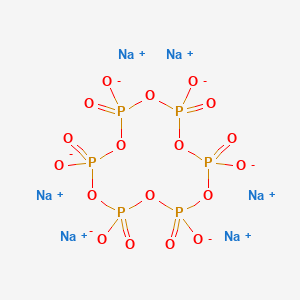
Structure chimique 2D PubChem pour le CAS 10124-56-8
CAS 10124-56-8PubChem CID 24968

Hexasodium hexametaphosphate

The CIR Expert Panel concluded that the following 31 ingredients are safe in the present practices of use and concentration in cosmetics as described in this safety assessment, when formulated to be non-irritating...Sodium Hexametaphosphate... — Cosmetic Ingredient Review (CIR)

Nom IUPAC
hexasodium;2,4,6,8,10,12-hexaoxido-1,3,5,7,9,11-hexaoxa-2lambda5,4lambda5,6lambda5,8lambda5,10lambda5,12lambda5-hexaphosphacyclododecane 2,4,6,8,10,12-hexaoxide
Formule moléculaire
Na6O18P6
Masse moléculaire
611.77 g/mol
Masse exacte
611.6896508 Da
Surface polaire topologique
296,0 Ų
Donneurs de liaisons hydrogène
0
Accepteurs de liaisons hydrogène
18
Unités covalentes
7
Stéréocentres définis
0

Également connu sous le nom de

Chemi-charlCalgon SCalgon (old)Caswell No. 772Hexasodium metaphosphatePhosphate, sodium hexametaFEMA 3027HSDB 5053
16 autres noms signalés
Natrium hexametaphosphatN40N91DW96EINECS 233-343-1Sodium hexametaphosphate (Na6P6O18)EPA Pesticide Chemical Code 076402UNII-N40N91DW96Metaphosphoric acid (H6P6O18), hexasodium saltMETAPHOSPHORIC ACID SODIUM SALTSODIUM HEXAMETAPHOSPHATE ((NAPO3)6)EC 233-343-1RefChem:55299HYPHOS CONCENTRATEHMPSodium HexametaphosphateGraham's saltSHMP
Identifiants de bases de données externes

Preuves issues de bases de données scientifiques complémentaires

NIH PubChem PUG-View
Correspondance exacte d’identifiant24968

Attributed physical-property, hazard, environmental and use annotations.

  • Solubility: CLEAR, HYGROSCOPIC GLASS; MP 628 °C; SOL IN WATER, BUT DISSOLVES SLOWLY; DEPOLYMERIZES IN AQ SOLN TO FORM SODIUM TRIMETAPHOSPHATE & SODIUM ORTHOPHOSPHATES. /POLYMERIC SODIUM METAPHOSPHATES/ Source: Hazardous Substances Data Bank (HSDB)
  • Solubility: SOL IN WATER; INSOL IN ORG SOLVENTS. /SODIUM HEXAMETAPHOSPHATE DETERGENTS/ Source: Hazardous Substances Data Bank (HSDB)
  • Note: This chemical does not meet GHS hazard criteria for 100% (19 of 19) of all reports. Source: European Chemicals Agency (ECHA)
  • GHS Hazard Statements: Not Classified; Reported as not meeting GHS hazard criteria by 19 of 19 companies. For more detailed information, please visit ECHA C&L website. Source: European Chemicals Agency (ECHA)
  • ECHA C&L Notifications Summary: Aggregated GHS information provided per 19 reports by companies from 1 notifications to the ECHA C&L Inventory.; Reported as not meeting GHS hazard criteria per 19 of 19 reports by companies.; There are 0 notifications provided by 0 of 19 reports by companies with hazard statement code(s).; Information may vary between notifications depending on impurities, additives, and other factors. The percentage value in parenthesis indicates the notified classification ratio from companies that provide hazard codes. Only hazard codes with percentage values above 10% are shown. For more detailed information, please visit ECHA C&L website. Source: European Chemicals Agency (ECHA)
  • Cosmetic Ingredient Review Conclusion: The CIR Expert Panel concluded that the following 31 ingredients are safe in the present practices of use and concentration in cosmetics as described in this safety assessment, when formulated to be non-irritating...Sodium Hexametaphosphate... Source: Cosmetic Ingredient Review (CIR)
  • Cosmetic Ingredient Review Finding(s): Safe for use in cosmetics, with qualifications Source: Cosmetic Ingredient Review (CIR)
  • Environmental Bioconcentration: A comprehensive examination of metal levels at various trophic levels within an undisturbed Precambrian Shield lake ecosystem was made. Concn of 21 naturally occurring elements including phosphorus were measured in sediments, clams, fish, birds, and mammals. Mercury was the only element to exhibit biomagnification. /Phosphorus/ Source: Hazardous Substances Data Bank (HSDB)

Mis en correspondance par: Existing checksum-valid CAS to unique PubChem CID match. Récupéré le: 2026-08-31. Ouvrir la fiche source

Les classifications scientifiques et les annotations de danger apportent du contexte et ne remplacent pas la décision réglementaire propre au marché indiquée ci-dessus.

Couverture des sources complémentaires et état des correspondances
SourceRésultatVérifié
EMBL-EBI ChEBIAucune fiche exacte2026-08-31
NIH PubChem PUG-ViewCorrespondance exacte2026-08-31

Une absence de correspondance enregistrée est une preuve utile que la source a été vérifiée ; ce n’est pas l’affirmation que la substance n’existe pas ailleurs.

Récupéré depuis NIH PubChem le 2026-08-31 par correspondance CAS à somme de contrôle valide. Les propriétés chimiques ne remplacent pas la décision réglementaire de cette page.
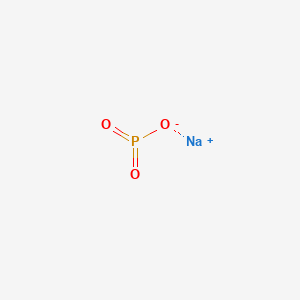
Structure chimique 2D PubChem pour le CAS 10361-03-2
CAS 10361-03-2PubChem CID 16133893

Sodium Metaphosphate

The CIR Expert Panel concluded that the following 31 ingredients are safe in the present practices of use and concentration in cosmetics as described in this safety assessment, when formulated to be non-irritating...Sodium Metaphosphate... — Cosmetic Ingredient Review (CIR)

Formule moléculaire
NaO3P
Masse moléculaire
101.962 g/mol
Masse exacte
101.94827514 Da
Surface polaire topologique
57,2 Ų
Donneurs de liaisons hydrogène
0
Accepteurs de liaisons hydrogène
3
Unités covalentes
2
Stéréocentres définis
0

Également connu sous le nom de

Kurrol's saltSporixMaddrell's saltSodium Kurrol's saltInsoluble metaphosphateSodium metaphosphate (NaPO3)532IUT7IRVSODIUM METAPHOSPHATE (NA(PO3))
16 autres noms signalés
J139.264FRefChem:1098817233-782-9Metaphosphoric acid, sodium saltSodium phosphate (NaPO3)Metaphosphoric acid (HPO3), sodium saltEINECS 238-595-6HSDB 5055EINECS 233-782-9UNII-532IUT7IRVsodium phosphenateNaO3PMetaphosphoric acid (HPO3), sodium salt (1:1)Sodium-m-phosphate monohydrateSODIUM METAPHOSPHATE [VANDF]SODIUM METAPHOSPHATE [WHO-DD]
Identifiants de bases de données externes

Preuves issues de bases de données scientifiques complémentaires

NIH PubChem PUG-View
Correspondance exacte d’identifiant16133893

Attributed physical-property, hazard, environmental and use annotations.

  • Solubility: White powder. Practically insol in water and in aq solns of pyrophosphates and hexametaphosphates. Sol in mineral acids. Does not form complexes with Fe(II), Fe(III), U(IV) salts. /Maddrell's salt (polymeric sodium metaphosphate)/ Source: Hazardous Substances Data Bank (HSDB)
  • Solubility: Sol in water (pH adjusted to 8-8.6). Insol in organic solvents. Possess dispersing and deflocculating properties, coagulate albumins, and inhibit the crystallinization of slightly sol compds such as calcium carbonate and calcium sulfate. /Glassy sodium metaphosphate; Graham's salt/ Source: Hazardous Substances Data Bank (HSDB)
  • Note: This chemical does not meet GHS hazard criteria for 90.5% (526 of 581) of all reports. Source: European Chemicals Agency (ECHA)
  • GHS Hazard Statements: Not Classified; Reported as not meeting GHS hazard criteria by 526 of 581 companies (only 9.5% companies provided GHS information). For more detailed information, please visit ECHA C&L website. Source: European Chemicals Agency (ECHA)
  • ECHA C&L Notifications Summary: Aggregated GHS information provided per 581 reports by companies from 8 notifications to the ECHA C&L Inventory.; Reported as not meeting GHS hazard criteria per 526 of 581 reports by companies.; There are 6 notifications provided by 55 of 581 reports by companies with hazard statement code(s).; Information may vary between notifications depending on impurities, additives, and other factors. The percentage value in parenthesis indicates the notified classification ratio from companies that provide hazard codes. Only hazard codes with percentage values above 10% are shown. For more detailed information, please visit ECHA C&L website. Source: European Chemicals Agency (ECHA)
  • Signal: Warning Source: European Chemicals Agency (ECHA)
  • GHS Hazard Statements: H315 (100%): Causes skin irritation [Warning Skin corrosion/irritation]; H319 (100%): Causes serious eye irritation [Warning Serious eye damage/eye irritation]; H335 (97.6%): May cause respiratory irritation [Warning Specific target organ toxicity, single exposure; Respiratory tract irritation] Source: European Chemicals Agency (ECHA)
  • Precautionary Statement Codes: P261, P264, P264+P265, P271, P280, P302+P352, P304+P340, P305+P351+P338, P319, P321, P332+P317, P337+P317, P362+P364, P403+P233, P405, and P501 (click each P-code to see the statement) Source: European Chemicals Agency (ECHA)
  • ECHA C&L Notifications Summary: Aggregated GHS information provided per 41 reports by companies from 4 notifications to the ECHA C&L Inventory. Each notification may be associated with multiple companies.; Information may vary between notifications depending on impurities, additives, and other factors. The percentage value in parenthesis indicates the notified classification ratio from companies that provide hazard codes. Only hazard codes with percentage values above 10% are shown. For more detailed information, please visit ECHA C&L website. Source: European Chemicals Agency (ECHA)
  • Note: This chemical does not meet GHS hazard criteria for 96.2% (25 of 26) of all reports. Source: European Chemicals Agency (ECHA)
  • GHS Hazard Statements: Not Classified; Reported as not meeting GHS hazard criteria by 25 of 26 companies (only 3.8% companies provided GHS information). For more detailed information, please visit ECHA C&L website. Source: European Chemicals Agency (ECHA)
  • ECHA C&L Notifications Summary: Aggregated GHS information provided per 26 reports by companies from 3 notifications to the ECHA C&L Inventory.; Reported as not meeting GHS hazard criteria per 25 of 26 reports by companies.; There is 1 notification provided by 1 of 26 reports by companies with hazard statement code(s).; Information may vary between notifications depending on impurities, additives, and other factors. The percentage value in parenthesis indicates the notified classification ratio from companies that provide hazard codes. Only hazard codes with percentage values above 10% are shown. For more detailed information, please visit ECHA C&L website. Source: European Chemicals Agency (ECHA)
  • Cosmetic Ingredient Review Conclusion: The CIR Expert Panel concluded that the following 31 ingredients are safe in the present practices of use and concentration in cosmetics as described in this safety assessment, when formulated to be non-irritating...Sodium Metaphosphate... Source: Cosmetic Ingredient Review (CIR)
  • Cosmetic Ingredient Review Finding(s): Safe for use in cosmetics, with qualifications Source: Cosmetic Ingredient Review (CIR)

Mis en correspondance par: Existing checksum-valid CAS to unique PubChem CID match. Récupéré le: 2026-08-31. Ouvrir la fiche source

Les classifications scientifiques et les annotations de danger apportent du contexte et ne remplacent pas la décision réglementaire propre au marché indiquée ci-dessus.

Couverture des sources complémentaires et état des correspondances
SourceRésultatVérifié
EMBL-EBI ChEBIAucune fiche exacte2026-08-31
NIH PubChem PUG-ViewCorrespondance exacte2026-08-31

Une absence de correspondance enregistrée est une preuve utile que la source a été vérifiée ; ce n’est pas l’affirmation que la substance n’existe pas ailleurs.

Récupéré depuis NIH PubChem le 2026-08-31 par correspondance CAS à somme de contrôle valide. Les propriétés chimiques ne remplacent pas la décision réglementaire de cette page.

Recherche complémentaire sur la substance auprès de sources faisant autorité

Chaque lien lance une recherche de cette identité dans la source concernée. Un lien est une piste de recherche, et non l’affirmation que la source détient une fiche exacte. Ce qu’est chaque source et sa valeur juridique

Aller plus loin avec cette fiche

Analyser dans une formuleOuvrir la comparaison autonome

Source officielle et champ d’application

Importé de la décision d’exécution (UE) 2025/1175 de la Commission (version du jeu de données EU 2025/1175). Le glossaire fournit les dénominations communes des ingrédients pour la liste d’ingrédients exigée par l’article 19, paragraphe 1, point g) ; ce n’est ni une liste d’autorisation ni une liste de sécurité.

Ouvrir la décision officielle