
CAS 1308-38-9
Le CAS 1308-38-9 correspond à 1 fiche d’annexe de l’UE dans les annexes II à VI du règlement (CE) n° 1223/2009.
Fiches pour le CAS 1308-38-9
1 au totalIdentité et propriétés chimiques
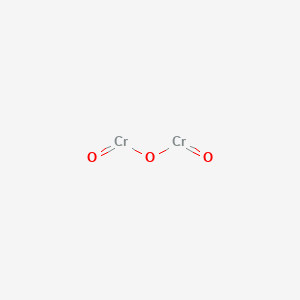
- Nom IUPAC
- oxo(oxochromiooxy)chromium
- Formule moléculaire
- Cr2O3
- Masse moléculaire
- 151.990 g/mol
- Masse exacte
- 151.865753 Da
- Surface polaire topologique
- 43,4 Ų
- Donneurs de liaisons hydrogène
- 0
- Accepteurs de liaisons hydrogène
- 3
- Unités covalentes
- 1
- Stéréocentres définis
- 0
Également connu sous le nom de
16 autres noms signalés
Identifiants de bases de données externes
- ChEBI:CHEBI:48242
- EPA DTXSID:DTXSID4043721
- PubMed:26086747
- PubMed:24885771
- PubMed:21384495
- PubMed:15003702
- PubMed:12634122
- PubMed:1423875
Preuves issues de bases de données scientifiques complémentaires
NIH PubChem PUG-View
Attributed physical-property, hazard, environmental and use annotations.
- Boiling Point: 4000 °C Source: Hazardous Substances Data Bank (HSDB)
- Boiling Point: 4000 °C Source: ILO-WHO International Chemical Safety Cards (ICSCs)
- Color/Form: Light to dark green, fine, hexagonal crystals Source: Hazardous Substances Data Bank (HSDB)
- Color/Form: Green powder Source: Hazardous Substances Data Bank (HSDB)
- Color/Form: Bright-green, extremely hard crystals Source: Hazardous Substances Data Bank (HSDB)
- Density: 5.22 at 25 °C Source: Hazardous Substances Data Bank (HSDB)
- Density: 5.22 g/cm³ Source: ILO-WHO International Chemical Safety Cards (ICSCs)
- Density: 5.22 @25 °C Source: PAC Chemical Database, U.S. Department of Energy
- Melting Point: 2435 °C Source: Hazardous Substances Data Bank (HSDB)
- Melting Point: 2435 °C Source: ILO-WHO International Chemical Safety Cards (ICSCs)
- Melting Point: 2320 °C Source: PAC Chemical Database, U.S. Department of Energy
- Physical Description: Dry Powder; Large Crystals; Dry Powder; Large Crystals; Liquid; Other Solid; Dry Powder; CBI; Large Crystals Source: EPA Chemical Data Reporting (CDR)
- Physical Description: Green, hygroscopic solid; [CHEMINFO] Insoluble in water; [ACGIH] Source: Haz-Map, Information on Hazardous Chemicals and Occupational Diseases
- Physical Description: LIGHT-TO-DARK-GREEN POWDER. Source: ILO-WHO International Chemical Safety Cards (ICSCs)
- Refractive Index: Index of refraction: 2.551 Source: Hazardous Substances Data Bank (HSDB)
- Solubility: In water, 3.13 ug/L at 20 °C, pH 6; 2.96 ug/L at 20 °C, pH 8 Source: Hazardous Substances Data Bank (HSDB)
- Solubility: Practically insoluble in water Source: Hazardous Substances Data Bank (HSDB)
- Solubility: Practically insoluble in alcohol, acetone; slightly soluble in acids, alkalies Source: Hazardous Substances Data Bank (HSDB)
- Solubility: Insoluble in acids, and alkalies Source: Hazardous Substances Data Bank (HSDB)
- Solubility: Solubility in water: none Source: ILO-WHO International Chemical Safety Cards (ICSCs)
- pH: Trivalent chromium compounds are amphoteric Source: Hazardous Substances Data Bank (HSDB)
- Carcinogen Classification: 3, not classifiable as to its carcinogenicity to humans. (L135) Source: Toxin and Toxin Target Database (T3DB)
- Exposure Routes: Oral (L16) ; inhalation (L16) ; dermal (L16) Source: Toxin and Toxin Target Database (T3DB)
- Note: This chemical does not meet GHS hazard criteria for 57.8% (1112 of 1924) of all reports. Source: European Chemicals Agency (ECHA)
- Signal: Danger Source: European Chemicals Agency (ECHA)
- GHS Hazard Statements: H302 (24%): Harmful if swallowed [Warning Acute toxicity, oral]; H317 (25.7%): May cause an allergic skin reaction [Warning Sensitization, Skin]; H319 (24.3%): Causes serious eye irritation [Warning Serious eye damage/eye irritation]; H360 (14.6%): May damage fertility or the unborn child [Danger Reproductive toxicity] Source: European Chemicals Agency (ECHA)
- Precautionary Statement Codes: P203, P261, P264, P264+P265, P270, P272, P280, P301+P317, P302+P352, P305+P351+P338, P318, P321, P330, P333+P317, P337+P317, P362+P364, P405, and P501 (click each P-code to see the statement) Source: European Chemicals Agency (ECHA)
- ECHA C&L Notifications Summary: Aggregated GHS information provided per 1924 reports by companies from 27 notifications to the ECHA C&L Inventory. Each notification may be associated with multiple companies.; Reported as not meeting GHS hazard criteria per 1112 of 1924 reports by companies.; There are 23 notifications provided by 812 of 1924 reports by companies with hazard statement code(s).; Information may vary between notifications depending on impurities, additives, and other factors. The percentage value in parenthesis indicates the notified classification ratio from companies that provide hazard codes. Only hazard codes with percentage values above 10% are shown. For more detailed information, please visit ECHA C&L website. Source: European Chemicals Agency (ECHA)
- Signal: Danger Source: NITE-CMC
- GHS Hazard Statements: H317: May cause an allergic skin reaction [Warning Sensitization, Skin]; H334: May cause allergy or asthma symptoms or breathing difficulties if inhaled [Danger Sensitization, respiratory]; H372: Causes damage to organs through prolonged or repeated exposure [Danger Specific target organ toxicity, repeated exposure] Source: NITE-CMC
- Precautionary Statement Codes: P233, P260, P261, P264, P270, P271, P272, P280, P284, P302+P352, P304+P340, P319, P321, P333+P317, P342+P316, P362+P364, P403, and P501 (click each P-code to see the statement) Source: NITE-CMC
- GHS Hazard Statements: H317: May cause an allergic skin reaction [Warning Sensitization, Skin]; H334: May cause allergy or asthma symptoms or breathing difficulties if inhaled [Danger Sensitization, respiratory] Source: NITE-CMC
- Precautionary Statement Codes: P233, P260, P261, P271, P272, P280, P284, P302+P352, P304+P340, P321, P333+P317, P342+P316, P362+P364, P403, and P501 (click each P-code to see the statement) Source: NITE-CMC
- Health Effects: Chromium in its trivalent state is not very toxic. It may be oxidized to hexavalent chromium, a known carcinogen. Hexavalent chromium has also been shown to affect reproduction and development. (A12) Source: Toxin and Toxin Target Database (T3DB)
- Toxicity Summary: IDENTIFICATION AND USE: Chromic oxide (Cr(2)O(3)) is a green powder. It is not registered for current use in the U.S., but approved pesticide uses may change periodically and so federal, state and local authorities must be consulted for currently approved uses. It is used in abrasives and electric semiconductors; in alloys; in printing fabrics and banknotes. It is also used in dyeing polymers; colorant for latex paints, in manufacturing of chromium metal and aluminum-chromium master alloys. It's other uses include catalyst in organic synthesis, green granules in asphalt roofing, component of refractory brick. Chromic oxide is a color additive in drug use. HUMAN EXPOSURE AND TOXICITY: Fine chromic oxide particles were insoluble in the culture medium; on the contrary, Cr(2)O(3) nanoparticles released soluble hexavalent chromium into the culture medium. Human lung carcinoma A549 cells and human keratinocyte HaCaT cells showed an increase in intracellular reactive oxygen species (ROS) level and activation of antioxidant defense systems on exposure to Cr(2)O(3) nanoparticles. The cellular influences of Cr(2)O(3) nanoparticles matched those of hexavalent chromium. Human lung epithelial c Source: Hazardous Substances Data Bank (HSDB)
- Toxicity Summary: Trivalent chromium may also form complexes with peptides, proteins, and DNA, resulting in DNA-protein crosslinks, DNA strand breaks, DNA-DNA interstrand crosslinks, chromium-DNA adducts, chromosomal aberrations and alterations in cellular signaling pathways. It has been shown to induce carcinogenesis by overstimulating cellular regulatory pathways and increasing peroxide levels by activating certain mitogen-activated protein kinases. It can also cause transcriptional repression by cross-linking histone deacetylase 1-DNA methyltransferase 1 complexes to CYP1A1 promoter chromatin, inhibiting histone modification. Chromium may increase its own toxicity by modifying metal regulatory transcription factor 1, causing the inhibition of zinc-induced metallothionein transcription. (A12, L16, A34, A35, A36) Source: Toxin and Toxin Target Database (T3DB)
- Consumer Uses: Other; Processing aids not otherwise specified; Catalyst; Not Known or Reasonably Ascertainable; Corrosion inhibitor; Pigment Source: EPA Chemical Data Reporting (CDR)
- Industry Uses: Abrasives; Other; Pigment; Dye; Catalyst; Not Known or Reasonably Ascertainable; Corrosion inhibitor Source: EPA Chemical Data Reporting (CDR)
- Sources/Uses: Used in abrasives, refractory materials, semiconductors, pigments, alloys, textile printing inks, and catalysts; [Merck Index] Used as a pigment in polymers and latex paints; [HSDB] Source: Haz-Map, Information on Hazardous Chemicals and Occupational Diseases
- Industrial Processes with risk of exposure: Semiconductor Manufacturing [Category: Industry]; Painting (Pigments, Binders, and Biocides) [Category: Paint]; Textiles (Printing, Dyeing, or Finishing) [Category: Industry] Source: Haz-Map, Information on Hazardous Chemicals and Occupational Diseases
- Uses: For chromic oxide (USEPA/OPP Pesticide Code: 021103) there are 0 labels match. /SRP: Not registered for current use in the U.S., but approved pesticide uses may change periodically and so federal, state and local authorities must be consulted for currently approved uses./ Source: Hazardous Substances Data Bank (HSDB)
- Uses: In abrasives, refractory materials, electric semiconductors; as pigment, particularly in coloring glass; in alloys; in printing fabrics and banknotes; catalyst for organic and inorganic reactions. Source: Hazardous Substances Data Bank (HSDB)
- Uses: Used in dyeing polymers, ... colorant for latex paints. Source: Hazardous Substances Data Bank (HSDB)
- Uses: In metallurgy in the manufacture of chromium metal and aluminum-chromium master alloys. Source: Hazardous Substances Data Bank (HSDB)
- Uses: For more Uses (Complete) data for Chromium (III) oxide (11 total), please visit the HSDB record page. Source: Hazardous Substances Data Bank (HSDB)
- Uses: Plastics -> Typical concentration range in plastic materials -> 1% Source: NORMAN Suspect List Exchange
- Uses: Chromium(III) oxide is commonly used as pigment, under the name viridian, in paints, inks, and glasses. (L523) Source: Toxin and Toxin Target Database (T3DB)
Mis en correspondance par: Existing checksum-valid CAS to unique PubChem CID match. Récupéré le: 2026-08-31. Ouvrir la fiche source
Les classifications scientifiques et les annotations de danger apportent du contexte et ne remplacent pas la décision réglementaire propre au marché indiquée ci-dessus.
Couverture des sources complémentaires et état des correspondances
| Source | Résultat | Vérifié |
|---|---|---|
| NIH PubChem PUG-View | Correspondance exacte | 2026-08-31 |
Une absence de correspondance enregistrée est une preuve utile que la source a été vérifiée ; ce n’est pas l’affirmation que la substance n’existe pas ailleurs.
Récupéré depuis NIH PubChem le 2026-09-02 par correspondance CAS à somme de contrôle valide. Les propriétés chimiques ne remplacent pas la décision réglementaire de cette page.
Comment le CAS 1308-38-9 est utilisé sur ce site
Le CAS 1308-38-9 est l’identifiant du Chemical Abstracts Service utilisé pour rattacher cette page à une substance précise. Dans le jeu de données actuel, 1 fiche d’annexe de l’UE partage cet identifiant, ce qui vous aide à vérifier si la même substance apparaît dans un seul contexte réglementaire ou dans plusieurs.
Utilisez cette page lorsqu’une spécification fournisseur, une FDS ou un dossier de matière première vous donne le CAS 1308-38-9 et que vous devez voir au même endroit toutes les fiches liées des annexes II à VI. Les cartes d’entrées ci-dessus sont le moyen le plus rapide d’accéder aux limites de concentration, aux avertissements, à l’annexe concernée et aux conditions par type de produit.
Questions fréquentes
Outils et étapes suivantes
Vérifiez votre formule
Analysez une liste INCI complète, puis utilisez le CAS 1308-38-9 pour recouper les documents fournisseurs relatifs aux substances identifiées.
Vérificateur INCIParcourir les annexes
Parcourez toutes les annexes du règlement de l’UE sur les cosmétiques par catégorie.
Toutes les annexesRechercher par nom
Recherchez les noms INCI, alias ou identifiants associés qui figurent à côté du CAS 1308-38-9 dans votre documentation.
Rechercher