Aller au contenu principal
CAS 1 fiche

CAS 1305-62-0

Le CAS 1305-62-0 correspond à 1 fiche d’annexe de l’UE dans les annexes II à VI du règlement (CE) n° 1223/2009.

Fiches pour le CAS 1305-62-0

1 au total
Annexe
III
Entrée
15c

CALCIUM HYDROXIDE

Calcium hydroxide

(a) Contains alkali Avoid contact with eyes Keep out of reach of children Can cause blindness (b) Contains alkali Keep out of reach of children Avoid contact with eyes

EC
Concentration max.

Identité et propriétés chimiques

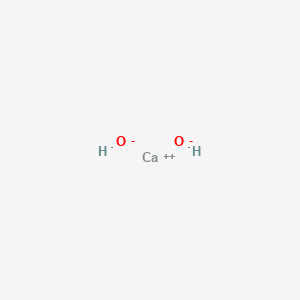
Structure chimique 2D PubChem pour le CAS 1305-62-0
CAS 1305-62-0PubChem CID 6093208

Calcium Hydroxide

Calcium dihydroxide is a calcium hydroxide. It has a role as an astringent. — ChEBI

Nom IUPAC
calcium dihydroxide
Formule moléculaire
CaH2O2
Masse moléculaire
74.09 g/mol
Masse exacte
73.9680702 Da
Surface polaire topologique
2,0 Ų
Donneurs de liaisons hydrogène
2
Accepteurs de liaisons hydrogène
2
Unités covalentes
3
Stéréocentres définis
0

Également connu sous le nom de

Slaked limeHydrated limeLime hydrateCalcium hydrateLime waterCalcium hydroxide (Ca(OH)2)HydralimeSlaked-lime
16 autres noms signalés
Lime milkCalcarea causticaINS NO.526PF5DZW74VNE-526CHEBI:31341Hydroxide, Calcium215-137-3O2 PatchRefChem:54625KO2, Ca(OH)2CHEBI:35150620-122-3Bell mineBiocalcCalbit
Identifiants de bases de données externes

Preuves issues de bases de données scientifiques complémentaires

NIH PubChem PUG-View
Correspondance exacte d’identifiant6093208

Attributed physical-property, hazard, environmental and use annotations.

  • Autoignition Temperature: Not flammable (USCG, 1999) Source: CAMEO Chemicals
  • First Aid: Excerpt from NIOSH Pocket Guide for Calcium hydroxide:; Eye: IRRIGATE IMMEDIATELY - If this chemical contacts the eyes, immediately wash (irrigate) the eyes with large amounts of water, occasionally lifting the lower and upper lids. Get medical attention immediately.; Skin: SOAP FLUSH IMMEDIATELY - If this chemical contacts the skin, immediately flush the contaminated skin with soap and water. If this chemical penetrates the clothing, immediately remove the clothing and flush the skin with water. If irritation persists after washing, get medical attention.; Breathing: RESPIRATORY SUPPORT - If a person breathes large amounts of this chemical, move the exposed person to fresh air at once. If breathing has stopped, perform artificial respiration. Keep the affected person warm and at rest. Get medical attention as soon as possible.; Swallow: MEDICAL ATTENTION IMMEDIATELY - If this chemical has been swallowed, get medical attention immediately. (NIOSH, 2024) Source: CAMEO Chemicals
  • First Aid: (General first aid procedures); Eye: Irrigate immediately - If this chemical contacts the eyes, immediately wash (irrigate) the eyes with large amounts of water, occasionally lifting the lower and upper lids. Get medical attention immediately.; Skin: Soap flush immediately - If this chemical contacts the skin, immediately flush the contaminated skin with soap and water. If this chemical penetrates the clothing, immediately remove the clothing and flush the skin with water. If irritation persists after washing, get medical attention.; Breathing: Respiratory support; Swallow: Medical attention immediately - If this chemical has been swallowed, get medical attention immediately. Source: The National Institute for Occupational Safety and Health (NIOSH)
  • Note: This chemical does not meet GHS hazard criteria for 0.4% (28 of 6644) of reports. Source: European Chemicals Agency (ECHA)
  • Signal: Danger Source: European Chemicals Agency (ECHA)
  • GHS Hazard Statements: H314 (22.4%): Causes severe skin burns and eye damage [Danger Skin corrosion/irritation]; H315 (45.3%): Causes skin irritation [Warning Skin corrosion/irritation]; H318 (76.9%): Causes serious eye damage [Danger Serious eye damage/eye irritation]; H335 (38.9%): May cause respiratory irritation [Warning Specific target organ toxicity, single exposure; Respiratory tract irritation] Source: European Chemicals Agency (ECHA)
  • Precautionary Statement Codes: P260, P261, P264, P264+P265, P271, P280, P301+P330+P331, P302+P352, P302+P361+P354, P304+P340, P305+P354+P338, P316, P317, P319, P321, P332+P317, P362+P364, P363, P403+P233, P405, and P501 (click each P-code to see the statement) Source: European Chemicals Agency (ECHA)
  • ECHA C&L Notifications Summary: Aggregated GHS information provided per 6644 reports by companies from 59 notifications to the ECHA C&L Inventory. Each notification may be associated with multiple companies.; Reported as not meeting GHS hazard criteria per 28 of 6644 reports by companies.; There are 56 notifications provided by 6616 of 6644 reports by companies with hazard statement code(s).; Information may vary between notifications depending on impurities, additives, and other factors. The percentage value in parenthesis indicates the notified classification ratio from companies that provide hazard codes. Only hazard codes with percentage values above 10% are shown. For more detailed information, please visit ECHA C&L website. Source: European Chemicals Agency (ECHA)
  • GHS Hazard Statements: Not Classified; Reported as not meeting GHS hazard criteria by 1 of 1 companies. For more detailed information, please visit ECHA C&L website. Source: European Chemicals Agency (ECHA)
  • Signal: Danger Source: NITE-CMC
  • GHS Hazard Statements: H315: Causes skin irritation [Warning Skin corrosion/irritation]; H318: Causes serious eye damage [Danger Serious eye damage/eye irritation]; H370: Causes damage to organs [Danger Specific target organ toxicity, single exposure] Source: NITE-CMC
  • Precautionary Statement Codes: P260, P264, P264+P265, P270, P280, P302+P352, P305+P354+P338, P308+P316, P317, P321, P332+P317, P362+P364, P405, and P501 (click each P-code to see the statement) Source: NITE-CMC
  • GHS Hazard Statements: H315: Causes skin irritation [Warning Skin corrosion/irritation]; H318: Causes serious eye damage [Danger Serious eye damage/eye irritation]; H370: Causes damage to organs [Danger Specific target organ toxicity, single exposure]; H373: May causes damage to organs through prolonged or repeated exposure [Warning Specific target organ toxicity, repeated exposure] Source: NITE-CMC
  • Precautionary Statement Codes: P260, P264, P264+P265, P270, P280, P302+P352, P305+P354+P338, P308+P316, P317, P319, P321, P332+P317, P362+P364, P405, and P501 (click each P-code to see the statement) Source: NITE-CMC
  • Signal: Danger Source: Hazardous Chemical Information System (HCIS), Safe Work Australia
  • Cosmetic Ingredient Review Conclusion: The CIR Expert Panel concluded that ... Calcium Hydroxide is safe in hair straighteners and depilatories under conditions of recommended use; users should minimize skin contact. These ingredients are safe for all other present practices of use and concentration described in this safety assessment when formulated to be nonirritating. Source: Cosmetic Ingredient Review (CIR)
  • Cosmetic Ingredient Review Finding(s): Safe for use in cosmetics, with qualifications Source: Cosmetic Ingredient Review (CIR)
  • Environmental Fate: Aquatic Fate: Aquatic toxicity is the function of an alkalinity effect. Addition of lime to soft water lakes has increased biological activity, possibly by providing a carbon dioxide reservoir. Source: Hazardous Substances Data Bank (HSDB)
  • Environmental Fate: Calcium hydroxide does not degrade by photooxidation; it is neutralized by absorption of atmospheric carbon dioxide. Source: Hazardous Substances Data Bank (HSDB)
  • Consumer Uses: Chemical reaction regulator; pH regulating agent; Other; Lubricating agent; Adhesion/cohesion promoter; Flocculating agent; Heat stabilizer; Intermediate; Reducing agent; Soil amendments (fertilizers); Filler; Not Known or Reasonably Ascertainable; Absorbent Source: EPA Chemical Data Reporting (CDR)
  • Industry Uses: Other; Binder; Lubricating agent; Processing aids not otherwise specified; Chemical reaction regulator; Fuel agents; pH regulating agent; Fuel; Antioxidant; Flux agent; Absorbent; Dehydrating agent (desiccant); Sealant (barrier); Reducing agent; Stabilizing agent; Flow promoter; Catalyst; Filler; Diluent; Not Known or Reasonably Ascertainable; Corrosion inhibitor; Soil amendments (fertilizers); Solids separation (precipitating) agent, not otherwise specified; Hardener; Flocculating agent; Adhesion/cohesion promoter; Processing aids, specific to petroleum production; Intermediate; Softener and conditioner; Oxidizing agent; Adsorbent Source: EPA Chemical Data Reporting (CDR)
  • Cosmetic Ingredient Review Link: CIR ingredient: Calcium Hydroxide Source: Cosmetic Ingredient Review (CIR)
  • Sources/Uses: Used in mortar, plaster, cement, lubricants, drilling fluids, paper pulp, and water treatment; also used to dehair hides; [ACGIH] Used in pesticides, fireproofing coatings, water-based paints, SBR rubber vulcanization, binding and paving materials, soil treatments, brewing manufacture, dental cements, petrochemicals, as chemical intermediate, buffering agent for metals, pearls, and celluloid, disinfectant, food additive, for ammonia recovery in gas manufacture, purification of sugar juices, to preserve eggs and apples during storage, in cattle feeds, and veterinary medicine; [HSDB] Used as both an inert and active ingredient (microbiocide/microbiostat) in pesticide products; [EPA REDs] Used as a nutritional supplement, pH control agent, firming agent, and processing aid for foods; [FDA] Source: Haz-Map, Information on Hazardous Chemicals and Occupational Diseases
  • Industrial Processes with risk of exposure: Petroleum Production and Refining [Category: Industry]; Pulp and Paper Processing [Category: Industry]; Painting (Pigments, Binders, and Biocides) [Category: Paint]; Using Disinfectants or Biocides [Category: Clean]; Farming (Pesticides) [Category: Industry]; Sewer and Wastewater Treatment [Category: Industry]; Leather Tanning and Processing [Category: Industry]; Cement Producing [Category: Industry]; Farming (Feed Additives) [Category: Industry] Source: Haz-Map, Information on Hazardous Chemicals and Occupational Diseases
  • Uses: For calcium hydroxide (USEPA/OPP Pesticide Code: 075601) ACTIVE products with label matches. /SRP: Registered for use in the USA but approved pesticide uses may change periodically and so federal, state and local authorities must be consulted for currently approved uses./ Source: Hazardous Substances Data Bank (HSDB)
  • Uses: In mortar, plaster, cement and other binding and paving materials; in lubricants, drilling fluid, pesticides, fireproofing coatings, water paint; as egg preservative; manufacture of paper pulp; in SBR rubber vulcanization; in water treatment; as absorbant for carbon dioxide; dehairing hides. Source: Hazardous Substances Data Bank (HSDB)
  • Uses: Chem int in chlorohydrin process for propylene oxide /former use/; chem int for calcium hypochlorite, bleaching powder, and the fungicide, lime-sulfur spray; flux in iron and steel mfr; soil treatment for acidic soils; water softening agent; stabilization of soils for road base; component of sand-lime bricks and blocks; component of masonary mortar; water correcting agent in brewing mfr; component of dental cement; buffering agent for metals, pearls and celluloid. Source: Hazardous Substances Data Bank (HSDB)
  • Uses: Calcium salts, causticizing soda, depilatory, whitewash, soil conditioner, ammonia recovery in gas manufacturing, disinfectant, water softening, purification of sugar juices, petrochemicals, food additive as buffer and neutralizing agent, shell-forming agent (poultry) Source: Hazardous Substances Data Bank (HSDB)
  • Uses: For more Uses (Complete) data for CALCIUM HYDROXIDE (13 total), please visit the HSDB record page. Source: Hazardous Substances Data Bank (HSDB)

Mis en correspondance par: Existing checksum-valid CAS to unique PubChem CID match. Récupéré le: 2026-08-31. Ouvrir la fiche source

Les classifications scientifiques et les annotations de danger apportent du contexte et ne remplacent pas la décision réglementaire propre au marché indiquée ci-dessus.

Couverture des sources complémentaires et état des correspondances
SourceRésultatVérifié
NIH PubChem PUG-ViewCorrespondance exacte2026-08-31

Une absence de correspondance enregistrée est une preuve utile que la source a été vérifiée ; ce n’est pas l’affirmation que la substance n’existe pas ailleurs.

Récupéré depuis NIH PubChem le 2026-08-31 par correspondance CAS à somme de contrôle valide. Les propriétés chimiques ne remplacent pas la décision réglementaire de cette page.

Comment le CAS 1305-62-0 est utilisé sur ce site

Le CAS 1305-62-0 est l’identifiant du Chemical Abstracts Service utilisé pour rattacher cette page à une substance précise. Dans le jeu de données actuel, 1 fiche d’annexe de l’UE partage cet identifiant, ce qui vous aide à vérifier si la même substance apparaît dans un seul contexte réglementaire ou dans plusieurs.

Utilisez cette page lorsqu’une spécification fournisseur, une FDS ou un dossier de matière première vous donne le CAS 1305-62-0 et que vous devez voir au même endroit toutes les fiches liées des annexes II à VI. Les cartes d’entrées ci-dessus sont le moyen le plus rapide d’accéder aux limites de concentration, aux avertissements, à l’annexe concernée et aux conditions par type de produit.

Questions fréquentes

Une substance identifiée par le CAS 1305-62-0 peut figurer dans plusieurs annexes du règlement de l’UE sur les cosmétiques lorsqu’elle est soumise à des conditions différentes selon les contextes. Par exemple, une substance peut être soumise à restrictions à l’annexe III avec des conditions précises, et le même CAS peut aussi figurer à l’annexe IV comme colorant autorisé, dans une entrée distincte avec ses propres conditions. Chaque entrée doit être examinée individuellement.

Recoupez le numéro CAS avec les fiches de spécification de vos matières premières et vos certificats d’analyse. Lorsqu’un CAS figure à l’annexe II, vérifiez son absence. Lorsqu’il figure à l’annexe III, vérifiez que les limites de concentration et les conditions de type de produit sont respectées dans votre formulation. Toutes les entrées d’annexe partageant ce numéro CAS sont énumérées ci-dessus.

Un numéro CAS est attribué par le Chemical Abstracts Service (États-Unis) et reconnu dans le monde entier. Un numéro CE est un identifiant de la Commission européenne issu d’inventaires tels que l’EINECS, l’ELINCS ou la liste NLP. Les deux identifiants peuvent figurer dans les entrées des annexes cosmétiques de l’UE. Certaines substances ont les deux, d’autres un seul, et certaines entrées plus anciennes peuvent n’en avoir aucun.

Le vérificateur INCI accepte les noms d’ingrédients, les numéros CAS et les numéros CE. Vérifiez directement ce numéro CAS, puis contrôlez le résultat auprès des fiches de spécification des fournisseurs et de toutes les conditions d’annexe associées.

Outils et étapes suivantes

Vérifiez votre formule

Analysez une liste INCI complète, puis utilisez le CAS 1305-62-0 pour recouper les documents fournisseurs relatifs aux substances identifiées.

Vérificateur INCI

Parcourir les annexes

Parcourez toutes les annexes du règlement de l’UE sur les cosmétiques par catégorie.

Toutes les annexes

Rechercher par nom

Recherchez les noms INCI, alias ou identifiants associés qui figurent à côté du CAS 1305-62-0 dans votre documentation.

Rechercher