Zum Hauptinhalt springen
CAS 1 Eintrag

CAS 1305-62-0

CAS 1305-62-0 entspricht 1 EU-Anhangseintrag in den Anhängen II–VI der Verordnung (EG) Nr. 1223/2009.

Einträge zu CAS 1305-62-0

1 insgesamt
Anhang
III
Eintrag
15c

CALCIUM HYDROXIDE

Calcium hydroxide

(a) Contains alkali Avoid contact with eyes Keep out of reach of children Can cause blindness (b) Contains alkali Keep out of reach of children Avoid contact with eyes

EC
Höchstkonzentration

Chemische Identität und Eigenschaften

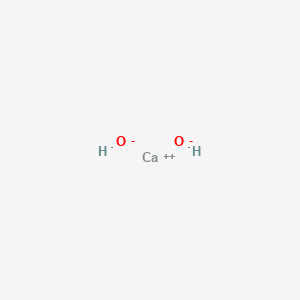
Chemische 2D-Struktur aus PubChem für CAS 1305-62-0
CAS 1305-62-0PubChem CID 6093208

Calcium Hydroxide

Calcium dihydroxide is a calcium hydroxide. It has a role as an astringent. — ChEBI

IUPAC-Name
calcium dihydroxide
Summenformel
CaH2O2
Molekulargewicht
74.09 g/mol
Exakte Masse
73.9680702 Da
Topologische polare Oberfläche
2,0 Ų
Wasserstoffbrücken-Donoren
2
Wasserstoffbrücken-Akzeptoren
2
Kovalente Einheiten
3
Definierte Stereozentren
0

Auch bekannt als

Slaked limeHydrated limeLime hydrateCalcium hydrateLime waterCalcium hydroxide (Ca(OH)2)HydralimeSlaked-lime
16 weitere gemeldete Namen
Lime milkCalcarea causticaINS NO.526PF5DZW74VNE-526CHEBI:31341Hydroxide, Calcium215-137-3O2 PatchRefChem:54625KO2, Ca(OH)2CHEBI:35150620-122-3Bell mineBiocalcCalbit
Kennungen in externen Datenbanken

Belege aus weiteren wissenschaftlichen Datenbanken

NIH PubChem PUG-View
Exakter Kennungstreffer6093208

Attributed physical-property, hazard, environmental and use annotations.

  • Autoignition Temperature: Not flammable (USCG, 1999) Quelle: CAMEO Chemicals
  • First Aid: Excerpt from NIOSH Pocket Guide for Calcium hydroxide:; Eye: IRRIGATE IMMEDIATELY - If this chemical contacts the eyes, immediately wash (irrigate) the eyes with large amounts of water, occasionally lifting the lower and upper lids. Get medical attention immediately.; Skin: SOAP FLUSH IMMEDIATELY - If this chemical contacts the skin, immediately flush the contaminated skin with soap and water. If this chemical penetrates the clothing, immediately remove the clothing and flush the skin with water. If irritation persists after washing, get medical attention.; Breathing: RESPIRATORY SUPPORT - If a person breathes large amounts of this chemical, move the exposed person to fresh air at once. If breathing has stopped, perform artificial respiration. Keep the affected person warm and at rest. Get medical attention as soon as possible.; Swallow: MEDICAL ATTENTION IMMEDIATELY - If this chemical has been swallowed, get medical attention immediately. (NIOSH, 2024) Quelle: CAMEO Chemicals
  • First Aid: (General first aid procedures); Eye: Irrigate immediately - If this chemical contacts the eyes, immediately wash (irrigate) the eyes with large amounts of water, occasionally lifting the lower and upper lids. Get medical attention immediately.; Skin: Soap flush immediately - If this chemical contacts the skin, immediately flush the contaminated skin with soap and water. If this chemical penetrates the clothing, immediately remove the clothing and flush the skin with water. If irritation persists after washing, get medical attention.; Breathing: Respiratory support; Swallow: Medical attention immediately - If this chemical has been swallowed, get medical attention immediately. Quelle: The National Institute for Occupational Safety and Health (NIOSH)
  • Note: This chemical does not meet GHS hazard criteria for 0.4% (28 of 6644) of reports. Quelle: European Chemicals Agency (ECHA)
  • Signal: Danger Quelle: European Chemicals Agency (ECHA)
  • GHS Hazard Statements: H314 (22.4%): Causes severe skin burns and eye damage [Danger Skin corrosion/irritation]; H315 (45.3%): Causes skin irritation [Warning Skin corrosion/irritation]; H318 (76.9%): Causes serious eye damage [Danger Serious eye damage/eye irritation]; H335 (38.9%): May cause respiratory irritation [Warning Specific target organ toxicity, single exposure; Respiratory tract irritation] Quelle: European Chemicals Agency (ECHA)
  • Precautionary Statement Codes: P260, P261, P264, P264+P265, P271, P280, P301+P330+P331, P302+P352, P302+P361+P354, P304+P340, P305+P354+P338, P316, P317, P319, P321, P332+P317, P362+P364, P363, P403+P233, P405, and P501 (click each P-code to see the statement) Quelle: European Chemicals Agency (ECHA)
  • ECHA C&L Notifications Summary: Aggregated GHS information provided per 6644 reports by companies from 59 notifications to the ECHA C&L Inventory. Each notification may be associated with multiple companies.; Reported as not meeting GHS hazard criteria per 28 of 6644 reports by companies.; There are 56 notifications provided by 6616 of 6644 reports by companies with hazard statement code(s).; Information may vary between notifications depending on impurities, additives, and other factors. The percentage value in parenthesis indicates the notified classification ratio from companies that provide hazard codes. Only hazard codes with percentage values above 10% are shown. For more detailed information, please visit ECHA C&L website. Quelle: European Chemicals Agency (ECHA)
  • GHS Hazard Statements: Not Classified; Reported as not meeting GHS hazard criteria by 1 of 1 companies. For more detailed information, please visit ECHA C&L website. Quelle: European Chemicals Agency (ECHA)
  • Signal: Danger Quelle: NITE-CMC
  • GHS Hazard Statements: H315: Causes skin irritation [Warning Skin corrosion/irritation]; H318: Causes serious eye damage [Danger Serious eye damage/eye irritation]; H370: Causes damage to organs [Danger Specific target organ toxicity, single exposure] Quelle: NITE-CMC
  • Precautionary Statement Codes: P260, P264, P264+P265, P270, P280, P302+P352, P305+P354+P338, P308+P316, P317, P321, P332+P317, P362+P364, P405, and P501 (click each P-code to see the statement) Quelle: NITE-CMC
  • GHS Hazard Statements: H315: Causes skin irritation [Warning Skin corrosion/irritation]; H318: Causes serious eye damage [Danger Serious eye damage/eye irritation]; H370: Causes damage to organs [Danger Specific target organ toxicity, single exposure]; H373: May causes damage to organs through prolonged or repeated exposure [Warning Specific target organ toxicity, repeated exposure] Quelle: NITE-CMC
  • Precautionary Statement Codes: P260, P264, P264+P265, P270, P280, P302+P352, P305+P354+P338, P308+P316, P317, P319, P321, P332+P317, P362+P364, P405, and P501 (click each P-code to see the statement) Quelle: NITE-CMC
  • Signal: Danger Quelle: Hazardous Chemical Information System (HCIS), Safe Work Australia
  • Cosmetic Ingredient Review Conclusion: The CIR Expert Panel concluded that ... Calcium Hydroxide is safe in hair straighteners and depilatories under conditions of recommended use; users should minimize skin contact. These ingredients are safe for all other present practices of use and concentration described in this safety assessment when formulated to be nonirritating. Quelle: Cosmetic Ingredient Review (CIR)
  • Cosmetic Ingredient Review Finding(s): Safe for use in cosmetics, with qualifications Quelle: Cosmetic Ingredient Review (CIR)
  • Environmental Fate: Aquatic Fate: Aquatic toxicity is the function of an alkalinity effect. Addition of lime to soft water lakes has increased biological activity, possibly by providing a carbon dioxide reservoir. Quelle: Hazardous Substances Data Bank (HSDB)
  • Environmental Fate: Calcium hydroxide does not degrade by photooxidation; it is neutralized by absorption of atmospheric carbon dioxide. Quelle: Hazardous Substances Data Bank (HSDB)
  • Consumer Uses: Chemical reaction regulator; pH regulating agent; Other; Lubricating agent; Adhesion/cohesion promoter; Flocculating agent; Heat stabilizer; Intermediate; Reducing agent; Soil amendments (fertilizers); Filler; Not Known or Reasonably Ascertainable; Absorbent Quelle: EPA Chemical Data Reporting (CDR)
  • Industry Uses: Other; Binder; Lubricating agent; Processing aids not otherwise specified; Chemical reaction regulator; Fuel agents; pH regulating agent; Fuel; Antioxidant; Flux agent; Absorbent; Dehydrating agent (desiccant); Sealant (barrier); Reducing agent; Stabilizing agent; Flow promoter; Catalyst; Filler; Diluent; Not Known or Reasonably Ascertainable; Corrosion inhibitor; Soil amendments (fertilizers); Solids separation (precipitating) agent, not otherwise specified; Hardener; Flocculating agent; Adhesion/cohesion promoter; Processing aids, specific to petroleum production; Intermediate; Softener and conditioner; Oxidizing agent; Adsorbent Quelle: EPA Chemical Data Reporting (CDR)
  • Cosmetic Ingredient Review Link: CIR ingredient: Calcium Hydroxide Quelle: Cosmetic Ingredient Review (CIR)
  • Sources/Uses: Used in mortar, plaster, cement, lubricants, drilling fluids, paper pulp, and water treatment; also used to dehair hides; [ACGIH] Used in pesticides, fireproofing coatings, water-based paints, SBR rubber vulcanization, binding and paving materials, soil treatments, brewing manufacture, dental cements, petrochemicals, as chemical intermediate, buffering agent for metals, pearls, and celluloid, disinfectant, food additive, for ammonia recovery in gas manufacture, purification of sugar juices, to preserve eggs and apples during storage, in cattle feeds, and veterinary medicine; [HSDB] Used as both an inert and active ingredient (microbiocide/microbiostat) in pesticide products; [EPA REDs] Used as a nutritional supplement, pH control agent, firming agent, and processing aid for foods; [FDA] Quelle: Haz-Map, Information on Hazardous Chemicals and Occupational Diseases
  • Industrial Processes with risk of exposure: Petroleum Production and Refining [Category: Industry]; Pulp and Paper Processing [Category: Industry]; Painting (Pigments, Binders, and Biocides) [Category: Paint]; Using Disinfectants or Biocides [Category: Clean]; Farming (Pesticides) [Category: Industry]; Sewer and Wastewater Treatment [Category: Industry]; Leather Tanning and Processing [Category: Industry]; Cement Producing [Category: Industry]; Farming (Feed Additives) [Category: Industry] Quelle: Haz-Map, Information on Hazardous Chemicals and Occupational Diseases
  • Uses: For calcium hydroxide (USEPA/OPP Pesticide Code: 075601) ACTIVE products with label matches. /SRP: Registered for use in the USA but approved pesticide uses may change periodically and so federal, state and local authorities must be consulted for currently approved uses./ Quelle: Hazardous Substances Data Bank (HSDB)
  • Uses: In mortar, plaster, cement and other binding and paving materials; in lubricants, drilling fluid, pesticides, fireproofing coatings, water paint; as egg preservative; manufacture of paper pulp; in SBR rubber vulcanization; in water treatment; as absorbant for carbon dioxide; dehairing hides. Quelle: Hazardous Substances Data Bank (HSDB)
  • Uses: Chem int in chlorohydrin process for propylene oxide /former use/; chem int for calcium hypochlorite, bleaching powder, and the fungicide, lime-sulfur spray; flux in iron and steel mfr; soil treatment for acidic soils; water softening agent; stabilization of soils for road base; component of sand-lime bricks and blocks; component of masonary mortar; water correcting agent in brewing mfr; component of dental cement; buffering agent for metals, pearls and celluloid. Quelle: Hazardous Substances Data Bank (HSDB)
  • Uses: Calcium salts, causticizing soda, depilatory, whitewash, soil conditioner, ammonia recovery in gas manufacturing, disinfectant, water softening, purification of sugar juices, petrochemicals, food additive as buffer and neutralizing agent, shell-forming agent (poultry) Quelle: Hazardous Substances Data Bank (HSDB)
  • Uses: For more Uses (Complete) data for CALCIUM HYDROXIDE (13 total), please visit the HSDB record page. Quelle: Hazardous Substances Data Bank (HSDB)

Zugeordnet durch: Existing checksum-valid CAS to unique PubChem CID match. Abgerufen: 2026-08-31. Quelleneintrag öffnen

Wissenschaftliche Klassifizierungen und Gefahrenannotationen liefern Kontext und ersetzen nicht die oben gezeigte marktspezifische regulatorische Entscheidung.

Weitere Quellenabdeckung und Trefferstatus
QuelleErgebnisGeprüft
NIH PubChem PUG-ViewExakter Treffer2026-08-31

Ein erfasster Nicht-Treffer ist ein nützlicher Beleg dafür, dass die Quelle geprüft wurde; er ist keine Behauptung, dass der Stoff anderswo nicht existiert.

Am 2026-08-31 von NIH PubChem durch prüfsummengültigen CAS-Abgleich abgerufen. Chemische Eigenschaften ersetzen nicht die regulatorische Entscheidung auf dieser Seite.

Wie CAS 1305-62-0 auf dieser Website verwendet wird

CAS 1305-62-0 ist die Kennung des Chemical Abstracts Service, mit der diese Seite einem bestimmten Stoff zugeordnet wird. Im aktuellen Datenbestand hat 1 EU-Anhangseintrag diese Kennung; so können Sie gegenprüfen, ob derselbe Stoff in einem oder in mehreren regulatorischen Zusammenhängen auftaucht.

Nutzen Sie diese Seite, wenn eine Lieferantenspezifikation, ein Sicherheitsdatenblatt oder ein Rohstoffdossier CAS 1305-62-0 nennt und Sie alle verknüpften Einträge der Anhänge II–VI an einem Ort sehen möchten. Die Eintragskarten oben sind der schnellste Weg zu Konzentrationsgrenzen, Warnhinweisen, Anhangszuordnung und Produktartbedingungen.

Häufig gestellte Fragen

Ein durch CAS 1305-62-0 identifizierter Stoff kann in mehreren Anhängen der EU-Kosmetikverordnung vorkommen, wenn er in unterschiedlichen Zusammenhängen unterschiedlichen Bedingungen unterliegt. Ein Stoff kann beispielsweise nach Anhang III mit bestimmten Bedingungen beschränkt sein, und dieselbe CAS-Nummer kann auch in Anhang IV als zugelassener Farbstoff unter eigenen Eintragsbedingungen erscheinen. Jeder Eintrag muss einzeln geprüft werden.

Gleichen Sie die CAS-Nummer mit den Spezifikationsblättern und Analysenzertifikaten Ihrer Rohstoffe ab. Erscheint eine CAS-Nummer in Anhang II, prüfen Sie die Abwesenheit des Stoffs. Erscheint sie in Anhang III, prüfen Sie, ob Konzentrationsgrenzen und Produktartbedingungen in Ihrer Rezeptur eingehalten werden. Alle Anhangseinträge mit dieser CAS-Nummer sind oben aufgeführt.

Eine CAS-Nummer wird vom Chemical Abstracts Service (USA) vergeben und ist weltweit anerkannt. Eine EC-Nummer ist eine Kennung der Europäischen Kommission aus Verzeichnissen wie EINECS, ELINCS oder der NLP-Liste. Beide Kennungen können in Einträgen der EU-Kosmetikanhänge vorkommen. Manche Stoffe haben beide, manche nur eine, und einige ältere Einträge haben möglicherweise keine von beiden.

Der INCI-Checker akzeptiert Inhaltsstoffnamen, CAS-Nummern und EC-Nummern. Prüfen Sie diese CAS-Nummer direkt und gleichen Sie das Ergebnis anschließend mit den Spezifikationsblättern der Lieferanten und allen verknüpften Anhangsbedingungen ab.

Werkzeuge und nächste Schritte

Rezeptur prüfen

Eine vollständige INCI-Liste prüfen und anschließend mit CAS 1305-62-0 Lieferantendokumente zu den gefundenen Stoffen gegenprüfen.

INCI-Checker

Anhänge durchsuchen

Alle Anhänge der EU-Kosmetikverordnung nach Kategorie durchsuchen.

Alle Anhänge

Nach Name suchen

Nach INCI-Namen, Aliasen oder verwandten Kennungen suchen, die in Ihrer Dokumentation neben CAS 1305-62-0 stehen.

Suche