Zum Hauptinhalt springen
CAS 1 Eintrag

CAS 12125-01-8

CAS 12125-01-8 entspricht 1 EU-Anhangseintrag in den Anhängen II–VI der Verordnung (EG) Nr. 1223/2009.

Einträge zu CAS 12125-01-8

1 insgesamt
Anhang
III
Eintrag
33

AMMONIUM FLUORIDE

Ammonium fluoride

Contains ammonium fluoride. For any toothpaste with compounds containing fluorine in a concentration of 0,1 to 0,15 % calculated as F unless it is already labelled as contra-indicated for children (e.g. “for adult use …
EC
Höchstkonzentration

Chemische Identität und Eigenschaften

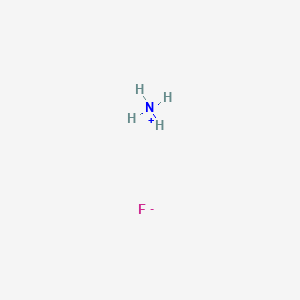
Chemische 2D-Struktur aus PubChem für CAS 12125-01-8
CAS 12125-01-8PubChem CID 25516

Ammonium fluoride

Ammonium fluoride is a fluoride salt having ammonium (NH4+) as the counterion. It is a fluoride salt and an ammonium salt. — ChEBI

IUPAC-Name
azanium fluoride
Summenformel
FH4N
Molekulargewicht
37.037 g/mol
Exakte Masse
37.032777294 Da
Topologische polare Oberfläche
1,0 Ų
Wasserstoffbrücken-Donoren
1
Wasserstoffbrücken-Akzeptoren
1
Kovalente Einheiten
2
Definierte Stereozentren
0

Auch bekannt als

Ammonium fluoride ((NH4)F)Fluoruro amonicoAmmonium fluorureNeutral ammonium fluorideFluorure d'ammoniumFluorek amonowy4QT928IM0ACHEBI:66871
16 weitere gemeldete Namen
RefChem:5548235-185-9NH4Fazanium;fluorideammonium monofluorideFluorek amonowy [Polish]Ammonium fluorure [French]Fluoruro amonico [Spanish]Fluorure d'ammonium [French]CCRIS 2285HSDB 6287EINECS 235-185-9UN2505UNII-4QT928IM0Aammonia hydrofluorideEC 235-185-9
Kennungen in externen Datenbanken

Belege aus weiteren wissenschaftlichen Datenbanken

NIH PubChem PUG-View
Exakter Kennungstreffer25516

Attributed physical-property, hazard, environmental and use annotations.

  • First Aid: Begin first aid as quickly as possible.; INHALATION: remove to fresh air.; INGESTION: perform gastric lavage with limewater or 1% calcium chloride solution; support respiration; call a physician.; EYES: flush with water for 15 min.; consult physician.; SKIN: shower immediately with large quantities of water; remove all contaminated clothing in the shower at once; consult physician. (USCG, 1999) Quelle: CAMEO Chemicals
  • ERG2024, Guide 154 (Ammonium fluoride): General First Aid:; · Call 911 or emergency medical service.; · Ensure that medical personnel are aware of the material(s) involved, take precautions to protect themselves and avoid contamination.; · Move victim to fresh air if it can be done safely.; · Administer oxygen if breathing is difficult.; · If victim is not breathing:; -- DO NOT perform mouth-to-mouth resuscitation; the victim may have ingested or inhaled the substance.; -- If equipped and pulse detected, wash face and mouth, then give artificial respiration using a proper respiratory medical device (bag-valve mask, pocket mask equipped with a one-way valve or other device).; -- If no pulse detected or no respiratory medical device available, provide continuous compressions. Conduct a pulse check every two minutes or monitor for any signs of spontaneous respirations.; · Remove and isolate contaminated clothing and shoes.; · For minor skin contact, avoid spreading material on unaffected skin.; · In case of contact with substance, remove immediately by flushing skin or eyes with running water for at least 20 minutes.; · For severe burns, immediate medical attention is required.; · Effects of exposure (inhalation, ingestion, Quelle: Emergency Response Guidebook (ERG)
  • Signal: Danger Quelle: Regulation (EC) No 1272/2008 of the European Parliament and of the Council
  • GHS Hazard Statements: H301: Toxic if swallowed [Danger Acute toxicity, oral]; H311: Toxic in contact with skin [Danger Acute toxicity, dermal]; H331: Toxic if inhaled [Danger Acute toxicity, inhalation] Quelle: Regulation (EC) No 1272/2008 of the European Parliament and of the Council
  • Precautionary Statement Codes: P261, P262, P264, P270, P271, P280, P301+P316, P302+P352, P304+P340, P316, P321, P330, P361+P364, P403+P233, P405, and P501 (click each P-code to see the statement) Quelle: Regulation (EC) No 1272/2008 of the European Parliament and of the Council
  • Signal: Danger Quelle: European Chemicals Agency (ECHA)
  • GHS Hazard Statements: H301 (100%): Toxic if swallowed [Danger Acute toxicity, oral]; H311 (98.7%): Toxic in contact with skin [Danger Acute toxicity, dermal]; H314 (14.7%): Causes severe skin burns and eye damage [Danger Skin corrosion/irritation]; H318 (16.7%): Causes serious eye damage [Danger Serious eye damage/eye irritation]; H331 (99.9%): Toxic if inhaled [Danger Acute toxicity, inhalation] Quelle: European Chemicals Agency (ECHA)
  • Precautionary Statement Codes: P260, P261, P262, P264, P264+P265, P270, P271, P280, P301+P316, P301+P330+P331, P302+P352, P302+P361+P354, P304+P340, P305+P354+P338, P316, P317, P321, P330, P361+P364, P363, P403+P233, P405, and P501 (click each P-code to see the statement) Quelle: European Chemicals Agency (ECHA)
  • ECHA C&L Notifications Summary: Aggregated GHS information provided per 3035 reports by companies from 19 notifications to the ECHA C&L Inventory. Each notification may be associated with multiple companies.; Information may vary between notifications depending on impurities, additives, and other factors. The percentage value in parenthesis indicates the notified classification ratio from companies that provide hazard codes. Only hazard codes with percentage values above 10% are shown. For more detailed information, please visit ECHA C&L website. Quelle: European Chemicals Agency (ECHA)
  • Signal: Danger Quelle: NITE-CMC
  • GHS Hazard Statements: H319: Causes serious eye irritation [Warning Serious eye damage/eye irritation]; H372: Causes damage to organs through prolonged or repeated exposure [Danger Specific target organ toxicity, repeated exposure] Quelle: NITE-CMC
  • Precautionary Statement Codes: P260, P264, P264+P265, P270, P280, P305+P351+P338, P319, P337+P317, and P501 (click each P-code to see the statement) Quelle: NITE-CMC
  • Signal: Warning Quelle: NITE-CMC
  • GHS Hazard Statements: H335: May cause respiratory irritation [Warning Specific target organ toxicity, single exposure; Respiratory tract irritation]; H373: May causes damage to organs through prolonged or repeated exposure [Warning Specific target organ toxicity, repeated exposure] Quelle: NITE-CMC
  • Industry Uses: Semiconductor and photovoltaic agent; Processing aids not otherwise specified; Plating agent; Other; Intermediate; Etching agent; Surface modifier; Cleaning agent Quelle: EPA Chemical Data Reporting (CDR)
  • Sources/Uses: Used in etching and frosting glass; as antiseptic in brewing beer; for preserving wood; in printing and dyeing textiles; and as mothproofing agent; [HSDB] Used as a wet etchant in semiconductor manufacturing at a standard concentration of 40%; [CSH, p. 46] Quelle: Haz-Map, Information on Hazardous Chemicals and Occupational Diseases
  • Industrial Processes with risk of exposure: Semiconductor Manufacturing [Category: Industry]; Applying Wood Preservatives [Category: Other]; Using Disinfectants or Biocides [Category: Clean]; Textiles (Printing, Dyeing, or Finishing) [Category: Industry]; Glass Manufacturing [Category: Industry] Quelle: Haz-Map, Information on Hazardous Chemicals and Occupational Diseases
  • Uses: Etching and frosting glass, as antiseptic in brewing beer; preserving wood; in printing and dyeing textiles; as mothproofing agent Quelle: Hazardous Substances Data Bank (HSDB)
  • Uses: Fluorides; analytical chemistry Quelle: Hazardous Substances Data Bank (HSDB)
  • Uses: Ammonium fluoride is available principally as a laboratory reagent. If it is needed in large quantities, one mole of aqueous ammonia can be mixed with one mole of the more readily available ammonium bifluoride. Quelle: Hazardous Substances Data Bank (HSDB)

Zugeordnet durch: Existing checksum-valid CAS to unique PubChem CID match. Abgerufen: 2026-08-31. Quelleneintrag öffnen

Wissenschaftliche Klassifizierungen und Gefahrenannotationen liefern Kontext und ersetzen nicht die oben gezeigte marktspezifische regulatorische Entscheidung.

Weitere Quellenabdeckung und Trefferstatus
QuelleErgebnisGeprüft
NIH PubChem PUG-ViewExakter Treffer2026-08-31

Ein erfasster Nicht-Treffer ist ein nützlicher Beleg dafür, dass die Quelle geprüft wurde; er ist keine Behauptung, dass der Stoff anderswo nicht existiert.

Am 2026-09-02 von NIH PubChem durch prüfsummengültigen CAS-Abgleich abgerufen. Chemische Eigenschaften ersetzen nicht die regulatorische Entscheidung auf dieser Seite.

Wie CAS 12125-01-8 auf dieser Website verwendet wird

CAS 12125-01-8 ist die Kennung des Chemical Abstracts Service, mit der diese Seite einem bestimmten Stoff zugeordnet wird. Im aktuellen Datenbestand hat 1 EU-Anhangseintrag diese Kennung; so können Sie gegenprüfen, ob derselbe Stoff in einem oder in mehreren regulatorischen Zusammenhängen auftaucht.

Nutzen Sie diese Seite, wenn eine Lieferantenspezifikation, ein Sicherheitsdatenblatt oder ein Rohstoffdossier CAS 12125-01-8 nennt und Sie alle verknüpften Einträge der Anhänge II–VI an einem Ort sehen möchten. Die Eintragskarten oben sind der schnellste Weg zu Konzentrationsgrenzen, Warnhinweisen, Anhangszuordnung und Produktartbedingungen.

Häufig gestellte Fragen

Ein durch CAS 12125-01-8 identifizierter Stoff kann in mehreren Anhängen der EU-Kosmetikverordnung vorkommen, wenn er in unterschiedlichen Zusammenhängen unterschiedlichen Bedingungen unterliegt. Ein Stoff kann beispielsweise nach Anhang III mit bestimmten Bedingungen beschränkt sein, und dieselbe CAS-Nummer kann auch in Anhang IV als zugelassener Farbstoff unter eigenen Eintragsbedingungen erscheinen. Jeder Eintrag muss einzeln geprüft werden.

Gleichen Sie die CAS-Nummer mit den Spezifikationsblättern und Analysenzertifikaten Ihrer Rohstoffe ab. Erscheint eine CAS-Nummer in Anhang II, prüfen Sie die Abwesenheit des Stoffs. Erscheint sie in Anhang III, prüfen Sie, ob Konzentrationsgrenzen und Produktartbedingungen in Ihrer Rezeptur eingehalten werden. Alle Anhangseinträge mit dieser CAS-Nummer sind oben aufgeführt.

Eine CAS-Nummer wird vom Chemical Abstracts Service (USA) vergeben und ist weltweit anerkannt. Eine EC-Nummer ist eine Kennung der Europäischen Kommission aus Verzeichnissen wie EINECS, ELINCS oder der NLP-Liste. Beide Kennungen können in Einträgen der EU-Kosmetikanhänge vorkommen. Manche Stoffe haben beide, manche nur eine, und einige ältere Einträge haben möglicherweise keine von beiden.

Der INCI-Checker akzeptiert Inhaltsstoffnamen, CAS-Nummern und EC-Nummern. Prüfen Sie diese CAS-Nummer direkt und gleichen Sie das Ergebnis anschließend mit den Spezifikationsblättern der Lieferanten und allen verknüpften Anhangsbedingungen ab.

Werkzeuge und nächste Schritte

Rezeptur prüfen

Eine vollständige INCI-Liste prüfen und anschließend mit CAS 12125-01-8 Lieferantendokumente zu den gefundenen Stoffen gegenprüfen.

INCI-Checker

Anhänge durchsuchen

Alle Anhänge der EU-Kosmetikverordnung nach Kategorie durchsuchen.

Alle Anhänge

Nach Name suchen

Nach INCI-Namen, Aliasen oder verwandten Kennungen suchen, die in Ihrer Dokumentation neben CAS 12125-01-8 stehen.

Suche