
CAS
1 fiche
CAS 12124-97-9
Le CAS 12124-97-9 correspond à 1 fiche d’annexe de l’UE dans les annexes II à VI du règlement (CE) n° 1223/2009.
Fiches pour le CAS 12124-97-9
1 au totalIdentité et propriétés chimiques
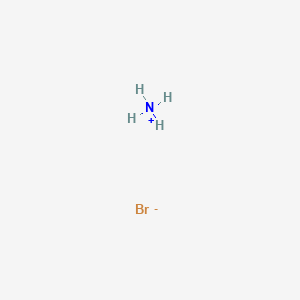
CAS 12124-97-9PubChem CID 25514
Ammonium Bromide
Ammonium bromide is an ammonium salt composed of ammonium and bromide ions in a 1:1 ratio. It is a bromide salt and an ammonium salt. — ChEBI
- Nom IUPAC
- azanium bromide
- Formule moléculaire
- BrH4N
- Masse moléculaire
- 97.94 g/mol
- Masse exacte
- 96.95271 Da
- Surface polaire topologique
- 1,0 Ų
- Donneurs de liaisons hydrogène
- 1
- Accepteurs de liaisons hydrogène
- 1
- Unités covalentes
- 2
- Stéréocentres définis
- 0
Également connu sous le nom de
NervineAmmonium bromatumAmmonii bromidumHydrobromic acid monoammoniateR0JB3224WSCHEBI:85364Ammoniun BromatumRefChem:58076
16 autres noms signalés
235-183-8Ammonium bromide ((NH4)Br)azanium;bromideNH4BrFlamex PA; Flovan BU; Fuzzicide; Hydrobromic acid monoammoniate; Spectrum XD 3899EINECS 235-183-8UNII-R0JB3224WSAmmonium Bromide; Flamex PA; Flovan BU; Fuzzicide; Hydrobromic Acid MonoammoniateAMMONIUMBROMIDEH4BrN(NH4)BrEC 235-183-8AMMONIUM BROMIDE [MI]Ammonium bromide, Puratronic?AMMONIUM BROMIDE [HSDB]AMMONIUM BROMATUM [HPUS]
Identifiants de bases de données externes
- ChEBI:CHEBI:85364
- EPA DTXSID:DTXSID8035681
Preuves issues de bases de données scientifiques complémentaires
NIH PubChem PUG-View
Correspondance exacte d’identifiant25514
Attributed physical-property, hazard, environmental and use annotations.
- Autoignition Temperature: Not flammable (USCG, 1999) Source: CAMEO Chemicals
- Boiling Point: Sublimes 1007 °F (USCG, 1999) Source: CAMEO Chemicals
- Boiling Point: 396 °C (sublimation point) Source: Hazardous Substances Data Bank (HSDB)
- Boiling Point: BP: 235 °C (in vacuum) Source: Hazardous Substances Data Bank (HSDB)
- Boiling Point: 235 °C @760 [mm Hg] Source: PAC Chemical Database, U.S. Department of Energy
- Color/Form: White tetragonal crystals Source: Hazardous Substances Data Bank (HSDB)
- Color/Form: White crystals or granules Source: Hazardous Substances Data Bank (HSDB)
- Color/Form: Colorless crystals or yellowish white powder Source: Hazardous Substances Data Bank (HSDB)
- Density: 2.429 at 68 °F (USCG, 1999) - Denser than water; will sink Source: CAMEO Chemicals
- Density: 2.429 at 25 °C Source: Hazardous Substances Data Bank (HSDB)
- Density: 2.429 @25 °C Source: PAC Chemical Database, U.S. Department of Energy
- Melting Point: Sublimes without melting (USCG, 1999) Source: CAMEO Chemicals
- Melting Point: 542 °C (decomposes) Source: Hazardous Substances Data Bank (HSDB)
- Melting Point: 452 °C Source: PAC Chemical Database, U.S. Department of Energy
- Odor: Odorless Source: Hazardous Substances Data Bank (HSDB)
- Physical Description: Ammonium bromide appears as white odorless crystals or granules that become yellow upon exposure to air. Sinks and mixes in water. (USCG, 1999) Source: CAMEO Chemicals
- Physical Description: Dry Powder Source: EPA Chemical Data Reporting (CDR)
- Physical Description: White odorless solid; Slightly hygroscopic; Yellows slowly in air; [Merck Index] Colorless granules; [MSDSonline] Source: Haz-Map, Information on Hazardous Chemicals and Occupational Diseases
- Refractive Index: Index of refraction: 1.712 at 25 °C Source: Hazardous Substances Data Bank (HSDB)
- Solubility: In water, 78.3 g/100 g water at 25 °C Source: Hazardous Substances Data Bank (HSDB)
- Solubility: Soluble in acetone, ether, ammonia, in water, 97 g/100 cc at 25 °C, 145.6 g/100 cc at 100 °C; in alcohol, 10 g/100 cc at 78 °C Source: Hazardous Substances Data Bank (HSDB)
- Solubility: Freely soluble in methanol, ethanol, acetone; slightly soluble in ether; practically insoluble in ethyl acetate Source: Hazardous Substances Data Bank (HSDB)
- Vapor Pressure: VP: 1 mm Hg at 198.3 °C Source: Hazardous Substances Data Bank (HSDB)
- pH: Slightly acid to litmus Source: Hazardous Substances Data Bank (HSDB)
- Carcinogen Classification: No indication of carcinogenicity to humans (not listed by IARC). Source: Toxin and Toxin Target Database (T3DB)
- Exposure Routes: Oral (L626) ; inhalation (L626) ; dermal (L626) Source: Toxin and Toxin Target Database (T3DB)
- First Aid: EYES AND SKIN: Flush with large amounts of water.; INGESTION: Induce vomiting and call a doctor. (USCG, 1999) Source: CAMEO Chemicals
- Signal: Danger Source: Regulation (EC) No 1272/2008 of the European Parliament and of the Council
- GHS Hazard Statements: H319: Causes serious eye irritation [Warning Serious eye damage/eye irritation]; H336: May cause drowsiness or dizziness [Warning Specific target organ toxicity, single exposure; Narcotic effects]; H360FD: May damage fertility; May damage the unborn child [Danger Reproductive toxicity]; H362: May cause harm to breast-fed children [Reproductive toxicity, effects on or via lactation]; H372: Causes damage to organs through prolonged or repeated exposure [Danger Specific target organ toxicity, repeated exposure] Source: Regulation (EC) No 1272/2008 of the European Parliament and of the Council
- Precautionary Statement Codes: P203, P260, P261, P263, P264, P264+P265, P270, P271, P280, P304+P340, P305+P351+P338, P318, P319, P337+P317, P403+P233, P405, and P501 (click each P-code to see the statement) Source: Regulation (EC) No 1272/2008 of the European Parliament and of the Council
- Note: This chemical does not meet GHS hazard criteria for 0.4% (3 of 704) of reports. Source: European Chemicals Agency (ECHA)
- Signal: Danger Source: European Chemicals Agency (ECHA)
- GHS Hazard Statements: H319 (99.6%): Causes serious eye irritation [Warning Serious eye damage/eye irritation]; H336 (21%): May cause drowsiness or dizziness [Warning Specific target organ toxicity, single exposure; Narcotic effects]; H360FD (17.8%): May damage fertility; May damage the unborn child [Danger Reproductive toxicity]; H362 (20.9%): May cause harm to breast-fed children [Reproductive toxicity, effects on or via lactation]; H372 (20.9%): Causes damage to organs through prolonged or repeated exposure [Danger Specific target organ toxicity, repeated exposure] Source: European Chemicals Agency (ECHA)
- Precautionary Statement Codes: P203, P260, P261, P263, P264, P264+P265, P270, P271, P280, P304+P340, P305+P351+P338, P318, P319, P337+P317, P403+P233, P405, and P501 (click each P-code to see the statement) Source: European Chemicals Agency (ECHA)
- ECHA C&L Notifications Summary: Aggregated GHS information provided per 704 reports by companies from 12 notifications to the ECHA C&L Inventory. Each notification may be associated with multiple companies.; Reported as not meeting GHS hazard criteria per 3 of 704 reports by companies.; There are 11 notifications provided by 701 of 704 reports by companies with hazard statement code(s).; Information may vary between notifications depending on impurities, additives, and other factors. The percentage value in parenthesis indicates the notified classification ratio from companies that provide hazard codes. Only hazard codes with percentage values above 10% are shown. For more detailed information, please visit ECHA C&L website. Source: European Chemicals Agency (ECHA)
- Signal: Danger Source: NITE-CMC
- GHS Hazard Statements: H320: Causes eye irritation [Warning Serious eye damage/eye irritation]; H336: May cause drowsiness or dizziness [Warning Specific target organ toxicity, single exposure; Narcotic effects]; H360: May damage fertility or the unborn child [Danger Reproductive toxicity]; H371: May cause damage to organs [Warning Specific target organ toxicity, single exposure]; H372: Causes damage to organs through prolonged or repeated exposure [Danger Specific target organ toxicity, repeated exposure]; H400: Very toxic to aquatic life [Warning Hazardous to the aquatic environment, acute hazard]; H410: Very toxic to aquatic life with long lasting effects [Warning Hazardous to the aquatic environment, long-term hazard] Source: NITE-CMC
- Precautionary Statement Codes: P203, P260, P261, P264, P264+P265, P270, P271, P273, P280, P304+P340, P305+P351+P338, P308+P316, P318, P319, P337+P317, P391, P403+P233, P405, and P501 (click each P-code to see the statement) Source: NITE-CMC
- Health Effects: Bromine vapour causes irritation and direct damage to the mucous membranes. Elemental bromine also burns the skin. The bromide ion is a central nervous system depressant and chronic exposure produces neuronal effects. This is called bromism and can result in central reactions reaching from somnolence to coma, cachexia, exicosis, loss of reflexes or pathologic reflexes, clonic seizures, tremor, ataxia, loss of neural sensitivity, paresis, papillar edema of the eyes, abnormal speech, cerebral edema, delirium, aggressiveness, and psychoses. (L625, L626, L627) Source: Toxin and Toxin Target Database (T3DB)
- Toxicity Summary: IDENTIFICATION AND USE: Ammonium bromide exists as white crystals or granules. It is used in process engraving and lithography, fireproofing of wood, and as a corrosion inhibitor. Bromide- containing medications is a prominent former use. HUMAN EXPOSURE AND TOXICITY: The warning symptoms of bromide intoxication, bromism, include mental dullness, slurred speech, weakened memory, apathy, anorexia, constipation, drowsiness and loss of sensitivity to touch and pain. These symptoms disappear on discontinuing the drug, but continued use leads to more serious symptoms including restlessness, disorientation, ocular disturbances, ataxia, hallucinations, delirium, stupor and coma. Bromide rash, of an acneform, nodular, or sometimes erythematous type, is of fairly common occurrence but may be absent even in patients who have developed severe mental symptoms. Transplacental bromism had been described in the literature. ANIMAL STUDIES: Ammonium bromide was not irritating to skin, but slightly irritating to eyes in rabbits. Ames test conducted in Salmonella typhimurium strains TA1535,TA100,TA1538,TA98,TA1537 with and without metabolic activation was negative. Source: Hazardous Substances Data Bank (HSDB)
- Toxicity Summary: Bromine is a powerful oxidizing agent and is able to release oxygen free radicals from the water in mucous membranes. These free radicals are also potent oxidizers and produce tissue damage. In additon, the formation of hydrobromic and bromic acids will result in secondary irritation. The bromide ion is also known to affect the central nervous system, causing bromism. This is believed to be a result of bromide ions substituting for chloride ions in the in actions of neurotransmitters and transport systems, thus affecting numerous synaptic processes. (L626, L627, A543) Source: Toxin and Toxin Target Database (T3DB)
- Industry Uses: Processing aids not otherwise specified; Flux agent; Flame retardant Source: EPA Chemical Data Reporting (CDR)
- Sources/Uses: Used in process engraving and lithography, fireproofing wood, textile finishing, manufacturing photographic emulsions, and metal treatment, Also used as a corrosion inhibitor and as a catalyst in the production of diphenylamine; [HSDB] Used as a sedative; [Merck Index] Source: Haz-Map, Information on Hazardous Chemicals and Occupational Diseases
- Industrial Processes with risk of exposure: Textiles (Printing, Dyeing, or Finishing) [Category: Industry] Source: Haz-Map, Information on Hazardous Chemicals and Occupational Diseases
- Activities with risk of exposure: Lithography printing [Category: Hobbies] Source: Haz-Map, Information on Hazardous Chemicals and Occupational Diseases
- Uses: For ammonium bromide (USEPA/OPP Pesticide Code: 000352) ACTIVE products with label matches. /SRP: Registered for use in the USA but approved pesticide uses may change periodically and so federal, state and local authorities must be consulted for currently approved uses./ Source: Hazardous Substances Data Bank (HSDB)
- Uses: Manufacturing of photographic films, plates, and papers; in process engraving and lithography; fireproofing of wood; in corrosion inhibitors; in photochemical reactions; precipitation of silver salts. Source: Hazardous Substances Data Bank (HSDB)
- Uses: Analytical chemistry, ... textile finishing, fire retardant, anticorrosive agent. Source: Hazardous Substances Data Bank (HSDB)
- Uses: MFR OF PHOTOGRAPHIC EMULSIONS; IN METAL TREATMENT; CATALYST IN PRODN OF DIPHENYLAMINE Source: Hazardous Substances Data Bank (HSDB)
- Uses: For more Uses (Complete) data for AMMONIUM BROMIDE (6 total), please visit the HSDB record page. Source: Hazardous Substances Data Bank (HSDB)
- Uses: Ammonium bromide is used for photography in films, plates and papers, for fireproofing wood, in lithography and process engraving, in corrosion inhibitors, and in pharmaceutical preparations. (L640) Source: Toxin and Toxin Target Database (T3DB)
Mis en correspondance par: Existing checksum-valid CAS to unique PubChem CID match. Récupéré le: 2026-08-31. Ouvrir la fiche source
Les classifications scientifiques et les annotations de danger apportent du contexte et ne remplacent pas la décision réglementaire propre au marché indiquée ci-dessus.
Couverture des sources complémentaires et état des correspondances
| Source | Résultat | Vérifié |
|---|---|---|
| NIH PubChem PUG-View | Correspondance exacte | 2026-08-31 |
Une absence de correspondance enregistrée est une preuve utile que la source a été vérifiée ; ce n’est pas l’affirmation que la substance n’existe pas ailleurs.
Récupéré depuis NIH PubChem le 2026-08-31 par correspondance CAS à somme de contrôle valide. Les propriétés chimiques ne remplacent pas la décision réglementaire de cette page.
Comment le CAS 12124-97-9 est utilisé sur ce site
Le CAS 12124-97-9 est l’identifiant du Chemical Abstracts Service utilisé pour rattacher cette page à une substance précise. Dans le jeu de données actuel, 1 fiche d’annexe de l’UE partage cet identifiant, ce qui vous aide à vérifier si la même substance apparaît dans un seul contexte réglementaire ou dans plusieurs.
Utilisez cette page lorsqu’une spécification fournisseur, une FDS ou un dossier de matière première vous donne le CAS 12124-97-9 et que vous devez voir au même endroit toutes les fiches liées des annexes II à VI. Les cartes d’entrées ci-dessus sont le moyen le plus rapide d’accéder aux limites de concentration, aux avertissements, à l’annexe concernée et aux conditions par type de produit.
Questions fréquentes
Une substance identifiée par le CAS 12124-97-9 peut figurer dans plusieurs annexes du règlement de l’UE sur les cosmétiques lorsqu’elle est soumise à des conditions différentes selon les contextes. Par exemple, une substance peut être soumise à restrictions à l’annexe III avec des conditions précises, et le même CAS peut aussi figurer à l’annexe IV comme colorant autorisé, dans une entrée distincte avec ses propres conditions. Chaque entrée doit être examinée individuellement.
Recoupez le numéro CAS avec les fiches de spécification de vos matières premières et vos certificats d’analyse. Lorsqu’un CAS figure à l’annexe II, vérifiez son absence. Lorsqu’il figure à l’annexe III, vérifiez que les limites de concentration et les conditions de type de produit sont respectées dans votre formulation. Toutes les entrées d’annexe partageant ce numéro CAS sont énumérées ci-dessus.
Un numéro CAS est attribué par le Chemical Abstracts Service (États-Unis) et reconnu dans le monde entier. Un numéro CE est un identifiant de la Commission européenne issu d’inventaires tels que l’EINECS, l’ELINCS ou la liste NLP. Les deux identifiants peuvent figurer dans les entrées des annexes cosmétiques de l’UE. Certaines substances ont les deux, d’autres un seul, et certaines entrées plus anciennes peuvent n’en avoir aucun.
Le vérificateur INCI accepte les noms d’ingrédients, les numéros CAS et les numéros CE. Vérifiez directement ce numéro CAS, puis contrôlez le résultat auprès des fiches de spécification des fournisseurs et de toutes les conditions d’annexe associées.
Outils et étapes suivantes
Vérifiez votre formule
Analysez une liste INCI complète, puis utilisez le CAS 12124-97-9 pour recouper les documents fournisseurs relatifs aux substances identifiées.
Vérificateur INCIParcourir les annexes
Parcourez toutes les annexes du règlement de l’UE sur les cosmétiques par catégorie.
Toutes les annexesRechercher par nom
Recherchez les noms INCI, alias ou identifiants associés qui figurent à côté du CAS 12124-97-9 dans votre documentation.
Rechercher