
CAS
1 fiche
CAS 10605-21-7
Le CAS 10605-21-7 correspond à 1 fiche d’annexe de l’UE dans les annexes II à VI du règlement (CE) n° 1223/2009.
Fiches pour le CAS 10605-21-7
1 au totalIdentité et propriétés chimiques
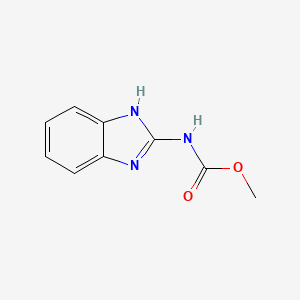
CAS 10605-21-7PubChem CID 25429
Carbendazim
Carbendazim is a member of the class of benzimidazoles that is 2-aminobenzimidazole in which the primary amino group is substituted by a methoxycarbonyl group. A fungicide, carbendazim controls Ascomycetes, Fungi Imperfecti, and Basidiomycetes on a wide variety of crops, including bananas, cereals, cotton, fruits, grapes, mushrooms, ornamentals, peanuts, sugarbeet, soybeans, tobacco, and vegetables. It has a role as a metabolite, an antinematodal drug, a microtubule-destabilising agent and an antifungal agrochemical. It is a member of benzimidazoles, a carbamate ester, a benzimidazole fungicide and a benzimidazolylcarbamate fungicide. It is functionally related to a 2-aminobenzimidazole. — ChEBI
- Nom IUPAC
- methyl N-(1H-benzimidazol-2-yl)carbamate
- Formule moléculaire
- C9H9N3O2
- Masse moléculaire
- 191.19 g/mol
- Masse exacte
- 191.069476538 Da
- XLogP3
- 1,5
- Surface polaire topologique
- 67,0 Ų
- Donneurs de liaisons hydrogène
- 2
- Accepteurs de liaisons hydrogène
- 3
- Unités covalentes
- 1
- Stéréocentres définis
- 0
Également connu sous le nom de
CarbendazoleMecarzoleBavistinThicoperCarbendazimeDerosalBavistanCarbendazol
16 autres noms signalés
FunabenSupercarbDelseneKolfugoMedamineBattalMycoMethyl 2-benzimidazolecarbamateCarbendazymEquitdazinGarbendaKemdazinAgrizimBavistin 3460BengardBitosen
Identifiants de bases de données externes
- ChEBI:CHEBI:3392
- ChEMBL:CHEMBL70971
- EPA DTXSID:DTXSID4024729
- PubMed:22994080
- PubMed:22982763
- PubMed:22980892
- PubMed:22974217
- PubMed:22960505
- PubMed:22952946
- PubMed:22868159
- PubMed:22854093
- PubMed:22845779
- PubMed:22806849
- PubMed:22803343
- PubMed:22747978
Preuves issues de bases de données scientifiques complémentaires
EMBL-EBI ChEBI
Correspondance exacte d’identifiantCHEBI:3392
carbendazim
A member of the class of benzimidazoles that is 2-aminobenzimidazole in which the primary amino group is substituted by a methoxycarbonyl group. A fungicide, carbendazim controls Ascomycetes, Fungi Imperfecti, and Basidiomycetes on a wide variety of crops, including bananas, cereals, cotton, fruits, grapes, mushrooms, ornamentals, peanuts, sugarbeet, soybeans, tobacco, and vegetables.
- Formule
- C9H9N3O2
- Masse moyenne
- 191.190 g/mol
- Masse monoisotopique
- 191.06948 Da
- Charge formelle
- 0
- benzimidazoles — is a (CHEBI:22715)
- benzimidazolylcarbamate fungicide — is a (CHEBI:87064)
- benzimidazole fungicide — is a (CHEBI:87036)
- carbamate ester — is a (CHEBI:23003)
- antineoplastic agent — has role (CHEBI:35610)
- antinematodal drug — has role (CHEBI:35444)
- microtubule-destabilising agent — has role (CHEBI:61951)
- metabolite — has role (CHEBI:25212)
- antifungal agrochemical — has role (CHEBI:86328)
- 2-aminobenzimidazole — has functional parent (CHEBI:27822)
- antineoplastic agent — has role (CHEBI:35610)
- antinematodal drug — has role (CHEBI:35444)
- microtubule-destabilising agent — has role (CHEBI:61951)
- metabolite — has role (CHEBI:25212)
- antifungal agrochemical — has role (CHEBI:86328)
- benzimidazoles — is a (CHEBI:22715)
- benzimidazolylcarbamate fungicide — is a (CHEBI:87064)
- benzimidazole fungicide — is a (CHEBI:87036)
- carbamate ester — is a (CHEBI:23003)
- 10978195 Source: PubMed
- 11087478 Source: PubMed
- 11782195 Source: PubMed
- 12127542 Source: PubMed
- 12517096 Source: PubMed
- 15161186 Source: PubMed
- 15769154 Source: PubMed
- 15769157 Source: PubMed
- 16420038 Source: PubMed
- 17331623 Source: PubMed
- 17375953 Source: PubMed
- 17618711 Source: PubMed
- 18052123 Source: PubMed
- 18342506 Source: PubMed
- 18616265 Source: PubMed
- 18778877 Source: PubMed
- 18954075 Source: PubMed
- 19319825 Source: PubMed
- 19560843 Source: PubMed
- 20038099 Source: PubMed
- 20408555 Source: PubMed
- 20483609 Source: PubMed
- 20553011 Source: PubMed
- 20621724 Source: PubMed
Noms supplémentaires validés
methyl 1H-benzimidazol-2-ylcarbamate1H-benzimidazol-2-ylcarbamic acid methyl ester2-benzimidazolecarbamic acid methyl ester2-(Methoxy-carbonylamino)-benzimidazol2-(methoxycarbonylamino)-benzimidazole2-(methoxycarbonylamino)benzimidazoleA 118A118BAS-67054FBavistinBMCCarbendazimcarbendazimeDerropreneEK-578FB-642Fenbendazole related compound aLignasanMBCMecarzolemethyl 2-benzimidazolecarbamatemethyl benzimidazol-2-ylcarbamateNSC-109874Thicoper
Références croisées de cette source
- CAS: 10605-21-7 — ChemIDplus
- CAS: 10605-21-7 — KEGG COMPOUND
- MANUAL_X_REF: 116 — PPDB
- MANUAL_X_REF: C10897 — KEGG COMPOUND
- MANUAL_X_REF: carbendazim — Alan Wood's Pesticides
- MANUAL_X_REF: Carbendazim — Wikipedia
- MANUAL_X_REF: HMDB0031769 — HMDB
- MANUAL_X_REF: US3010968 — Patent
- REGISTRY_NUMBER: 649044 — Reaxys
Mis en correspondance par: Exact CAS cross-reference in the ChEBI compound record. Source mise à jour le: 2023-11-22. Récupéré le: 2026-08-31. Ouvrir la fiche source
NIH PubChem PUG-View
Correspondance exacte d’identifiant25429
Attributed physical-property, hazard, environmental and use annotations.
- Color/Form: White powder Source: Hazardous Substances Data Bank (HSDB)
- Color/Form: Crystalline powder Source: Hazardous Substances Data Bank (HSDB)
- Color/Form: Nearly white solid /Technical/ Source: Hazardous Substances Data Bank (HSDB)
- Color/Form: Light-gray powder Source: Hazardous Substances Data Bank (HSDB)
- Color/Form: Off-white, crystalline powder Source: Hazardous Substances Data Bank (HSDB)
- Density: 1.45 at 68 °F (NTP, 1992) - Denser than water; will sink Source: CAMEO Chemicals
- Density: 1.45 g/cu cm at 25 °C Source: Hazardous Substances Data Bank (HSDB)
- Density: 0.27 g/cm³ Source: ILO-WHO International Chemical Safety Cards (ICSCs)
- Dissociation Constants: pKa = 4.29 Source: Hazardous Substances Data Bank (HSDB)
- Dissociation Constants: pKa = 4.2, weak base Source: Hazardous Substances Data Bank (HSDB)
- LogP: log Kow = 1.52 Source: Hazardous Substances Data Bank (HSDB)
- LogP: 1.52 Source: Human Metabolome Database (HMDB)
- LogP: 1.49 Source: ILO-WHO International Chemical Safety Cards (ICSCs)
- Melting Point: 576 to 585 °F (decomposes) (NTP, 1992) Source: CAMEO Chemicals
- Melting Point: Decomposes at 300 °C Source: Hazardous Substances Data Bank (HSDB)
- Melting Point: MP: 302-307 °C (decomposes) Source: Hazardous Substances Data Bank (HSDB)
- Melting Point: 302 - 307 °C Source: Human Metabolome Database (HMDB)
- Odor: Odorless /Technical/ Source: Hazardous Substances Data Bank (HSDB)
- Physical Description: Carbendazim appears as light gray or beige powder. (NTP, 1992) Source: CAMEO Chemicals
- Physical Description: White to light-gray, odorless solid; [HSDB] Powder; [MSDSonline] Source: Haz-Map, Information on Hazardous Chemicals and Occupational Diseases
- Physical Description: Solid Source: Human Metabolome Database (HMDB)
- Physical Description: COLOURLESS CRYSTALS OR GREY-TO-WHITE POWDER. Source: ILO-WHO International Chemical Safety Cards (ICSCs)
- Solubility: less than 1 mg/mL at 70 °F (NTP, 1992) Source: CAMEO Chemicals
- Solubility: Solubility in water at 24 °C: 29 mg/L at pH 4; 8 mg/L at pH 7; 1.49 mg/L at pH 8 Source: Hazardous Substances Data Bank (HSDB)
- Solubility: Soluble in (g/L at 24 °C): dimethylformamide 5, acetone 0.3, ethanol 0.3, chloroform 0.1, ehtyl acetate 0.135, dichlormethane 0.068, benzene 0.036, cyclohexane <0.01, diethyl ether <0.01, hexane 0.0005 Source: Hazardous Substances Data Bank (HSDB)
- Solubility: Xylene: <1 g/100 g at 20 °C; Cylcohexanone: < 1 g/100 g /Technical grade/ Source: Hazardous Substances Data Bank (HSDB)
- Solubility: Solubility at 20 °C (mg/L): hexane 0.5; benzene 36; dichloromethane 68; ethanol 300; dimethylformamide 5000, chloroform 100, acetone 300 Source: Hazardous Substances Data Bank (HSDB)
- Solubility: Slightly soluble in most solvents Source: Hazardous Substances Data Bank (HSDB)
- Solubility: 29 mg/L @ 24C (exp) Source: Human Metabolome Database (HMDB)
- Solubility: Solubility in water, g/100ml at 24 °C: 0.0008 Source: ILO-WHO International Chemical Safety Cards (ICSCs)
- Vapor Pressure: less than 0.000000075 mmHg at 68 °F ; <0.001 mmHg at 257 °F (NTP, 1992) Source: CAMEO Chemicals
- Vapor Pressure: 7.5X10⁻¹⁰ mm Hg at 20 °C Source: Hazardous Substances Data Bank (HSDB)
- Vapor Pressure: Vapor pressure at 20 °C: negligible Source: ILO-WHO International Chemical Safety Cards (ICSCs)
- Carcinogen Classification: No indication of carcinogenicity to humans (not listed by IARC). Source: Toxin and Toxin Target Database (T3DB)
- Exposure Routes: The substance can be absorbed into the body by inhalation of its aerosol. Source: ILO-WHO International Chemical Safety Cards (ICSCs)
- Exposure Routes: Inhalation (L793) ; oral (L793); dermal (L793) Source: Toxin and Toxin Target Database (T3DB)
- First Aid: EYES: First check the victim for contact lenses and remove if present. Flush victim's eyes with water or normal saline solution for 20 to 30 minutes while simultaneously calling a hospital or poison control center. Do not put any ointments, oils, or medication in the victim's eyes without specific instructions from a physician. If symptoms (such as redness or irritation) develop, immediately transport the victim to a hospital.; SKIN: IMMEDIATELY flood affected skin with water while removing and isolating all contaminated clothing. Gently wash all affected skin areas thoroughly with soap and water. If symptoms such as redness or irritation develop, IMMEDIATELY call a physician and be prepared to transport the victim to a hospital for treatment.; INHALATION: IMMEDIATELY leave the contaminated area; take deep breaths of fresh air. If symptoms (such as wheezing, coughing, shortness of breath, or burning in the mouth, throat, or chest) develop, call a physician and be prepared to transport the victim to a hospital. Provide proper respiratory protection to rescuers entering an unknown atmosphere. Whenever possible, Self-Contained Breathing Apparatus (SCBA) should be used; if not availabl Source: CAMEO Chemicals
- Signal: Danger Source: Regulation (EC) No 1272/2008 of the European Parliament and of the Council
- GHS Hazard Statements: H317: May cause an allergic skin reaction [Warning Sensitization, Skin]; H340: May cause genetic defects [Danger Germ cell mutagenicity]; H360FD: May damage fertility; May damage the unborn child [Danger Reproductive toxicity]; H400: Very toxic to aquatic life [Warning Hazardous to the aquatic environment, acute hazard]; H410: Very toxic to aquatic life with long lasting effects [Warning Hazardous to the aquatic environment, long-term hazard] Source: Regulation (EC) No 1272/2008 of the European Parliament and of the Council
- Precautionary Statement Codes: P203, P261, P272, P273, P280, P302+P352, P318, P321, P333+P317, P362+P364, P391, P405, and P501 (click each P-code to see the statement) Source: Regulation (EC) No 1272/2008 of the European Parliament and of the Council
- Note: This chemical does not meet GHS hazard criteria for 0.3% (2 of 692) of reports. Source: European Chemicals Agency (ECHA)
- Signal: Danger Source: European Chemicals Agency (ECHA)
- GHS Hazard Statements: H317 (27.9%): May cause an allergic skin reaction [Warning Sensitization, Skin]; H340 (99.6%): May cause genetic defects [Danger Germ cell mutagenicity]; H360 (74%): May damage fertility or the unborn child [Danger Reproductive toxicity]; H360FD (25.6%): May damage fertility; May damage the unborn child [Danger Reproductive toxicity]; H400 (98.1%): Very toxic to aquatic life [Warning Hazardous to the aquatic environment, acute hazard]; H410 (99.7%): Very toxic to aquatic life with long lasting effects [Warning Hazardous to the aquatic environment, long-term hazard] Source: European Chemicals Agency (ECHA)
- Precautionary Statement Codes: P203, P261, P272, P273, P280, P302+P352, P318, P321, P333+P317, P362+P364, P391, P405, and P501 (click each P-code to see the statement) Source: European Chemicals Agency (ECHA)
- ECHA C&L Notifications Summary: Aggregated GHS information provided per 692 reports by companies from 27 notifications to the ECHA C&L Inventory. Each notification may be associated with multiple companies.; Reported as not meeting GHS hazard criteria per 2 of 692 reports by companies.; There are 26 notifications provided by 690 of 692 reports by companies with hazard statement code(s).; Information may vary between notifications depending on impurities, additives, and other factors. The percentage value in parenthesis indicates the notified classification ratio from companies that provide hazard codes. Only hazard codes with percentage values above 10% are shown. For more detailed information, please visit ECHA C&L website. Source: European Chemicals Agency (ECHA)
- Signal: Danger Source: NITE-CMC
- GHS Hazard Statements: H317: May cause an allergic skin reaction [Warning Sensitization, Skin]; H340: May cause genetic defects [Danger Germ cell mutagenicity]; H360: May damage fertility or the unborn child [Danger Reproductive toxicity]; H371: May cause damage to organs [Warning Specific target organ toxicity, single exposure]; H373: May causes damage to organs through prolonged or repeated exposure [Warning Specific target organ toxicity, repeated exposure] Source: NITE-CMC
- Precautionary Statement Codes: P203, P260, P261, P264, P270, P272, P280, P302+P352, P308+P316, P318, P319, P321, P333+P317, P362+P364, P405, and P501 (click each P-code to see the statement) Source: NITE-CMC
- Signal: Warning Source: NITE-CMC
- Health Effects: Carbendazim is a suspected endocrine disruptor. It is also a developmental toxin. Animals exposed to carbendazim in the womb to have serious deformities such as lack of eyes and hydrocephalus (water on the brain). Carbendazim can disrupt the development of sperm and damage testicular development in adult rats. Source: Toxin and Toxin Target Database (T3DB)
- Toxicity Summary: IDENTIFICATION AND USE: Carbendazim is a white powder. it is a systemic leaf and soil fungicide, absorbed through the roots and green tissues. HUMAN EXPOSURE AND TOXICITY: Six human chromosomes were investigated in pairs (1 and 8, 11 and 18, and X and 17). Abnormalities were classified as chromosome loss (including centromeric positive micronuclei), chromosome gain, non-disjunction, or polyploidy. ANIMAL STUDIES: Previous studies indicate that carbendazim may interfere with mitosis and thus may disrupt or inhibit microtubule function resulting in apoptosis. Carbendazim even at low dose exhibited toxicity, affected the liver and also caused specific changes in hematological and biochemical parameters in the rat. Male rats (6 per dose level) were gavaged with 200, 3400 and 5000 mg/kg 5 days/wk for 2 wk. Two out of the 6 rats died at the dose level of 3400 mg/kg per day. At all dose levels, gross and microscopic evidence of adverse effects on the testes and reduction or absence of sperm in the epididymides was seen. The testes were small and discolored, with tubular degeneration and evidence of aspermatogenesis. At the dose level of 3400 mg/kg per day, there were also morphological ch Source: Hazardous Substances Data Bank (HSDB)
- Toxicity Summary: Carbendazim targets beta tubulin in actively dividing cells. It binds to microtubules, interfering with cell functions, such as meiosis and intracellular transportation (A15332). Source: Toxin and Toxin Target Database (T3DB)
- Environmental Bioconcentration: BCFs of <1.5-3.5 and 0.6-1.1 were measured using carp (Cyprinus carpio) exposed to 2 and 20 ug/L, respectively, carbendazim over a 6-week period(1). Carbendazim was not bioconcentrated in perch (Perca fluviatilis) and carp exposed to food pellets containing a mixture of 13 pesticides(2). According to a classification scheme(3), these BCF values suggest bioconcentration in aquatic organisms is low(SRC). Source: Hazardous Substances Data Bank (HSDB)
- Environmental Fate: TERRESTRIAL FATE: Based on a classification scheme(1), Koc values of 122.3-2805(2-3), indicate that carbendazim is expected to have high mobility in some soils with decreasing mobility as the amount of clay and organic carbon content increases, pH will have a lesser effect on mobility. Volatilization of carbendazim from moist soil surfaces is not expected to be an important fate process(SRC) given an estimated Henry's Law constant of 1.5X10⁻¹² atm-cu m/mole(SRC), using a fragment constant estimation method(4). Carbendazim is not expected to volatilize from dry soil surfaces(SRC) based upon a vapor pressure of 7.5X10⁻¹⁰ mm Hg at 25 °C(5). Measured soil biodegradation rates of 45% in 21 days and 45% in 14 days suggest that carbendazim is expected to biodegrade slowly under normal environmental conditions(6). However, biodegradation rates of 100% in 5 days and 97% in 9 days suggest that biodegradation of carbendazim will be enhanced in pretreated soils(6). Source: Hazardous Substances Data Bank (HSDB)
- Environmental Fate: TERRESTRIAL FATE: Carbendazim is absorbed through the roots and green tissues of plants, with translocation acropetally. Source: Hazardous Substances Data Bank (HSDB)
- Environmental Fate: AQUATIC FATE: Based on a classification scheme(1), Koc values of 122.3-2805(2-3), indicate that carbendazim is expected to adsorb to suspended solids and sediment(SRC). Volatilization from water surfaces is not expected(4) based upon an estimated Henry's Law constant of 1.5X10⁻¹² atm-cu m/mole(SRC), developed using a fragment constant estimation method(5). Measured hydrolysis half-lives for carbendazim at 22 °C were >350 days at pH 5-7 and 124 days at pH 9(6). According to a classification scheme(7), BCFs of <1.5-3.5 measured in carp(8), suggest bioconcentration in aquatic organisms is low(SRC). A 0% of Theoretical BOD using activated sludge in the Japanese MITI test(8) suggests that biodegradation is not an important environmental fate process in water(SRC). Source: Hazardous Substances Data Bank (HSDB)
- Environmental Fate: ATMOSPHERIC FATE: According to a model of gas/particle partitioning of semivolatile organic compounds in the atmosphere(1), carbendazim, which has a vapor pressure of 7.5X10⁻¹⁰ mm Hg at 25 °C(2), is expected to exist solely in the particulate phase in the ambient atmosphere. Particulate-phase carbendazim may be removed from the air by wet and dry deposition(SRC). Source: Hazardous Substances Data Bank (HSDB)
- Sources/Uses: Used as a fungicide in cereals, fruits, vines, hops, vegetables, ornamentals, coffee, cotton, rice, flax, beet, sugar cane, peanuts, oilseed rape, cucurbits, rubber, tobacco, turf, mushrooms, and other crops; [HSDB] Source: Haz-Map, Information on Hazardous Chemicals and Occupational Diseases
- Industrial Processes with risk of exposure: Farming (Pesticides) [Category: Industry] Source: Haz-Map, Information on Hazardous Chemicals and Occupational Diseases
- Uses: For carbendazim (USEPA/OPP Pesticide Code: 128872) ACTIVE products with label matches. /SRP: Registered for use in the U.S. but approved pesticide uses may change periodically and so federal, state and local authorities must be consulted for currently approved uses./ Source: Hazardous Substances Data Bank (HSDB)
- Uses: Fungicide Source: Hazardous Substances Data Bank (HSDB)
- Uses: Systemic leaf and soil fungicide, absorbed through the roots and green tissues. Source: Hazardous Substances Data Bank (HSDB)
- Uses: /Carbendazim is/ used as a preservative in paint, papermaking and leather industry, and as a preservative of fruits. Source: Hazardous Substances Data Bank (HSDB)
- Uses: Antimicrobial in caulks, concrete, grouts, inks, paints, sealants, stains and textiles Source: Hazardous Substances Data Bank (HSDB)
- Uses: It is a systemic fungicide that is selectively toxic to microorganisms and invertebrates. It is also employed as a casting worm control agent in amenity turf situations such as golf greens and tennis courts. It is also used to control plant diseases in cereals and fruits, including citrus, bananas, strawberries, pineapples, and pomes. Source: Toxin and Toxin Target Database (T3DB)
Mis en correspondance par: Existing checksum-valid CAS to unique PubChem CID match. Récupéré le: 2026-08-31. Ouvrir la fiche source
Les classifications scientifiques et les annotations de danger apportent du contexte et ne remplacent pas la décision réglementaire propre au marché indiquée ci-dessus.
Couverture des sources complémentaires et état des correspondances
| Source | Résultat | Vérifié |
|---|---|---|
| EMBL-EBI ChEBI | Correspondance exacte | 2026-08-31 |
| NIH PubChem PUG-View | Correspondance exacte | 2026-08-31 |
Une absence de correspondance enregistrée est une preuve utile que la source a été vérifiée ; ce n’est pas l’affirmation que la substance n’existe pas ailleurs.
Récupéré depuis NIH PubChem le 2026-08-31 par correspondance CAS à somme de contrôle valide. Les propriétés chimiques ne remplacent pas la décision réglementaire de cette page.
Comment le CAS 10605-21-7 est utilisé sur ce site
Le CAS 10605-21-7 est l’identifiant du Chemical Abstracts Service utilisé pour rattacher cette page à une substance précise. Dans le jeu de données actuel, 1 fiche d’annexe de l’UE partage cet identifiant, ce qui vous aide à vérifier si la même substance apparaît dans un seul contexte réglementaire ou dans plusieurs.
Utilisez cette page lorsqu’une spécification fournisseur, une FDS ou un dossier de matière première vous donne le CAS 10605-21-7 et que vous devez voir au même endroit toutes les fiches liées des annexes II à VI. Les cartes d’entrées ci-dessus sont le moyen le plus rapide d’accéder aux limites de concentration, aux avertissements, à l’annexe concernée et aux conditions par type de produit.
Questions fréquentes
Une substance identifiée par le CAS 10605-21-7 peut figurer dans plusieurs annexes du règlement de l’UE sur les cosmétiques lorsqu’elle est soumise à des conditions différentes selon les contextes. Par exemple, une substance peut être soumise à restrictions à l’annexe III avec des conditions précises, et le même CAS peut aussi figurer à l’annexe IV comme colorant autorisé, dans une entrée distincte avec ses propres conditions. Chaque entrée doit être examinée individuellement.
Recoupez le numéro CAS avec les fiches de spécification de vos matières premières et vos certificats d’analyse. Lorsqu’un CAS figure à l’annexe II, vérifiez son absence. Lorsqu’il figure à l’annexe III, vérifiez que les limites de concentration et les conditions de type de produit sont respectées dans votre formulation. Toutes les entrées d’annexe partageant ce numéro CAS sont énumérées ci-dessus.
Un numéro CAS est attribué par le Chemical Abstracts Service (États-Unis) et reconnu dans le monde entier. Un numéro CE est un identifiant de la Commission européenne issu d’inventaires tels que l’EINECS, l’ELINCS ou la liste NLP. Les deux identifiants peuvent figurer dans les entrées des annexes cosmétiques de l’UE. Certaines substances ont les deux, d’autres un seul, et certaines entrées plus anciennes peuvent n’en avoir aucun.
Le vérificateur INCI accepte les noms d’ingrédients, les numéros CAS et les numéros CE. Vérifiez directement ce numéro CAS, puis contrôlez le résultat auprès des fiches de spécification des fournisseurs et de toutes les conditions d’annexe associées.
Outils et étapes suivantes
Vérifiez votre formule
Analysez une liste INCI complète, puis utilisez le CAS 10605-21-7 pour recouper les documents fournisseurs relatifs aux substances identifiées.
Vérificateur INCIParcourir les annexes
Parcourez toutes les annexes du règlement de l’UE sur les cosmétiques par catégorie.
Toutes les annexesRechercher par nom
Recherchez les noms INCI, alias ou identifiants associés qui figurent à côté du CAS 10605-21-7 dans votre documentation.
Rechercher