
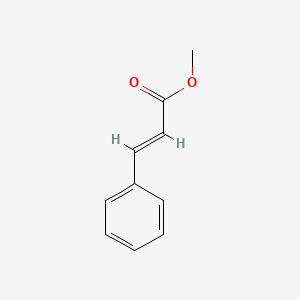
Methyl Cinnamate
Methyl cinnamate is a methyl ester resulting from the formal condensation of methyl cinnamic acid with methanol. It is found naturally in the essential oils of Alpinia and Basil leaf oil, and widely used in the flavor and perfume industries. It has a role as an insect attractant, a volatile oil component, a flavouring agent, a fragrance and an anti-inflammatory agent. It is an alkyl cinnamate and a methyl ester. — ChEBI
- Nom IUPAC
- methyl (E)-3-phenylprop-2-enoate
- Formule moléculaire
- C10H10O2
- Masse moléculaire
- 162.18 g/mol
- Masse exacte
- 162.068079557 Da
- XLogP3
- 2,6
- Surface polaire topologique
- 26,3 Ų
- Donneurs de liaisons hydrogène
- 0
- Accepteurs de liaisons hydrogène
- 2
- Unités covalentes
- 1
- Stéréocentres définis
- 0
Également connu sous le nom de
16 autres noms signalés
Identifiants de bases de données externes
- ChEBI:CHEBI:194138
- ChEBI:CHEBI:6857
- ChEMBL:CHEMBL55060
- EPA DTXSID:DTXSID5044314
- PubMed:29968805
- PubMed:15464616
- PubMed:7748198
Preuves issues de bases de données scientifiques complémentaires
EMBL-EBI ChEBI
methyl cinnamate
A methyl ester resulting from the formal condensation of methyl cinnamic acid with methanol. It is found naturally in the essential oils of Alpinia and Basil leaf oil, and widely used in the flavor and perfume industries.
- Formule
- C10H10O2
- Masse moyenne
- 162.188 g/mol
- Masse monoisotopique
- 162.06808 Da
- Charge formelle
- 0
- alkyl cinnamate — is a (CHEBI:17958)
- methyl ester — is a (CHEBI:25248)
- fragrance — has role (CHEBI:48318)
- volatile oil component — has role (CHEBI:27311)
- anti-inflammatory agent — has role (CHEBI:67079)
- flavouring agent — has role (CHEBI:35617)
- insect attractant — has role (CHEBI:24850)
- fragrance — has role (CHEBI:48318)
- volatile oil component — has role (CHEBI:27311)
- anti-inflammatory agent — has role (CHEBI:67079)
- flavouring agent — has role (CHEBI:35617)
- insect attractant — has role (CHEBI:24850)
- alkyl cinnamate — is a (CHEBI:17958)
- methyl ester — is a (CHEBI:25248)
- 18037211 Source: PubMed
- 18066606 Source: PubMed
- 22273148 Source: PubMed
- 24405047 Source: PubMed
- 25046838 Source: PubMed
- 25815070 Source: PubMed
- 28152405 Source: PubMed
- 28764029 Source: PubMed
- 29802834 Source: PubMed
- 34052086 Source: PubMed
- 35709502 Source: PubMed
- 7381745 Source: PubMed
- 841581 Source: PubMed
- IND20380578 Source: Agricola
- IND605813183 Source: Agricola
- IND606825425 Source: Agricola
Noms supplémentaires validés
Références croisées de cette source
- CAS: 103-26-4 — ChemIDplus
- CAS: 103-26-4 — NIST Chemistry WebBook
- REGISTRY_NUMBER: 386468 — Reaxys
- MANUAL_X_REF: C00053486 — KNApSAcK
- MANUAL_X_REF: C06358 — KEGG COMPOUND
- MANUAL_X_REF: FDB012001 — FooDB
- MANUAL_X_REF: HMDB0033833 — HMDB
- MANUAL_X_REF: Methyl_cinnamate — Wikipedia
Mis en correspondance par: Exact CAS cross-reference in the ChEBI compound record. Source mise à jour le: 2022-11-29. Récupéré le: 2026-08-31. Ouvrir la fiche source
NIH PubChem PUG-View
Attributed physical-property, hazard, environmental and use annotations.
- Boiling Point: 262-263 °C Source: Joint FAO/WHO Expert Committee on Food Additives (JECFA)
- Physical Description: Liquid Source: EPA Chemical Data Reporting (CDR)
- Physical Description: Solid with a fruity, balsamic odor like strawberries; mp = 36 deg C; [Merck Index] Light yellow crystals; mp = 36-38 deg C; [Sigma-Aldrich MSDS] Source: Haz-Map, Information on Hazardous Chemicals and Occupational Diseases
- Physical Description: Colourless crystalline mass, fruity balsamic odour Source: Joint FAO/WHO Expert Committee on Food Additives (JECFA)
- Solubility: insoluble in water; soluble in oils Source: Joint FAO/WHO Expert Committee on Food Additives (JECFA)
- Solubility: moderately soluble (in ethanol) Source: Joint FAO/WHO Expert Committee on Food Additives (JECFA)
- Vapor Pressure: 0.04 [mmHg] Source: Haz-Map, Information on Hazardous Chemicals and Occupational Diseases
- Note: This chemical does not meet GHS hazard criteria for 17.1% (298 of 1745) of reports. Source: European Chemicals Agency (ECHA)
- Signal: Warning Source: European Chemicals Agency (ECHA)
- GHS Hazard Statements: H317 (82.9%): May cause an allergic skin reaction [Warning Sensitization, Skin] Source: European Chemicals Agency (ECHA)
- Precautionary Statement Codes: P261, P272, P280, P302+P352, P321, P333+P317, P362+P364, and P501 (click each P-code to see the statement) Source: European Chemicals Agency (ECHA)
- ECHA C&L Notifications Summary: Aggregated GHS information provided per 1745 reports by companies from 6 notifications to the ECHA C&L Inventory.; Reported as not meeting GHS hazard criteria per 298 of 1745 reports by companies.; There are 4 notifications provided by 1447 of 1745 reports by companies with hazard statement code(s).; Information may vary between notifications depending on impurities, additives, and other factors. The percentage value in parenthesis indicates the notified classification ratio from companies that provide hazard codes. Only hazard codes with percentage values above 10% are shown. For more detailed information, please visit ECHA C&L website. Source: European Chemicals Agency (ECHA)
- GHS Hazard Statements: H317 (91.7%): May cause an allergic skin reaction [Warning Sensitization, Skin] Source: European Chemicals Agency (ECHA)
- ECHA C&L Notifications Summary: Aggregated GHS information provided per 12 reports by companies from 2 notifications to the ECHA C&L Inventory.; Information may vary between notifications depending on impurities, additives, and other factors. The percentage value in parenthesis indicates the notified classification ratio from companies that provide hazard codes. Only hazard codes with percentage values above 10% are shown. For more detailed information, please visit ECHA C&L website. Source: European Chemicals Agency (ECHA)
- Consumer Uses: Fragrance Source: EPA Chemical Data Reporting (CDR)
- Sources/Uses: Permitted for use as an inert ingredient in non-food pesticide products; [EPA] Used as a fragrance and flavoring agent; [Merck Index] Source: Haz-Map, Information on Hazardous Chemicals and Occupational Diseases
Mis en correspondance par: Existing checksum-valid CAS to unique PubChem CID match. Récupéré le: 2026-08-31. Ouvrir la fiche source
Les classifications scientifiques et les annotations de danger apportent du contexte et ne remplacent pas la décision réglementaire propre au marché indiquée ci-dessus.
Couverture des sources complémentaires et état des correspondances
| Source | Résultat | Vérifié |
|---|---|---|
| EMBL-EBI ChEBI | Correspondance exacte | 2026-08-31 |
| NIH PubChem PUG-View | Correspondance exacte | 2026-08-31 |
Une absence de correspondance enregistrée est une preuve utile que la source a été vérifiée ; ce n’est pas l’affirmation que la substance n’existe pas ailleurs.
Récupéré depuis NIH PubChem le 2026-08-31 par correspondance CAS à somme de contrôle valide. Les propriétés chimiques ne remplacent pas la décision réglementaire de cette page.