
CAS
1 fiche
CAS 10124-43-3
Le CAS 10124-43-3 correspond à 1 fiche d’annexe de l’UE dans les annexes II à VI du règlement (CE) n° 1223/2009.
Fiches pour le CAS 10124-43-3
1 au totalIdentité et propriétés chimiques
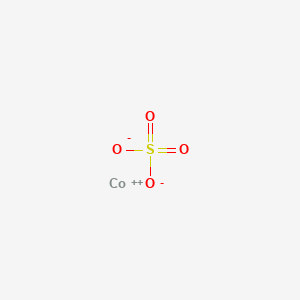
CAS 10124-43-3PubChem CID 24965
Cobalt Sulfate
Cobalt(2+) sulfate is a compound of cobalt and sulfate in which the ratio of cobalt (+2 oxidation state) to sulfate is 1:1. It contains a cobalt(2+). — ChEBI
- Nom IUPAC
- cobalt(2+) sulfate
- Formule moléculaire
- CoO4S
- Masse moléculaire
- 155.00 g/mol
- Masse exacte
- 154.884923 Da
- Surface polaire topologique
- 88,6 Ų
- Donneurs de liaisons hydrogène
- 0
- Accepteurs de liaisons hydrogène
- 4
- Unités covalentes
- 2
- Stéréocentres définis
- 0
Également connu sous le nom de
Cobaltous sulfateCobalt(II) sulfateCobalt BrownCobalt monosulfateCobalt(II) sulphateCobalt (2+) sulfateCobalt sulfate (1:1)Cobalt(II) sulfate (1:1)
16 autres noms signalés
Cobalt sulfate (CoSO4)Sulfuric acid, cobalt(2+) salt (1:1)Cobaltous sulfate salt (1:1)CoSO4H7965X29HXCOBALTOUS SULPHATECOBALT(2+) SULPHATECHEBI:53470COBALT SULPHATE (1:1)RefChem:127219Cobalt sulfate, 7-hydratelambda2-cobalt(2+) ion sulfateSulfuric Acid, Cobalt (2+) Salt (1:1) Heptahydrate233-334-2Cobalt sulphatecobalt(2+);sulfate
Identifiants de bases de données externes
- ChEBI:CHEBI:53470
- EPA DTXSID:DTXSID1031042
Preuves issues de bases de données scientifiques complémentaires
EMBL-EBI ChEBI
Correspondance exacte d’identifiantCHEBI:53470
cobalt(2+) sulfate
A compound of cobalt and sulfate in which the ratio of cobalt (+2 oxidation state) to sulfate is 1:1.
- Formule
- Co.O4S
- Masse moyenne
- 154.996 g/mol
- Masse monoisotopique
- 154.88492 Da
- Charge formelle
- 0
- metal sulfate — is a (CHEBI:51336)
- cobalt(2+) — has part (CHEBI:48828)
- metal sulfate — is a (CHEBI:51336)
- 2415590 Source: PubMed
Noms supplémentaires validés
cobalt(2+) sulfateCobalt (2+) sulfateCobalt BrownCobalt(II) sulfateCobalt monosulfateCobaltous sulfateCobalt sulfateCoSO4
Références croisées de cette source
- CAS: 10026-24-1 — KEGG COMPOUND
- CAS: 10124-43-3 — KEGG COMPOUND
- CAS: 10124-43-3 — ChemIDplus
- CAS: 10124-43-3 — NIST Chemistry WebBook
- REGISTRY_NUMBER: 268815 — Gmelin
- REGISTRY_NUMBER: 270126 — Gmelin
- REGISTRY_NUMBER: 270959 — Gmelin
- REGISTRY_NUMBER: 8292 — Gmelin
- MANUAL_X_REF: C17383 — KEGG COMPOUND
- MANUAL_X_REF: C19215 — KEGG COMPOUND
Mis en correspondance par: Exact CAS cross-reference in the ChEBI compound record. Source mise à jour le: 2016-02-17. Récupéré le: 2026-08-31. Ouvrir la fiche source
NIH PubChem PUG-View
Correspondance exacte d’identifiant24965
Attributed physical-property, hazard, environmental and use annotations.
- Color/Form: Red to lavender dimorphic, othorhombic crystals Source: Hazardous Substances Data Bank (HSDB)
- Color/Form: Red orthorhombic crystals Source: Hazardous Substances Data Bank (HSDB)
- Color/Form: Red powder Source: Hazardous Substances Data Bank (HSDB)
- Color/Form: Rose-pink solid Source: Hazardous Substances Data Bank (HSDB)
- Density: 1.948 at 68 °F (USCG, 1999) - Denser than water; will sink Source: CAMEO Chemicals
- Density: 3.71 at 25 °C/4 °C Source: Hazardous Substances Data Bank (HSDB)
- Density: Light red crystalline solid; loses waters of crystallization when heated above 42 °C, producing the monohydrate at 100 °C and anhydrous salt above 250 °C; density: 2.01 kg/L at 25 °C /Cobalt(II) sulfate hexahydrate/ Source: Hazardous Substances Data Bank (HSDB)
- Density: Density: 1.948 g/cu cm; loses heptahydrate at 420 °C /Cobalt(II) sulfate heptahydrate/ Source: Hazardous Substances Data Bank (HSDB)
- Density: 3.71 g/cm³ Source: ILO-WHO International Chemical Safety Cards (ICSCs)
- Density: 3.71 @25 °C Source: PAC Chemical Database, U.S. Department of Energy
- Melting Point: 735 °C Source: Hazardous Substances Data Bank (HSDB)
- Melting Point: 735 °C Source: PAC Chemical Database, U.S. Department of Energy
- Odor: Odorless Source: Hazardous Substances Data Bank (HSDB)
- Physical Description: Cobalt sulfate is an odorless rose-pink solid. Sinks and mixes with water. (USCG, 1999) Source: CAMEO Chemicals
- Physical Description: Dry Powder; Large Crystals; Large Crystals; Liquid; Dry Powder; Large Crystals Source: EPA Chemical Data Reporting (CDR)
- Physical Description: Red to lavender solid; [Merck Index] Blue odorless powder; Soluble in water (362 g/L at 20 deg C); [MSDSonline] Source: Haz-Map, Information on Hazardous Chemicals and Occupational Diseases
- Physical Description: LAVENDER-TO-DARK-BLUE CRYSTALS. Source: ILO-WHO International Chemical Safety Cards (ICSCs)
- Solubility: Odorless; heat of solution: 23 BTU/lb= 13 cal/g= 0.54X10+5 J/kg; solubility: 35.040 lb/100 lb water at 70 °F /Cobaltous sulfate heptahydrate/ Source: Hazardous Substances Data Bank (HSDB)
- Solubility: In water, 330 g/L at 20 °C Source: Hazardous Substances Data Bank (HSDB)
- Solubility: 38.3 g/100 g water at 25 °C Source: Hazardous Substances Data Bank (HSDB)
- Solubility: Dissolves slowly in boiling water Source: Hazardous Substances Data Bank (HSDB)
- Solubility: 84 g/100 mL water at 100 °C Source: Hazardous Substances Data Bank (HSDB)
- Solubility: For more Solubility (Complete) data for Cobaltous sulfate (6 total), please visit the HSDB record page. Source: Hazardous Substances Data Bank (HSDB)
- Solubility: Solubility in water, g/100ml at 20 °C: 36.2 (good) Source: ILO-WHO International Chemical Safety Cards (ICSCs)
- pH: Acidic salts, such as cobalt sulfate ... resulting aqueous solutions contain moderate concentrations of hydrogen ions and have pH's of less than 7.0. They react as acids to neutralize bases. Source: Hazardous Substances Data Bank (HSDB)
- Carcinogen Classification: 2B, possibly carcinogenic to humans. (L135) Source: Toxin and Toxin Target Database (T3DB)
- Exposure Routes: The substance can be absorbed into the body by inhalation and by ingestion. Source: ILO-WHO International Chemical Safety Cards (ICSCs)
- Exposure Routes: Inhalation (L29) ; oral (L29) ; dermal (L29) Source: Toxin and Toxin Target Database (T3DB)
- First Aid: INHALATION: move to fresh air; if breathing has stopped, begin artificial respiration and call a doctor.; INGESTION: give large amount of water; induce vomiting; call a doctor.; EYES: flush with water for at least 15 min.; consult a physician if irritation persists.; SKIN: flush with water. (USCG, 1999) Source: CAMEO Chemicals
- Signal: Danger Source: Regulation (EC) No 1272/2008 of the European Parliament and of the Council
- GHS Hazard Statements: H302: Harmful if swallowed [Warning Acute toxicity, oral]; H317: May cause an allergic skin reaction [Warning Sensitization, Skin]; H334: May cause allergy or asthma symptoms or breathing difficulties if inhaled [Danger Sensitization, respiratory]; H341: Suspected of causing genetic defects [Warning Germ cell mutagenicity]; H350i: May cause cancer by inhalation [Danger Carcinogenicity]; H360F ***: May damage fertility [Danger Reproductive toxicity]; H400: Very toxic to aquatic life [Warning Hazardous to the aquatic environment, acute hazard]; H410: Very toxic to aquatic life with long lasting effects [Warning Hazardous to the aquatic environment, long-term hazard] Source: Regulation (EC) No 1272/2008 of the European Parliament and of the Council
- Precautionary Statement Codes: P203, P233, P260, P261, P264, P270, P271, P272, P273, P280, P284, P301+P317, P302+P352, P304+P340, P318, P321, P330, P333+P317, P342+P316, P362+P364, P391, P403, P405, and P501 (click each P-code to see the statement) Source: Regulation (EC) No 1272/2008 of the European Parliament and of the Council
- Signal: Danger Source: European Chemicals Agency (ECHA)
- GHS Hazard Statements: H302 (99.8%): Harmful if swallowed [Warning Acute toxicity, oral]; H317 (100%): May cause an allergic skin reaction [Warning Sensitization, Skin]; H319 (15.9%): Causes serious eye irritation [Warning Serious eye damage/eye irritation]; H334 (> 99.9%): May cause allergy or asthma symptoms or breathing difficulties if inhaled [Danger Sensitization, respiratory]; H341 (99.8%): Suspected of causing genetic defects [Warning Germ cell mutagenicity]; H350 (85.6%): May cause cancer [Danger Carcinogenicity]; H350i (14.4%): May cause cancer by inhalation [Danger Carcinogenicity]; H360 (84.1%): May damage fertility or the unborn child [Danger Reproductive toxicity]; H360F (10.5%): May damage fertility [Danger Reproductive toxicity]; H400 (99.9%): Very toxic to aquatic life [Warning Hazardous to the aquatic environment, acute hazard]; H410 (97.3%): Very toxic to aquatic life with long lasting effects [Warning Hazardous to the aquatic environment, long-term hazard] Source: European Chemicals Agency (ECHA)
- Precautionary Statement Codes: P203, P233, P260, P261, P264, P264+P265, P270, P271, P272, P273, P280, P284, P301+P317, P302+P352, P304+P340, P305+P351+P338, P318, P321, P330, P333+P317, P337+P317, P342+P316, P362+P364, P391, P403, P405, and P501 (click each P-code to see the statement) Source: European Chemicals Agency (ECHA)
- ECHA C&L Notifications Summary: Aggregated GHS information provided per 2654 reports by companies from 34 notifications to the ECHA C&L Inventory. Each notification may be associated with multiple companies.; Information may vary between notifications depending on impurities, additives, and other factors. The percentage value in parenthesis indicates the notified classification ratio from companies that provide hazard codes. Only hazard codes with percentage values above 10% are shown. For more detailed information, please visit ECHA C&L website. Source: European Chemicals Agency (ECHA)
- Signal: Danger Source: NITE-CMC
- GHS Hazard Statements: H350: May cause cancer [Danger Carcinogenicity] Source: NITE-CMC
- Precautionary Statement Codes: P203, P280, P318, P405, and P501 (click each P-code to see the statement) Source: NITE-CMC
- Signal: Warning Source: NITE-CMC
- GHS Hazard Statements: H341: Suspected of causing genetic defects [Warning Germ cell mutagenicity] Source: NITE-CMC
- Health Effects: Exposure to high amount of cobalt can cause heart, lung, kidney, and liver damage. Skin contact is known to result in contact dermatitis. Cobalt may also have mutagenic and carcinogenic effects. (L29, L30) Source: Toxin and Toxin Target Database (T3DB)
- Toxicity Summary: IDENTIFICATION: Cobalt sulfate is a red powder. It is used in storage batteries; in cobalt-electroplating baths; as drier for lithographic inks, and varnishes; in ceramics, enamels, and glazes to prevent discoloring; in cobalt pigments for decorating porcelain. HUMAN EXPOSURE AND TOXICITY: Cardiomyopathy has been observed in individuals who consume large quantities of beer where cobalt sulfate was added as a foam stabilizer. Repeated or prolonged contact may cause skin sensitization. Repeated or prolonged inhalation exposure may cause asthma. The substance may have effects on the heart, thyroid and bone marrow, resulting in cardiomyopathy, goiter and polycythemia. ANIMAL STUDIES: Rats and mice exposed short term to cobalt sulfate by inhalation exhibited necrosis and inflammation of the respiratory tract epithelium. Rats developed thymus necrosis and testicular atrophy. Rats exposed for 2-3 months to cobalt sulfate in the diet for 24 weeks had significant reductions in heart enzyme activity levels. Rats and mice were exposed to cobalt sulfate heptahydrate by inhalation 6 hr/day, 5 days/week for 13 weeks developed adverse effects throughout the respiratory system. At higher concentra Source: Hazardous Substances Data Bank (HSDB)
- Toxicity Summary: Cobalt is believed to exhibit its toxicity through a oxidant-based and free radical-based processes. It produces oxygen radicals and may be oxidized to ionic cobalt, causing increased lipid peroxidation, DNA damage, and inducing certain enzymes that lead to cell apoptosis. Cobalt has also been shown to block inorganic calcium channels, possibly impairing neurotransmission. Cobalt can also chelate lipoic acids, impairing oxidation of pyruvate or fatty acids. In addition, cobalt may inhibit DNA repair by interacting with zinc finger DNA repair proteins, and has also been shown to inhibit heme synthesis and glucose metabolism. Cobalt may activate specific helper T-lymphocyte cells and interact directly with immunologic proteins, such as antibodies (IgA and IgE) or Fc receptors, resulting in immunosensitization. (L29) Source: Toxin and Toxin Target Database (T3DB)
- Environmental Bioconcentration: Food Chain Concentration Potential of Cobaltous Sulfate (heptahydrate): Bioconcentration of 200-1000 fold only under constant exposure. Not significant in spill conditions(1). Source: Hazardous Substances Data Bank (HSDB)
- Environmental Fate: ATMOSPHERIC FATE: Inorganic cobalt compounds are nonvolatile and released into the atmosphere in particulate form(1). Particulate-phase cobalt compounds are removed from the air by wet and dry deposition(SRC). Cobalt has been detected in atmospheric deposition(2) and in rain-snow precipitation(3). Source: Hazardous Substances Data Bank (HSDB)
- Consumer Uses: Laboratory chemicals; Processing aids not otherwise specified Source: EPA Chemical Data Reporting (CDR)
- Industry Uses: Processing aids not otherwise specified; Plating agent; Intermediate; Pigment; Catalyst; Soil amendments (fertilizers) Source: EPA Chemical Data Reporting (CDR)
- Sources/Uses: Used as a pigment (ceramics, glazes, and enamels), catalyst, paint and ink drier, and soil additive; Also used in electroplating, storage batteries, and veterinary medicine (prevent and treat of cobalt-deficiency in ruminants; [HSDB] Source: Haz-Map, Information on Hazardous Chemicals and Occupational Diseases
- Industrial Processes with risk of exposure: Electroplating [Category: Plate]; Battery Manufacturing [Category: Industry]; Painting (Pigments, Binders, and Biocides) [Category: Paint] Source: Haz-Map, Information on Hazardous Chemicals and Occupational Diseases
- Activities with risk of exposure: Ceramics making [Category: Hobbies]; Enameling [Category: Hobbies] Source: Haz-Map, Information on Hazardous Chemicals and Occupational Diseases
- Uses: Usual source of water-soluble cobalt since it is the most economical and it shows less tendency to deliquesc or dehydrate than the chloride or nitrate. Used in storage batteries; in cobalt-electroplating baths; as drier for lithographic inks, varnishes; in ceramics, enamels, glazes to prevent discoloring; in cobalt pigments for decorating porcelain. Source: Hazardous Substances Data Bank (HSDB)
- Uses: Additive to soils, catalyst. Source: Hazardous Substances Data Bank (HSDB)
- Uses: ... used in feed supplements. Source: Hazardous Substances Data Bank (HSDB)
- Uses: Added to nickel plating baths to improve smoothness, brightness, hardness, and ductility of deposits. Source: Hazardous Substances Data Bank (HSDB)
- Uses: Cobalt(II) sulfate is used in pigments for glass and porcelain, as well as in storage batteries and electroplating baths, sympathetic inks, and as an additive to soils and animal feeds. (L36) Source: Toxin and Toxin Target Database (T3DB)
Mis en correspondance par: Existing checksum-valid CAS to unique PubChem CID match. Récupéré le: 2026-08-31. Ouvrir la fiche source
Les classifications scientifiques et les annotations de danger apportent du contexte et ne remplacent pas la décision réglementaire propre au marché indiquée ci-dessus.
Couverture des sources complémentaires et état des correspondances
| Source | Résultat | Vérifié |
|---|---|---|
| EMBL-EBI ChEBI | Correspondance exacte | 2026-08-31 |
| NIH PubChem PUG-View | Correspondance exacte | 2026-08-31 |
Une absence de correspondance enregistrée est une preuve utile que la source a été vérifiée ; ce n’est pas l’affirmation que la substance n’existe pas ailleurs.
Récupéré depuis NIH PubChem le 2026-09-02 par correspondance CAS à somme de contrôle valide. Les propriétés chimiques ne remplacent pas la décision réglementaire de cette page.
Comment le CAS 10124-43-3 est utilisé sur ce site
Le CAS 10124-43-3 est l’identifiant du Chemical Abstracts Service utilisé pour rattacher cette page à une substance précise. Dans le jeu de données actuel, 1 fiche d’annexe de l’UE partage cet identifiant, ce qui vous aide à vérifier si la même substance apparaît dans un seul contexte réglementaire ou dans plusieurs.
Utilisez cette page lorsqu’une spécification fournisseur, une FDS ou un dossier de matière première vous donne le CAS 10124-43-3 et que vous devez voir au même endroit toutes les fiches liées des annexes II à VI. Les cartes d’entrées ci-dessus sont le moyen le plus rapide d’accéder aux limites de concentration, aux avertissements, à l’annexe concernée et aux conditions par type de produit.
Questions fréquentes
Une substance identifiée par le CAS 10124-43-3 peut figurer dans plusieurs annexes du règlement de l’UE sur les cosmétiques lorsqu’elle est soumise à des conditions différentes selon les contextes. Par exemple, une substance peut être soumise à restrictions à l’annexe III avec des conditions précises, et le même CAS peut aussi figurer à l’annexe IV comme colorant autorisé, dans une entrée distincte avec ses propres conditions. Chaque entrée doit être examinée individuellement.
Recoupez le numéro CAS avec les fiches de spécification de vos matières premières et vos certificats d’analyse. Lorsqu’un CAS figure à l’annexe II, vérifiez son absence. Lorsqu’il figure à l’annexe III, vérifiez que les limites de concentration et les conditions de type de produit sont respectées dans votre formulation. Toutes les entrées d’annexe partageant ce numéro CAS sont énumérées ci-dessus.
Un numéro CAS est attribué par le Chemical Abstracts Service (États-Unis) et reconnu dans le monde entier. Un numéro CE est un identifiant de la Commission européenne issu d’inventaires tels que l’EINECS, l’ELINCS ou la liste NLP. Les deux identifiants peuvent figurer dans les entrées des annexes cosmétiques de l’UE. Certaines substances ont les deux, d’autres un seul, et certaines entrées plus anciennes peuvent n’en avoir aucun.
Le vérificateur INCI accepte les noms d’ingrédients, les numéros CAS et les numéros CE. Vérifiez directement ce numéro CAS, puis contrôlez le résultat auprès des fiches de spécification des fournisseurs et de toutes les conditions d’annexe associées.
Outils et étapes suivantes
Vérifiez votre formule
Analysez une liste INCI complète, puis utilisez le CAS 10124-43-3 pour recouper les documents fournisseurs relatifs aux substances identifiées.
Vérificateur INCIParcourir les annexes
Parcourez toutes les annexes du règlement de l’UE sur les cosmétiques par catégorie.
Toutes les annexesRechercher par nom
Recherchez les noms INCI, alias ou identifiants associés qui figurent à côté du CAS 10124-43-3 dans votre documentation.
Rechercher