
CAS
1 fiche
CAS 101-61-1
Le CAS 101-61-1 correspond à 1 fiche d’annexe de l’UE dans les annexes II à VI du règlement (CE) n° 1223/2009.
Fiches pour le CAS 101-61-1
1 au totalIdentité et propriétés chimiques
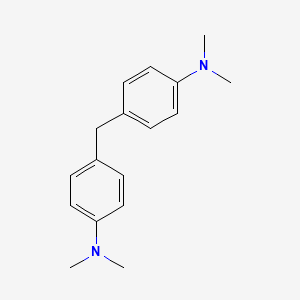
CAS 101-61-1PubChem CID 7567
Bis(p-(dimethylamino)phenyl)methane
4,4'-Methylenebis(N,N-dimethylaniline) is a diarylmethane. — ChEBI
- Nom IUPAC
- 4-[[4-(dimethylamino)phenyl]methyl]-N,N-dimethylaniline
- Formule moléculaire
- C17H22N2
- Masse moléculaire
- 254.37 g/mol
- Masse exacte
- 254.178298710 Da
- XLogP3
- 3,9
- Surface polaire topologique
- 6,5 Ų
- Donneurs de liaisons hydrogène
- 0
- Accepteurs de liaisons hydrogène
- 2
- Unités covalentes
- 1
- Stéréocentres définis
- 0
Également connu sous le nom de
4,4'-Methylenebis(N,N-dimethylaniline)Michler's baseMethane baseBis[4-(dimethylamino)phenyl]methaneMichler's hydrideMethylene baseMichler's methaneReduced michler'S ketone
16 autres noms signalés
4,4'-Bis(dimethylamino)diphenylmethaneArnold's baseTetramethyldiaminodiphenylmethaneBis(4-(N,N-dimethylamino)phenyl)methane4,4'-TetramethyldiaminodiphenylmethaneBaze michlerova4,4'-Methylenebis(N,N-dimethyl)benzenamine4,4'-(Dimethylamino)diphenylmethanep,p-Dimethylaminodiphenylmethanep,p'-Bis(dimethylamino)diphenylmethaneNCI-C01990Diphenylmethane, tetramethyldiamino-p,p-TetramethyldiaminodiphenylmethaneN,N'-Tetramethyldiaminodiphenylmethane4,4'-Methylenebis(N,N-dimethylbenzenamine)BAZE michlerova [Czech]
Identifiants de bases de données externes
- ChEBI:CHEBI:34370
- ChEMBL:CHEMBL1613260
- EPA DTXSID:DTXSID5020869
- PubMed:21860479
- PubMed:21089904
- PubMed:20797896
- PubMed:20709357
- PubMed:17550616
- PubMed:17266228
- PubMed:16909869
- PubMed:16834197
- PubMed:16497524
- PubMed:15710170
- PubMed:15326672
- PubMed:12919023
Preuves issues de bases de données scientifiques complémentaires
EMBL-EBI ChEBI
Correspondance exacte d’identifiantCHEBI:34370
4,4'-Methylenebis(N,N-dimethylaniline)
- Formule
- C17H22N2
- Masse moyenne
- 254.377 g/mol
- Masse monoisotopique
- 254.17830 Da
- Charge formelle
- 0
- diarylmethane — is a (CHEBI:51614)
- diarylmethane — is a (CHEBI:51614)
Noms supplémentaires validés
4,4'-Methylenebis(N,N-dimethylaniline)Michler's base
Références croisées de cette source
- CAS: 101-61-1 — KEGG COMPOUND
- MANUAL_X_REF: C14135 — KEGG COMPOUND
Mis en correspondance par: Exact CAS cross-reference in the ChEBI compound record. Source mise à jour le: 2014-07-28. Récupéré le: 2026-08-31. Ouvrir la fiche source
NIH PubChem PUG-View
Correspondance exacte d’identifiant7567
Attributed physical-property, hazard, environmental and use annotations.
- Boiling Point: 734 °F at 760 mmHg (NTP, 1992) Source: CAMEO Chemicals
- Boiling Point: 390 °C decomposes Source: Hazardous Substances Data Bank (HSDB)
- Boiling Point: BP: 155-157 °C at 0.1 mm Hg Source: Hazardous Substances Data Bank (HSDB)
- Boiling Point: BP: 183 °C at 3 mm Hg Source: Hazardous Substances Data Bank (HSDB)
- Color/Form: Lustrous leaflets Source: Hazardous Substances Data Bank (HSDB)
- Color/Form: Yellowish leaflets or glistening plates Source: Hazardous Substances Data Bank (HSDB)
- Color/Form: Platelets or tablets from alcohol, ligand Source: Hazardous Substances Data Bank (HSDB)
- Density: 1.14 at 68 °F (NTP, 1992) - Denser than water; will sink Source: CAMEO Chemicals
- Flash Point: 412 °F (NTP, 1992) Source: CAMEO Chemicals
- Flash Point: 211 °C Source: Haz-Map, Information on Hazardous Chemicals and Occupational Diseases
- Melting Point: 194 to 196 °F (NTP, 1992) Source: CAMEO Chemicals
- Melting Point: 91.5 °C Source: Hazardous Substances Data Bank (HSDB)
- Physical Description: Yellowish glistening leaflets or plates or tan crystals. Weak odor. Sublimes without decomposition. (NTP, 1992) Source: CAMEO Chemicals
- Physical Description: Yellowish solid; [Hawley] Crystalline powder; [MSDSonline] Source: Haz-Map, Information on Hazardous Chemicals and Occupational Diseases
- Solubility: less than 1 mg/mL at 72 °F (NTP, 1992) Source: CAMEO Chemicals
- Solubility: Insoluble in water Source: Hazardous Substances Data Bank (HSDB)
- Solubility: Soluble in benzene, ether, carbon disulfide, acids; slightly soluble in cold alcohol, more soluble in hot alcohol Source: Hazardous Substances Data Bank (HSDB)
- Solubility: Slightly soluble in ethanol; soluble in acid; very soluble in ether, benzene, carbon disulfide Source: Hazardous Substances Data Bank (HSDB)
- Vapor Pressure: less than 0.000075 mmHg at 68 °F (NTP, 1992) Source: CAMEO Chemicals
- Vapor Pressure: 0.0000175 [mmHg] Source: Haz-Map, Information on Hazardous Chemicals and Occupational Diseases
- IARC Carcinogenic Agent: Michler’s base [4,4´-methylenebis(N,N-dimethyl)benzenamine] Source: International Agency for Research on Cancer (IARC)
- IARC Carcinogenic Classes: Group 2B: Possibly carcinogenic to humans Source: International Agency for Research on Cancer (IARC)
- IARC Monographs: Volume 27: (1982) Some Aromatic Amines, Anthraquinones and Nitroso Compounds, and Inorganic Fluorides Used in Drinking-water and Dental Preparations; Volume Sup 7: Overall Evaluations of Carcinogenicity: An Updating of IARC Monographs Volumes 1 to 42, 1987; 440 pages; ISBN 92-832-1411-0 (out of print); Volume 99: (2010) Some Aromatic Amines, Organic Dyes, and Related Exposures Source: International Agency for Research on Cancer (IARC)
- Publication Year: 2010 Source: International Agency for Research on Cancer (IARC)
- Evaluation Year: 2008 Source: International Agency for Research on Cancer (IARC)
- Substance: 4,4'-Methylenebis (n,n-dimethyl) benzenamine Source: NTP Technical Reports
- NTP Technical Report: TR-186: Bioassay of 4,4'-Methylenebis-(N,N-dimethyl)benzeneamine for Possible Carcinogenicity (CASRN 101-61-1) (1979 ) Source: NTP Technical Reports
- Peer Review Date: 10/25/78 Source: NTP Technical Reports
- Conclusion for Male Rat: Clear Evidence Source: NTP Technical Reports
- Conclusion for Female Rat: Clear Evidence Source: NTP Technical Reports
- Conclusion for Male Mice: Equivocal Evidence Source: NTP Technical Reports
- Conclusion for Female Mice: Clear Evidence Source: NTP Technical Reports
- First Aid: EYES: First check the victim for contact lenses and remove if present. Flush victim's eyes with water or normal saline solution for 20 to 30 minutes while simultaneously calling a hospital or poison control center. Do not put any ointments, oils, or medication in the victim's eyes without specific instructions from a physician. IMMEDIATELY transport the victim after flushing eyes to a hospital even if no symptoms (such as redness or irritation) develop.; SKIN: IMMEDIATELY flood affected skin with water while removing and isolating all contaminated clothing. Gently wash all affected skin areas thoroughly with soap and water. IMMEDIATELY call a hospital or poison control center even if no symptoms (such as redness or irritation) develop. IMMEDIATELY transport the victim to a hospital for treatment after washing the affected areas.; INHALATION: IMMEDIATELY leave the contaminated area; take deep breaths of fresh air. IMMEDIATELY call a physician and be prepared to transport the victim to a hospital even if no symptoms (such as wheezing, coughing, shortness of breath, or burning in the mouth, throat, or chest) develop. Provide proper respiratory protection to rescuers entering an unknow Source: CAMEO Chemicals
- Signal: Danger Source: European Chemicals Agency (ECHA)
- GHS Hazard Statements: H350 (100%): May cause cancer [Danger Carcinogenicity]; H400 (100%): Very toxic to aquatic life [Warning Hazardous to the aquatic environment, acute hazard]; H410 (100%): Very toxic to aquatic life with long lasting effects [Warning Hazardous to the aquatic environment, long-term hazard] Source: European Chemicals Agency (ECHA)
- Precautionary Statement Codes: P203, P273, P280, P318, P391, P405, and P501 (click each P-code to see the statement) Source: European Chemicals Agency (ECHA)
- ECHA C&L Notifications Summary: Aggregated GHS information provided per 46 reports by companies from 3 notifications to the ECHA C&L Inventory. Each notification may be associated with multiple companies.; Information may vary between notifications depending on impurities, additives, and other factors. The percentage value in parenthesis indicates the notified classification ratio from companies that provide hazard codes. Only hazard codes with percentage values above 10% are shown. For more detailed information, please visit ECHA C&L website. Source: European Chemicals Agency (ECHA)
- Signal: Danger Source: NITE-CMC
- GHS Hazard Statements: H350: May cause cancer [Danger Carcinogenicity]; H373: May causes damage to organs through prolonged or repeated exposure [Warning Specific target organ toxicity, repeated exposure] Source: NITE-CMC
- Precautionary Statement Codes: P203, P260, P280, P318, P319, P405, and P501 (click each P-code to see the statement) Source: NITE-CMC
- Signal: Warning Source: NITE-CMC
- GHS Hazard Statements: H303: May be harmful if swallowed [Warning Acute toxicity, oral]; H351: Suspected of causing cancer [Warning Carcinogenicity] Source: NITE-CMC
- Precautionary Statement Codes: P203, P280, P301+P317, P318, P405, and P501 (click each P-code to see the statement) Source: NITE-CMC
- Environmental Bioconcentration: Bis(p-(dimethylamino)phenyl)methane, present at 0.50 and 0.050 mg/L resulted in BCF of 629 and 423, respectively, in fish using carp (Cyprinus carpio) which were exposed over an 4-week period(1). According to a classification scheme(2), these BCF values suggest that bioconcentration in aquatic organisms is high(SRC). Source: Hazardous Substances Data Bank (HSDB)
- Environmental Fate: TERRESTRIAL FATE: Based on a classification scheme(1), a log Koc of 3.26(2) (Koc of 9,100(SRC)), determined from a structure estimation method(2), indicates that bis(p-(dimethylamino)phenyl)methane is expected to be immobile in soil(SRC). Volatilization of bis(p-(dimethylamino)phenyl)methane from moist soil surfaces is not expected to be an important fate process(SRC) given an estimated Henry's Law constant of 1.2X10⁻⁷ atm-cu m/mole(SRC), using a fragment constant estimation method(3). Bis(p-(dimethylamino)phenyl)methane is not expected to volatilize from dry soil surfaces(SRC) based upon an estimated vapor pressure of 3.3X10⁻⁶ mm Hg at 25 °C(SRC), determined from a fragment constant method(4). A 0% of theoretical BOD using activated sludge in the Japanese MITI test(5) suggests that biodegradation is not an important environmental fate process in soil(SRC). Source: Hazardous Substances Data Bank (HSDB)
- Environmental Fate: AQUATIC FATE: Based on a classification scheme(1), a log Koc of 3.26(2) (Koc of 9,100(SRC)), determined from a structure estimation method(2), indicates that bis(p-(dimethylamino)phenyl)methane is expected to adsorb to suspended solids and sediment(SRC). Volatilization from water surfaces is not expected(3) based upon an estimated Henry's Law constant of 1.2X10⁻⁷ atm-cu m/mole(SRC), developed using a fragment constant estimation method(4). According to a classification scheme(5), BCF values of 423 and 629(8), suggest that bioconcentration in aquatic organisms is high(SRC). A 0% of theoretical BOD using activated sludge in the Japanese MITI test(6) suggests that biodegradation is not an important environmental fate process in water(SRC). Source: Hazardous Substances Data Bank (HSDB)
- Environmental Fate: ATMOSPHERIC FATE: According to a model of gas/particle partitioning of semivolatile organic compounds in the atmosphere(1), bis(p-(dimethylamino)phenyl)methane, which has an estimated vapor pressure of 3.3X10⁻⁶ mm Hg at 25 °C(SRC), determined from a fragment constant method(2), will exist in both the vapor and particulate phases in the ambient atmosphere. Vapor-phase bis(p-(dimethylamino)phenyl)methane is degraded in the atmosphere by reaction with photochemically-produced hydroxyl radicals(SRC); the half-life for this reaction in air is estimated to be 1 hour(SRC), calculated from its rate constant of 2.1X10⁻¹⁰ cu cm/molecule-sec at 25 °C(SRC) that was derived using a structure estimation method(3). Particulate-phase bis(p-dimethylamino)phenyl)methane may be removed from the air by wet or dry deposition(SRC). Bis(p-dimethylamino)phenyl)methane does not contain chromophores that absorb at wavelengths >290 nm(4), and therefore is not expected to be susceptible to direct photolysis by sunlight(SRC). Source: Hazardous Substances Data Bank (HSDB)
- Sources/Uses: Used to manufacture dyes and as a reagent for lead; [Merck Index] Source: Haz-Map, Information on Hazardous Chemicals and Occupational Diseases
- Uses: Has been used in manufacture of dyes. As reagent for lead. Source: Hazardous Substances Data Bank (HSDB)
- Uses: ... Used as an intermediate in the manufacture of at least six dyes and one pigment (including Methylene Red and C.I. Basic Yellow 2, Basic Orange 14, Solvent Orange 15, and Solvent Yellow 34). Its hydrochloride salt is used as an analytical reagent for the determination of lead. Source: Hazardous Substances Data Bank (HSDB)
- Uses: Dye intermediate Source: Hazardous Substances Data Bank (HSDB)
Mis en correspondance par: Existing checksum-valid CAS to unique PubChem CID match. Récupéré le: 2026-08-31. Ouvrir la fiche source
Les classifications scientifiques et les annotations de danger apportent du contexte et ne remplacent pas la décision réglementaire propre au marché indiquée ci-dessus.
Couverture des sources complémentaires et état des correspondances
| Source | Résultat | Vérifié |
|---|---|---|
| EMBL-EBI ChEBI | Correspondance exacte | 2026-08-31 |
| NIH PubChem PUG-View | Correspondance exacte | 2026-08-31 |
Une absence de correspondance enregistrée est une preuve utile que la source a été vérifiée ; ce n’est pas l’affirmation que la substance n’existe pas ailleurs.
Récupéré depuis NIH PubChem le 2026-09-02 par correspondance CAS à somme de contrôle valide. Les propriétés chimiques ne remplacent pas la décision réglementaire de cette page.
Comment le CAS 101-61-1 est utilisé sur ce site
Le CAS 101-61-1 est l’identifiant du Chemical Abstracts Service utilisé pour rattacher cette page à une substance précise. Dans le jeu de données actuel, 1 fiche d’annexe de l’UE partage cet identifiant, ce qui vous aide à vérifier si la même substance apparaît dans un seul contexte réglementaire ou dans plusieurs.
Utilisez cette page lorsqu’une spécification fournisseur, une FDS ou un dossier de matière première vous donne le CAS 101-61-1 et que vous devez voir au même endroit toutes les fiches liées des annexes II à VI. Les cartes d’entrées ci-dessus sont le moyen le plus rapide d’accéder aux limites de concentration, aux avertissements, à l’annexe concernée et aux conditions par type de produit.
Questions fréquentes
Une substance identifiée par le CAS 101-61-1 peut figurer dans plusieurs annexes du règlement de l’UE sur les cosmétiques lorsqu’elle est soumise à des conditions différentes selon les contextes. Par exemple, une substance peut être soumise à restrictions à l’annexe III avec des conditions précises, et le même CAS peut aussi figurer à l’annexe IV comme colorant autorisé, dans une entrée distincte avec ses propres conditions. Chaque entrée doit être examinée individuellement.
Recoupez le numéro CAS avec les fiches de spécification de vos matières premières et vos certificats d’analyse. Lorsqu’un CAS figure à l’annexe II, vérifiez son absence. Lorsqu’il figure à l’annexe III, vérifiez que les limites de concentration et les conditions de type de produit sont respectées dans votre formulation. Toutes les entrées d’annexe partageant ce numéro CAS sont énumérées ci-dessus.
Un numéro CAS est attribué par le Chemical Abstracts Service (États-Unis) et reconnu dans le monde entier. Un numéro CE est un identifiant de la Commission européenne issu d’inventaires tels que l’EINECS, l’ELINCS ou la liste NLP. Les deux identifiants peuvent figurer dans les entrées des annexes cosmétiques de l’UE. Certaines substances ont les deux, d’autres un seul, et certaines entrées plus anciennes peuvent n’en avoir aucun.
Le vérificateur INCI accepte les noms d’ingrédients, les numéros CAS et les numéros CE. Vérifiez directement ce numéro CAS, puis contrôlez le résultat auprès des fiches de spécification des fournisseurs et de toutes les conditions d’annexe associées.
Outils et étapes suivantes
Vérifiez votre formule
Analysez une liste INCI complète, puis utilisez le CAS 101-61-1 pour recouper les documents fournisseurs relatifs aux substances identifiées.
Vérificateur INCIParcourir les annexes
Parcourez toutes les annexes du règlement de l’UE sur les cosmétiques par catégorie.
Toutes les annexesRechercher par nom
Recherchez les noms INCI, alias ou identifiants associés qui figurent à côté du CAS 101-61-1 dans votre documentation.
Rechercher