
alpha-Chlorotoluene (Benzyl chloride)
alpha-Chlorotoluene (Benzyl chloride) figure à l’annexe II en tant que substance interdite dans les produits cosmétiques mis sur le marché de l’UE.
Détails de la fiche
Nom chimique
alpha-Chlorotoluene (Benzyl chloride)
Nom chimique / IUPAC
Benzyl chloride
Informations réglementaires
Avis du SCCS
- Opinion concerning Chemical Ingredients in Cosmetic Products classified as Carcinogenic, Mutagenic or Toxic to Reproduction according to the Chemicals Directive 67/548/EECC
- Opinion concerning Chemical Ingredients in Cosmetic Products classified as Carcinogenic, Mutagenic or Toxic to Reproduction according to the Chemicals Directive 67/548/EEC
CMR
| Catégorie | Carcinogenic | Mutagenic | Reprotoxic |
|---|---|---|---|
| Cat. 1B | ✓ | — | — |
Données clés
Identité et propriétés chimiques
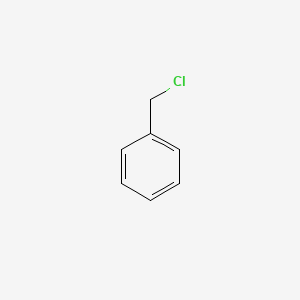
Benzyl Chloride
Benzyl chloride is a member of the class of benzyl chlorides that is toluene substituted on the alpha-carbon with chlorine. — ChEBI
- Nom IUPAC
- chloromethylbenzene
- Formule moléculaire
- C7H7Cl
- Masse moléculaire
- 126.58 g/mol
- Masse exacte
- 126.0236279 Da
- XLogP3
- 2,3
- Surface polaire topologique
- 0,0 Ų
- Donneurs de liaisons hydrogène
- 0
- Accepteurs de liaisons hydrogène
- 0
- Unités covalentes
- 1
- Stéréocentres définis
- 0
Également connu sous le nom de
16 autres noms signalés
Identifiants de bases de données externes
- ChEBI:CHEBI:615597
- ChEMBL:CHEMBL498878
- EPA DTXSID:DTXSID0020153
- PubMed:22606153
- PubMed:22590290
- PubMed:22589987
- PubMed:22546633
- PubMed:22412719
- PubMed:22412651
- PubMed:22390789
- PubMed:22313188
- PubMed:22292034
- PubMed:22259582
- PubMed:22224095
- PubMed:22220017
Preuves issues de bases de données scientifiques complémentaires
EMBL-EBI ChEBI
benzyl chloride
A member of the class of benzyl chlorides that is toluene substituted on the α-carbon with chlorine.
- Formule
- C7H7Cl
- Masse moyenne
- 126.586 g/mol
- Masse monoisotopique
- 126.02363 Da
- Charge formelle
- 0
Noms supplémentaires validés
Références croisées de cette source
- CAS: 100-44-7 — ChemIDplus
- CAS: 100-44-7 — KEGG COMPOUND
- CAS: 100-44-7 — NIST Chemistry WebBook
- MANUAL_X_REF: 1644 — PPDB
- MANUAL_X_REF: Benzyl_chloride — Wikipedia
- MANUAL_X_REF: C19167 — KEGG COMPOUND
- MANUAL_X_REF: HMDB0059882 — HMDB
- REGISTRY_NUMBER: 471308 — Reaxys
Mis en correspondance par: Exact CAS cross-reference in the ChEBI compound record. Source mise à jour le: 2014-07-28. Récupéré le: 2026-08-31. Ouvrir la fiche source
NIH PubChem PUG-View
Attributed physical-property, hazard, environmental and use annotations.
- Autoignition Temperature: 1161 °F (USCG, 1999) Source: CAMEO Chemicals
- Autoignition Temperature: 1085 °F (585 °C) Source: Hazardous Substances Data Bank (HSDB)
- Autoignition Temperature: 585 °C Source: ILO-WHO International Chemical Safety Cards (ICSCs)
- Boiling Point: 354 °F at 760 mmHg (EPA, 1998) Source: CAMEO Chemicals
- Boiling Point: 174 °C Source: Hazardous Substances Data Bank (HSDB)
- Boiling Point: BP: 99 °C at 62 mm Hg Source: Hazardous Substances Data Bank (HSDB)
- Boiling Point: 179 °C Source: ILO-WHO International Chemical Safety Cards (ICSCs)
- Boiling Point: 354 °F Source: Occupational Safety and Health Administration (OSHA)
- Boiling Point: 179 °C @760 [mm Hg] Source: PAC Chemical Database, U.S. Department of Energy
- Boiling Point: 354 °F Source: The National Institute for Occupational Safety and Health (NIOSH)
- Color/Form: Colorless to slightly yellow liquid Source: Hazardous Substances Data Bank (HSDB)
- Density: 1.1 at 68 °F (EPA, 1998) - Denser than water; will sink Source: CAMEO Chemicals
- Density: 1.1004 g/cu cm at 20 °C Source: Hazardous Substances Data Bank (HSDB)
- Density: Relative density (water = 1): 1.1 Source: ILO-WHO International Chemical Safety Cards (ICSCs)
- Density: 1.1 Source: Occupational Safety and Health Administration (OSHA)
- Density: 1.1004 @ 20°C Source: PAC Chemical Database, U.S. Department of Energy
- Density: 1.10 Source: The National Institute for Occupational Safety and Health (NIOSH)
- Flash Point: 153 °F (EPA, 1998) Source: CAMEO Chemicals
- Flash Point: 153 °F Source: Haz-Map, Information on Hazardous Chemicals and Occupational Diseases
- Flash Point: 153 °F (67 °C) (closed cup) Source: Hazardous Substances Data Bank (HSDB)
- Flash Point: 74 °C (open cup) Source: Hazardous Substances Data Bank (HSDB)
- Flash Point: 67 °C c.c. Source: ILO-WHO International Chemical Safety Cards (ICSCs)
- Flash Point: 153 °F Source: Occupational Safety and Health Administration (OSHA)
- Flash Point: 153 °F Source: The National Institute for Occupational Safety and Health (NIOSH)
- LogP: log Kow = 2.30 Source: Hazardous Substances Data Bank (HSDB)
- LogP: 2.3 Source: ILO-WHO International Chemical Safety Cards (ICSCs)
- Melting Point: -54 to -45 °F (EPA, 1998) Source: CAMEO Chemicals
- Melting Point: -39.4 °C Source: Hazardous Substances Data Bank (HSDB)
- Melting Point: MP: -48 to -43 °C. Specific gravity: 1.100 at 20 °C/20 °C. Rapidly decomposes when heated in the presence of iron Source: Hazardous Substances Data Bank (HSDB)
- Melting Point: ~-43 °C Source: ILO-WHO International Chemical Safety Cards (ICSCs)
- Melting Point: -38 °F Source: Occupational Safety and Health Administration (OSHA)
- Melting Point: -45 °C Source: PAC Chemical Database, U.S. Department of Energy
- Melting Point: -38 °F Source: The National Institute for Occupational Safety and Health (NIOSH)
- Odor: Rather unpleasant, irritating odor Source: Hazardous Substances Data Bank (HSDB)
- Odor: Pungent, aromatic odor Source: Hazardous Substances Data Bank (HSDB)
- Physical Description: Benzyl chloride appears as a colorless liquid with an irritating odor. Toxic by inhalation and skin absorption. Flash point 153 °F. Slightly soluble in water. Corrosive to metals and tissue. A lachrymator. Density 9.2 lb /gal. Source: CAMEO Chemicals
- Physical Description: Liquid Source: EPA Chemical Data Reporting (CDR)
- Physical Description: Colorless to slightly yellow liquid with a pungent, aromatic odor; [NIOSH] Source: Haz-Map, Information on Hazardous Chemicals and Occupational Diseases
- Physical Description: COLOURLESS LIQUID WITH PUNGENT ODOUR. Source: ILO-WHO International Chemical Safety Cards (ICSCs)
- Physical Description: Colorless to slightly yellow liquid with a pungent, aromatic odor. Source: Occupational Safety and Health Administration (OSHA)
- Physical Description: Colorless to slightly yellow liquid with a pungent, aromatic odor. Source: The National Institute for Occupational Safety and Health (NIOSH)
- Refractive Index: Index of refraction: 1.5391 at 20 °C/D Source: Hazardous Substances Data Bank (HSDB)
- Refractive Index: Index of refraction: 1.5415 at 15 °C/D; very refractive Source: Hazardous Substances Data Bank (HSDB)
- Solubility: Reaction (NTP, 1992) Source: CAMEO Chemicals
- Solubility: In water, 525 mg/L at 25 °C Source: Hazardous Substances Data Bank (HSDB)
- Solubility: Miscible with ethanol, ethyl ether, chloroform; slightly soluble in carbon tetrachloride Source: Hazardous Substances Data Bank (HSDB)
- Solubility: Miscible in most organic solvents Source: Hazardous Substances Data Bank (HSDB)
- Solubility: Soluble in ethanol(>10%), ethyl ether(>10%), and chloroform(>10%) Source: Hazardous Substances Data Bank (HSDB)
- Solubility: Solubility in water, g/100ml: Source: ILO-WHO International Chemical Safety Cards (ICSCs)
- Solubility: 0.05% Source: The National Institute for Occupational Safety and Health (NIOSH)
- Vapor Pressure: 1 mmHg at 71.6 °F (EPA, 1998) Source: CAMEO Chemicals
- Vapor Pressure: 1.23 [mmHg] Source: Haz-Map, Information on Hazardous Chemicals and Occupational Diseases
- Vapor Pressure: VP: 1 Pa at -34 °C; 10 Pa at -11 °C; 100 Pa at 17.7 °C; 1 kPa at 55.4 °C; 10 kPa at 106.3 °C; 100 kPa at 178.9 °C Source: Hazardous Substances Data Bank (HSDB)
- Vapor Pressure: 1.23 mm Hg at 25 °C Source: Hazardous Substances Data Bank (HSDB)
- Vapor Pressure: Vapor pressure, Pa at 20 °C: 120 Source: ILO-WHO International Chemical Safety Cards (ICSCs)
- Vapor Pressure: 1 mmHg Source: Occupational Safety and Health Administration (OSHA)
- Vapor Pressure: 0.75 [mm Hg] @17.7 °C Source: PAC Chemical Database, U.S. Department of Energy
- Vapor Pressure: 1 mmHg Source: The National Institute for Occupational Safety and Health (NIOSH)
- Exposure Routes: The substance can be absorbed into the body by inhalation, through the skin and by ingestion. Source: ILO-WHO International Chemical Safety Cards (ICSCs)
- Exposure Routes: inhalation, ingestion, skin and/or eye contact Source: The National Institute for Occupational Safety and Health (NIOSH)
- First Aid: Signs and Symptoms of Acute Benzyl Chloride Exposure: Benzyl chloride may be very irritating to the skin, eyes, and mucous membranes. Eye irritation may be severe, and permanent eye damage may result. Lacrimation (tearing) is common. Other signs and symptoms of acute exposure may include headache, dizziness, weakness, fatigue, irritability, itching of the skin, profuse sweating, insomnia, tremors, unsteadiness, and central nervous system depression. Gastrointestinal effects may include nausea, vomiting, cramps, anorexia, and diarrhea. Pulmonary edema and disturbance of liver function may also occur.; Emergency Life-Support Procedures: Acute exposure to benzyl chloride may require decontamination and life support for the victims. Emergency personnel should wear protective clothing appropriate to the type and degree of contamination. Air-purifying or supplied-air respiratory equipment should also be worn, as necessary. Rescue vehicles should carry supplies such as plastic sheeting and disposable plastic bags to assist in preventing spread of contamination.; Inhalation Exposure:; 1. Move victims to fresh air. Emergency personnel should avoid self-exposure to benzyl chloride.; 2. Evalu Source: CAMEO Chemicals
- ERG2024, Guide 156 (Benzyl chloride): General First Aid:; · Call 911 or emergency medical service.; · Ensure that medical personnel are aware of the material(s) involved, take precautions to protect themselves and avoid contamination.; · Move victim to fresh air if it can be done safely.; · Administer oxygen if breathing is difficult.; · If victim is not breathing:; -- DO NOT perform mouth-to-mouth resuscitation; the victim may have ingested or inhaled the substance.; -- If equipped and pulse detected, wash face and mouth, then give artificial respiration using a proper respiratory medical device (bag-valve mask, pocket mask equipped with a one-way valve or other device).; -- If no pulse detected or no respiratory medical device available, provide continuous compressions. Conduct a pulse check every two minutes or monitor for any signs of spontaneous respirations.; · Remove and isolate contaminated clothing and shoes.; · For minor skin contact, avoid spreading material on unaffected skin.; · In case of contact with substance, remove immediately by flushing skin or eyes with running water for at least 20 minutes.; · For severe burns, immediate medical attention is required.; · Effects of exposure (inhalation, ingestion, Source: Emergency Response Guidebook (ERG)
- First Aid: (General first aid procedures); Eye: Irrigate immediately - If this chemical contacts the eyes, immediately wash (irrigate) the eyes with large amounts of water, occasionally lifting the lower and upper lids. Get medical attention immediately.; Skin: Soap wash immediately - If this chemical contacts the skin, immediately wash the contaminated skin with soap and water. If this chemical penetrates the clothing, immediately remove the clothing, wash the skin with soap and water, and get medical attention promptly.; Breathing: Respiratory support; Swallow: Medical attention immediately - If this chemical has been swallowed, get medical attention immediately. Source: The National Institute for Occupational Safety and Health (NIOSH)
- Signal: Danger Source: Regulation (EC) No 1272/2008 of the European Parliament and of the Council
- GHS Hazard Statements: H302: Harmful if swallowed [Warning Acute toxicity, oral]; H315: Causes skin irritation [Warning Skin corrosion/irritation]; H318: Causes serious eye damage [Danger Serious eye damage/eye irritation]; H331: Toxic if inhaled [Danger Acute toxicity, inhalation]; H335: May cause respiratory irritation [Warning Specific target organ toxicity, single exposure; Respiratory tract irritation]; H350: May cause cancer [Danger Carcinogenicity]; H373 **: May causes damage to organs through prolonged or repeated exposure [Warning Specific target organ toxicity, repeated exposure] Source: Regulation (EC) No 1272/2008 of the European Parliament and of the Council
- Precautionary Statement Codes: P203, P260, P261, P264, P264+P265, P270, P271, P280, P301+P317, P302+P352, P304+P340, P305+P354+P338, P316, P317, P318, P319, P321, P330, P332+P317, P362+P364, P403+P233, P405, and P501 (click each P-code to see the statement) Source: Regulation (EC) No 1272/2008 of the European Parliament and of the Council
- Signal: Danger Source: European Chemicals Agency (ECHA)
- GHS Hazard Statements: H302 (100%): Harmful if swallowed [Warning Acute toxicity, oral]; H315 (100%): Causes skin irritation [Warning Skin corrosion/irritation]; H317 (19.6%): May cause an allergic skin reaction [Warning Sensitization, Skin]; H318 (100%): Causes serious eye damage [Danger Serious eye damage/eye irritation]; H331 (99.9%): Toxic if inhaled [Danger Acute toxicity, inhalation]; H335 (99.9%): May cause respiratory irritation [Warning Specific target organ toxicity, single exposure; Respiratory tract irritation]; H350 (99.9%): May cause cancer [Danger Carcinogenicity]; H373 (99.9%): May causes damage to organs through prolonged or repeated exposure [Warning Specific target organ toxicity, repeated exposure] Source: European Chemicals Agency (ECHA)
- Precautionary Statement Codes: P203, P260, P261, P264, P264+P265, P270, P271, P272, P280, P301+P317, P302+P352, P304+P340, P305+P354+P338, P316, P317, P318, P319, P321, P330, P332+P317, P333+P317, P362+P364, P403+P233, P405, and P501 (click each P-code to see the statement) Source: European Chemicals Agency (ECHA)
- ECHA C&L Notifications Summary: Aggregated GHS information provided per 899 reports by companies from 23 notifications to the ECHA C&L Inventory. Each notification may be associated with multiple companies.; Information may vary between notifications depending on impurities, additives, and other factors. The percentage value in parenthesis indicates the notified classification ratio from companies that provide hazard codes. Only hazard codes with percentage values above 10% are shown. For more detailed information, please visit ECHA C&L website. Source: European Chemicals Agency (ECHA)
- Signal: Warning Source: European Chemicals Agency (ECHA)
- GHS Hazard Statements: H226 (50%): Flammable liquid and vapor [Warning Flammable liquids]; H317 (50%): May cause an allergic skin reaction [Warning Sensitization, Skin]; H332 (100%): Harmful if inhaled [Warning Acute toxicity, inhalation]; H361 (50%): Suspected of damaging fertility or the unborn child [Warning Reproductive toxicity]; H411 (100%): Toxic to aquatic life with long lasting effects [Hazardous to the aquatic environment, long-term hazard] Source: European Chemicals Agency (ECHA)
- Precautionary Statement Codes: P203, P210, P233, P240, P241, P242, P243, P261, P271, P272, P273, P280, P302+P352, P303+P361+P353, P304+P340, P317, P318, P321, P333+P317, P362+P364, P370+P378, P391, P403+P235, P405, and P501 (click each P-code to see the statement) Source: European Chemicals Agency (ECHA)
- ECHA C&L Notifications Summary: Aggregated GHS information provided per 2 reports by companies from 2 notifications to the ECHA C&L Inventory. Each notification may be associated with multiple companies.; Information may vary between notifications depending on impurities, additives, and other factors. The percentage value in parenthesis indicates the notified classification ratio from companies that provide hazard codes. Only hazard codes with percentage values above 10% are shown. For more detailed information, please visit ECHA C&L website. Source: European Chemicals Agency (ECHA)
- Signal: Danger Source: NITE-CMC
- NFPA Health Rating: 3 - Materials that, under emergency conditions, can cause serious or permanent injury. Source: Hazardous Substances Data Bank (HSDB)
- NFPA Fire Rating: 2 - Materials that must be moderately heated or exposed to relatively high ambient temperatures before ignition can occur. Materials would not under normal conditions form hazardous atmospheres with air, but under high ambient temperatures or under moderate heating could release vapor in sufficient quantities to produce hazardous atmospheres with air. Source: Hazardous Substances Data Bank (HSDB)
- NFPA Instability Rating: 1 - Materials that in themselves are normally stable but that can become unstable at elevated temperatures and pressures. Source: Hazardous Substances Data Bank (HSDB)
- Target Organs: Eyes, skin, respiratory system, central nervous system Source: The National Institute for Occupational Safety and Health (NIOSH)
- Toxicity Summary: Toxic by all routes (ie, oral, dermal, inhalation), exposure to benzyl chloride may occur occupationally at sites where the substance is used as a chemical intermediate in the synthesis of a wide range of commercial products (eg, dyes, perfumes, resins, plasticizers, and pesticides), or environmentally, from air contaminated by industrial sources, incinerators, and certain floor tiles. This colorless to slightly yellow liquid is an extreme irritant to skin, eyes, and mucous membranes. Symptomatology may include severe irritation of the upper respiratory tract (with coughing), conjuctivitis, dizziness, weakness, headache, tremors in eyelids and fingers, increased bilirubin in blood, and decrease in number of leukocytes. Lung damage, pulmonary edema, permanent eye damage, and CNS depression are all possible from severe exposure. While listed in one source as an example of primary carcinogen, IARC reports that inadequate evidence in humans, and only limited evidence in animals prevents benzyl chloride from being classified as to its carcinogenicity to humans. Acute oral dosing of rats led to severe gastritis, hyperkeratosis and hyperplasia of the squamouns stomach, and progressive les Source: Hazardous Substances Data Bank (HSDB)
- Environmental Bioconcentration: An estimated BCF of 20 was calculated in fish for benzyl chloride(SRC), using a log Kow of 2.30(1) and a regression-derived equation(2). According to a classification scheme(3), this BCF suggests the potential for bioconcentration in aquatic organisms is low(SRC). Source: Hazardous Substances Data Bank (HSDB)
- Environmental Fate: TERRESTRIAL FATE: Based on a classification scheme(1), an estimated Koc value of 100(SRC), determined from a log Kow of 2.30(2) and a regression-derived equation(3), indicates that benzyl chloride is expected to have high mobility in soil(SRC). Volatilization of benzyl chloride from moist soil surfaces is expected to be an important fate process(SRC) given an estimated Henry's Law constant of 4.1X10⁻⁴ atm-cu m/mole(SRC), derived from its vapor pressure, 1.23 mm Hg(4), and water solubility, 525 mg/L(5). Benzyl chloride is expected to volatilize from dry soil surfaces(SRC) based upon its vapor pressure(4). Utilizing the Japanese MITI test, 70.9% of the Theoretical BOD was reached in 2 weeks(6) indicating that biodegradation is an important environmental fate process(SRC). However, because of its rapid reaction in water, the percent biodegradation may be that of the hydrolysis product, benzyl alcohol(6). Source: Hazardous Substances Data Bank (HSDB)
- Environmental Fate: AQUATIC FATE: Based on a classification scheme(1), an estimated Koc value of 100(SRC), determined from a log Kow of 2.30(2) and a regression-derived equation(3), indicates that benzyl chloride is not expected to adsorb to suspended solids and sediment(SRC). Volatilization from water surfaces is expected(4) based upon an estimated Henry's Law constant of 4.1X10⁻⁴ atm-cu m/mole(SRC), derived from its vapor pressure, 1.23 mm Hg(5), and water solubility, 525 mg/L(6). Using this Henry's Law constant and an estimation method(4), volatilization half-lives for a model river and model lake are 6 hrs and 5 days, respectively(SRC). Benzyl chloride hydrolyzes in water with a reported half-life of 15 hours reported(7). According to a classification scheme(8), an estimated BCF of 20(SRC), from its log Kow(2) and a regression-derived equation(3), suggests the potential for bioconcentration in aquatic organisms is low(SRC). Utilizing the Japanese MITI test, 70.9% of the Theoretical BOD was reached in 2 weeks(9) indicating that biodegradation is an important environmental fate process(SRC). However, because of its rapid reaction in water, the percent biodegradation may be that of the hydrolysis pro Source: Hazardous Substances Data Bank (HSDB)
- Environmental Fate: ATMOSPHERIC FATE: According to a model of gas/particle partitioning of semivolatile organic compounds in the atmosphere(1), benzyl chloride, which has a vapor pressure of 1.23 mm Hg at 25 °C(2), is expected to exist solely as a vapor in the ambient atmosphere. Vapor-phase benzyl chloride is degraded in the atmosphere by reaction with photochemically-produced hydroxyl radicals(SRC); the half-life for this reaction in air is estimated to be 7 days(SRC), calculated from its rate constant of 2.90X10⁻¹² cu cm/molecule-sec at 25 °C(3). Benzyl chloride does not contain chromophores that absorb at wavelengths >290 nm(4) and, therefore, is not expected to be susceptible to direct photolysis by sunlight(SRC). Source: Hazardous Substances Data Bank (HSDB)
- Industry Uses: Plasticizer; Corrosion inhibitor; Intermediate; Lubricating agent Source: EPA Chemical Data Reporting (CDR)
- Uses: Benzyl chloride is used as a chemical intermediate in the manufacture of certain dyes and pharmaceutical, perfume and flavor products. It is also used as a photographic developer. Benzyl chloride has been used as an irritant gas in chemical warfare. Source: EPA Hazardous Air Pollutants
- Sources/Uses: Used in the manufacture of dyes, plasticizers, lubricants, pharmaceuticals, and other organic chemicals; [ACGIH] Source: Haz-Map, Information on Hazardous Chemicals and Occupational Diseases
- Uses: ... Used mainly to produce plasticizers (e.g., benzyl butyl phthalate), benzyl alcohol, and phenylacetic acid via benzyl cyanide (used in the production of synthetic penicillin). On a smaller scale, it is used to produce quaternary ammonium salts (for disinfectants and phase-transfer catalysts), benzyl esters (benzyl benzoate and benzyl acetate for the flavors and perfumes industry), dyes of the triphenylmethane series, dibenzyl disulfide (antioxidant for lubricants), benzylphenol, and benzylamines. Source: Hazardous Substances Data Bank (HSDB)
- Uses: Manufacture of benzyl compounds, perfumes, pharmaceutical products, dyes, synthetic tannins, and artificial resins Source: Hazardous Substances Data Bank (HSDB)
- Uses: As an irritant gas in chemical warfare (former use) Source: Hazardous Substances Data Bank (HSDB)
- Uses: Manufacture of photographic developer; penicillin precursors; gasoline gum inhibitors; quarternary compounds; intermediates Source: Hazardous Substances Data Bank (HSDB)
- Uses: For more Uses (Complete) data for BENZYL CHLORIDE (9 total), please visit the HSDB record page. Source: Hazardous Substances Data Bank (HSDB)
Mis en correspondance par: Existing checksum-valid CAS to unique PubChem CID match. Récupéré le: 2026-08-31. Ouvrir la fiche source
Les classifications scientifiques et les annotations de danger apportent du contexte et ne remplacent pas la décision réglementaire propre au marché indiquée ci-dessus.
Couverture des sources complémentaires et état des correspondances
| Source | Résultat | Vérifié |
|---|---|---|
| EMBL-EBI ChEBI | Correspondance exacte | 2026-08-31 |
| NIH PubChem PUG-View | Correspondance exacte | 2026-08-31 |
Une absence de correspondance enregistrée est une preuve utile que la source a été vérifiée ; ce n’est pas l’affirmation que la substance n’existe pas ailleurs.
Récupéré depuis NIH PubChem le 2026-08-31 par correspondance CAS à somme de contrôle valide. Les propriétés chimiques ne remplacent pas la décision réglementaire de cette page.
Fiches associées pour alpha-Chlorotoluene (Benzyl chloride)
Les correspondances directes sont limitées pour cette fiche ; des entrées voisines de l’annexe II sont donc également affichées.
alpha,alpha,alpha-Trichlorotoluene
Bromoethylene (Vinyl bromide)
1,2-Dibromo-3-chloropropane
Methyloxirane (Propylene oxide)
(Epoxyethyl)benzene (Styrene oxide)
Ce que signifie l’annexe II pour alpha-Chlorotoluene (Benzyl chloride)
alpha-Chlorotoluene (Benzyl chloride) figure comme substance interdite à l’annexe II du règlement (CE) n° 1223/2009 relatif aux produits cosmétiques et ne doit pas être ajouté intentionnellement. L’article 17 traite séparément des traces involontaires, techniquement inévitables dans le respect des bonnes pratiques de fabrication et compatibles avec l’exigence de sécurité de l’article 3.
Les formulateurs doivent contrôler leurs ingrédients et matières premières afin de s’assurer qu’aucun ne contient cette substance. Les fournisseurs doivent fournir, sur demande, une documentation confirmant son absence.
La page fait également apparaître 12 fiches d’annexe associées présentant des identifiants, une logique d’annexe ou des schémas de dénomination qui se recoupent.
Liste de contrôle de conformité
- Vérifiez que cette substance est absente de toutes les matières premières et formulations finies.
- Demandez aux fournisseurs de matières premières une attestation d’absence ou un certificat d’analyse.
- Consignez le résultat du contrôle dans le dossier d’information produit (DIP).
- Cette substance a une classification CMR. Examinez le tableau CMR ci-dessus et vérifiez le statut actuel dans les annexes II/III avant toute utilisation.
Questions fréquentes
Note de source pour la fiche alpha-Chlorotoluene (Benzyl chloride) de l’annexe II
Cette page résume une fiche de l’annexe II pour alpha-Chlorotoluene (Benzyl chloride) à partir de documents publics de la Commission européenne sur les cosmétiques et ajoute les correspondances d’inventaire ou d’identifiants associées lorsqu’elles sont disponibles.
Utilisez cette page de fiche pour examiner les conditions de l’annexe II pour alpha-Chlorotoluene (Benzyl chloride), mais confirmez toute décision réglementaire finale auprès du libellé officiel en vigueur de l’annexe et des fichiers sources.
Outils et étapes suivantes
Vérifiez votre formule
Collez une liste INCI complète pour détecter alpha-Chlorotoluene (Benzyl chloride) et d’autres fiches d’annexe de l’UE signalées en une seule passe.
Vérificateur INCIComparer des entrées
Comparez alpha-Chlorotoluene (Benzyl chloride) côte à côte avec une autre fiche d’annexe pour examiner les différences de restrictions, de concentrations et d’annexe.
ComparerParcourir l’annexe
Consultez toutes les fiches de l’annexe II et comparez les conditions réglementaires entre les substances de cette annexe.
Ouvrir l’annexe II