
Safrole, except for normal content in the natural essences used and provided that the concentration does not exceed: 100 ppm in the finished cosmetic product, 50 ppm in products for dental and oral hygiene, and provided that Safrole is not present in toothpastes intended specifically for children
Safrole, except for normal content in the natural essences used and provided that the concentration does not exceed: 100 ppm in the finished cosmetic product, 50 ppm in products for dental and oral hygiene, and provided that Safrole is not present in toothpastes intended specifically for children figure à l’annexe II en tant que substance interdite dans les produits cosmétiques mis sur le marché de l’UE.
Détails de la fiche
Nom chimique
Safrole, except for normal content in the natural essences used and provided that the concentration does not exceed: 100 ppm in the finished cosmetic product, 50 ppm in products for dental and oral hygiene, and provided that Safrole is not present in toothpastes intended specifically for children
Nom chimique / IUPAC
5-allyl-1,3-benzodioxole
Informations réglementaires
Ingrédients identifiés
- Safrole
- CINNAMOMUM CAMPHORA FORMOSANA LEAF OIL RECTIFIED
- CINNAMOMUM CAMPHORA FORMOSANA ROOT EXTRACT
- CINNAMOMUM CAMPHORA FORMOSANA ROOT OIL
- CINNAMOMUM CAMPHORA LINALOOLIFERUM ROOT EXTRACT
- CINNAMOMUM CAMPHORA LINALOOLIFERUM ROOT OIL
- SASSAFRAS OFFICINALE BARK/ROOT EXTRACT
- SASSAFRAS OFFICINALE ROOT OIL
- SASSAFRAS OFFICINALE BARK EXTRACT
CMR
| Catégorie | Carcinogenic | Mutagenic | Reprotoxic |
|---|---|---|---|
| Cat. 1B | ✓ | — | — |
| Cat. 2 | — | ✓ | — |
Données clés
Identité et propriétés chimiques
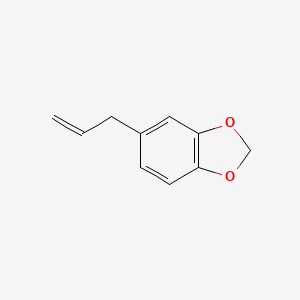
Safrole
Safrole appears as clear colorless or slightly yellow liquid with the odor of sassafras. Denser than water (density 1.09 g / cm3) and insoluble in water. Hence sinks in water. Obtained from oil of sassafras or oil of camphor. — CAMEO Chemicals
- Nom IUPAC
- 5-prop-2-enyl-1,3-benzodioxole
- Formule moléculaire
- C10H10O2
- Masse moléculaire
- 162.18 g/mol
- Masse exacte
- 162.068079557 Da
- XLogP3
- 3,0
- Surface polaire topologique
- 18,5 Ų
- Donneurs de liaisons hydrogène
- 0
- Accepteurs de liaisons hydrogène
- 2
- Unités covalentes
- 1
- Stéréocentres définis
- 0
Également connu sous le nom de
16 autres noms signalés
Identifiants de bases de données externes
- ChEBI:CHEBI:8994
- ChEMBL:CHEMBL242273
- EPA DTXSID:DTXSID0021254
- PubMed:25058030
- PubMed:23074021
- PubMed:22934566
- PubMed:22857782
- PubMed:22820429
- PubMed:22708042
- PubMed:22701361
- PubMed:22624127
- PubMed:22593445
- PubMed:22588462
- PubMed:22531970
- PubMed:22454674
Récupéré depuis NIH PubChem le 2026-09-02 par correspondance CAS à somme de contrôle valide. Les propriétés chimiques ne remplacent pas la décision réglementaire de cette page.
Liens d’inventaire pour Safrole, except for normal content in the natural essences used and provided that the concentration does not exceed: 100 ppm in the finished cosmetic product, 50 ppm in products for dental and oral hygiene, and provided that Safrole is not present in toothpastes intended specifically for children
CINNAMOMUM CAMPHORA FORMOSANA LEAF OIL RECTIFIED
CINNAMOMUM CAMPHORA FORMOSANA ROOT EXTRACT
CINNAMOMUM CAMPHORA FORMOSANA ROOT OIL
CINNAMOMUM CAMPHORA LINALOOLIFERUM ROOT EXTRACT
CINNAMOMUM CAMPHORA LINALOOLIFERUM ROOT OIL
Fiches associées pour Safrole, except for normal content in the natural essences used and provided that the concentration does not exceed: 100 ppm in the finished cosmetic product, 50 ppm in products for dental and oral hygiene, and provided that Safrole is not present in toothpastes intended specifically for children
Les correspondances directes sont limitées pour cette fiche ; des entrées voisines de l’annexe II sont donc également affichées.
Oil from the seeds of Laurus nobilis L.
5,5'-Di-isopropyl-2,2'-dimethylbiphenyl-4,4'-diyl dihypoiodite (thymol iodide)
Furocoumarines (e.g. trioxysalen (INN), 8-methoxypsoralen, 5-methoxypsoralen) except for normal con…
3'-Ethyl-5',6',7',8'-tetrahydro-5',5',8',8'-tetramethyl-2'-acetonaphthone or 7-acetyl-6-ethyl-1,1,4…
Benzoates of 4-hydroxy-3-methoxycinnamyl alcohol (coniferyl alcohol) except for normal content in n…
o-Phenylenediamine and its salts
4-Phenylbut-3-en-2-one (Benzylideneacetone)
4-Methyl-m-phenylenediamine (Toluene-2,4-diamine) and its salts
Dimethylformamide (N,N-Dimethylformamide)
Aristolochic acid and its salts; Aristolochia spp. and their preparations
Ce que signifie l’annexe II pour Safrole, except for normal content in the natural essences used and provided that the concentration does not exceed: 100 ppm in the finished cosmetic product, 50 ppm in products for dental and oral hygiene, and provided that Safrole is not present in toothpastes intended specifically for children
Safrole, except for normal content in the natural essences used and provided that the concentration does not exceed: 100 ppm in the finished cosmetic product, 50 ppm in products for dental and oral hygiene, and provided that Safrole is not present in toothpastes intended specifically for children figure comme substance interdite à l’annexe II du règlement (CE) n° 1223/2009 relatif aux produits cosmétiques et ne doit pas être ajouté intentionnellement. L’article 17 traite séparément des traces involontaires, techniquement inévitables dans le respect des bonnes pratiques de fabrication et compatibles avec l’exigence de sécurité de l’article 3.
Les formulateurs doivent contrôler leurs ingrédients et matières premières afin de s’assurer qu’aucun ne contient cette substance. Les fournisseurs doivent fournir, sur demande, une documentation confirmant son absence.
Cette fiche est liée à 8 ingrédients de l’inventaire CosIng pour le recoupement des noms et des identifiants. La page fait également apparaître 12 fiches d’annexe associées présentant des identifiants, une logique d’annexe ou des schémas de dénomination qui se recoupent.
Liste de contrôle de conformité
- Vérifiez que cette substance est absente de toutes les matières premières et formulations finies.
- Demandez aux fournisseurs de matières premières une attestation d’absence ou un certificat d’analyse.
- Consignez le résultat du contrôle dans le dossier d’information produit (DIP).
- Cette substance a une classification CMR. Examinez le tableau CMR ci-dessus et vérifiez le statut actuel dans les annexes II/III avant toute utilisation.
Questions fréquentes
Note de source pour la fiche Safrole, except for normal content in the natural essences used and provided that the concentration does not exceed: 100 ppm in the finished cosmetic product, 50 ppm in products for dental and oral hygiene, and provided that Safrole is not present in toothpastes intended specifically for children de l’annexe II
Cette page résume une fiche de l’annexe II pour Safrole, except for normal content in the natural essences used and provided that the concentration does not exceed: 100 ppm in the finished cosmetic product, 50 ppm in products for dental and oral hygiene, and provided that Safrole is not present in toothpastes intended specifically for children à partir de documents publics de la Commission européenne sur les cosmétiques et ajoute les correspondances d’inventaire ou d’identifiants associées lorsqu’elles sont disponibles.
Utilisez cette page de fiche pour examiner les conditions de l’annexe II pour Safrole, except for normal content in the natural essences used and provided that the concentration does not exceed: 100 ppm in the finished cosmetic product, 50 ppm in products for dental and oral hygiene, and provided that Safrole is not present in toothpastes intended specifically for children, mais confirmez toute décision réglementaire finale auprès du libellé officiel en vigueur de l’annexe et des fichiers sources.
Outils et étapes suivantes
Vérifiez votre formule
Collez une liste INCI complète pour détecter Safrole, except for normal content in the natural essences used and provided that the concentration does not exceed: 100 ppm in the finished cosmetic product, 50 ppm in products for dental and oral hygiene, and provided that Safrole is not present in toothpastes intended specifically for children et d’autres fiches d’annexe de l’UE signalées en une seule passe.
Vérificateur INCIComparer des entrées
Comparez Safrole, except for normal content in the natural essences used and provided that the concentration does not exceed: 100 ppm in the finished cosmetic product, 50 ppm in products for dental and oral hygiene, and provided that Safrole is not present in toothpastes intended specifically for children côte à côte avec une autre fiche d’annexe pour examiner les différences de restrictions, de concentrations et d’annexe.
ComparerParcourir l’annexe
Consultez toutes les fiches de l’annexe II et comparez les conditions réglementaires entre les substances de cette annexe.
Ouvrir l’annexe II