
硼酸盐和四硼酸盐 — Borates and tetraborates (CAS No. 1330-43-4 / CAS No. 1303-96-4 / CAS No. 10377-81-8 / CAS No. 68003-13-4)
Borates and tetraborates (CAS No. 1330-43-4 / CAS No. 1303-96-4 / CAS No. 10377-81-8 / CAS No. 68003-13-4)
The NMPA binding 2021 catalogue prohibits this raw material in cosmetic formulas in China.
Regulatorische Entscheidung und vollständige Bedingungen
- Status
- Prohibited
- Rechtsrolle
- Binding rule
- Regulatorische Zusammenfassung
- The NMPA binding 2021 catalogue prohibits this raw material in cosmetic formulas in China.
- Bedingungen und Beschränkungen
Prohibited in cosmetic product formulas. Verify the cited Chinese source identity and any later NMPA amendment before use.
Stoffidentität
- Name in der amtlichen Quelle
- 硼酸盐和四硼酸盐 — Borates and tetraborates (CAS No. 1330-43-4 / CAS No. 1303-96-4 / CAS No. 10377-81-8 / CAS No. 68003-13-4)
- CAS
- 1330-43-4; 1303-96-4; 10377-81-8; 68003-13-4
- EC
- Not supplied in this source row
- Identitätszuordnung
- Exact CAS: 1330-43-4
- Verknüpfter Inhaltsstoff
- SODIUM BORATE
Verknüpfte CosIng-Identitätsdaten
Namen und Aliase
CosIng-Beschreibung: Disodium tetraborate, anhydrous (boric acid, disodium salt); Disodium tetraborate decahydrate (borax decahydrate)
Beschränkungshinweis aus dem EU-Verzeichnis: II/1396
Erfasste kosmetische Funktion: BUFFERING
Funktionsseiten:BUFFERING
Das vollständige Inhaltsstoffprofil ansehenMarktübergreifende Übersicht zu dieser Identität
Exakte verknüpfte Einträge, die derzeit auf dieser Website vorhanden sind. Ein fehlender Markt bedeutet, dass kein exakter Treffer importiert wurde, nicht dass der Stoff verwendet werden darf.
European Union
1 verknüpfter Eintrag
Unterstützenden Eintrag öffnenCanada
2 verknüpfte Einträge · 2 mit besonderen Bedingungen
Unterstützenden Eintrag öffnenNew Zealand
4 verknüpfte Einträge
Unterstützenden Eintrag öffnenChina
Aktueller Eintrag1 verknüpfter Eintrag · 1 mit besonderen Bedingungen
Unterstützenden Eintrag öffnenSouth Korea
1 verknüpfter Eintrag · 1 mit besonderen Bedingungen
Unterstützenden Eintrag öffnenBrazil
1 verknüpfter Eintrag · 1 mit besonderen Bedingungen
Unterstützenden Eintrag öffnenIndia
2 verknüpfte Einträge · 2 mit besonderen Bedingungen
Unterstützenden Eintrag öffnenSaudi Arabia
1 verknüpfter Eintrag
Unterstützenden Eintrag öffnen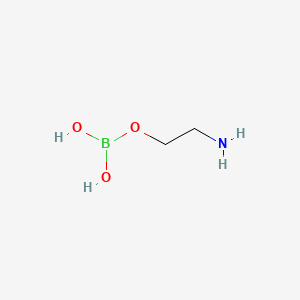
Verifizierte Chemie für CAS 10377-81-8
Monoethanolamine borate
- IUPAC-Name
- 2-aminoethoxyboronic acid
- Summenformel
- C2H8BNO3
- Molekulargewicht
- 104.90 g/mol
- Exakte Masse
- 105.0597233 Da
- Monoisotopische Masse
- 105.0597233 Da
- Topologische polare Oberfläche
- 75,7 Ų
- Molekulare Komplexität
- 41,0
- Formale Ladung
- 0
- Wasserstoffbrücken-Donoren
- 3
- Wasserstoffbrücken-Akzeptoren
- 4
- Drehbare Bindungen
- 3
- Schweratome
- 7
- Kovalente Einheiten
- 1
An PubChem gemeldete Namen und Synonyme
12 weitere gemeldete Namen
Kennungen in externen Datenbanken
- EPA DTXSID:DTXSID3049673
Erweiterte Strukturstatistik
- Definierte Atom-Stereozentren
- 0
- Nicht definierte Atom-Stereozentren
- 0
- Definierte Bindungs-Stereozentren
- 0
- Nicht definierte Bindungs-Stereozentren
- 0
- 3D-Konformere
- 0
Maschinenlesbare Strukturkennungen
- SMILES
B(O)(O)OCCN- InChI
InChI=1S/C2H8BNO3/c4-1-2-7-3(5)6/h5-6H,1-2,4H2- InChIKey
JCAYXDKNUSEQRT-UHFFFAOYSA-N
Belege aus weiteren wissenschaftlichen Datenbanken
NIH PubChem PUG-View
Attributed physical-property, hazard, environmental and use annotations.
- Note: This chemical does not meet GHS hazard criteria for 29.7% (11 of 37) of reports. Quelle: European Chemicals Agency (ECHA)
- Signal: Warning Quelle: European Chemicals Agency (ECHA)
- GHS Hazard Statements: H315 (70.3%): Causes skin irritation [Warning Skin corrosion/irritation]; H319 (70.3%): Causes serious eye irritation [Warning Serious eye damage/eye irritation]; H335 (67.6%): May cause respiratory irritation [Warning Specific target organ toxicity, single exposure; Respiratory tract irritation] Quelle: European Chemicals Agency (ECHA)
- Precautionary Statement Codes: P261, P264, P264+P265, P271, P280, P302+P352, P304+P340, P305+P351+P338, P319, P321, P332+P317, P337+P317, P362+P364, P403+P233, P405, and P501 (click each P-code to see the statement) Quelle: European Chemicals Agency (ECHA)
- ECHA C&L Notifications Summary: Aggregated GHS information provided per 37 reports by companies from 3 notifications to the ECHA C&L Inventory. Each notification may be associated with multiple companies.; Reported as not meeting GHS hazard criteria per 11 of 37 reports by companies.; There are 2 notifications provided by 26 of 37 reports by companies with hazard statement code(s).; Information may vary between notifications depending on impurities, additives, and other factors. The percentage value in parenthesis indicates the notified classification ratio from companies that provide hazard codes. Only hazard codes with percentage values above 10% are shown. For more detailed information, please visit ECHA C&L website. Quelle: European Chemicals Agency (ECHA)
Zugeordnet durch: Existing checksum-valid CAS to unique PubChem CID match. Abgerufen: 2026-08-31. Quelleneintrag öffnen
Wissenschaftliche Klassifizierungen und Gefahrenannotationen liefern Kontext und ersetzen nicht die oben gezeigte marktspezifische regulatorische Entscheidung.
Weitere Quellenabdeckung und Trefferstatus
| Quelle | Ergebnis | Geprüft |
|---|---|---|
| EMBL-EBI ChEBI | Kein exakter Eintrag | 2026-08-31 |
| NIH PubChem PUG-View | Exakter Treffer | 2026-08-31 |
Ein erfasster Nicht-Treffer ist ein nützlicher Beleg dafür, dass die Quelle geprüft wurde; er ist keine Behauptung, dass der Stoff anderswo nicht existiert.
Am 2026-09-02 von NIH PubChem durch prüfsummengültigen CAS-Abgleich abgerufen. Chemische Eigenschaften ersetzen nicht die regulatorische Entscheidung auf dieser Seite.
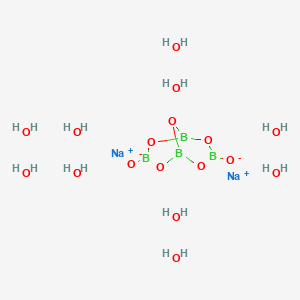
Verifizierte Chemie für CAS 1303-96-4
Borax (B4Na2O7.10H2O)
Borax is a mineral with formula of Na2B4O5(OH)4·8H2O. The IMA symbol is Brx. — RRUFF Project
- IUPAC-Name
- disodium;3,7-dioxido-2,4,6,8,9-pentaoxa-1,3,5,7-tetraborabicyclo[3.3.1]nonane;decahydrate
- Summenformel
- B4H20Na2O17
- Molekulargewicht
- 381.4 g/mol
- Exakte Masse
- 382.0868084 Da
- Monoisotopische Masse
- 382.0868084 Da
- Topologische polare Oberfläche
- 102,0 Ų
- Molekulare Komplexität
- 121,0
- Formale Ladung
- 0
- Wasserstoffbrücken-Donoren
- 10
- Wasserstoffbrücken-Akzeptoren
- 17
- Drehbare Bindungen
- 0
- Schweratome
- 23
- Kovalente Einheiten
- 13
An PubChem gemeldete Namen und Synonyme
16 weitere gemeldete Namen
Kennungen in externen Datenbanken
- ChEMBL:CHEMBL3833375
- EPA DTXSID:DTXSID701014356
- PubMed:10010
Erweiterte Strukturstatistik
- Definierte Atom-Stereozentren
- 0
- Nicht definierte Atom-Stereozentren
- 0
- Definierte Bindungs-Stereozentren
- 0
- Nicht definierte Bindungs-Stereozentren
- 0
- 3D-Konformere
- 0
Maschinenlesbare Strukturkennungen
- SMILES
B1(OB2OB(OB(O1)O2)[O-])[O-].O.O.O.O.O.O.O.O.O.O.[Na+].[Na+]- InChI
InChI=1S/B4O7.2Na.10H2O/c5-1-7-3-9-2(6)10-4(8-1)11-3;;;;;;;;;;;;/h;;;10*1H2/q-2;2*+1;;;;;;;;;;- InChIKey
CDMADVZSLOHIFP-UHFFFAOYSA-N
Belege aus weiteren wissenschaftlichen Datenbanken
NIH PubChem PUG-View
Attributed physical-property, hazard, environmental and use annotations.
- Boiling Point: 608 °F Quelle: Occupational Safety and Health Administration (OSHA)
- Boiling Point: 608 °F Quelle: The National Institute for Occupational Safety and Health (NIOSH)
- Color/Form: White, monoclinic crystals Quelle: Hazardous Substances Data Bank (HSDB)
- Color/Form: Hard crystals, granules or crystalline powder; efflorescent in dry air, the crystals often being coated with white powder Quelle: Hazardous Substances Data Bank (HSDB)
- Color/Form: Crystalline granules or crystalline powder Quelle: Hazardous Substances Data Bank (HSDB)
- Color/Form: White, crystalline solid [Note: Becomes anhydrous at 608 degrees F] Quelle: Hazardous Substances Data Bank (HSDB)
- Density: 1.73 g/cu cm Quelle: Hazardous Substances Data Bank (HSDB)
- Density: Relative density (water = 1): 1.7 Quelle: ILO-WHO International Chemical Safety Cards (ICSCs)
- Density: 1.73 Quelle: Occupational Safety and Health Administration (OSHA)
- Density: 1.73 @25 °C Quelle: PAC Chemical Database, U.S. Department of Energy
- Density: 1.73 Quelle: The National Institute for Occupational Safety and Health (NIOSH)
- Melting Point: 75 °C (decomposes) Quelle: Hazardous Substances Data Bank (HSDB)
- Melting Point: 167 °F Quelle: Occupational Safety and Health Administration (OSHA)
- Melting Point: 167 °F Quelle: The National Institute for Occupational Safety and Health (NIOSH)
- Odor: Odorless Quelle: Hazardous Substances Data Bank (HSDB)
- Physical Description: Liquid; Other Solid; Large Crystals; Wet Solid; Dry Powder Quelle: EPA Chemical Data Reporting (CDR)
- Physical Description: White, odorless, crystalline solid; Becomes anhydrous at 608 degrees F; [NIOSH] Quelle: Haz-Map, Information on Hazardous Chemicals and Occupational Diseases
- Physical Description: WHITE CRYSTALS OR CRYSTALLINE POWDER. Quelle: ILO-WHO International Chemical Safety Cards (ICSCs)
- Physical Description: White, odorless, crystalline solid. Quelle: Occupational Safety and Health Administration (OSHA)
- Physical Description: White, odorless, crystalline solid. [herbicide] [Note: Becomes anhydrous at 608 °F.] Quelle: The National Institute for Occupational Safety and Health (NIOSH)
- Refractive Index: Index of refraction: 1.447 (alpha); 1.469 (beta); 1.472 (gamma) Quelle: Hazardous Substances Data Bank (HSDB)
- Solubility: Aqueous solution is alkaline to litmus and phenolphthalein; pH about pH = 9.5 Quelle: Hazardous Substances Data Bank (HSDB)
- Solubility: At 100 °C loses 5H2O; at 150 °C loses 9H2O; becomes anhydrous at 320 °C; borax dissolves many metallic oxides when fused with them Quelle: Hazardous Substances Data Bank (HSDB)
- Solubility: In water, 5.93X10+4 mg/L at 25 °C Quelle: Hazardous Substances Data Bank (HSDB)
- Solubility: 3.17 g/100 g water at 25 °C Quelle: Hazardous Substances Data Bank (HSDB)
- Solubility: 1 g/16 mL in water; 1 g/0.6 mL boiling water; 1 g/1 mL glycerol; insoluble in alcohol Quelle: Hazardous Substances Data Bank (HSDB)
- Solubility: Insoluble in ethanol Quelle: Hazardous Substances Data Bank (HSDB)
- Solubility: 0.60 g/100 g acetone Quelle: Hazardous Substances Data Bank (HSDB)
- Solubility: Solubility in water, g/100ml at 20 °C: 5.1 Quelle: ILO-WHO International Chemical Safety Cards (ICSCs)
- Solubility: 6% Quelle: The National Institute for Occupational Safety and Health (NIOSH)
- Vapor Pressure: Approximately 0 mm Hg Quelle: Hazardous Substances Data Bank (HSDB)
- Vapor Pressure: 0 mmHg (approx) Quelle: Occupational Safety and Health Administration (OSHA)
- Vapor Pressure: 0 mmHg (approx) Quelle: The National Institute for Occupational Safety and Health (NIOSH)
- pH: pH at 20 °C: 9.3 (0.1% solution); 9.2 (1.0% solution) Quelle: Hazardous Substances Data Bank (HSDB)
- Exposure Routes: The substance can be absorbed into the body by inhalation and by ingestion. Quelle: ILO-WHO International Chemical Safety Cards (ICSCs)
- Exposure Routes: inhalation, ingestion, skin and/or eye contact Quelle: The National Institute for Occupational Safety and Health (NIOSH)
- First Aid: (General first aid procedures); Eye: Irrigate immediately - If this chemical contacts the eyes, immediately wash (irrigate) the eyes with large amounts of water, occasionally lifting the lower and upper lids. Get medical attention immediately.; Skin: Soap wash - If this chemical contacts the skin, wash the contaminated skin with soap and water.; Breathing: Respiratory support; Swallow: Medical attention immediately - If this chemical has been swallowed, get medical attention immediately. Quelle: The National Institute for Occupational Safety and Health (NIOSH)
- Signal: Danger Quelle: Regulation (EC) No 1272/2008 of the European Parliament and of the Council
- GHS Hazard Statements: H360FD: May damage fertility; May damage the unborn child [Danger Reproductive toxicity] Quelle: Regulation (EC) No 1272/2008 of the European Parliament and of the Council
- Precautionary Statement Codes: P203, P280, P318, P405, and P501 (click each P-code to see the statement) Quelle: Regulation (EC) No 1272/2008 of the European Parliament and of the Council
- Note: This chemical does not meet GHS hazard criteria for < 0.1% (1 of 2865) of reports. Quelle: European Chemicals Agency (ECHA)
- Signal: Danger Quelle: European Chemicals Agency (ECHA)
- GHS Hazard Statements: H319 (12.6%): Causes serious eye irritation [Warning Serious eye damage/eye irritation]; H360 (93.2%): May damage fertility or the unborn child [Danger Reproductive toxicity] Quelle: European Chemicals Agency (ECHA)
- Precautionary Statement Codes: P203, P264+P265, P280, P305+P351+P338, P318, P337+P317, P405, and P501 (click each P-code to see the statement) Quelle: European Chemicals Agency (ECHA)
- ECHA C&L Notifications Summary: Aggregated GHS information provided per 2865 reports by companies from 31 notifications to the ECHA C&L Inventory. Each notification may be associated with multiple companies.; Reported as not meeting GHS hazard criteria per 1 of 2865 reports by companies.; There are 30 notifications provided by 2864 of 2865 reports by companies with hazard statement code(s).; Information may vary between notifications depending on impurities, additives, and other factors. The percentage value in parenthesis indicates the notified classification ratio from companies that provide hazard codes. Only hazard codes with percentage values above 10% are shown. For more detailed information, please visit ECHA C&L website. Quelle: European Chemicals Agency (ECHA)
- Signal: Danger Quelle: NITE-CMC
- GHS Hazard Statements: H315: Causes skin irritation [Warning Skin corrosion/irritation]; H319: Causes serious eye irritation [Warning Serious eye damage/eye irritation]; H335: May cause respiratory irritation [Warning Specific target organ toxicity, single exposure; Respiratory tract irritation]; H360: May damage fertility or the unborn child [Danger Reproductive toxicity]; H370: Causes damage to organs [Danger Specific target organ toxicity, single exposure]; H372: Causes damage to organs through prolonged or repeated exposure [Danger Specific target organ toxicity, repeated exposure]; H413: May cause long lasting harmful effects to aquatic life [Hazardous to the aquatic environment, long-term hazard] Quelle: NITE-CMC
- Precautionary Statement Codes: P203, P260, P261, P264, P264+P265, P270, P271, P273, P280, P302+P352, P304+P340, P305+P351+P338, P308+P316, P318, P319, P321, P332+P317, P337+P317, P362+P364, P403+P233, P405, and P501 (click each P-code to see the statement) Quelle: NITE-CMC
- GHS Hazard Statements: H303: May be harmful if swallowed [Warning Acute toxicity, oral]; H315: Causes skin irritation [Warning Skin corrosion/irritation]; H319: Causes serious eye irritation [Warning Serious eye damage/eye irritation]; H361: Suspected of damaging fertility or the unborn child [Warning Reproductive toxicity]; H370: Causes damage to organs [Danger Specific target organ toxicity, single exposure]; H372: Causes damage to organs through prolonged or repeated exposure [Danger Specific target organ toxicity, repeated exposure]; H373: May causes damage to organs through prolonged or repeated exposure [Warning Specific target organ toxicity, repeated exposure] Quelle: NITE-CMC
- Target Organs: Eyes, skin, respiratory system Quelle: The National Institute for Occupational Safety and Health (NIOSH)
- Cosmetic Ingredient Review Conclusion: The Expert Panel concludes that Sodium Borate and Boric Acid, in concentrations less than or equal to 5 percent, are safe as cosmetic ingredients when used as currently recommended; however, cosmetic formulations containing free Sodium Borate or Boric Acid at this concentration should not be used on infant skin or injured skin. Note: In 2003, the CIR Expert Panel considered available new data on these ingredients and reaffirmed the above conclusion. Quelle: Cosmetic Ingredient Review (CIR)
- Cosmetic Ingredient Review Finding(s): Safe for use in cosmetics, with qualifications Quelle: Cosmetic Ingredient Review (CIR)
- Environmental Bioconcentration: In a greenhouse experiment with sandy loam soil treated with 0-8.0 ppm boron as borax, boron toxicity symptoms appeared earliest in lentil plants and barley seedlings exposed to 8.0 ppm boron. In barley the severity of boron toxicity decreased with the decrease in boron levels, whereas in lentil the severity of the symptoms eventually reached the same level in 2 and 4 ppm boron treatments as with the highest concentration. Dry matter yield decreased 38.6% in lentil and 23.4% in barley exposed to 8.0 ppm boron in comparison with controls. Boron contents of lentil and barley plants on soil treated with 8 ppm boron were approximately 7- and approximately 8-fold those of control plants, respectively. Quelle: Hazardous Substances Data Bank (HSDB)
- Environmental Fate: TERRESTRIAL FATE: Boron is naturally occurring and ubiquitous in the environment. No microbial degradation. Disappearance from soil is by washing out. Persistence in soil is about 2 years, depending on rainfall and soil structure. Quelle: Hazardous Substances Data Bank (HSDB)
- Consumer Uses: Other; Adhesion/cohesion promoter; Soil amendments (fertilizers); Not Known or Reasonably Ascertainable; Flame retardant Quelle: EPA Chemical Data Reporting (CDR)
- Industry Uses: Abrasives; Plating agent; Etching agent; Chelating agent; Flame retardant; Soil amendments (fertilizers) Quelle: EPA Chemical Data Reporting (CDR)
- Cosmetic Ingredient Review Link: CIR ingredient: Sodium Borate Quelle: Cosmetic Ingredient Review (CIR)
- Sources/Uses: Used as a preservative, antiseptic and fungicide; also used to manufacture glazes, enamels, soldering fluxes and cleaning compounds and to fireproof textiles and wood; [ACGIH] Boric acid and borates as tablets or powder are used to kill larvae in barns and other insects in houses. Rarely, they are sprayed as herbicides. [EPA: Recognition of Pesticide Poisonings] Used in photo developing bath; [www.ci.tucson.az.us/arthazards/medium.html] Borax (borax decahydrate) is found naturally in some salt lakes and alkaline soils. Boric acid is formed by crystallizing a solution of hydrochloric acid or sulfuric acid and borax. [Hawley] Quelle: Haz-Map, Information on Hazardous Chemicals and Occupational Diseases
- Industrial Processes with risk of exposure: Soldering [Category: Heat or Machine]; Using Disinfectants or Biocides [Category: Clean]; Farming (Pesticides) [Category: Industry]; Photographic Processing [Category: Other]; Textiles (Printing, Dyeing, or Finishing) [Category: Industry] Quelle: Haz-Map, Information on Hazardous Chemicals and Occupational Diseases
- Uses: For borax (USEPA/OPP Pesticide Code: 011102) ACTIVE products with label matches. /SRP: Registered for use in the U.S. but approved pesticide uses may change periodically and so federal, state and local authorities must be consulted for currently approved uses./ Quelle: Hazardous Substances Data Bank (HSDB)
- Uses: Long been used as a mild antiseptic fungicide and as a herbicide ... Total control of vegetation on non-crop land, such as paths, giving long-term control. Also used in insect baits for food stores to control Formicidae. Quelle: Hazardous Substances Data Bank (HSDB)
- Uses: Soldering metals; manufacture of glazes and enamels; tanning; in cleaning compounds; artificially aging wood; as preservative, either alone or with other antiseptics against wood fungus; fireproofing fabrics and wood; curing and preserving skins; in cockroach control. In buffers; as a complexing or masking agent in analytical chemistry. Pharmaceutic aid (alkalizer). Quelle: Hazardous Substances Data Bank (HSDB)
- Uses: Used in ant poisons, for fly control around refuse and manure piles, as a larvicide, in manufacture of glazes, enamels, cleaning compounds, and in soldering metals Quelle: Hazardous Substances Data Bank (HSDB)
- Uses: For more Uses (Complete) data for BORAX (17 total), please visit the HSDB record page. Quelle: Hazardous Substances Data Bank (HSDB)
Zugeordnet durch: Existing checksum-valid CAS to unique PubChem CID match. Abgerufen: 2026-08-31. Quelleneintrag öffnen
Wissenschaftliche Klassifizierungen und Gefahrenannotationen liefern Kontext und ersetzen nicht die oben gezeigte marktspezifische regulatorische Entscheidung.
Weitere Quellenabdeckung und Trefferstatus
| Quelle | Ergebnis | Geprüft |
|---|---|---|
| NIH PubChem PUG-View | Exakter Treffer | 2026-08-31 |
Ein erfasster Nicht-Treffer ist ein nützlicher Beleg dafür, dass die Quelle geprüft wurde; er ist keine Behauptung, dass der Stoff anderswo nicht existiert.
Am 2026-09-02 von NIH PubChem durch prüfsummengültigen CAS-Abgleich abgerufen. Chemische Eigenschaften ersetzen nicht die regulatorische Entscheidung auf dieser Seite.
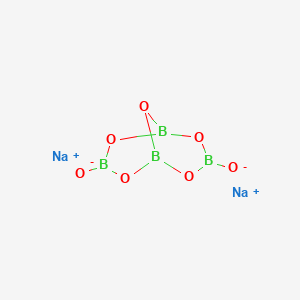
Verifizierte Chemie für CAS 1330-43-4
Sodium Tetraborate
- IUPAC-Name
- disodium;3,7-dioxido-2,4,6,8,9-pentaoxa-1,3,5,7-tetraborabicyclo[3.3.1]nonane
- Summenformel
- B4Na2O7
- Molekulargewicht
- 201.2 g/mol
- Exakte Masse
- 201.9811616 Da
- Monoisotopische Masse
- 201.9811616 Da
- Topologische polare Oberfläche
- 92,3 Ų
- Molekulare Komplexität
- 121,0
- Formale Ladung
- 0
- Wasserstoffbrücken-Donoren
- 0
- Wasserstoffbrücken-Akzeptoren
- 7
- Drehbare Bindungen
- 0
- Schweratome
- 13
- Kovalente Einheiten
- 3
An PubChem gemeldete Namen und Synonyme
16 weitere gemeldete Namen
Kennungen in externen Datenbanken
- EPA DTXSID:DTXSID101014358
- PubMed:21774671
- PubMed:19059942
- PubMed:1432568
Erweiterte Strukturstatistik
- Definierte Atom-Stereozentren
- 0
- Nicht definierte Atom-Stereozentren
- 0
- Definierte Bindungs-Stereozentren
- 0
- Nicht definierte Bindungs-Stereozentren
- 0
- 3D-Konformere
- 0
Maschinenlesbare Strukturkennungen
- SMILES
B1(OB2OB(OB(O1)O2)[O-])[O-].[Na+].[Na+]- InChI
InChI=1S/B4O7.2Na/c5-1-7-3-9-2(6)10-4(8-1)11-3;;/q-2;2*+1- InChIKey
UQGFMSUEHSUPRD-UHFFFAOYSA-N
Am 2026-09-02 von NIH PubChem durch prüfsummengültigen CAS-Abgleich abgerufen. Chemische Eigenschaften ersetzen nicht die regulatorische Entscheidung auf dieser Seite.
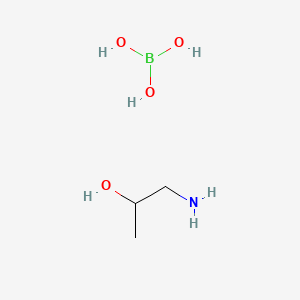
Verifizierte Chemie für CAS 68003-13-4
(2-Hydroxypropyl)ammonium dihydrogen orthoborate
- IUPAC-Name
- 1-aminopropan-2-ol;boric acid
- Summenformel
- C3H12BNO4
- Molekulargewicht
- 136.95 g/mol
- Exakte Masse
- 137.0859380 Da
- Monoisotopische Masse
- 137.0859380 Da
- Topologische polare Oberfläche
- 107,0 Ų
- Molekulare Komplexität
- 30,0
- Formale Ladung
- 0
- Wasserstoffbrücken-Donoren
- 5
- Wasserstoffbrücken-Akzeptoren
- 5
- Drehbare Bindungen
- 1
- Schweratome
- 9
- Kovalente Einheiten
- 2
An PubChem gemeldete Namen und Synonyme
5 weitere gemeldete Namen
Kennungen in externen Datenbanken
- EPA DTXSID:DTXSID10892195
Erweiterte Strukturstatistik
- Definierte Atom-Stereozentren
- 0
- Nicht definierte Atom-Stereozentren
- 1
- Definierte Bindungs-Stereozentren
- 0
- Nicht definierte Bindungs-Stereozentren
- 0
- 3D-Konformere
- 0
Maschinenlesbare Strukturkennungen
- SMILES
B(O)(O)O.CC(CN)O- InChI
InChI=1S/C3H9NO.BH3O3/c1-3(5)2-4;2-1(3)4/h3,5H,2,4H2,1H3;2-4H- InChIKey
FWGLAJMZAXEFTA-UHFFFAOYSA-N
Am 2026-09-02 von NIH PubChem durch prüfsummengültigen CAS-Abgleich abgerufen. Chemische Eigenschaften ersetzen nicht die regulatorische Entscheidung auf dieser Seite.
Amtliche Quelle und Herkunft
- Registrierte Quelle
- China NMPA banned raw-material catalogues (2021)
- Quellenverweis
- NMPA 2021 Catalogue of Raw Materials Banned for Cosmetics, entry 1267
- Eintrags-ID der Quelle
chemical-1267- Quellenversion
- NMPA Announcement No. 74 of 2021, effective 2021-05-26
- Quellsprache
- Chinese with source English/Latin identity
- Übersetzungsstatus
- Official English translation · Englische Übersetzung
- Datum des Inkrafttretens
- 2021-05-26
- Quelle aktualisiert
- 2021-05-26
- Stand geprüft
- 2026-08-31 14:13 UTC
- Validierungsmethode
- pdfplumber tables; exact 1,284 + 109 row counts and contiguous source numbering
- SHA-256
8848aa3e0c7ac5e74f56fc27927336c4fc2e5bc80137da087c2ca9ba2d2c075e
Hinweise zum registrierten Datensatz
- Datensatzabdeckung
- All 1,284 banned raw materials and 109 banned plant/animal raw materials effective from 26 May 2021
- Hinweis zur Behörde
- Binding NMPA catalogues replacing Tables 1 and 2 of the 2015 Technical Specification
Wie dieser Eintrag in den Marktdatensatz passt
Statusverteilung
Bedingungstext ist bei 1393 von 1393 aktuellen Einträgen vorhanden. Ein leeres Bedingungsfeld wird entsprechend der oben genannten Eintragsart interpretiert; es wird niemals in die Aussage einer uneingeschränkten Verwendung umgedeutet.
China Marktkontext
Complete prohibited catalogues plus official-source workflow
Abdeckungsversion: NMPA 2021 banned catalogues plus dynamic IECIC List I/List II system current since 2025
All 1,284 banned raw materials and 109 banned plant/animal raw materials, plus the official workflow for the dynamic existing-ingredient inventory, other technical restrictions and new ingredients.
Verifizierungs-Checkliste
- Search the current NMPA IECIC List I and List II by Chinese name and identity.
- Check prohibited/restricted and positive lists in the current Safety and Technical Standards.
- Review technical purpose, use history and any monitoring period.
- Confirm Chinese labelling, safety assessment and filing/registration duties.
Amtliche Marktquellen
- China NMPA IECIC dynamic inventoryOfficial NMPA inventory, not a blanket permission or safety decision
- China draft mandatory cosmetic safety standardConsultation draft — not current law and not a substitute for the effective NMPA catalogues
- China NMPA banned raw-material catalogues (2021)Binding NMPA catalogues replacing Tables 1 and 2 of the 2015 Technical Specification
Verifizierungsablauf und Vollständigkeit des Eintrags
Bevor Sie dieses Ergebnis für eine Compliance-Entscheidung verwenden
- Bestätigen Sie, dass „硼酸盐和四硼酸盐 — Borates and tetraborates (CAS No. 1330-43-4 / CAS No. 1303-96-4 / CAS No. 10377-81-8 / CAS No. 68003-13-4)“ und jede CAS-/EC-Kennung sich auf das Material in Ihrer Lieferantenspezifikation beziehen.
- Search the current NMPA IECIC List I and List II by Chinese name and identity.
- Check prohibited/restricted and positive lists in the current Safety and Technical Standards.
- Review technical purpose, use history and any monitoring period.
- Confirm Chinese labelling, safety assessment and filing/registration duties.
- Dokumentieren Sie die Quellenversion und prüfen Sie die Behörde vor Herstellung, Notifizierung oder Inverkehrbringen erneut.
In diesem Eintrag verfügbare Felder
- Amtlicher StoffnameVerfügbar
- CASVerfügbar
- ECNicht angegeben
- Gesonderter BedingungstextVerfügbar
- Datum des InkrafttretensVerfügbar
- Snapshot-Hash und MethodeVerfügbar
Fragen, die diese Seite beantwortet
Dauerhafte Zitierweise
硼酸盐和四硼酸盐 — Borates and tetraborates (CAS No. 1330-43-4 / CAS No. 1303-96-4 / CAS No. 10377-81-8 / CAS No. 68003-13-4). NMPA 2021 Catalogue of Raw Materials Banned for Cosmetics, entry 1267. China. Source version NMPA Announcement No. 74 of 2021, effective 2021-05-26. CosIng Checker regulatory record: https://cosingchecker.com/de/regulations/cn/records/12956/
Zitieren Sie die Aufsichtsbehörde als rechtliche Autorität. Diese Seite ist ein strukturierter Belegindex und eine Verifizierungshilfe, kein Ersatz für den amtlichen Text oder eine fachkundige rechtliche Bewertung.
Auslegung und Grenzen für China
This official record identifies the substance as prohibited for cosmetic use in the stated market scope.
Do not rely on a formulation containing this identity until the cited source, effective date and exact substance match have been verified.
Wie die Rechtsrolle auszulegen ist
The cited row forms part of a binding rule or legally incorporated list for this market.
Belege auf dieser Seite
- Erfasstes Ergebnis: Prohibited
- Rechtsrolle: Binding rule
- Quellenversion: NMPA Announcement No. 74 of 2021, effective 2021-05-26
- Datum des Inkrafttretens: 2021-05-26
Was es nicht beweist
IECIC listing is not blanket approval; absence may require the new cosmetic ingredient route, and restrictions are checked separately.
Weitere maßgebliche Stoffrecherche
Keine dieser Quellen hebt die oben genannte Marktentscheidung auf.
Cosmetic Ingredient Review safety assessments
Expert Panel conclusions, assessed ingredient groups, use conditions, dates and report documents
Independent expert review considered by FDA; not a government approval or binding market rule
Diese Identität bei der Quelle recherchierenFDA Global Substance Registration System
UNII identifiers, preferred names, substance types, codes and public substance relationships
Identity registry only; UNII availability does not imply FDA review or approval
Diese Identität bei der Quelle recherchierenILO/WHO International Chemical Safety Cards
Hazards, symptoms, first aid, storage, incompatibilities and physical properties for covered chemicals
International occupational chemical-safety reference; not cosmetic-use approval
Diese Identität bei der Quelle recherchierenJapan NITE-CHRIP
Chemical identity, Japanese and foreign legal lists, GHS hazards and exposure-related information
Chemical-management evidence; cosmetic status remains governed by the applicable MHLW standard and market rules
Diese Identität bei der Quelle recherchierenNIOSH Pocket Guide to Chemical Hazards
REL, PEL, IDLH, properties, exposure routes, symptoms, target organs, first aid and measurement methods for covered workplace chemicals
US occupational-health guidance and limits; not a cosmetic ingredient decision
Diese Identität bei der Quelle recherchierenOECD eChemPortal
Gateway to authority-owned physical-property, fate, ecotoxicity, toxicity, exposure and GHS records
Discovery gateway; each linked authority remains responsible for its data
Diese Identität bei der Quelle recherchierenUS EPA CompTox CTX APIs
Für den Import ist ein API-Schlüssel erforderlichDTXSID identity, experimental and predicted properties, toxicity, bioactivity, exposure and environmental data
Scientific and computational evidence; predictions must remain labelled and do not determine cosmetic legality
Diese Identität bei der Quelle recherchieren