
Alkyl (C ) trimethyl ammonium bromide and 12-22 chloride) (+) Behentrimonium chloride (11) (CAS No. 17301- 53-0), cetrimonium bromide (CAS No. 57-09-0), cetrimonium chloride (12) (CAS No. 112-02- 7), laurtrimonium bromide, (CAS No. 1119- 94-4), laurtrimonium chloride (CAS No. 112- 00-5), steartrimonium bromide (CAS No. 1120-02-1), steartrimonium chloride (12) (CAS No. 112-03-8)
Alkyl (C ) trimethyl ammonium bromide and 12-22 chloride) (+) Behentrimonium chloride (11) (CAS No. 17301- 53-0), cetrimonium bromide (CAS No. 57-09-0), cetrimonium chloride (12) (CAS No. 112-02- 7), laurtrimonium bromide, (CAS No. 1119- 94-4), laurtrimon
ASEAN Annex VI lists this record among preservatives allowed for cosmetic use. Member-state transition rules and deviations still require local verification.
Regulatorische Entscheidung und vollständige Bedingungen
- Status
- Permitted list with conditions
- Rechtsrolle
- Binding rule
- Regulatorische Zusammenfassung
- ASEAN Annex VI lists this record among preservatives allowed for cosmetic use. Member-state transition rules and deviations still require local verification.
- Bedingungen und Beschränkungen
0.1%
Stoffidentität
- Name in der amtlichen Quelle
- Alkyl (C ) trimethyl ammonium bromide and 12-22 chloride) (+) Behentrimonium chloride (11) (CAS No. 17301- 53-0), cetrimonium bromide (CAS No. 57-09-0), cetrimonium chloride (12) (CAS No. 112-02- 7), laurtrimonium bromide, (CAS No. 1119- 94-4), laurtrimonium chloride (CAS No. 112- 00-5), steartrimonium bromide (CAS No. 1120-02-1), steartrimonium chloride (12) (CAS No. 112-03-8)
- CAS
- 17301-53-0; 57-09-0; 112-02-7; 1119-94-4; 112-00-5; 1120-02-1; 112-03-8
- EC
- 241-327-0
- Identitätszuordnung
- cas_number
- Verknüpfter Inhaltsstoff
- BEHENTRIMONIUM CHLORIDE
Verknüpfte CosIng-Identitätsdaten
Namen und Aliase
CosIng-Beschreibung: Docosyltrimethylammonium chloride
Beschränkungshinweis aus dem EU-Verzeichnis: V/44
Erfasste kosmetische Funktion: ANTISTATIC, HAIR CONDITIONING, PRESERVATIVE
Funktionsseiten:ANTISTATIC, HAIR CONDITIONING, PRESERVATIVE
Das vollständige Inhaltsstoffprofil ansehenMarktübergreifende Übersicht zu dieser Identität
Exakte verknüpfte Einträge, die derzeit auf dieser Website vorhanden sind. Ein fehlender Markt bedeutet, dass kein exakter Treffer importiert wurde, nicht dass der Stoff verwendet werden darf.
European Union
3 verknüpfte Einträge · 3 mit besonderen Bedingungen
Unterstützenden Eintrag öffnenGreat Britain
3 verknüpfte Einträge · 3 mit besonderen Bedingungen
Unterstützenden Eintrag öffnenNew Zealand
10 verknüpfte Einträge · 10 mit besonderen Bedingungen
Unterstützenden Eintrag öffnenASEAN
Aktueller Eintrag3 verknüpfte Einträge · 3 mit besonderen Bedingungen
Unterstützenden Eintrag öffnenSouth Korea
3 verknüpfte Einträge · 3 mit besonderen Bedingungen
Unterstützenden Eintrag öffnenIndia
2 verknüpfte Einträge · 2 mit besonderen Bedingungen
Unterstützenden Eintrag öffnenSaudi Arabia
2 verknüpfte Einträge
Unterstützenden Eintrag öffnen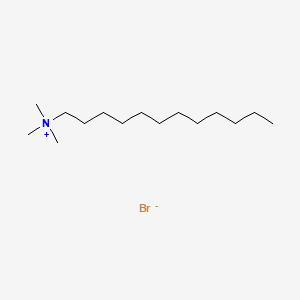
Verifizierte Chemie für CAS 1119-94-4
Dodecyltrimethylammonium bromide
Dodecyltrimethylammonium bromide is a bromide salt and a quaternary ammonium salt. It has a role as a surfactant. It contains a dodecyltrimethylammonium ion. — ChEBI
- IUPAC-Name
- dodecyl(trimethyl)azanium bromide
- Summenformel
- C15H34BrN
- Molekulargewicht
- 308.34 g/mol
- Exakte Masse
- 307.18746 Da
- Monoisotopische Masse
- 307.18746 Da
- Topologische polare Oberfläche
- 0,0 Ų
- Molekulare Komplexität
- 135,0
- Formale Ladung
- 0
- Wasserstoffbrücken-Donoren
- 0
- Wasserstoffbrücken-Akzeptoren
- 1
- Drehbare Bindungen
- 11
- Schweratome
- 17
- Kovalente Einheiten
- 2
An PubChem gemeldete Namen und Synonyme
16 weitere gemeldete Namen
Kennungen in externen Datenbanken
- ChEBI:CHEBI:282662
- ChEMBL:CHEMBL109873
- EPA DTXSID:DTXSID5044366
Erweiterte Strukturstatistik
- Definierte Atom-Stereozentren
- 0
- Nicht definierte Atom-Stereozentren
- 0
- Definierte Bindungs-Stereozentren
- 0
- Nicht definierte Bindungs-Stereozentren
- 0
- 3D-Konformere
- 0
Maschinenlesbare Strukturkennungen
- SMILES
CCCCCCCCCCCC[N+](C)(C)C.[Br-]- InChI
InChI=1S/C15H34N.BrH/c1-5-6-7-8-9-10-11-12-13-14-15-16(2,3)4;/h5-15H2,1-4H3;1H/q+1;/p-1- InChIKey
XJWSAJYUBXQQDR-UHFFFAOYSA-M
Belege aus weiteren wissenschaftlichen Datenbanken
NIH PubChem PUG-View
Attributed physical-property, hazard, environmental and use annotations.
- Physical Description: Dry Powder Quelle: EPA Chemical Data Reporting (CDR)
- Physical Description: White to light yellow odorless powder; Hygroscopic; [Acros Organics MSDS] Quelle: Haz-Map, Information on Hazardous Chemicals and Occupational Diseases
- Note: This chemical does not meet GHS hazard criteria for 2.2% (2 of 89) of reports. Quelle: European Chemicals Agency (ECHA)
- Signal: Danger Quelle: European Chemicals Agency (ECHA)
- GHS Hazard Statements: H301 (20.2%): Toxic if swallowed [Danger Acute toxicity, oral]; H302 (53.9%): Harmful if swallowed [Warning Acute toxicity, oral]; H315 (96.6%): Causes skin irritation [Warning Skin corrosion/irritation]; H317 (23.6%): May cause an allergic skin reaction [Warning Sensitization, Skin]; H319 (96.6%): Causes serious eye irritation [Warning Serious eye damage/eye irritation]; H335 (62.9%): May cause respiratory irritation [Warning Specific target organ toxicity, single exposure; Respiratory tract irritation]; H400 (69.7%): Very toxic to aquatic life [Warning Hazardous to the aquatic environment, acute hazard]; H410 (66.3%): Very toxic to aquatic life with long lasting effects [Warning Hazardous to the aquatic environment, long-term hazard] Quelle: European Chemicals Agency (ECHA)
- Precautionary Statement Codes: P261, P264, P264+P265, P270, P271, P272, P273, P280, P301+P316, P301+P317, P302+P352, P304+P340, P305+P351+P338, P319, P321, P330, P332+P317, P333+P317, P337+P317, P362+P364, P391, P403+P233, P405, and P501 (click each P-code to see the statement) Quelle: European Chemicals Agency (ECHA)
- ECHA C&L Notifications Summary: Aggregated GHS information provided per 89 reports by companies from 18 notifications to the ECHA C&L Inventory. Each notification may be associated with multiple companies.; Reported as not meeting GHS hazard criteria per 2 of 89 reports by companies.; There are 17 notifications provided by 87 of 89 reports by companies with hazard statement code(s).; Information may vary between notifications depending on impurities, additives, and other factors. The percentage value in parenthesis indicates the notified classification ratio from companies that provide hazard codes. Only hazard codes with percentage values above 10% are shown. For more detailed information, please visit ECHA C&L website. Quelle: European Chemicals Agency (ECHA)
- Signal: Danger Quelle: NITE-CMC
- GHS Hazard Statements: H301: Toxic if swallowed [Danger Acute toxicity, oral]; H315: Causes skin irritation [Warning Skin corrosion/irritation]; H400: Very toxic to aquatic life [Warning Hazardous to the aquatic environment, acute hazard]; H410: Very toxic to aquatic life with long lasting effects [Warning Hazardous to the aquatic environment, long-term hazard] Quelle: NITE-CMC
- Precautionary Statement Codes: P264, P270, P273, P280, P301+P316, P302+P352, P321, P330, P332+P317, P362+P364, P391, P405, and P501 (click each P-code to see the statement) Quelle: NITE-CMC
- Signal: Danger Quelle: Hazardous Chemical Information System (HCIS), Safe Work Australia
- GHS Hazard Statements: H302: Harmful if swallowed [Warning Acute toxicity, oral]; H312: Harmful in contact with skin [Warning Acute toxicity, dermal]; H314: Causes severe skin burns and eye damage [Danger Skin corrosion/irritation] Quelle: Hazardous Chemical Information System (HCIS), Safe Work Australia
- Precautionary Statement Codes: P260, P264, P270, P280, P301+P317, P301+P330+P331, P302+P352, P302+P361+P354, P304+P340, P305+P354+P338, P316, P317, P321, P330, P362+P364, P363, P405, and P501 (click each P-code to see the statement) Quelle: Hazardous Chemical Information System (HCIS), Safe Work Australia
- Cosmetic Ingredient Review Conclusion: The CIR Expert Panel concluded the following ingredients are safe in the present practices of use and concentration described in the safety assessment when formulated to be non-irritating...Laurtrimonium Bromide... Quelle: Cosmetic Ingredient Review (CIR)
- Cosmetic Ingredient Review Finding(s): Safe for use in cosmetics, with qualifications Quelle: Cosmetic Ingredient Review (CIR)
- Industry Uses: Defoamer Quelle: EPA Chemical Data Reporting (CDR)
- Cosmetic Ingredient Review Link: CIR ingredient: Laurtrimonium Bromide Quelle: Cosmetic Ingredient Review (CIR)
Zugeordnet durch: Existing checksum-valid CAS to unique PubChem CID match. Abgerufen: 2026-08-31. Quelleneintrag öffnen
Wissenschaftliche Klassifizierungen und Gefahrenannotationen liefern Kontext und ersetzen nicht die oben gezeigte marktspezifische regulatorische Entscheidung.
Weitere Quellenabdeckung und Trefferstatus
| Quelle | Ergebnis | Geprüft |
|---|---|---|
| NIH PubChem PUG-View | Exakter Treffer | 2026-08-31 |
Ein erfasster Nicht-Treffer ist ein nützlicher Beleg dafür, dass die Quelle geprüft wurde; er ist keine Behauptung, dass der Stoff anderswo nicht existiert.
Am 2026-08-31 von NIH PubChem durch prüfsummengültigen CAS-Abgleich abgerufen. Chemische Eigenschaften ersetzen nicht die regulatorische Entscheidung auf dieser Seite.
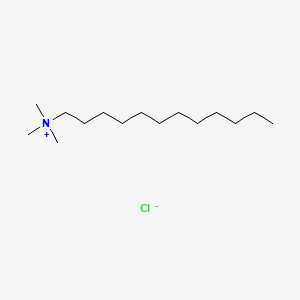
Verifizierte Chemie für CAS 112-00-5
Dodecyltrimethylammonium chloride
The CIR Expert Panel concluded the following ingredients are safe in the present practices of use and concentration described in the safety assessment when formulated to be non-irritating...Laurtrimonium Chloride... — Cosmetic Ingredient Review (CIR)
- IUPAC-Name
- dodecyl(trimethyl)azanium chloride
- Summenformel
- C15H34ClN
- Molekulargewicht
- 263.89 g/mol
- Exakte Masse
- 263.2379778 Da
- Monoisotopische Masse
- 263.2379778 Da
- Topologische polare Oberfläche
- 0,0 Ų
- Molekulare Komplexität
- 135,0
- Formale Ladung
- 0
- Wasserstoffbrücken-Donoren
- 0
- Wasserstoffbrücken-Akzeptoren
- 1
- Drehbare Bindungen
- 11
- Schweratome
- 17
- Kovalente Einheiten
- 2
An PubChem gemeldete Namen und Synonyme
16 weitere gemeldete Namen
Kennungen in externen Datenbanken
- ChEMBL:CHEMBL1884887
- EPA DTXSID:DTXSID1026900
Erweiterte Strukturstatistik
- Definierte Atom-Stereozentren
- 0
- Nicht definierte Atom-Stereozentren
- 0
- Definierte Bindungs-Stereozentren
- 0
- Nicht definierte Bindungs-Stereozentren
- 0
- 3D-Konformere
- 0
Maschinenlesbare Strukturkennungen
- SMILES
CCCCCCCCCCCC[N+](C)(C)C.[Cl-]- InChI
InChI=1S/C15H34N.ClH/c1-5-6-7-8-9-10-11-12-13-14-15-16(2,3)4;/h5-15H2,1-4H3;1H/q+1;/p-1- InChIKey
DDXLVDQZPFLQMZ-UHFFFAOYSA-M
Belege aus weiteren wissenschaftlichen Datenbanken
NIH PubChem PUG-View
Attributed physical-property, hazard, environmental and use annotations.
- Physical Description: CBI; Liquid Quelle: EPA Chemical Data Reporting (CDR)
- Physical Description: Solid; [EPA ChAMP: Initial Risk-Based Prioritization Document] White to light yellow powder and chunks; Hygroscopic; [Acros Organics MSDS] Quelle: Haz-Map, Information on Hazardous Chemicals and Occupational Diseases
- Vapor Pressure: 0.00000001 [mmHg] Quelle: Haz-Map, Information on Hazardous Chemicals and Occupational Diseases
- Note: This chemical does not meet GHS hazard criteria for 2.5% (12 of 476) of reports. Quelle: European Chemicals Agency (ECHA)
- Signal: Danger Quelle: European Chemicals Agency (ECHA)
- GHS Hazard Statements: H302 (87.2%): Harmful if swallowed [Warning Acute toxicity, oral]; H314 (31.1%): Causes severe skin burns and eye damage [Danger Skin corrosion/irritation]; H315 (64.1%): Causes skin irritation [Warning Skin corrosion/irritation]; H318 (28.8%): Causes serious eye damage [Danger Serious eye damage/eye irritation]; H319 (54%): Causes serious eye irritation [Warning Serious eye damage/eye irritation]; H335 (30%): May cause respiratory irritation [Warning Specific target organ toxicity, single exposure; Respiratory tract irritation]; H400 (80.3%): Very toxic to aquatic life [Warning Hazardous to the aquatic environment, acute hazard]; H410 (27.9%): Very toxic to aquatic life with long lasting effects [Warning Hazardous to the aquatic environment, long-term hazard]; H411 (10.1%): Toxic to aquatic life with long lasting effects [Hazardous to the aquatic environment, long-term hazard] Quelle: European Chemicals Agency (ECHA)
- Precautionary Statement Codes: P260, P261, P264, P264+P265, P270, P271, P273, P280, P301+P317, P301+P330+P331, P302+P352, P302+P361+P354, P304+P340, P305+P351+P338, P305+P354+P338, P316, P317, P319, P321, P330, P332+P317, P337+P317, P362+P364, P363, P391, P403+P233, P405, and P501 (click each P-code to see the statement) Quelle: European Chemicals Agency (ECHA)
- ECHA C&L Notifications Summary: Aggregated GHS information provided per 476 reports by companies from 28 notifications to the ECHA C&L Inventory. Each notification may be associated with multiple companies.; Reported as not meeting GHS hazard criteria per 12 of 476 reports by companies.; There are 27 notifications provided by 464 of 476 reports by companies with hazard statement code(s).; Information may vary between notifications depending on impurities, additives, and other factors. The percentage value in parenthesis indicates the notified classification ratio from companies that provide hazard codes. Only hazard codes with percentage values above 10% are shown. For more detailed information, please visit ECHA C&L website. Quelle: European Chemicals Agency (ECHA)
- Signal: Warning Quelle: NITE-CMC
- GHS Hazard Statements: H302: Harmful if swallowed [Warning Acute toxicity, oral]; H315: Causes skin irritation [Warning Skin corrosion/irritation]; H319: Causes serious eye irritation [Warning Serious eye damage/eye irritation] Quelle: NITE-CMC
- Precautionary Statement Codes: P264, P264+P265, P270, P280, P301+P317, P302+P352, P305+P351+P338, P321, P330, P332+P317, P337+P317, P362+P364, and P501 (click each P-code to see the statement) Quelle: NITE-CMC
- GHS Hazard Statements: Not Classified Quelle: NITE-CMC
- Signal: Danger Quelle: Hazardous Chemical Information System (HCIS), Safe Work Australia
- GHS Hazard Statements: H302: Harmful if swallowed [Warning Acute toxicity, oral]; H312: Harmful in contact with skin [Warning Acute toxicity, dermal]; H314: Causes severe skin burns and eye damage [Danger Skin corrosion/irritation] Quelle: Hazardous Chemical Information System (HCIS), Safe Work Australia
- Precautionary Statement Codes: P260, P264, P270, P280, P301+P317, P301+P330+P331, P302+P352, P302+P361+P354, P304+P340, P305+P354+P338, P316, P317, P321, P330, P362+P364, P363, P405, and P501 (click each P-code to see the statement) Quelle: Hazardous Chemical Information System (HCIS), Safe Work Australia
- Cosmetic Ingredient Review Conclusion: The CIR Expert Panel concluded the following ingredients are safe in the present practices of use and concentration described in the safety assessment when formulated to be non-irritating...Laurtrimonium Chloride... Quelle: Cosmetic Ingredient Review (CIR)
- Cosmetic Ingredient Review Finding(s): Safe for use in cosmetics, with qualifications Quelle: Cosmetic Ingredient Review (CIR)
- Consumer Uses: Corrosion inhibitor; Surfactant (surface active agent) Quelle: EPA Chemical Data Reporting (CDR)
- Industry Uses: CBI; Surfactant (surface active agent); Corrosion inhibitor; Etching agent Quelle: EPA Chemical Data Reporting (CDR)
- Cosmetic Ingredient Review Link: CIR ingredient: Laurtrimonium Chloride Quelle: Cosmetic Ingredient Review (CIR)
- Sources/Uses: Typical uses of category members include surfactants, intermediates, anti-scaling agents, fabric softeners, multifunctional laundry detergents, antistatic sprays, germicides, deodorizers, emulsifiers, hair-care products, industrial lubricants, and corrosion inhibitors; [EPA ChAMP: Initial Risk-Based Prioritization Document] Quelle: Haz-Map, Information on Hazardous Chemicals and Occupational Diseases
- Industrial Processes with risk of exposure: Using Disinfectants or Biocides [Category: Clean] Quelle: Haz-Map, Information on Hazardous Chemicals and Occupational Diseases
Zugeordnet durch: Existing checksum-valid CAS to unique PubChem CID match. Abgerufen: 2026-08-31. Quelleneintrag öffnen
Wissenschaftliche Klassifizierungen und Gefahrenannotationen liefern Kontext und ersetzen nicht die oben gezeigte marktspezifische regulatorische Entscheidung.
Weitere Quellenabdeckung und Trefferstatus
| Quelle | Ergebnis | Geprüft |
|---|---|---|
| NIH PubChem PUG-View | Exakter Treffer | 2026-08-31 |
Ein erfasster Nicht-Treffer ist ein nützlicher Beleg dafür, dass die Quelle geprüft wurde; er ist keine Behauptung, dass der Stoff anderswo nicht existiert.
Am 2026-09-02 von NIH PubChem durch prüfsummengültigen CAS-Abgleich abgerufen. Chemische Eigenschaften ersetzen nicht die regulatorische Entscheidung auf dieser Seite.
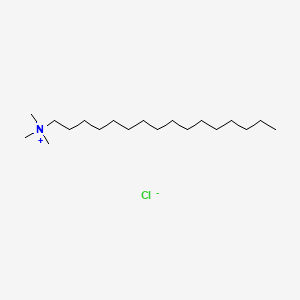
Verifizierte Chemie für CAS 112-02-7
Hexadecyltrimethylammonium chloride
Cetyltrimethylammonium chloride is the organic chloride salt of cetyltrimethylammonium. It has a role as a surfactant. It is a quaternary ammonium salt and an organic chloride salt. It contains a cetyltrimethylammonium ion. — ChEBI
- IUPAC-Name
- hexadecyl(trimethyl)azanium chloride
- Summenformel
- C19H42ClN
- Molekulargewicht
- 320.0 g/mol
- Exakte Masse
- 319.3005780 Da
- Monoisotopische Masse
- 319.3005780 Da
- Topologische polare Oberfläche
- 0,0 Ų
- Molekulare Komplexität
- 181,0
- Formale Ladung
- 0
- Wasserstoffbrücken-Donoren
- 0
- Wasserstoffbrücken-Akzeptoren
- 1
- Drehbare Bindungen
- 15
- Schweratome
- 21
- Kovalente Einheiten
- 2
An PubChem gemeldete Namen und Synonyme
16 weitere gemeldete Namen
Kennungen in externen Datenbanken
- ChEBI:CHEBI:53581
- ChEMBL:CHEMBL1895807
- EPA DTXSID:DTXSID6026901
- PubMed:10124
Erweiterte Strukturstatistik
- Definierte Atom-Stereozentren
- 0
- Nicht definierte Atom-Stereozentren
- 0
- Definierte Bindungs-Stereozentren
- 0
- Nicht definierte Bindungs-Stereozentren
- 0
- 3D-Konformere
- 0
Maschinenlesbare Strukturkennungen
- SMILES
CCCCCCCCCCCCCCCC[N+](C)(C)C.[Cl-]- InChI
InChI=1S/C19H42N.ClH/c1-5-6-7-8-9-10-11-12-13-14-15-16-17-18-19-20(2,3)4;/h5-19H2,1-4H3;1H/q+1;/p-1- InChIKey
WOWHHFRSBJGXCM-UHFFFAOYSA-M
Belege aus weiteren wissenschaftlichen Datenbanken
NIH PubChem PUG-View
Attributed physical-property, hazard, environmental and use annotations.
- Autoignition Temperature: 750 °F (USCG, 1999) Quelle: CAMEO Chemicals
- Autoignition Temperature: 750 °F /ISOPROPYL ALCOHOL SOLN OF CETYLTRIMETHYLAMMONIUM CHLORIDE/ Quelle: Hazardous Substances Data Bank (HSDB)
- Boiling Point: 180 °F at 760 mmHg (isopropyl alcohol) (USCG, 1999) Quelle: CAMEO Chemicals
- Density: 0.9 at 77 °F (approx.) (USCG, 1999) - Less dense than water; will float Quelle: CAMEO Chemicals
- Flash Point: 69 °F (USCG, 1999) Quelle: CAMEO Chemicals
- LogP: log Kow= 3.23 Quelle: Hazardous Substances Data Bank (HSDB)
- Physical Description: Hexadecyltrimethylammonium chloride appears as colorless to pale yellow liquid with an odor of rubbing alcohol. Floats or sinks in water. (USCG, 1999) Quelle: CAMEO Chemicals
- Physical Description: Liquid; CBI Quelle: EPA Chemical Data Reporting (CDR)
- Physical Description: Solution: Clear to pale yellow liquid; [HSDB] White powder; [MSDSonline] Quelle: Haz-Map, Information on Hazardous Chemicals and Occupational Diseases
- Solubility: Water solubility: 440 mg/l at 30 °C Quelle: Hazardous Substances Data Bank (HSDB)
- First Aid: INGESTION: do NOT induce vomiting; drink large quanities of fluid and call a physician immediately.; EYES: flush with water for at least 15 min. and call a physician.; SKIN: flush with water. (USCG, 1999) Quelle: CAMEO Chemicals
- Note: This chemical does not meet GHS hazard criteria for 0.5% (5 of 1105) of reports. Quelle: European Chemicals Agency (ECHA)
- Signal: Danger Quelle: European Chemicals Agency (ECHA)
- GHS Hazard Statements: H302 (49%): Harmful if swallowed [Warning Acute toxicity, oral]; H311 (28.6%): Toxic in contact with skin [Danger Acute toxicity, dermal]; H314 (41.5%): Causes severe skin burns and eye damage [Danger Skin corrosion/irritation]; H315 (52.3%): Causes skin irritation [Warning Skin corrosion/irritation]; H318 (85.7%): Causes serious eye damage [Danger Serious eye damage/eye irritation]; H335 (44.3%): May cause respiratory irritation [Warning Specific target organ toxicity, single exposure; Respiratory tract irritation]; H400 (99.4%): Very toxic to aquatic life [Warning Hazardous to the aquatic environment, acute hazard]; H410 (40.9%): Very toxic to aquatic life with long lasting effects [Warning Hazardous to the aquatic environment, long-term hazard] Quelle: European Chemicals Agency (ECHA)
- Precautionary Statement Codes: P260, P261, P262, P264, P264+P265, P270, P271, P273, P280, P301+P317, P301+P330+P331, P302+P352, P302+P361+P354, P304+P340, P305+P354+P338, P316, P317, P319, P321, P330, P332+P317, P361+P364, P362+P364, P363, P391, P403+P233, P405, and P501 (click each P-code to see the statement) Quelle: European Chemicals Agency (ECHA)
- ECHA C&L Notifications Summary: Aggregated GHS information provided per 1105 reports by companies from 42 notifications to the ECHA C&L Inventory. Each notification may be associated with multiple companies.; Reported as not meeting GHS hazard criteria per 5 of 1105 reports by companies.; There are 41 notifications provided by 1100 of 1105 reports by companies with hazard statement code(s).; Information may vary between notifications depending on impurities, additives, and other factors. The percentage value in parenthesis indicates the notified classification ratio from companies that provide hazard codes. Only hazard codes with percentage values above 10% are shown. For more detailed information, please visit ECHA C&L website. Quelle: European Chemicals Agency (ECHA)
- Signal: Danger Quelle: NITE-CMC
- GHS Hazard Statements: H302: Harmful if swallowed [Warning Acute toxicity, oral]; H315: Causes skin irritation [Warning Skin corrosion/irritation]; H318: Causes serious eye damage [Danger Serious eye damage/eye irritation]; H335: May cause respiratory irritation [Warning Specific target organ toxicity, single exposure; Respiratory tract irritation]; H400: Very toxic to aquatic life [Warning Hazardous to the aquatic environment, acute hazard]; H410: Very toxic to aquatic life with long lasting effects [Warning Hazardous to the aquatic environment, long-term hazard] Quelle: NITE-CMC
- Precautionary Statement Codes: P261, P264, P264+P265, P270, P271, P273, P280, P301+P317, P302+P352, P304+P340, P305+P354+P338, P317, P319, P321, P330, P332+P317, P362+P364, P391, P403+P233, P405, and P501 (click each P-code to see the statement) Quelle: NITE-CMC
- Signal: Warning Quelle: NITE-CMC
- GHS Hazard Statements: H302: Harmful if swallowed [Warning Acute toxicity, oral]; H315: Causes skin irritation [Warning Skin corrosion/irritation]; H319: Causes serious eye irritation [Warning Serious eye damage/eye irritation]; H335: May cause respiratory irritation [Warning Specific target organ toxicity, single exposure; Respiratory tract irritation] Quelle: NITE-CMC
- Precautionary Statement Codes: P261, P264, P264+P265, P270, P271, P280, P301+P317, P302+P352, P304+P340, P305+P351+P338, P319, P321, P330, P332+P317, P337+P317, P362+P364, P403+P233, P405, and P501 (click each P-code to see the statement) Quelle: NITE-CMC
- Signal: Danger Quelle: Hazardous Chemical Information System (HCIS), Safe Work Australia
- Cosmetic Ingredient Review Conclusion: The CIR Expert Panel concluded the following ingredients are safe in the present practices of use and concentration described in the safety assessment when formulated to be non-irritating...Cetrimonium Chloride... Quelle: Cosmetic Ingredient Review (CIR)
- Cosmetic Ingredient Review Finding(s): Safe for use in cosmetics, with qualifications Quelle: Cosmetic Ingredient Review (CIR)
- Environmental Bioconcentration: An estimated BCF of 71 was calculated for trimethylhexadecylammonium chloride(SRC), using an estimated log Kow of 3.23(1) and a regression-derived equation(2). According to a classification scheme(3), this BCF suggests the potential for bioconcentration in aquatic organisms is moderate. Quelle: Hazardous Substances Data Bank (HSDB)
- Environmental Fate: TERRESTRIAL FATE: Based on a classification scheme(1), an estimated Koc value of 2.2X10+5(SRC), determined from a structure estimation method(2), indicates that trimethylhexadecylammonium chloride is expected to be immobile in soil(SRC). Volatilization of trimethylhexadecylammonium chloride from moist soil surfaces is not expected to be an important fate process(SRC) given an estimated Henry's Law constant of 2.9X10⁻¹⁰ atm-cu m/mole(SRC), using a fragment constant estimation method(3). Trimethylhexadecylammonium chloride is not expected to volatilize from dry soil surfaces(SRC) based upon an estimated vapor pressure of 2.8X10⁻¹⁰ mm Hg(SRC), determined from a fragment constant method(4). Quelle: Hazardous Substances Data Bank (HSDB)
- Environmental Fate: AQUATIC FATE: Based on a classification scheme(1), an estimated Koc value of 2.2X10+5(SRC), determined from an estimation method(2), indicates that trimethylhexadecylammonium chloride is expected to adsorb to suspended solids and sediment in water(SRC). Volatilization from water surfaces is not expected(3) based upon an estimated Henry's Law constant of 2.9X10⁻¹⁰ atm-cu m/mole(SRC), developed using a fragment constant estimation method(4). According to a classification scheme(5), an estimated BCF of 71(SRC), from its log Kow of 3.23(6) and a regression-derived equation(7), suggests the potential for bioconcentration in aquatic organisms is moderate. The MITI, closed bottle, and Sturm tests revealed no degradation after 10 days, microbial growth after 17 days, and 84% degradation after 13 days, respectively(8). 10-20 ppm trimethylhexadecylammonium chloride was degraded with a half-life of 3.1 days in freshwater collected from the Ohio river 1 mile below discharge from a municipal treatment plant at 20 °C and pH 6.9(9). Quelle: Hazardous Substances Data Bank (HSDB)
- Environmental Fate: ATMOSPHERIC FATE: According to a model of gas/particle partitioning of semivolatile organic compounds in the atmosphere(1), trimethylhexadecylammonium chloride, which has an estimated vapor pressure of 2.8X10⁻¹⁰ mm Hg at 25 °C(SRC), using a fragment constant estimation method(2), is expected to exist solely in the particulate phase in the ambient atmosphere. Particulate-phase trimethylhexadecylammonium chloride may be removed from the air by wet and dry deposition(SRC). Quelle: Hazardous Substances Data Bank (HSDB)
- Consumer Uses: Cleaning agent; Corrosion inhibitor; Softener and conditioner; Surface modifier; Surfactant (surface active agent) Quelle: EPA Chemical Data Reporting (CDR)
- Industry Uses: Corrosion inhibitor; Processing aids, specific to petroleum production; Softener and conditioner; Surface modifier; CBI; Processing aids not otherwise specified; Surfactant (surface active agent) Quelle: EPA Chemical Data Reporting (CDR)
- Cosmetic Ingredient Review Link: CIR ingredient: Cetrimonium Chloride Quelle: Cosmetic Ingredient Review (CIR)
- Sources/Uses: Available as a 25% aqueous solution and 50% solution in isopropyl alcohol and water for use in antifungal formulations and hair conditioners; Also used as a disinfectant/germicide, cationic detergent, fermentation aid, dispersant, coagulant for antibiotic production, and antistatic and softening agent for textile finishes; [HSDB] Quelle: Haz-Map, Information on Hazardous Chemicals and Occupational Diseases
- Industrial Processes with risk of exposure: Using Disinfectants or Biocides [Category: Clean]; Textiles (Printing, Dyeing, or Finishing) [Category: Industry] Quelle: Haz-Map, Information on Hazardous Chemicals and Occupational Diseases
- Uses: USED IN ANTIFUNGAL FORMULATION; IN HAIR CONDITIONER FORMULATION; DISINFECTANT; CATIONIC DETERGENT Quelle: Hazardous Substances Data Bank (HSDB)
- Uses: SOFTENER IN HAIR TREATMENTS, EG, CREME RINSES Quelle: Hazardous Substances Data Bank (HSDB)
- Uses: FERMENTATION AID Quelle: Hazardous Substances Data Bank (HSDB)
- Uses: GERMICIDE Quelle: Hazardous Substances Data Bank (HSDB)
- Uses: For more Uses (Complete) data for TRIMETHYLHEXADECYLAMMONIUM CHLORIDE (6 total), please visit the HSDB record page. Quelle: Hazardous Substances Data Bank (HSDB)
Zugeordnet durch: Existing checksum-valid CAS to unique PubChem CID match. Abgerufen: 2026-08-31. Quelleneintrag öffnen
Wissenschaftliche Klassifizierungen und Gefahrenannotationen liefern Kontext und ersetzen nicht die oben gezeigte marktspezifische regulatorische Entscheidung.
Weitere Quellenabdeckung und Trefferstatus
| Quelle | Ergebnis | Geprüft |
|---|---|---|
| NIH PubChem PUG-View | Exakter Treffer | 2026-08-31 |
Ein erfasster Nicht-Treffer ist ein nützlicher Beleg dafür, dass die Quelle geprüft wurde; er ist keine Behauptung, dass der Stoff anderswo nicht existiert.
Am 2026-08-31 von NIH PubChem durch prüfsummengültigen CAS-Abgleich abgerufen. Chemische Eigenschaften ersetzen nicht die regulatorische Entscheidung auf dieser Seite.
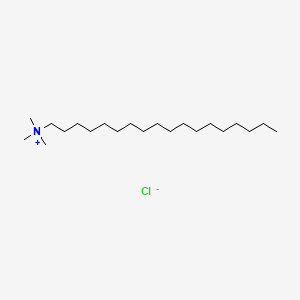
Verifizierte Chemie für CAS 112-03-8
Stearyltrimethylammonium chloride
Stearyltrimethylammonium chloride is an organic molecular entity. — ChEBI
- IUPAC-Name
- trimethyl(octadecyl)azanium chloride
- Summenformel
- C21H46ClN
- Molekulargewicht
- 348.0 g/mol
- Exakte Masse
- 347.3318782 Da
- Monoisotopische Masse
- 347.3318782 Da
- Topologische polare Oberfläche
- 0,0 Ų
- Molekulare Komplexität
- 204,0
- Formale Ladung
- 0
- Wasserstoffbrücken-Donoren
- 0
- Wasserstoffbrücken-Akzeptoren
- 1
- Drehbare Bindungen
- 17
- Schweratome
- 23
- Kovalente Einheiten
- 2
An PubChem gemeldete Namen und Synonyme
16 weitere gemeldete Namen
Kennungen in externen Datenbanken
- ChEBI:CHEBI:81710
- ChEMBL:CHEMBL118745
- EPA DTXSID:DTXSID1026902
Erweiterte Strukturstatistik
- Definierte Atom-Stereozentren
- 0
- Nicht definierte Atom-Stereozentren
- 0
- Definierte Bindungs-Stereozentren
- 0
- Nicht definierte Bindungs-Stereozentren
- 0
- 3D-Konformere
- 0
Maschinenlesbare Strukturkennungen
- SMILES
CCCCCCCCCCCCCCCCCC[N+](C)(C)C.[Cl-]- InChI
InChI=1S/C21H46N.ClH/c1-5-6-7-8-9-10-11-12-13-14-15-16-17-18-19-20-21-22(2,3)4;/h5-21H2,1-4H3;1H/q+1;/p-1- InChIKey
VBIIFPGSPJYLRR-UHFFFAOYSA-M
Belege aus weiteren wissenschaftlichen Datenbanken
NIH PubChem PUG-View
Attributed physical-property, hazard, environmental and use annotations.
- Physical Description: CBI; Large Crystals Quelle: EPA Chemical Data Reporting (CDR)
- Carcinogen Classification: Not listed by IARC. Certain nitrosamines are classified by IARC as either probably or possibly carcinogenic to humans (Groups 2A and 2B, respectively). (L135) Quelle: Toxin and Toxin Target Database (T3DB)
- Exposure Routes: Oral (A2880) ; inhalation (A2880) ; dermal (L1889) Quelle: Toxin and Toxin Target Database (T3DB)
- Note: This chemical does not meet GHS hazard criteria for 3.7% (10 of 268) of reports. Quelle: European Chemicals Agency (ECHA)
- Signal: Danger Quelle: European Chemicals Agency (ECHA)
- GHS Hazard Statements: H302 (88.1%): Harmful if swallowed [Warning Acute toxicity, oral]; H311 (54.5%): Toxic in contact with skin [Danger Acute toxicity, dermal]; H312 (19.8%): Harmful in contact with skin [Warning Acute toxicity, dermal]; H314 (79.1%): Causes severe skin burns and eye damage [Danger Skin corrosion/irritation]; H318 (29.5%): Causes serious eye damage [Danger Serious eye damage/eye irritation]; H400 (71.6%): Very toxic to aquatic life [Warning Hazardous to the aquatic environment, acute hazard]; H410 (78.7%): Very toxic to aquatic life with long lasting effects [Warning Hazardous to the aquatic environment, long-term hazard] Quelle: European Chemicals Agency (ECHA)
- Precautionary Statement Codes: P260, P262, P264, P264+P265, P270, P273, P280, P301+P317, P301+P330+P331, P302+P352, P302+P361+P354, P304+P340, P305+P354+P338, P316, P317, P321, P330, P361+P364, P362+P364, P363, P391, P405, and P501 (click each P-code to see the statement) Quelle: European Chemicals Agency (ECHA)
- ECHA C&L Notifications Summary: Aggregated GHS information provided per 268 reports by companies from 19 notifications to the ECHA C&L Inventory. Each notification may be associated with multiple companies.; Reported as not meeting GHS hazard criteria per 10 of 268 reports by companies.; There are 18 notifications provided by 258 of 268 reports by companies with hazard statement code(s).; Information may vary between notifications depending on impurities, additives, and other factors. The percentage value in parenthesis indicates the notified classification ratio from companies that provide hazard codes. Only hazard codes with percentage values above 10% are shown. For more detailed information, please visit ECHA C&L website. Quelle: European Chemicals Agency (ECHA)
- Signal: Warning Quelle: NITE-CMC
- GHS Hazard Statements: H302: Harmful if swallowed [Warning Acute toxicity, oral]; H312: Harmful in contact with skin [Warning Acute toxicity, dermal] Quelle: NITE-CMC
- Precautionary Statement Codes: P264, P270, P280, P301+P317, P302+P352, P317, P321, P330, P362+P364, and P501 (click each P-code to see the statement) Quelle: NITE-CMC
- Signal: Danger Quelle: Hazardous Chemical Information System (HCIS), Safe Work Australia
- GHS Hazard Statements: H302: Harmful if swallowed [Warning Acute toxicity, oral]; H312: Harmful in contact with skin [Warning Acute toxicity, dermal]; H314: Causes severe skin burns and eye damage [Danger Skin corrosion/irritation] Quelle: Hazardous Chemical Information System (HCIS), Safe Work Australia
- Precautionary Statement Codes: P260, P264, P270, P280, P301+P317, P301+P330+P331, P302+P352, P302+P361+P354, P304+P340, P305+P354+P338, P316, P317, P321, P330, P362+P364, P363, P405, and P501 (click each P-code to see the statement) Quelle: Hazardous Chemical Information System (HCIS), Safe Work Australia
- Health Effects: Quaternium-10 may react to produce nitrosamines, which are believed to be carcinogenic. (L1890) Quelle: Toxin and Toxin Target Database (T3DB)
- Cosmetic Ingredient Review Conclusion: The CIR Expert Panel concluded the following ingredients are safe in the present practices of use and concentration described in the safety assessment when formulated to be non-irritating...Steartrimonium Chloride... Quelle: Cosmetic Ingredient Review (CIR)
- Cosmetic Ingredient Review Finding(s): Safe for use in cosmetics, with qualifications Quelle: Cosmetic Ingredient Review (CIR)
- Toxicity Summary: While quaternium-10 itself is not toxic, it is a nitrosating agent. Nitrosating agents may decompose and/or react to cause nitrosamine contamination. Nitrosamines are produced from secondary amines and amides in the presence of nitrite ions and are believed to be carcinogenic. Once in the body, nitrosamines are activated by cytochrome P-450 enzymes. They are then believed to induce their carcinogenic effects by forming DNA adducts at the N- and O-atoms. (L1889, L1890, A2878, A2879, A2880) Quelle: Toxin and Toxin Target Database (T3DB)
- Cosmetic Ingredient Review Link: CIR ingredient: Steartrimonium Chloride Quelle: Cosmetic Ingredient Review (CIR)
- Uses: Quaternium-10 is a quaternary ammonium salt found in numerous cosmetics. (L1890) Quelle: Toxin and Toxin Target Database (T3DB)
Zugeordnet durch: Existing checksum-valid CAS to unique PubChem CID match. Abgerufen: 2026-08-31. Quelleneintrag öffnen
Wissenschaftliche Klassifizierungen und Gefahrenannotationen liefern Kontext und ersetzen nicht die oben gezeigte marktspezifische regulatorische Entscheidung.
Weitere Quellenabdeckung und Trefferstatus
| Quelle | Ergebnis | Geprüft |
|---|---|---|
| NIH PubChem PUG-View | Exakter Treffer | 2026-08-31 |
Ein erfasster Nicht-Treffer ist ein nützlicher Beleg dafür, dass die Quelle geprüft wurde; er ist keine Behauptung, dass der Stoff anderswo nicht existiert.
Am 2026-08-31 von NIH PubChem durch prüfsummengültigen CAS-Abgleich abgerufen. Chemische Eigenschaften ersetzen nicht die regulatorische Entscheidung auf dieser Seite.
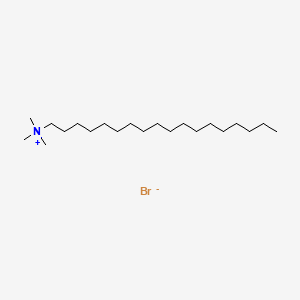
Verifizierte Chemie für CAS 1120-02-1
Octadecyltrimethylammonium bromide
The CIR Expert Panel concluded the following ingredients are safe in the present practices of use and concentration described in the safety assessment when formulated to be non-irritating...Steartrimonium Bromide... — Cosmetic Ingredient Review (CIR)
- IUPAC-Name
- trimethyl(octadecyl)azanium bromide
- Summenformel
- C21H46BrN
- Molekulargewicht
- 392.5 g/mol
- Exakte Masse
- 391.28136 Da
- Monoisotopische Masse
- 391.28136 Da
- Topologische polare Oberfläche
- 0,0 Ų
- Molekulare Komplexität
- 204,0
- Formale Ladung
- 0
- Wasserstoffbrücken-Donoren
- 0
- Wasserstoffbrücken-Akzeptoren
- 1
- Drehbare Bindungen
- 17
- Schweratome
- 23
- Kovalente Einheiten
- 2
An PubChem gemeldete Namen und Synonyme
16 weitere gemeldete Namen
Kennungen in externen Datenbanken
- ChEMBL:CHEMBL109458
- EPA DTXSID:DTXSID40883652
Erweiterte Strukturstatistik
- Definierte Atom-Stereozentren
- 0
- Nicht definierte Atom-Stereozentren
- 0
- Definierte Bindungs-Stereozentren
- 0
- Nicht definierte Bindungs-Stereozentren
- 0
- 3D-Konformere
- 0
Maschinenlesbare Strukturkennungen
- SMILES
CCCCCCCCCCCCCCCCCC[N+](C)(C)C.[Br-]- InChI
InChI=1S/C21H46N.BrH/c1-5-6-7-8-9-10-11-12-13-14-15-16-17-18-19-20-21-22(2,3)4;/h5-21H2,1-4H3;1H/q+1;/p-1- InChIKey
SZEMGTQCPRNXEG-UHFFFAOYSA-M
Belege aus weiteren wissenschaftlichen Datenbanken
NIH PubChem PUG-View
Attributed physical-property, hazard, environmental and use annotations.
- Physical Description: White hygroscopic powder; [Sigma-Aldrich MSDS] Quelle: Haz-Map, Information on Hazardous Chemicals and Occupational Diseases
- Signal: Danger Quelle: European Chemicals Agency (ECHA)
- GHS Hazard Statements: H302 (13%): Harmful if swallowed [Warning Acute toxicity, oral]; H315 (100%): Causes skin irritation [Warning Skin corrosion/irritation]; H317 (10.9%): May cause an allergic skin reaction [Warning Sensitization, Skin]; H318 (10.9%): Causes serious eye damage [Danger Serious eye damage/eye irritation]; H319 (89.1%): Causes serious eye irritation [Warning Serious eye damage/eye irritation]; H335 (87%): May cause respiratory irritation [Warning Specific target organ toxicity, single exposure; Respiratory tract irritation] Quelle: European Chemicals Agency (ECHA)
- Precautionary Statement Codes: P261, P264, P264+P265, P270, P271, P272, P280, P301+P317, P302+P352, P304+P340, P305+P351+P338, P305+P354+P338, P317, P319, P321, P330, P332+P317, P333+P317, P337+P317, P362+P364, P403+P233, P405, and P501 (click each P-code to see the statement) Quelle: European Chemicals Agency (ECHA)
- ECHA C&L Notifications Summary: Aggregated GHS information provided per 46 reports by companies from 7 notifications to the ECHA C&L Inventory. Each notification may be associated with multiple companies.; Information may vary between notifications depending on impurities, additives, and other factors. The percentage value in parenthesis indicates the notified classification ratio from companies that provide hazard codes. Only hazard codes with percentage values above 10% are shown. For more detailed information, please visit ECHA C&L website. Quelle: European Chemicals Agency (ECHA)
- Cosmetic Ingredient Review Conclusion: The CIR Expert Panel concluded the following ingredients are safe in the present practices of use and concentration described in the safety assessment when formulated to be non-irritating...Steartrimonium Bromide... Quelle: Cosmetic Ingredient Review (CIR)
- Cosmetic Ingredient Review Finding(s): Safe for use in cosmetics, with qualifications Quelle: Cosmetic Ingredient Review (CIR)
- Cosmetic Ingredient Review Link: CIR ingredient: Steartrimonium Bromide Quelle: Cosmetic Ingredient Review (CIR)
Zugeordnet durch: Existing checksum-valid CAS to unique PubChem CID match. Abgerufen: 2026-08-31. Quelleneintrag öffnen
Wissenschaftliche Klassifizierungen und Gefahrenannotationen liefern Kontext und ersetzen nicht die oben gezeigte marktspezifische regulatorische Entscheidung.
Weitere Quellenabdeckung und Trefferstatus
| Quelle | Ergebnis | Geprüft |
|---|---|---|
| NIH PubChem PUG-View | Exakter Treffer | 2026-08-31 |
Ein erfasster Nicht-Treffer ist ein nützlicher Beleg dafür, dass die Quelle geprüft wurde; er ist keine Behauptung, dass der Stoff anderswo nicht existiert.
Am 2026-09-02 von NIH PubChem durch prüfsummengültigen CAS-Abgleich abgerufen. Chemische Eigenschaften ersetzen nicht die regulatorische Entscheidung auf dieser Seite.
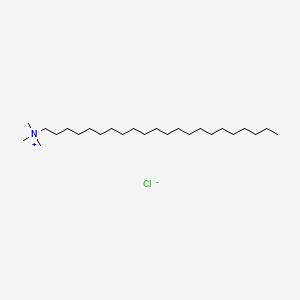
Verifizierte Chemie für CAS 17301-53-0
Behentrimonium Chloride
The CIR Expert Panel concluded the following ingredients are safe in the present practices of use and concentration described in the safety assessment when formulated to be non-irritating...Behentrimonium Chloride... — Cosmetic Ingredient Review (CIR)
- IUPAC-Name
- docosyl(trimethyl)azanium chloride
- Summenformel
- C25H54ClN
- Molekulargewicht
- 404.2 g/mol
- Exakte Masse
- 403.3944784 Da
- Monoisotopische Masse
- 403.3944784 Da
- Topologische polare Oberfläche
- 0,0 Ų
- Molekulare Komplexität
- 253,0
- Formale Ladung
- 0
- Wasserstoffbrücken-Donoren
- 0
- Wasserstoffbrücken-Akzeptoren
- 1
- Drehbare Bindungen
- 21
- Schweratome
- 27
- Kovalente Einheiten
- 2
An PubChem gemeldete Namen und Synonyme
16 weitere gemeldete Namen
Kennungen in externen Datenbanken
- EPA DTXSID:DTXSID60884964
Erweiterte Strukturstatistik
- Definierte Atom-Stereozentren
- 0
- Nicht definierte Atom-Stereozentren
- 0
- Definierte Bindungs-Stereozentren
- 0
- Nicht definierte Bindungs-Stereozentren
- 0
- 3D-Konformere
- 0
Maschinenlesbare Strukturkennungen
- SMILES
CCCCCCCCCCCCCCCCCCCCCC[N+](C)(C)C.[Cl-]- InChI
InChI=1S/C25H54N.ClH/c1-5-6-7-8-9-10-11-12-13-14-15-16-17-18-19-20-21-22-23-24-25-26(2,3)4;/h5-25H2,1-4H3;1H/q+1;/p-1- InChIKey
YSJGOMATDFSEED-UHFFFAOYSA-M
Am 2026-09-02 von NIH PubChem durch prüfsummengültigen CAS-Abgleich abgerufen. Chemische Eigenschaften ersetzen nicht die regulatorische Entscheidung auf dieser Seite.
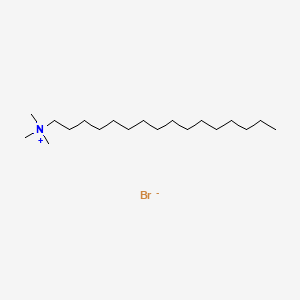
Verifizierte Chemie für CAS 57-09-0
Hexadecyltrimethylammonium Bromide
Cetyltrimethylammonium bromide is the organic bromide salt that is the bromide salt of cetyltrimethylammonium; one of the components of the topical antiseptic cetrimide. It has a role as a detergent and a surfactant. It is a quaternary ammonium salt and an organic bromide salt. It contains a cetyltrimethylammonium ion. — ChEBI
- IUPAC-Name
- hexadecyl(trimethyl)azanium bromide
- Summenformel
- C19H42BrN
- Molekulargewicht
- 364.4 g/mol
- Exakte Masse
- 363.25006 Da
- Monoisotopische Masse
- 363.25006 Da
- Topologische polare Oberfläche
- 0,0 Ų
- Molekulare Komplexität
- 181,0
- Formale Ladung
- 0
- Wasserstoffbrücken-Donoren
- 0
- Wasserstoffbrücken-Akzeptoren
- 1
- Drehbare Bindungen
- 15
- Schweratome
- 21
- Kovalente Einheiten
- 2
An PubChem gemeldete Namen und Synonyme
16 weitere gemeldete Namen
Kennungen in externen Datenbanken
- ChEBI:CHEBI:3567
- ChEMBL:CHEMBL307346
- EPA DTXSID:DTXSID5037028
Erweiterte Strukturstatistik
- Definierte Atom-Stereozentren
- 0
- Nicht definierte Atom-Stereozentren
- 0
- Definierte Bindungs-Stereozentren
- 0
- Nicht definierte Bindungs-Stereozentren
- 0
- 3D-Konformere
- 0
Maschinenlesbare Strukturkennungen
- SMILES
CCCCCCCCCCCCCCCC[N+](C)(C)C.[Br-]- InChI
InChI=1S/C19H42N.BrH/c1-5-6-7-8-9-10-11-12-13-14-15-16-17-18-19-20(2,3)4;/h5-19H2,1-4H3;1H/q+1;/p-1- InChIKey
LZZYPRNAOMGNLH-UHFFFAOYSA-M
Am 2026-09-02 von NIH PubChem durch prüfsummengültigen CAS-Abgleich abgerufen. Chemische Eigenschaften ersetzen nicht die regulatorische Entscheidung auf dieser Seite.
Amtliche Quelle und Herkunft
- Registrierte Quelle
- ASEAN Cosmetic Directive annexes
- Quellenverweis
- ASEAN Annex VI, reference 44
- Eintrags-ID der Quelle
VI-44- Quellenversion
- 2026-1
- Quellsprache
- English
- Übersetzungsstatus
- Original is English
- Quelle aktualisiert
- 2026-06-22
- Stand geprüft
- 2026-08-30 04:44 UTC
- Validierungsmethode
- pdfplumber ruled-table extraction with per-annex reviewed counts
- SHA-256
ffad59f6c01a92c82042c54203ee14969425c2a82bd04c2f4012ff82513e69f1
Hinweise zum registrierten Datensatz
- Datensatzabdeckung
- Banned, restricted and positive-list substances under the harmonised ASEAN framework
- Hinweis zur Behörde
- Regional directive; member-state transitions and deviations still require local verification
Wie dieser Eintrag in den Marktdatensatz passt
Statusverteilung
Bedingungstext ist bei 462 von 2224 aktuellen Einträgen vorhanden. Ein leeres Bedingungsfeld wird entsprechend der oben genannten Eintragsart interpretiert; es wird niemals in die Aussage einer uneingeschränkten Verwendung umgedeutet.
ASEAN Marktkontext
Complete regional annex dataset
Abdeckungsversion: ASEAN Cosmetic Directive annexes 2026-1, 22 June 2026
Annexes II, III, IV, VI and VII covering prohibited, restricted and positive-list substances.
Verifizierungs-Checkliste
- Search all ACD annexes by name and identifiers.
- Apply product type, maximum level and warning conditions.
- Confirm the target member state's adoption and transition date.
- Complete the local notification and responsible-company requirements.
Amtliche Marktquellen
- ASEAN Cosmetic Directive annexesRegional directive; member-state transitions and deviations still require local verification
Verifizierungsablauf und Vollständigkeit des Eintrags
Bevor Sie dieses Ergebnis für eine Compliance-Entscheidung verwenden
- Bestätigen Sie, dass „Alkyl (C ) trimethyl ammonium bromide and 12-22 chloride) (+) Behentrimonium chloride (11) (CAS No. 17301- 53-0), cetrimonium bromide (CAS No. 57-09-0), cetrimonium chloride (12) (CAS No. 112-02- 7), laurtrimonium bromide, (CAS No. 1119- 94-4), laurtrimonium chloride (CAS No. 112- 00-5), steartrimonium bromide (CAS No. 1120-02-1), steartrimonium chloride (12) (CAS No. 112-03-8)“ und jede CAS-/EC-Kennung sich auf das Material in Ihrer Lieferantenspezifikation beziehen.
- Search all ACD annexes by name and identifiers.
- Apply product type, maximum level and warning conditions.
- Confirm the target member state's adoption and transition date.
- Complete the local notification and responsible-company requirements.
- Dokumentieren Sie die Quellenversion und prüfen Sie die Behörde vor Herstellung, Notifizierung oder Inverkehrbringen erneut.
In diesem Eintrag verfügbare Felder
- Amtlicher StoffnameVerfügbar
- CASVerfügbar
- ECVerfügbar
- Gesonderter BedingungstextVerfügbar
- Datum des InkrafttretensNicht angegeben
- Snapshot-Hash und MethodeVerfügbar
Fragen, die diese Seite beantwortet
Dauerhafte Zitierweise
Alkyl (C ) trimethyl ammonium bromide and 12-22 chloride) (+) Behentrimonium chloride (11) (CAS No. 17301- 53-0), cetrimonium bromide (CAS No. 57-09-0), cetrimonium chloride (12) (CAS No. 112-02- 7), laurtrimonium bromide, (CAS No. 1119- 94-4), laurtrimonium chloride (CAS No. 112- 00-5), steartrimonium bromide (CAS No. 1120-02-1), steartrimonium chloride (12) (CAS No. 112-03-8). ASEAN Annex VI, reference 44. ASEAN. Source version 2026-1. CosIng Checker regulatory record: https://cosingchecker.com/de/regulations/asean/records/4303/
Zitieren Sie die Aufsichtsbehörde als rechtliche Autorität. Diese Seite ist ein strukturierter Belegindex und eine Verifizierungshilfe, kein Ersatz für den amtlichen Text oder eine fachkundige rechtliche Bewertung.
Auslegung und Grenzen für ASEAN
This identity appears on a market positive list for the list function represented by the source record.
Confirm that the intended function and product use fall within the list scope and every stated condition.
Wie die Rechtsrolle auszulegen ist
The cited row forms part of a binding rule or legally incorporated list for this market.
Belege auf dieser Seite
- Erfasstes Ergebnis: Permitted list with conditions
- Rechtsrolle: Binding rule
- Quellenversion: 2026-1
Was es nicht beweist
Regional annex coverage does not replace member-state implementation dates, notifications or national deviations.
Weitere maßgebliche Stoffrecherche
Keine dieser Quellen hebt die oben genannte Marktentscheidung auf.
Cosmetic Ingredient Review safety assessments
Expert Panel conclusions, assessed ingredient groups, use conditions, dates and report documents
Independent expert review considered by FDA; not a government approval or binding market rule
Diese Identität bei der Quelle recherchierenFDA Global Substance Registration System
UNII identifiers, preferred names, substance types, codes and public substance relationships
Identity registry only; UNII availability does not imply FDA review or approval
Diese Identität bei der Quelle recherchierenILO/WHO International Chemical Safety Cards
Hazards, symptoms, first aid, storage, incompatibilities and physical properties for covered chemicals
International occupational chemical-safety reference; not cosmetic-use approval
Diese Identität bei der Quelle recherchierenJapan NITE-CHRIP
Chemical identity, Japanese and foreign legal lists, GHS hazards and exposure-related information
Chemical-management evidence; cosmetic status remains governed by the applicable MHLW standard and market rules
Diese Identität bei der Quelle recherchierenNIOSH Pocket Guide to Chemical Hazards
REL, PEL, IDLH, properties, exposure routes, symptoms, target organs, first aid and measurement methods for covered workplace chemicals
US occupational-health guidance and limits; not a cosmetic ingredient decision
Diese Identität bei der Quelle recherchierenOECD eChemPortal
Gateway to authority-owned physical-property, fate, ecotoxicity, toxicity, exposure and GHS records
Discovery gateway; each linked authority remains responsible for its data
Diese Identität bei der Quelle recherchierenUS EPA CompTox CTX APIs
Für den Import ist ein API-Schlüssel erforderlichDTXSID identity, experimental and predicted properties, toxicity, bioactivity, exposure and environmental data
Scientific and computational evidence; predictions must remain labelled and do not determine cosmetic legality
Diese Identität bei der Quelle recherchieren