
CHLOROPHENE
Phenol, 4-chloro-2-(phenylmethyl)-
CHLOROPHENE ist auf dieser Seite mit 1 EU-Anhangseintrag verknüpft. Hinweis aus dem Verzeichnis: II/1602.
Auf einen Blick
- Funktion
- Antimicrobial, preservative
- CAS
- 120-32-1
- EC
- 204-385-8
- EU-Anhänge
- Anhang II/1602
- Anhang II/1602: in kosmetischen Mitteln verboten
Regulatorische Belege nach Markt
Diese Matrix trennt verifizierte Vorschriften zu Inhaltsstoffen von Quellen, die zwar erfasst, aber noch nicht importiert sind. Eine fehlende importierte Vorschrift bedeutet nicht, dass der Inhaltsstoff zulässig ist.
Wischen oder scrollen Sie horizontal, um alle Spalten zu sehen.
| Markt | Belegstatus | Einträge | Quellsprache |
|---|---|---|---|
| European Union | Beleg verknüpft Prohibited entry found Diesen Beleg öffnen | 1 | English and EU languages |
| Great Britain | Beleg verknüpft Prohibited Diesen Beleg öffnen | 1 | English |
| Canada | Quelle erfasst Official source mapped; ingredient rule not imported | 0 | English and French |
| New Zealand | Beleg verknüpft Prohibited Diesen Beleg öffnen | 1 | English |
| ASEAN | Beleg verknüpft Prohibited Diesen Beleg öffnen | 1 | English and national languages |
| China | Beleg verknüpft Prohibited Diesen Beleg öffnen | 1 | Chinese with selected English material |
| Japan | Quelle erfasst Official source mapped; ingredient rule not imported | 0 | Japanese; official English translation available |
| South Korea | Beleg verknüpft Restricted Diesen Beleg öffnen | 1 | Korean with some English names |
| United States | Quelle erfasst Official source mapped; ingredient rule not imported | 0 | English |
| Australia | Quelle erfasst Official source mapped; ingredient rule not imported | 0 | English |
| Brazil | Beleg verknüpft Prohibited Diesen Beleg öffnen | 1 | Portuguese with INCI crosswalks |
| India | Beleg verknüpft Prohibited Diesen Beleg öffnen | 1 | English and Hindi |
| Saudi Arabia | Beleg verknüpft Prohibited Diesen Beleg öffnen | 1 | Arabic and English |
Verzeichnisangaben zu CHLOROPHENE
INCI-Name
CHLOROPHENE
INN-Name
clorofene
Beschreibung
Phenol, 4-chloro-2-(phenylmethyl)-
Herkunft des Eintrags
- Verzeichnisverweis
- 32664
- Importierte Identität
- CHLOROPHENE
- Quellenaktualisierung
- 30/07/2020
Anhangseinträge für CHLOROPHENE
Clorofene; chlorophene; 2-benzyl-4-chlorophenol
Kerndaten
- ANTIMICROBIAL
Preventing and/or slowing down microbial growth.
- PRESERVATIVE
Exclusively or mainly intended to inhibit the development of micro-organisms in the cosmetic product. All authorised preservatives are substances in the positive list of Annex V to the Cosmetics Regulation 1223/2009.
Chemische Identität und Eigenschaften
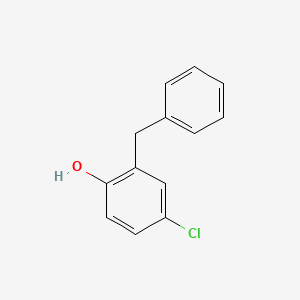
- IUPAC-Name
- 2-benzyl-4-chlorophenol
- Summenformel
- C13H11ClO
- Molekulargewicht
- 218.68 g/mol
- Exakte Masse
- 218.0498427 Da
- XLogP3
- 4,0
- Topologische polare Oberfläche
- 20,2 Ų
- Wasserstoffbrücken-Donoren
- 1
- Wasserstoffbrücken-Akzeptoren
- 1
- Kovalente Einheiten
- 1
- Definierte Stereozentren
- 0
Auch bekannt als
16 weitere gemeldete Namen
Kennungen in externen Datenbanken
- ChEBI:CHEBI:228003
- ChEMBL:CHEMBL1328919
- EPA DTXSID:DTXSID5020154
- PubMed:33049310
- PubMed:29228274
- PubMed:28728110
- PubMed:22649928
- PubMed:21251949
- PubMed:20629411
- PubMed:18822043
- PubMed:16678383
- PubMed:15546637
- PubMed:12537123
- PubMed:11417646
- PubMed:8529821
Belege aus weiteren wissenschaftlichen Datenbanken
NIH PubChem PUG-View
Attributed physical-property, hazard, environmental and use annotations.
- Boiling Point: 320 to 324 °F at 3.5 mmHg (NTP, 1992) Quelle: CAMEO Chemicals
- Boiling Point: 160-162 °C at 3.5 mm Hg Quelle: Hazardous Substances Data Bank (HSDB)
- Color/Form: White to light tan or pink flakes Quelle: Hazardous Substances Data Bank (HSDB)
- Density: 1.22 (NTP, 1992) - Denser than water; will sink Quelle: CAMEO Chemicals
- Density: 1.185 at 58 °C Quelle: Hazardous Substances Data Bank (HSDB)
- Flash Point: 370 °F (NTP, 1992) Quelle: CAMEO Chemicals
- LogP: log Kow = 3.6 Quelle: Hazardous Substances Data Bank (HSDB)
- Melting Point: 119.3 °F (NTP, 1992) Quelle: CAMEO Chemicals
- Melting Point: 48.5 °C Quelle: Hazardous Substances Data Bank (HSDB)
- Odor: White to light tan or pink flakes Quelle: Hazardous Substances Data Bank (HSDB)
- Physical Description: Ortho-benzyl-para-chlorophenol appears as white to light tan or pink flakes or white crystals. Insoluble in water. Slight phenolic odor. (NTP, 1992) Quelle: CAMEO Chemicals
- Physical Description: White to light tan or pink solid; [Hawley] Quelle: Haz-Map, Information on Hazardous Chemicals and Occupational Diseases
- Solubility: less than 1 mg/mL at 61 °F (NTP, 1992) Quelle: CAMEO Chemicals
- Solubility: Highly sol in alcohol and other org solvents Quelle: Hazardous Substances Data Bank (HSDB)
- Solubility: In water, 149 mg/L at 25 °C Quelle: Hazardous Substances Data Bank (HSDB)
- Vapor Pressure: 0.1 mmHg at 68 °F (NTP, 1992) Quelle: CAMEO Chemicals
- Vapor Pressure: 0.0000506 [mmHg] Quelle: Haz-Map, Information on Hazardous Chemicals and Occupational Diseases
- Vapor Pressure: 1.87X10⁻⁷ kPa = 1.4X10⁻⁶ mm Hg /extrapolated/ Quelle: Hazardous Substances Data Bank (HSDB)
- Substance: o-Benzyl-p-Chlorophenol Quelle: NTP Technical Reports
- NTP Technical Report: TR-444: One-Year Initiation/Promotion Study of o-Benzyl-p-Chlorophenol (CASRN 120-32-1) in Swiss (CD-1) Mice (Mouse Skin Study) (1995 ) Quelle: NTP Technical Reports
- Peer Review Date: 11/17/93 Quelle: NTP Technical Reports
- Note: Initiation/Promotion Study Quelle: NTP Technical Reports
- Summary: Under the conditions of this 1-year mouse skin initiation/promotion study in Swiss (CD-1) mice, o -benzyl- p -chlorophenol was a cutaneous irritant and a weak skin tumor promoter relative to strong promoters such as TPA. BCP had no activity as an initiator or as a complete carcinogen. Quelle: NTP Technical Reports
- NTP Technical Report: TR-424: Toxicology and Carcinogenesis Studies of o-Benzyl-p-Chlorophenol (CASRN 120-32-1) in F344/N Rats and B6C3F1 Mice (Gavage Studies) (1994 ) Quelle: NTP Technical Reports
- Peer Review Date: 12/01/92 Quelle: NTP Technical Reports
- Conclusion for Male Rat: No Evidence Quelle: NTP Technical Reports
- Conclusion for Female Rat: Equivocal Evidence Quelle: NTP Technical Reports
- Conclusion for Male Mice: Some Evidence Quelle: NTP Technical Reports
- Conclusion for Female Mice: No Evidence Quelle: NTP Technical Reports
- Summary: Under the conditions of these 2-year gavage studies, there was no evidence of carcinogenic activity of o-benzyl-p-chlorophenol in male F344/N rats receiving 30, 60, or 120 mg/kg body weight. There was equivocal evidence of carcinogenic activity of o-benzyl-p-chlorophenol in female F344/N rats based on the occurrence of two rare renal transitional cell carcinomas. There was some evidence of carcinogenic activity of o-benzyl-p-chlorophenol in male B6C3F1 mice based on increased incidences of renal tubule adenoma and renal tubule adenoma or carcinoma (combined). There was no evidence of carcinogenic activity of o-benzyl-p-chlorophenol in female B6C3F1, mice receiving 120, 240, or 480 mg/kg.; o-Benzyl-p-chlorophenol was nephrotoxic for male and female F344/N rats and B6C3F1 mice. The severity of nephropathy was increased in male and female rats and the incidence and severity of nephropathy was increased in male and female mice. The incidence and severity of nephropathy increased with length of treatment. Other lesions considered to be associated with the nephropathy and the secondary hyperparathyroidism in male rats and in male and female mice included fibrous osteodystrophy and soft t Quelle: NTP Technical Reports
- First Aid: EYES: First check the victim for contact lenses and remove if present. Flush victim's eyes with water or normal saline solution for 20 to 30 minutes while simultaneously calling a hospital or poison control center. Do not put any ointments, oils, or medication in the victim's eyes without specific instructions from a physician. IMMEDIATELY transport the victim after flushing eyes to a hospital even if no symptoms (such as redness or irritation) develop.; SKIN: IMMEDIATELY flood affected skin with water while removing and isolating all contaminated clothing. Gently wash all affected skin areas thoroughly with soap and water. IMMEDIATELY call a hospital or poison control center even if no symptoms (such as redness or irritation) develop. IMMEDIATELY transport the victim to a hospital for treatment after washing the affected areas.; INHALATION: IMMEDIATELY leave the contaminated area; take deep breaths of fresh air. If symptoms (such as wheezing, coughing, shortness of breath, or burning in the mouth, throat, or chest) develop, call a physician and be prepared to transport the victim to a hospital. Provide proper respiratory protection to rescuers entering an unknown atmosphere. Whene Quelle: CAMEO Chemicals
- Signal: Danger Quelle: Regulation (EC) No 1272/2008 of the European Parliament and of the Council
- GHS Hazard Statements: H315: Causes skin irritation [Warning Skin corrosion/irritation]; H317: May cause an allergic skin reaction [Warning Sensitization, Skin]; H318: Causes serious eye damage [Danger Serious eye damage/eye irritation]; H332: Harmful if inhaled [Warning Acute toxicity, inhalation]; H351: Suspected of causing cancer [Warning Carcinogenicity]; H361f: Suspected of damaging fertility [Warning Reproductive toxicity]; H373: May causes damage to organs through prolonged or repeated exposure [Warning Specific target organ toxicity, repeated exposure]; H400: Very toxic to aquatic life [Warning Hazardous to the aquatic environment, acute hazard]; H410: Very toxic to aquatic life with long lasting effects [Warning Hazardous to the aquatic environment, long-term hazard] Quelle: Regulation (EC) No 1272/2008 of the European Parliament and of the Council
- Precautionary Statement Codes: P203, P260, P261, P264, P264+P265, P271, P272, P273, P280, P302+P352, P304+P340, P305+P354+P338, P317, P318, P319, P321, P332+P317, P333+P317, P362+P364, P391, P405, and P501 (click each P-code to see the statement) Quelle: Regulation (EC) No 1272/2008 of the European Parliament and of the Council
- Note: This chemical does not meet GHS hazard criteria for 3.3% (5 of 150) of reports. Quelle: European Chemicals Agency (ECHA)
- Signal: Danger Quelle: European Chemicals Agency (ECHA)
- GHS Hazard Statements: H302 (42%): Harmful if swallowed [Warning Acute toxicity, oral]; H315 (69.3%): Causes skin irritation [Warning Skin corrosion/irritation]; H317 (34%): May cause an allergic skin reaction [Warning Sensitization, Skin]; H318 (90.7%): Causes serious eye damage [Danger Serious eye damage/eye irritation]; H332 (31.3%): Harmful if inhaled [Warning Acute toxicity, inhalation]; H335 (37.3%): May cause respiratory irritation [Warning Specific target organ toxicity, single exposure; Respiratory tract irritation]; H351 (31.3%): Suspected of causing cancer [Warning Carcinogenicity]; H361 (28.7%): Suspected of damaging fertility or the unborn child [Warning Reproductive toxicity]; H373 (31.3%): May causes damage to organs through prolonged or repeated exposure [Warning Specific target organ toxicity, repeated exposure]; H400 (66%): Very toxic to aquatic life [Warning Hazardous to the aquatic environment, acute hazard]; H410 (62%): Very toxic to aquatic life with long lasting effects [Warning Hazardous to the aquatic environment, long-term hazard]; H411 (24.7%): Toxic to aquatic life with long lasting effects [Hazardous to the aquatic environment, long-term hazard] Quelle: European Chemicals Agency (ECHA)
- Precautionary Statement Codes: P203, P260, P261, P264, P264+P265, P270, P271, P272, P273, P280, P301+P317, P302+P352, P304+P340, P305+P354+P338, P317, P318, P319, P321, P330, P332+P317, P333+P317, P362+P364, P391, P403+P233, P405, and P501 (click each P-code to see the statement) Quelle: European Chemicals Agency (ECHA)
- ECHA C&L Notifications Summary: Aggregated GHS information provided per 150 reports by companies from 14 notifications to the ECHA C&L Inventory. Each notification may be associated with multiple companies.; Reported as not meeting GHS hazard criteria per 5 of 150 reports by companies.; There are 13 notifications provided by 145 of 150 reports by companies with hazard statement code(s).; Information may vary between notifications depending on impurities, additives, and other factors. The percentage value in parenthesis indicates the notified classification ratio from companies that provide hazard codes. Only hazard codes with percentage values above 10% are shown. For more detailed information, please visit ECHA C&L website. Quelle: European Chemicals Agency (ECHA)
- Signal: Danger Quelle: NITE-CMC
- GHS Hazard Statements: H315: Causes skin irritation [Warning Skin corrosion/irritation]; H317: May cause an allergic skin reaction [Warning Sensitization, Skin]; H318: Causes serious eye damage [Danger Serious eye damage/eye irritation]; H332: Harmful if inhaled [Warning Acute toxicity, inhalation]; H351: Suspected of causing cancer [Warning Carcinogenicity]; H361: Suspected of damaging fertility or the unborn child [Warning Reproductive toxicity]; H371: May cause damage to organs [Warning Specific target organ toxicity, single exposure]; H372: Causes damage to organs through prolonged or repeated exposure [Danger Specific target organ toxicity, repeated exposure]; H400: Very toxic to aquatic life [Warning Hazardous to the aquatic environment, acute hazard]; H410: Very toxic to aquatic life with long lasting effects [Warning Hazardous to the aquatic environment, long-term hazard] Quelle: NITE-CMC
- Precautionary Statement Codes: P203, P260, P261, P264, P264+P265, P270, P271, P272, P273, P280, P302+P352, P304+P340, P305+P354+P338, P308+P316, P317, P318, P319, P321, P332+P317, P333+P317, P362+P364, P391, P405, and P501 (click each P-code to see the statement) Quelle: NITE-CMC
- Signal: Danger Quelle: Hazardous Chemical Information System (HCIS), Safe Work Australia
- Cosmetic Ingredient Review Conclusion: The CIR Expert Panel concludes that the available data are insufficient to support safety of Dichlorophene or Chlorophene. Quelle: Cosmetic Ingredient Review (CIR)
- Cosmetic Ingredient Review Finding(s): Ingredients for which the data are insufficient and their use in cosmetics is not supported Quelle: Cosmetic Ingredient Review (CIR)
- Toxicity Summary: AR binding was observed for clorophene, which were both associated with delays in sexual development and decrements in reproductive performance. Quelle: Toxin and Toxin Target Database (T3DB)
- Environmental Bioconcentration: A BCF value of 75 was measured for bluegill sunfish(1). Bluegill sunfish (Lepomis machrochirus) were exposed to 0.057 mg/L o-benzyl-p-chlorophenol for a period of 96 hours followed by a depuration period of 96 hours to determine the ability of the fish to metabolize and eliminate o-benzyl-p-chlorophenol. Depuration rate constants were from 4.67 to 6.94/days with a half-life of 0.14 days(1). The rate constant of o-benzyl-p-chlorophenol uptake in fish ranged from 11.8 to 13.8/days with a half-life of 0.06 days. According to a classification scheme(2), this BCF value suggests that bioconcentration in aquatic organisms is moderate(SRC). Quelle: Hazardous Substances Data Bank (HSDB)
- Environmental Fate: TERRESTRIAL FATE: Based on a classification scheme(1), a Koc value of 2,050(2), indicates that o-benzyl-p-chlorophenol is expected to have slight mobility in soil(SRC). Volatilization from moist soil surfaces is not expected to be an important fate process based upon an estimated Henry's Law constant of 2.7X10⁻⁹ atm-cu m/mole(SRC) derived from its extrapolated vapor pressure, 1.4X10⁻⁶ mm Hg(2), and water solubility, 149 mg/L(2). Volatilization from dry soil surfaces is not expected to be important based on the vapor pressure of this compound(2). Biodegradation of o-benzyl-p-chlorophenol is expected to occur rapidly based on degradation half-lives of 1 to 2 days, in a sewage sludge(2). Quelle: Hazardous Substances Data Bank (HSDB)
- Environmental Fate: AQUATIC FATE: Based on a classification scheme(1), a Koc value of 2,050 (2), indicates that o-benzyl-p-chlorophenol is expected to adsorb to suspended solids and sediment(SRC). Volatilization from water surfaces is not expected to be an important fate process(3) based upon an estimated Henry's Law constant of 2.7X10⁻⁹ atm-cu m/mole(SRC) derived from its extrapolated vapor pressure, 1.4X10⁻⁶ mm Hg(2), and water solubility, 149 mg/L(2). According to a classification scheme(4), a BCF of 75 measured in fish(2), suggests bioconcentration in aquatic organisms is moderate(SRC). An aqueous photolysis half-life of approximately 0.7 days(2), indicates photolysis in sunlit surface waters will be an important fate process(SRC). In addition, river die-away studies using non-acclimated river water indicates that the biodegradation half-life of o-benzyl-p-chlorophenol is approximately 1 to 3 days(2,5). Quelle: Hazardous Substances Data Bank (HSDB)
- Environmental Fate: ATMOSPHERIC FATE: According to a model of gas/particle partitioning of semivolatile organic compounds in the atmosphere(1), o-benzyl-p-chlorophenol, which has an extrapolated vapor pressure of 1.4X10⁻⁶ mm Hg at 25 °C(2), is expected to exist in both the vapor and particulate phases in the ambient atmosphere. Vapor-phase o-benzyl-p-chlorophenol is degraded in the atmosphere by reaction with photochemically-produced hydroxyl radicals(SRC); the half-life for this reaction in air is estimated to be about 22 hours (SRC), calculated from its rate constant of 1.8X10⁻¹¹ cu cm/molecule-sec at 25 °C(SRC) that was derived using a structure estimation method(3). Particulate-phase o-benzyl-p-chlorophenol may be removed from the air by wet and dry deposition(SRC). o-Benzyl-p-chlorophenol has been shown to undergo direct photolysis in aqueous solutions with a half-life of approximately 0.7 days(2), which indicates that direct photolysis in the atmosphere may be possible(SRC). Quelle: Hazardous Substances Data Bank (HSDB)
- Cosmetic Ingredient Review Link: CIR ingredient: Chlorophene Quelle: Cosmetic Ingredient Review (CIR)
- Sources/Uses: Used in household, hospital, and veterinary disinfectants; Also used as a fungicide, herbicide, antimicrobial, and cosmetics preservative; [HSDB] Used as a disinfectant (swimming pool decks, industrial water systems, poultry houses and other farming premises, food processing, and restaurants); [Reference #1] Quelle: Haz-Map, Information on Hazardous Chemicals and Occupational Diseases
- Industrial Processes with risk of exposure: Using Disinfectants or Biocides [Category: Clean]; Farming (Pesticides) [Category: Industry] Quelle: Haz-Map, Information on Hazardous Chemicals and Occupational Diseases
- Uses: For o-benzyl-p-chlorophenol (USEPA/OPP Pesticide Code: 062201) ACTIVE products with label matches. /SRP: Registered for use in the U.S. but approved pesticide uses may change periodically and so federal, state and local authorities must be consulted for currently approved uses./ Quelle: Hazardous Substances Data Bank (HSDB)
- Uses: Active principle or enhancing agent for disinfectants Quelle: Hazardous Substances Data Bank (HSDB)
- Uses: Germicide in disinfectant solutions & soap formulations. Quelle: Hazardous Substances Data Bank (HSDB)
- Uses: o-Benzyl-p-chlorophenol is produced as a fungicide. Quelle: Hazardous Substances Data Bank (HSDB)
- Uses: For more Uses (Complete) data for O-BENZYL-P-CHLOROPHENOL (7 total), please visit the HSDB record page. Quelle: Hazardous Substances Data Bank (HSDB)
- Uses: Use (kg; approx.) in Germany (2009): >250; Consumption (g per capita; approx.) in Germany (2009): 0.00305; Calculated removal (%): 47.9 Quelle: NORMAN Suspect List Exchange
- Uses: Clorophene is used as an antiseptic agent and a disinfectant in hospitals and restaurants. Quelle: Toxin and Toxin Target Database (T3DB)
Zugeordnet durch: Existing checksum-valid CAS to unique PubChem CID match. Abgerufen: 2026-08-31. Quelleneintrag öffnen
Wissenschaftliche Klassifizierungen und Gefahrenannotationen liefern Kontext und ersetzen nicht die oben gezeigte marktspezifische regulatorische Entscheidung.
Weitere Quellenabdeckung und Trefferstatus
| Quelle | Ergebnis | Geprüft |
|---|---|---|
| NIH PubChem PUG-View | Exakter Treffer | 2026-08-31 |
Ein erfasster Nicht-Treffer ist ein nützlicher Beleg dafür, dass die Quelle geprüft wurde; er ist keine Behauptung, dass der Stoff anderswo nicht existiert.
Am 2026-08-31 von NIH PubChem durch prüfsummengültigen CAS-Abgleich abgerufen. Chemische Eigenschaften ersetzen nicht die regulatorische Entscheidung auf dieser Seite.
Belege zum amtlichen EU-Inhaltsstoffnamen
Der Inhaltsstoffname stimmt exakt mit dem amtlichen EU-Glossar 2025 der gebräuchlichen Inhaltsstoffnamen überein.
Die Märkte sind sich bei diesem Stoff nicht einig: In einigen ist er verboten, in anderen unter Bedingungen zulässig, über die 9 Märkte hinweg, die dafür eine Vorschrift führen.
- verboten
- European UnionGreat BritainNew ZealandASEANChinaBrazilIndiaSaudi Arabia
- beschränkt
- South Korea
Alle Stoffe ansehen, bei denen die Märkte voneinander abweichen
Verwandte Belege aus dem Verzeichnis
Inhaltsstoffe mit sich überschneidenden Rezepturfunktionen
Weitere amtliche und wissenschaftliche Quellen
11 externe Datenbanken zur Prüfung dieser Identität
Jeder Link durchsucht die jeweilige Quelle nach dieser Identität. Was jede Quelle ist und welches rechtliche Gewicht sie hat
Wie CHLOROPHENE im CosIng-Verzeichnis erscheint
Das CosIng-Verzeichnis führt CHLOROPHENE als kosmetischen Inhaltsstoff, und diese Seite verknüpft ihn mit 1 Anhangseintrag. Der Verzeichniseintrag erfasst Namen und Kennungen, während der Anhangseintrag zeigt, wo der Stoff im EU-Kosmetikrecht verboten, beschränkt oder positiv gelistet ist.
CHLOROPHENE ist in den amtlichen Daten außerdem mit 2 kosmetischen Funktionen gekennzeichnet. Funktionsbezeichnungen beschreiben die beabsichtigte Verwendung, ersetzen aber nicht die regulatorische Prüfung verknüpfter Anhangseinträge vor der Rezeptierung oder Kennzeichnung.
Häufig gestellte Fragen
Quellenhinweis zu CHLOROPHENE
Diese Seite verbindet den CosIng-Verzeichniseintrag für CHLOROPHENE mit 1 verknüpften Eintrag aus den Anhängen II–VI aus unserem Datenbestand, der aus öffentlichen Materialien der Europäischen Kommission zu kosmetischen Inhaltsstoffen aufgebaut ist.
Nutzen Sie diese Verzeichnisseite, um CHLOROPHENE zu recherchieren und verknüpfte Einträge zu vergleichen; verifizieren Sie Beschränkungen und Rechtsstatus jedoch anhand des aktuellen amtlichen Quellentextes und Rechts, bevor Sie regulatorische Entscheidungen treffen.
Werkzeuge und nächste Schritte
Rezeptur prüfen
Eine vollständige INCI-Liste prüfen, um CHLOROPHENE und etwaige verknüpfte EU-Anhangsbeschränkungen oder Allergenmarkierungen zu erkennen.
INCI-CheckerÄhnliche Inhaltsstoffe suchen
Weitere Inhaltsstoffe aus dem Verzeichnis und Anhangseinträge finden, die mit CHLOROPHENE, seinen Kennungen oder nahen Namensvarianten zusammenhängen.
Suche