
BENZYL CINNAMATE
2-Propenoic acid, 3-phenyl, phenylmethyl ester
BENZYL CINNAMATE ist auf dieser Seite mit 1 EU-Anhangseintrag verknüpft. Hinweis aus dem Verzeichnis: III/81.
Auf einen Blick
- Funktion
- Perfuming
- CAS
- 103-41-3
- EC
- 203-109-3
- EU-Anhänge
- Anhang III/81
- Anhang III/81: keine einzelne Höchstkonzentration angegeben
Wissenschaftliche Grundlage: 4 SCCS-Stellungnahmen
Der Wissenschaftliche Ausschuss „Verbrauchersicherheit“ (SCCS) der EU hat diesen Stoff bewertet. Seine Stellungnahmen sind die wissenschaftliche Grundlage des Anhangeintrags.
- Opinion concerning Essential Oils
- Opinion concerning Fragrance Allergy in Consumers - A Review of the Problem - Analysis of the need for appropriate Consumer Information and Identification of C…
- Opinion concerning the Interim Position on Fragrance Allergy
- Memorandum on the SCCNFP Opinion concerning Fragrance Allergy
Regulatorische Belege nach Markt
Diese Matrix trennt verifizierte Vorschriften zu Inhaltsstoffen von Quellen, die zwar erfasst, aber noch nicht importiert sind. Eine fehlende importierte Vorschrift bedeutet nicht, dass der Inhaltsstoff zulässig ist.
Wischen oder scrollen Sie horizontal, um alle Spalten zu sehen.
| Markt | Belegstatus | Einträge | Quellsprache |
|---|---|---|---|
| European Union | Beleg verknüpft Restricted entry found Diesen Beleg öffnen | 1 | English and EU languages |
| Great Britain | Beleg verknüpft Restricted Diesen Beleg öffnen | 1 | English |
| Canada | Quelle erfasst Official source mapped; ingredient rule not imported | 0 | English and French |
| New Zealand | Beleg verknüpft Restricted Diesen Beleg öffnen | 1 | English |
| ASEAN | Quelle erfasst Official source mapped; ingredient rule not imported | 0 | English and national languages |
| China | Quelle erfasst Official source mapped; ingredient rule not imported | 0 | Chinese with selected English material |
| Japan | Quelle erfasst Official source mapped; ingredient rule not imported | 0 | Japanese; official English translation available |
| South Korea | Quelle erfasst Official source mapped; ingredient rule not imported | 0 | Korean with some English names |
| United States | Quelle erfasst Official source mapped; ingredient rule not imported | 0 | English |
| Australia | Quelle erfasst Official source mapped; ingredient rule not imported | 0 | English |
| Brazil | Quelle erfasst Official source mapped; ingredient rule not imported | 0 | Portuguese with INCI crosswalks |
| India | Beleg verknüpft Restricted Diesen Beleg öffnen | 1 | English and Hindi |
| Saudi Arabia | Beleg verknüpft Restricted Diesen Beleg öffnen | 1 | Arabic and English |
Verzeichnisangaben zu BENZYL CINNAMATE
INCI-Name
BENZYL CINNAMATE
Beschreibung
2-Propenoic acid, 3-phenyl, phenylmethyl ester
Herkunft des Eintrags
- Verzeichnisverweis
- 32155
- Importierte Identität
- BENZYL CINNAMATE
- Quellenaktualisierung
- 15/10/2010
Anhangseinträge für BENZYL CINNAMATE
Kerndaten
Chemische Identität und Eigenschaften
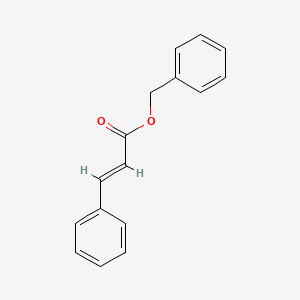
Benzyl Cinnamate
Benzyl cinnamate is the cinnamate ester derived from cinnamic acid and benzyl alcohol. Occuring in Balsam of Peru and Tolu balsam, in Sumatra and Penang benzoin, and as the main constituent of copaiba balsam, it is used in heavy oriental perfumes, as a fixative and as a flavouring agent. It has a role as a flavouring agent, a fragrance, a fixative, an epitope and an antigen. — ChEBI
- IUPAC-Name
- benzyl (E)-3-phenylprop-2-enoate
- Summenformel
- C16H14O2
- Molekulargewicht
- 238.28 g/mol
- Exakte Masse
- 238.099379685 Da
- XLogP3
- 3,8
- Topologische polare Oberfläche
- 26,3 Ų
- Wasserstoffbrücken-Donoren
- 0
- Wasserstoffbrücken-Akzeptoren
- 2
- Kovalente Einheiten
- 1
- Definierte Stereozentren
- 0
Auch bekannt als
16 weitere gemeldete Namen
Kennungen in externen Datenbanken
- ChEBI:CHEBI:146174
- ChEMBL:CHEMBL361197
- EPA DTXSID:DTXSID00880905
- PubMed:29540657
- PubMed:27965148
- PubMed:27270453
- PubMed:22023385
- PubMed:20491607
- PubMed:15464616
Belege aus weiteren wissenschaftlichen Datenbanken
NIH PubChem PUG-View
Attributed physical-property, hazard, environmental and use annotations.
- Boiling Point: 228-230 °C @ 22 mm Hg Quelle: Hazardous Substances Data Bank (HSDB)
- Boiling Point: 350 °C; 195 °C (5 mm Hg) Quelle: Joint FAO/WHO Expert Committee on Food Additives (JECFA)
- Color/Form: WHITE TO PALE-YELLOW, FUSED, CRYSTALLINE SOLID Quelle: Hazardous Substances Data Bank (HSDB)
- Color/Form: Crystals from 95% ethanol Quelle: Hazardous Substances Data Bank (HSDB)
- Color/Form: White crystals Quelle: Hazardous Substances Data Bank (HSDB)
- Density: 1.109 AT 15 °C Quelle: Hazardous Substances Data Bank (HSDB)
- Density: PRISMS; SADTLER REFERENCE NUMBER: 1520 (IR, PRISM); 430 (UV); 104 (NMR); DENSITY: 1.109 @ 15 °C /TRANS/ Quelle: Hazardous Substances Data Bank (HSDB)
- Flash Point: GREATER THAN 100 °C Quelle: Hazardous Substances Data Bank (HSDB)
- Melting Point: 39 °C Quelle: Hazardous Substances Data Bank (HSDB)
- Melting Point: MELTING POINT: 35-36 °C /TRANS/; 30 °C /CIS/ Quelle: Hazardous Substances Data Bank (HSDB)
- Odor: Sweet odor of balsam Quelle: Hazardous Substances Data Bank (HSDB)
- Physical Description: Solid with a sweet odor of balsam; Practically insoluble in water; mp = 39 deg C; [Merck Index] Quelle: Haz-Map, Information on Hazardous Chemicals and Occupational Diseases
- Physical Description: White to pale yellow solid Quelle: Joint FAO/WHO Expert Committee on Food Additives (JECFA)
- Solubility: 1:8 IN 90% ALCOHOL Quelle: Hazardous Substances Data Bank (HSDB)
- Solubility: Practically insol in water, propylene glycol and glycerin. Sol in alcohol, ether, oils. Quelle: Hazardous Substances Data Bank (HSDB)
- Solubility: insoluble in water; soluble in oils Quelle: Joint FAO/WHO Expert Committee on Food Additives (JECFA)
- Solubility: very soluble (in ethanol) Quelle: Joint FAO/WHO Expert Committee on Food Additives (JECFA)
- Vapor Pressure: 1 mm Hg @ 173.8 °C Quelle: Hazardous Substances Data Bank (HSDB)
- Carcinogen Classification: No indication of carcinogenicity to humans (not listed by IARC). Quelle: Toxin and Toxin Target Database (T3DB)
- Signal: Warning Quelle: European Chemicals Agency (ECHA)
- GHS Hazard Statements: H317 (99.8%): May cause an allergic skin reaction [Warning Sensitization, Skin]; H411 (99.5%): Toxic to aquatic life with long lasting effects [Hazardous to the aquatic environment, long-term hazard] Quelle: European Chemicals Agency (ECHA)
- Precautionary Statement Codes: P261, P272, P273, P280, P302+P352, P321, P333+P317, P362+P364, P391, and P501 (click each P-code to see the statement) Quelle: European Chemicals Agency (ECHA)
- ECHA C&L Notifications Summary: Aggregated GHS information provided per 1794 reports by companies from 13 notifications to the ECHA C&L Inventory. Each notification may be associated with multiple companies.; Information may vary between notifications depending on impurities, additives, and other factors. The percentage value in parenthesis indicates the notified classification ratio from companies that provide hazard codes. Only hazard codes with percentage values above 10% are shown. For more detailed information, please visit ECHA C&L website. Quelle: European Chemicals Agency (ECHA)
- Environmental Bioconcentration: An estimated BCF of 270 was calculated for benzyl cinnamate(SRC), using an estimated log Kow of 4.1(1) and a regression-derived equation(2). According to a classification scheme(3), this BCF suggests the potential for bioconcentration in aquatic organisms is high(SRC). Quelle: Hazardous Substances Data Bank (HSDB)
- Environmental Fate: TERRESTRIAL FATE: Based on a classification scheme(1), an estimated Koc value of 10,400(SRC), determined from a structure estimation method(2), indicates that benzyl cinnamate is expected to be immobile in soil(SRC). Volatilization of benzyl cinnamate from moist soil surfaces is not expected to be an important fate process(SRC) given an estimated Henry's Law constant of 3.3X10⁻⁷ atm-cu m/mole(SRC), using a fragment constant estimation method(3). Benzyl cinnamate is not expected to volatilize from dry soil surfaces(SRC) based upon an estimated vapor pressure of 1X10⁻⁵ mm Hg(4). Quelle: Hazardous Substances Data Bank (HSDB)
- Environmental Fate: AQUATIC FATE: Based on a classification scheme(1), an estimated Koc value of 10,390(SRC), determined from a structure estimation method(2), indicates that benzyl cinnamate is expected to adsorb to suspended solids and sediment(SRC). Volatilization from water surfaces is not expected(3) based upon an estimated Henry's Law constant of 3.3X10⁻⁷ atm-cu m/mole(SRC), developed using a fragment constant estimation method(4). A base-catalyzed second-order hydrolysis rate constant of 3.8X10⁻² L/mole-sec(SRC) was estimated using a structure estimation method(5); this corresponds to half-lives of 6 years and 211 days at pH values of 7 and 8, respectively(5). According to a classification scheme(6), an estimated BCF of 269(SRC), from an estimated log Kow of 4.06(7) and a regression derived equation(8), suggests the potential for bioconcentration in aquatic organisms is high(SRC). Quelle: Hazardous Substances Data Bank (HSDB)
- Environmental Fate: ATMOSPHERIC FATE: According to a model of gas/particle partitioning of semivolatile organic compounds in the atmosphere(1), benzyl cinnamate, which has an estimated vapor pressure of 1X10⁻⁵ mm Hg at 25 °C(2), will exist in both the vapor and particulate phases in the ambient atmosphere. Vapor-phase benzyl cinnamate is degraded in the atmosphere by reaction with photochemically-produced hydroxyl radicals(SRC); the half-life for this reaction in air is estimated to be 14 hours for the cis-isomer and 13 hours for the trans-isomer of benzyl cinnamate(SRC), calculated from their rate constants of 28X10-12 and 31X10-12 cu cm/molecule-sec at 25 °C, respectively(SRC), determined using a structure estimation method(3). Particulate-phase benzyl cinnamate may be removed from the air by wet and dry deposition(SRC). Quelle: Hazardous Substances Data Bank (HSDB)
- Sources/Uses: Constituent of storax, Peru, and Tolu balsams; [Merck Index] Used in flavors and perfumes; [HSDB] Quelle: Haz-Map, Information on Hazardous Chemicals and Occupational Diseases
- Uses: In artificial flavors, in perfumes, mainly as a fixative Quelle: Hazardous Substances Data Bank (HSDB)
- Uses: Fixative in perfumes and as a component of heavy, oriental perfumes. Quelle: Hazardous Substances Data Bank (HSDB)
Zugeordnet durch: Existing checksum-valid CAS to unique PubChem CID match. Abgerufen: 2026-08-31. Quelleneintrag öffnen
Wissenschaftliche Klassifizierungen und Gefahrenannotationen liefern Kontext und ersetzen nicht die oben gezeigte marktspezifische regulatorische Entscheidung.
Weitere Quellenabdeckung und Trefferstatus
| Quelle | Ergebnis | Geprüft |
|---|---|---|
| EMBL-EBI ChEBI | Kein exakter Eintrag | 2026-08-31 |
| NIH PubChem PUG-View | Exakter Treffer | 2026-08-31 |
Ein erfasster Nicht-Treffer ist ein nützlicher Beleg dafür, dass die Quelle geprüft wurde; er ist keine Behauptung, dass der Stoff anderswo nicht existiert.
Am 2026-09-02 von NIH PubChem durch prüfsummengültigen CAS-Abgleich abgerufen. Chemische Eigenschaften ersetzen nicht die regulatorische Entscheidung auf dieser Seite.
Belege zum amtlichen EU-Inhaltsstoffnamen
Der Inhaltsstoffname stimmt exakt mit dem amtlichen EU-Glossar 2025 der gebräuchlichen Inhaltsstoffnamen überein.
Dieser Stoff steht auf der EU-Liste der Duftstoffallergene, die in der Inhaltsstoffliste einzeln genannt werden müssen und nicht durch das Wort „parfum“ abgedeckt sind, sobald sie in einem Produkt, das auf der Haut verbleibt, 0,001% oder in einem abzuspülenden Produkt 0,01% überschreiten.
Die Kennzeichnung ist eine Pflicht nach Artikel 19 und keine Verwendungsbeschränkung. Den Allergeneintrag ansehen
Verwandte Belege aus dem Verzeichnis
Inhaltsstoffe mit sich überschneidenden Rezepturfunktionen
Weitere amtliche und wissenschaftliche Quellen
11 externe Datenbanken zur Prüfung dieser Identität
Jeder Link durchsucht die jeweilige Quelle nach dieser Identität. Was jede Quelle ist und welches rechtliche Gewicht sie hat
Wie BENZYL CINNAMATE im CosIng-Verzeichnis erscheint
Das CosIng-Verzeichnis führt BENZYL CINNAMATE als kosmetischen Inhaltsstoff, und diese Seite verknüpft ihn mit 1 Anhangseintrag. Der Verzeichniseintrag erfasst Namen und Kennungen, während der Anhangseintrag zeigt, wo der Stoff im EU-Kosmetikrecht verboten, beschränkt oder positiv gelistet ist.
BENZYL CINNAMATE ist in den amtlichen Daten außerdem mit 1 kosmetischen Funktion gekennzeichnet. Funktionsbezeichnungen beschreiben die beabsichtigte Verwendung, ersetzen aber nicht die regulatorische Prüfung verknüpfter Anhangseinträge vor der Rezeptierung oder Kennzeichnung.
Häufig gestellte Fragen
Quellenhinweis zu BENZYL CINNAMATE
Diese Seite verbindet den CosIng-Verzeichniseintrag für BENZYL CINNAMATE mit 1 verknüpften Eintrag aus den Anhängen II–VI aus unserem Datenbestand, der aus öffentlichen Materialien der Europäischen Kommission zu kosmetischen Inhaltsstoffen aufgebaut ist.
Nutzen Sie diese Verzeichnisseite, um BENZYL CINNAMATE zu recherchieren und verknüpfte Einträge zu vergleichen; verifizieren Sie Beschränkungen und Rechtsstatus jedoch anhand des aktuellen amtlichen Quellentextes und Rechts, bevor Sie regulatorische Entscheidungen treffen.
Werkzeuge und nächste Schritte
Rezeptur prüfen
Eine vollständige INCI-Liste prüfen, um BENZYL CINNAMATE und etwaige verknüpfte EU-Anhangsbeschränkungen oder Allergenmarkierungen zu erkennen.
INCI-CheckerÄhnliche Inhaltsstoffe suchen
Weitere Inhaltsstoffe aus dem Verzeichnis und Anhangseinträge finden, die mit BENZYL CINNAMATE, seinen Kennungen oder nahen Namensvarianten zusammenhängen.
Suche