
Amtlicher EU-KennzeichnungsnameGlossareintrag 331
4-HYDROXYBENZOIC ACID
Dieser Eintrag bestätigt einen amtlichen gebräuchlichen Inhaltsstoffnamen für die EU-Kennzeichnung kosmetischer Mittel. Er bestätigt für sich genommen nicht, dass der Stoff zulässig, unbeschränkt oder sicher ist.
Globale Belegübersicht
Die ermittelte Identität hat übereinstimmende regulatorische Belege in 4 von 13 indizierten Marktdatensätzen: 4 Ländereinträge und 0 EU-Anhangseinträge. Jedes Ergebnis und jede Belegslücke ist unten aufgeführt.
Geprüfte Märkte
13
Märkte mit Belegen
4
Belegslücken
9
Ermittelte Kennungen
20
Ermittelte Stoffidentität
CAS:99-96-799-76-336457-19-916782-08-45026-62-035285-68-8120-47-8114-63-626112-07-269959-44-0
EC:202-804-9202-785-7253-048-1240-830-2225-714-1252-487-6204-399-4204-051-1247-464-2274-235-4
Einträge im Inhaltsstoffindex:
4-HYDROXYBENZOIC ACID
Kosmetische Funktionen: FRAGRANCE, PRESERVATIVE
4-hydroxybenzoic acid
Beschränkungshinweis aus dem Verzeichnis: V/12
5 übereinstimmende oder gemeldete Namen
4-HYDROXYBENZOIC ACID4-Hydroxybenzoic acidmethylparabenpotassium ethylparabenpotassium parabensodium methylparabensodium ethylparabenethylparabensodium parabenpotassium methylparabencalcium paraben4-Hydroxybenzoic acid and its methyl- and ethyl-esters, and their salts e.g. 4-hydroxybenzoic acid4-Hydroxybenzoic acid and its Methyl- and Ethyl- esters, and their salts (INCI) 4-Hydroxybenzoic acid; CAS No. 99-96-7; Methylparaben; CAS No. 99-76-3; potassium ethylparaben; CAS No. 36457-19-9; potassium paraben; CAS No. 16782-08-4 sodium methylparaben; CAS No. 5026-62-0; sodium ethylparaben; CAS No. 35285-68-8; ethylparaben; CAS No. 120-47-8; sodium paraben; CAS No. 114-63-6; potassium methylparaben; CAS No. 26112-07- 2; calcium paraben; CAS No. 69959-44-0;p-하이드록시벤조익애씨드, 그 염류 및에스텔류 (다만, 에스텔류 중 페닐은제외)
Regulatorische Belege in allen 13 Märkten
Öffnen Sie jeden übereinstimmenden Eintrag, um Geltungsbereich, Konzentration, Bedingungen, Warnhinweise und die Version der amtlichen Quelle zu sehen.
Wischen oder scrollen Sie horizontal, um Datenabdeckung und nächste Schritte zu sehen.
| Markt | Ergebnis | Einträge | Datensatz | Bedeutung / nächster Schritt |
|---|---|---|---|---|
| European Union EU | Kein Treffer gefunden | 0 | Complete annex dataset Regulation (EC) 1223/2009 consolidated to 1 May 2026 | No annex match only means that these five annexes did not return a match; CosIng identity data and other EU obligations still need review. |
| Great Britain GB | Permitted list with conditions | 1Eintrag öffnen 1 | Complete consolidated annex dataset GB retained Regulation 1223/2009 schedules, effective 15 August 2026 | Prüfen Sie jeden verknüpften Eintrag und die genauen Bedingungen. |
| Canada CA | Kein Treffer gefunden | 0 | Complete Hotlist snapshot Health Canada Cosmetic Ingredient Hotlist, 13 August 2025 | The Hotlist is an administrative compliance tool, not an exhaustive safety approval list. |
| New Zealand NZ | Permitted list with conditions | 1Eintrag öffnen 1 | Complete schedules dataset Cosmetic Products Group Standard schedules effective 1 January 2026 | Prüfen Sie jeden verknüpften Eintrag und die genauen Bedingungen. |
| ASEAN ASEAN | Permitted list with conditions | 1Eintrag öffnen 1 | Complete regional annex dataset ASEAN Cosmetic Directive annexes 2026-1, 22 June 2026 | Prüfen Sie jeden verknüpften Eintrag und die genauen Bedingungen. |
| China CN | Kein Treffer gefunden | 0 | Complete prohibited catalogues plus official-source workflow NMPA 2021 banned catalogues plus dynamic IECIC List I/List II system current since 2025 | IECIC listing is not blanket approval; absence may require the new cosmetic ingredient route, and restrictions are checked separately. |
| Japan JP | Kein Treffer gefunden | 0 | Complete Standards appendices dataset MHLW Standards for Cosmetics official English source and Japanese amendments checked for the imported snapshot | The Japanese text and subsequent notices are canonical; no local match is not a product-compliance conclusion. |
| South Korea KR | Restricted | 1Eintrag öffnen 1 | Complete current appendix dataset MFDS Notice 2026-19, effective 18 March 2026 | Prüfen Sie jeden verknüpften Eintrag und die genauen Bedingungen. |
| United States US | Kein Treffer gefunden | 0 | Complete enumerated federal ingredient rules eCFR Title 21 issue date 27 August 2026 | FDA has no general approved-cosmetic-ingredient catalogue; absence from these sections is not approval or proof of safety. |
| Australia AU | Kein Treffer gefunden | 0 | Complete cosmetic-relevant Poisons Standard subset plus official workflow Therapeutic Goods (Poisons Standard—June 2026) Instrument 2026 | An AICIS Inventory match is not cosmetic approval; no Inventory match can indicate a new, exempted, reported or confidential introduction. |
| Brazil BR | Kein Treffer gefunden | 0 | Complete prohibited dataset plus current restricted-list workflow ANVISA RDC 1.029/2026 and RDC 1.030/2026, published 15 June 2026 | RDC 1.030/2026 amends rather than replaces the prohibited baseline, and the second restricted-list revision was still under consultation in July 2026. |
| India IN | Kein Treffer gefunden | 0 | Complete current Part 2 dataset plus official workflow for Parts 1, 3 and 4 Cosmetics Rules 2020 plus current BIS IS 4707 parts (1:2020, 2:2025, 3:2025, 4:2022) | The standards are separate controlled publications; absence from a locally indexed excerpt is not permission. |
| Saudi Arabia SA | Kein Treffer gefunden | 0 | Complete official list index SFDA live prohibited/restricted lists, snapshot 30 August 2026 | No list match is not permission; Gulf/SFDA product, claim, notification and technical requirements still apply. |
Keine Marktzeilen entsprechen diesem Filter.
Übereinstimmende Markteinträge und Bedingungen
New Zealand
Cosmetic Products Group Standard schedules effective 1 January 2026South Korea
MFDS Notice 2026-19, effective 18 March 2026Chemische Identität und Eigenschaften
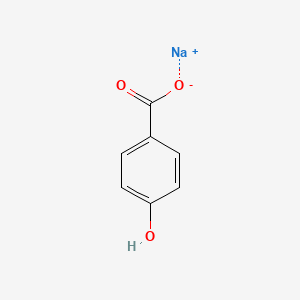
CAS 114-63-6PubChem CID 16219477
Sodium 4-hydroxybenzoate
Sodium 4-hydroxybenzoate is an organic sodium salt resulting from the replacement of the proton from the carboxy group of 4-hydroxybenzoic acid by a sodium ion. It has a role as a plant metabolite and an algal metabolite. It contains a 4-hydroxybenzoate. — ChEBI
- IUPAC-Name
- sodium 4-hydroxybenzoate
- Summenformel
- C7H5NaO3
- Molekulargewicht
- 160.10 g/mol
- Exakte Masse
- 160.01363830 Da
- Topologische polare Oberfläche
- 60,4 Ų
- Wasserstoffbrücken-Donoren
- 1
- Wasserstoffbrücken-Akzeptoren
- 3
- Kovalente Einheiten
- 2
- Definierte Stereozentren
- 0
Auch bekannt als
Sodium p-hydroxybenzoate4-Hydroxybenzoic acid sodium saltsodium parabenp-Hydroxybenzoic acid sodium saltBenzoic acid, 4-hydroxy-, monosodium saltMonosodium p-hydroxybenzoateMonosodium 4-hydroxybenzoateBenzoic acid, 4-hydroxy-, sodium salt (1:1)
16 weitere gemeldete Namen
EINECS 204-051-1p-hydroxybenzoic acid monosodium saltV6102T509BBENZOIC ACID, p-HYDROXY-, SODIUM SALTCHEBI:113449SODIUM 4-HYDROXYBENZOIC ACIDBENZOIC ACID, P-HYDROXY-, MONOSODIUM SALTRefChem:887100SODIUM PARABEN [INCI]sodium;4-hydroxybenzoateC7H5NaO3H0221UNII-V6102T509B4-Hydroxybenzoate sodiumsodium parahydroxybenzoate4-Hydroxybenzoic acid sodium
Kennungen in externen Datenbanken
- ChEBI:CHEBI:113449
- ChEMBL:CHEMBL1762656
- EPA DTXSID:DTXSID3059426
Belege aus weiteren wissenschaftlichen Datenbanken
NIH PubChem PUG-View
Exakter Kennungstreffer16219477
Attributed physical-property, hazard, environmental and use annotations.
- Note: This chemical does not meet GHS hazard criteria for 3.5% (3 of 86) of reports. Quelle: European Chemicals Agency (ECHA)
- Signal: Warning Quelle: European Chemicals Agency (ECHA)
- GHS Hazard Statements: H315 (96.5%): Causes skin irritation [Warning Skin corrosion/irritation]; H319 (96.5%): Causes serious eye irritation [Warning Serious eye damage/eye irritation]; H335 (95.3%): May cause respiratory irritation [Warning Specific target organ toxicity, single exposure; Respiratory tract irritation] Quelle: European Chemicals Agency (ECHA)
- Precautionary Statement Codes: P261, P264, P264+P265, P271, P280, P302+P352, P304+P340, P305+P351+P338, P319, P321, P332+P317, P337+P317, P362+P364, P403+P233, P405, and P501 (click each P-code to see the statement) Quelle: European Chemicals Agency (ECHA)
- ECHA C&L Notifications Summary: Aggregated GHS information provided per 86 reports by companies from 6 notifications to the ECHA C&L Inventory. Each notification may be associated with multiple companies.; Reported as not meeting GHS hazard criteria per 3 of 86 reports by companies.; There are 5 notifications provided by 83 of 86 reports by companies with hazard statement code(s).; Information may vary between notifications depending on impurities, additives, and other factors. The percentage value in parenthesis indicates the notified classification ratio from companies that provide hazard codes. Only hazard codes with percentage values above 10% are shown. For more detailed information, please visit ECHA C&L website. Quelle: European Chemicals Agency (ECHA)
- Cosmetic Ingredient Review Conclusion: The CIR Expert Panel concluded that the following 20 parabens are safe in cosmetics in the present practices of use and concentration described in the safety assessment when the sum of the combined concentration of parabens in any given formulation does not exceed 0.8 %...Sodium Paraben... Quelle: Cosmetic Ingredient Review (CIR)
- Cosmetic Ingredient Review Finding(s): Safe for use in cosmetics, with qualifications Quelle: Cosmetic Ingredient Review (CIR)
- Cosmetic Ingredient Review Link: CIR ingredient: Sodium Paraben Quelle: Cosmetic Ingredient Review (CIR)
Zugeordnet durch: Existing checksum-valid CAS to unique PubChem CID match. Abgerufen: 2026-08-31. Quelleneintrag öffnen
Wissenschaftliche Klassifizierungen und Gefahrenannotationen liefern Kontext und ersetzen nicht die oben gezeigte marktspezifische regulatorische Entscheidung.
Weitere Quellenabdeckung und Trefferstatus
| Quelle | Ergebnis | Geprüft |
|---|---|---|
| NIH PubChem PUG-View | Exakter Treffer | 2026-08-31 |
Ein erfasster Nicht-Treffer ist ein nützlicher Beleg dafür, dass die Quelle geprüft wurde; er ist keine Behauptung, dass der Stoff anderswo nicht existiert.
Am 2026-09-02 von NIH PubChem durch prüfsummengültigen CAS-Abgleich abgerufen. Chemische Eigenschaften ersetzen nicht die regulatorische Entscheidung auf dieser Seite.
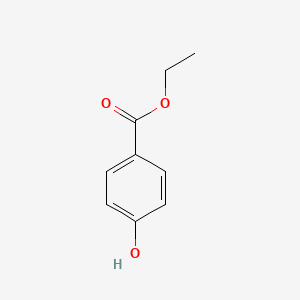
CAS 120-47-8PubChem CID 8434
Ethylparaben
Ethylparaben is an ethyl ester resulting from the formal condensation of the carboxy group of 4-hydroxybenzoic acid with ethanol. It has a role as an antifungal agent, an antimicrobial food preservative, a plant metabolite and a phytoestrogen. It is an ethyl ester and a paraben. — ChEBI
- IUPAC-Name
- ethyl 4-hydroxybenzoate
- Summenformel
- C9H10O3
- Molekulargewicht
- 166.17 g/mol
- Exakte Masse
- 166.062994177 Da
- XLogP3
- 2,5
- Topologische polare Oberfläche
- 46,5 Ų
- Wasserstoffbrücken-Donoren
- 1
- Wasserstoffbrücken-Akzeptoren
- 3
- Kovalente Einheiten
- 1
- Definierte Stereozentren
- 0
Auch bekannt als
Ethyl parabenEthyl p-hydroxybenzoateTegosept EMycoctenEthyl parasept4-Hydroxybenzoic acid ethyl esterAseptoform ENipagin A
16 weitere gemeldete Namen
EaseptolEthyl butexNapagin ANipazin ASolbrol ASobrol AEthyl parahydroxybenzoatep-Hydroxybenzoic acid ethyl esterEthyl p-oxybenzoateBonomold OEBenzoic acid, 4-hydroxy-, ethyl esterp-CarbethoxyphenolEthyl-p-hydroxybenzoateMekkings EAseptin AEthyl hydroxybenzoate
Kennungen in externen Datenbanken
- ChEBI:CHEBI:31575
- ChEMBL:CHEMBL15841
- EPA DTXSID:DTXSID9022528
- PubMed:39532263
- PubMed:37690743
- PubMed:35307500
- PubMed:34101200
- PubMed:33113465
- PubMed:31472229
- PubMed:30481674
- PubMed:29162470
- PubMed:27432241
- PubMed:27286252
- PubMed:25349334
- PubMed:25012808
Belege aus weiteren wissenschaftlichen Datenbanken
NIH PubChem PUG-View
Exakter Kennungstreffer8434
Attributed physical-property, hazard, environmental and use annotations.
- Boiling Point: 297-298 °C (decomposition) Quelle: Hazardous Substances Data Bank (HSDB)
- Boiling Point: 298.00 °C. @ 760.00 mm Hg Quelle: Human Metabolome Database (HMDB)
- Color/Form: Small, colorless crystals or powder at room temperature Quelle: Hazardous Substances Data Bank (HSDB)
- Color/Form: Crystals from dilute alcohol Quelle: Hazardous Substances Data Bank (HSDB)
- Dissociation Constants: pKa = 8.34 Quelle: Hazardous Substances Data Bank (HSDB)
- LogP: log Kow = 2.47 Quelle: Hazardous Substances Data Bank (HSDB)
- LogP: 2.47 Quelle: Human Metabolome Database (HMDB)
- Melting Point: ofp-hydroxybenzoic acid isolated by acidification and not recrystallised: 213 °C to 217 °C, after vacuum drying in a sulphuric acid desiccator Quelle: EU Food Improvement Agents
- Melting Point: 117 °C Quelle: Hazardous Substances Data Bank (HSDB)
- Melting Point: 116 °C Quelle: Human Metabolome Database (HMDB)
- Odor: Odorless Quelle: Hazardous Substances Data Bank (HSDB)
- Physical Description: Liquid; Other Solid Quelle: EPA Chemical Data Reporting (CDR)
- Physical Description: Almost odourless, small, colourless crystals or a white, crystalline powder Quelle: EU Food Improvement Agents
- Physical Description: Colorless solid; [Hawley] Crystalline powder; [MSDSonline] Quelle: Haz-Map, Information on Hazardous Chemicals and Occupational Diseases
- Physical Description: Solid Quelle: Human Metabolome Database (HMDB)
- Solubility: In water, 8.85X10+2 mg/L at 25 °C Quelle: Hazardous Substances Data Bank (HSDB)
- Solubility: Solubility in water at 25 °C is 0.075% w/w; at 20 °C. 0.70% w/w Quelle: Hazardous Substances Data Bank (HSDB)
- Solubility: Solubilities in various solvents [Table#2496] Quelle: Hazardous Substances Data Bank (HSDB)
- Solubility: AT 25 °C: 0.5 G/100 G GLYCERIN Quelle: Hazardous Substances Data Bank (HSDB)
- Solubility: For more Solubility (Complete) data for ETHYLPARABEN (6 total), please visit the HSDB record page. Quelle: Hazardous Substances Data Bank (HSDB)
- Solubility: 0.885 mg/mL at 25 °C Quelle: Human Metabolome Database (HMDB)
- Vapor Pressure: 0.0000929 [mmHg] Quelle: Haz-Map, Information on Hazardous Chemicals and Occupational Diseases
- Carcinogen Classification: No indication of carcinogenicity to humans (not listed by IARC). Quelle: Toxin and Toxin Target Database (T3DB)
- Note: This chemical does not meet GHS hazard criteria for 60.7% (811 of 1336) of all reports. Quelle: European Chemicals Agency (ECHA)
- Signal: Danger Quelle: European Chemicals Agency (ECHA)
- GHS Hazard Statements: H304 (33.5%): May be fatal if swallowed and enters airways [Danger Aspiration hazard]; H315 (38.8%): Causes skin irritation [Warning Skin corrosion/irritation]; H317 (34%): May cause an allergic skin reaction [Warning Sensitization, Skin]; H319 (39.3%): Causes serious eye irritation [Warning Serious eye damage/eye irritation] Quelle: European Chemicals Agency (ECHA)
- Precautionary Statement Codes: P261, P264, P264+P265, P272, P280, P301+P316, P302+P352, P305+P351+P338, P321, P331, P332+P317, P333+P317, P337+P317, P362+P364, P405, and P501 (click each P-code to see the statement) Quelle: European Chemicals Agency (ECHA)
- ECHA C&L Notifications Summary: Aggregated GHS information provided per 1336 reports by companies from 10 notifications to the ECHA C&L Inventory. Each notification may be associated with multiple companies.; Reported as not meeting GHS hazard criteria per 811 of 1336 reports by companies.; There are 8 notifications provided by 525 of 1336 reports by companies with hazard statement code(s).; Information may vary between notifications depending on impurities, additives, and other factors. The percentage value in parenthesis indicates the notified classification ratio from companies that provide hazard codes. Only hazard codes with percentage values above 10% are shown. For more detailed information, please visit ECHA C&L website. Quelle: European Chemicals Agency (ECHA)
- Note: This chemical does not meet GHS hazard criteria for 100% (2 of 2) of all reports. Quelle: European Chemicals Agency (ECHA)
- GHS Hazard Statements: Not Classified; Reported as not meeting GHS hazard criteria by 2 of 2 companies. For more detailed information, please visit ECHA C&L website. Quelle: European Chemicals Agency (ECHA)
- ECHA C&L Notifications Summary: Aggregated GHS information provided per 2 reports by companies from 1 notifications to the ECHA C&L Inventory.; Reported as not meeting GHS hazard criteria per 2 of 2 reports by companies.; There are 0 notifications provided by 0 of 2 reports by companies with hazard statement code(s).; Information may vary between notifications depending on impurities, additives, and other factors. The percentage value in parenthesis indicates the notified classification ratio from companies that provide hazard codes. Only hazard codes with percentage values above 10% are shown. For more detailed information, please visit ECHA C&L website. Quelle: European Chemicals Agency (ECHA)
- GHS Hazard Statements: H401: Toxic to aquatic life [Hazardous to the aquatic environment, acute hazard] Quelle: Hazardous Substances Data Bank (HSDB)
- Precautionary Statement Codes: P273, and P501 (click each P-code to see the statement) Quelle: Hazardous Substances Data Bank (HSDB)
- Cosmetic Ingredient Review Conclusion: The CIR Expert Panel concluded that the following 20 parabens are safe in cosmetics in the present practices of use and concentration described in the safety assessment when the sum of the combined concentration of parabens in any given formulation does not exceed 0.8 %...Ehtylparaben.. Quelle: Cosmetic Ingredient Review (CIR)
- Cosmetic Ingredient Review Finding(s): Safe for use in cosmetics, with qualifications Quelle: Cosmetic Ingredient Review (CIR)
- Toxicity Summary: IDENTIFICATION AND USE: Ethylparaben forms small colorless crystals, or white powder. Ethylparaben inhibits the growth of fungi and bacteria and is used as a preservative for pharmaceuticals, adhesives, and various cosmetic preparations. HUMAN EXPOSURE AND TOXICITY: Ethylparaben was a skin irritant in man. It gave no evidence of sensitizing potential in a human study. The paraben esters as a generic class are rare sensitizers when applied to the intact skin of man. Application to the damaged skin is a more common cause of sensitization. A methyl:ethyl:propylparaben mixture has been shown on oral administration to exacerbate pre-existing skin complaints. ANIMAL STUDIES: Ethylparaben was an eye irritant in rabbits. A low acute oral toxicity has been demonstrated for ethylparaben in laboratory animals. Limited long-term studies in rats have also indicated a low toxicity and have generated no evidence of carcinogenic activity. Ethylparaben in the diet produced cell proliferation in the forestomach of rats. No evidence of mutagenicity was reported in limited Ames Bacterial tests. Ethylparaben did increase chromosomal aberrations in a Chinese Hamster ovary cell assay, but similar effects Quelle: Hazardous Substances Data Bank (HSDB)
- Environmental Bioconcentration: An estimated BCF of 20 was calculated for ethylparaben(SRC), using a log Kow of 2.47(1) and a regression derived equation(2). According to a classification scheme(3), this BCF suggests the potential for bioconcentration in aquatic organisms is low(SRC). Quelle: Hazardous Substances Data Bank (HSDB)
- Environmental Fate: TERRESTRIAL FATE: Based on a classification scheme(1), Koc values ranging from 119 to 209(2) indicate that ethylparaben is expected to have high to moderate mobility in soil(SRC). The pKa of ethylparaben is 8.34(3), indicating that this compound will partially exist in the anion form in the environment and anions generally do not adsorb more strongly to soils containing organic carbon and clay than their neutral counterparts(4). Volatilization of ethylparaben from moist soil surfaces is not expected to be an important fate process(SRC) given an estimated Henry's Law constant of 4.8X10⁻⁹ atm-cu m/mole(SRC), using a fragment constant estimation method(5). Ethylparaben is not expected to volatilize from dry soil surfaces(SRC) based upon an estimated vapor pressure of 9.3X10⁻⁵ mm Hg(SRC), determined from a fragment constant method(6). Half-lives of about 14 days and 3.5 days were measured in aerobic screening tests conducted with phenol- and cresol-acclimated sludge over 7 day and 1 day incubation periods(7,8), respectively, suggesting that biodegradation may be an important fate process in soil(SRC). Quelle: Hazardous Substances Data Bank (HSDB)
- Environmental Fate: AQUATIC FATE: Based on a classification scheme(1), Koc values ranging from 119 to 209(2), indicate that ethylparaben is not expected to adsorb to suspended solids and sediment(SRC). Volatilization from water surfaces is not expected(3) based upon an estimated Henry's Law constant of 4.8X10⁻⁹ atm-cu m/mole(SRC), developed using a fragment constant estimation method(4). According to a classification scheme(5), an estimated BCF of 20(SRC), from its log Kow of 2.47(6) and a regression-derived equation(7), suggests the potential for bioconcentration in aquatic organisms is low(SRC). Half-lives of about 14 days and 3.5 days were measured in aerobic screening tests conducted with phenol- and cresol-acclimated sludge over 7 day and 1 day incubation periods(8,9), respectively, suggesting that biodegradation may be an important fate process in water(SRC). Quelle: Hazardous Substances Data Bank (HSDB)
- Environmental Fate: ATMOSPHERIC FATE: According to a model of gas/particle partitioning of semivolatile organic compounds in the atmosphere(1), ethylparaben, which has an estimated vapor pressure of 9.3X10⁻⁵ mm Hg at 25 °C(SRC), determined from a fragment constant method(2), will exist in both the vapor and particulate phases in the ambient atmosphere. Vapor-phase ethylparaben is degraded in the atmosphere by reaction with photochemically-produced hydroxyl radicals(SRC); the half-life for this reaction in air is estimated to be one day(SRC), calculated from its rate constant of 1.3X10⁻¹¹ cu cm/molecule-sec at 25 °C(SRC) that was derived using a structure estimation method(3). Particulate-phase ethylparaben may be removed from the air by wet and dry deposition(SRC). Ethylparaben contains chromophores that absorb at wavelengths >290 nm(4) and therefore may be susceptible to direct photolysis by sunlight(SRC). Quelle: Hazardous Substances Data Bank (HSDB)
- Consumer Uses: Not Known or Reasonably Ascertainable Quelle: EPA Chemical Data Reporting (CDR)
- Cosmetic Ingredient Review Link: CIR ingredient: Ethylparaben Quelle: Cosmetic Ingredient Review (CIR)
- Sources/Uses: Used as a preservative for pharmaceuticals, adhesives, and various cosmetic preparations (inhibits fungal and bacterial growth); [HSDB] The parabens (methyl, ethyl, propyl, and butyl) were the most widely used preservatives in cosmetics (0.1% to 0.8%) until their sensitizing potential was recognized; [Marks, p. 115] Quelle: Haz-Map, Information on Hazardous Chemicals and Occupational Diseases
- Industrial Processes with risk of exposure: Working with Glues and Adhesives [Category: Other] Quelle: Haz-Map, Information on Hazardous Chemicals and Occupational Diseases
- Uses: For ethylparaben (USEPA/OPP Pesticide Code: 061202) there are 0 labels match. /SRP: Not registered for current use in the U.S., but approved pesticide uses may change periodically and so federal, state and local authorities must be consulted for currently approved uses./ Quelle: Hazardous Substances Data Bank (HSDB)
- Uses: Antimicrobial preservative for pharmaceuticals. Quelle: Hazardous Substances Data Bank (HSDB)
- Uses: Ethyl paraben ... inhibits the growth of fungi and bacteria and is used as a preservative for pharmaceuticals, adhesives, and various cosmetic preparations. Quelle: Hazardous Substances Data Bank (HSDB)
- Uses: ... Antibacterials that prevent /food spoilage by/ Clostridium botulinum include ... parabens ... /Parabens/ Quelle: Hazardous Substances Data Bank (HSDB)
- Uses: Ethylparaben is found in alcoholic beverages. Quelle: Toxin and Toxin Target Database (T3DB)
Zugeordnet durch: Existing checksum-valid CAS to unique PubChem CID match. Abgerufen: 2026-08-31. Quelleneintrag öffnen
Wissenschaftliche Klassifizierungen und Gefahrenannotationen liefern Kontext und ersetzen nicht die oben gezeigte marktspezifische regulatorische Entscheidung.
Weitere Quellenabdeckung und Trefferstatus
| Quelle | Ergebnis | Geprüft |
|---|---|---|
| NIH PubChem PUG-View | Exakter Treffer | 2026-08-31 |
Ein erfasster Nicht-Treffer ist ein nützlicher Beleg dafür, dass die Quelle geprüft wurde; er ist keine Behauptung, dass der Stoff anderswo nicht existiert.
Am 2026-09-02 von NIH PubChem durch prüfsummengültigen CAS-Abgleich abgerufen. Chemische Eigenschaften ersetzen nicht die regulatorische Entscheidung auf dieser Seite.
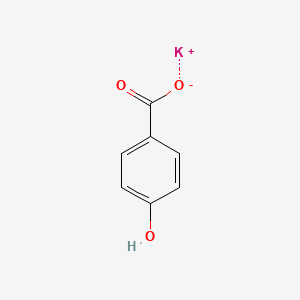
CAS 16782-08-4PubChem CID 23672310
Potassium Paraben
The CIR Expert Panel concluded that the following 20 parabens are safe in cosmetics in the present practices of use and concentration described in the safety assessment when the sum of the combined concentration of parabens in any given formulation does not exceed 0.8 %...Potassium Paraben... — Cosmetic Ingredient Review (CIR)
- IUPAC-Name
- potassium 4-hydroxybenzoate
- Summenformel
- C7H5KO3
- Molekulargewicht
- 176.21 g/mol
- Exakte Masse
- 175.98757550 Da
- Topologische polare Oberfläche
- 60,4 Ų
- Wasserstoffbrücken-Donoren
- 1
- Wasserstoffbrücken-Akzeptoren
- 3
- Kovalente Einheiten
- 2
- Definierte Stereozentren
- 0
Auch bekannt als
potassium p-hydroxybenzoateUNII-UHZ6Y0A8VRUHZ6Y0A8VREINECS 240-830-2MONOPOTASSIUM P-HYDROXYBENZOATE4-HYDROXYBENZOIC ACID POTASSIUM SALTP-HYDROXYBENZOIC ACID MONOPOTASSIUM SALTBENZOIC ACID, 4-HYDROXY-, MONOPOTASSIUM SALT
10 weitere gemeldete Namen
BENZOIC ACID, P-HYDROXY-, MONOPOTASSIUM SALTBENZOIC ACID, 4-HYDROXY-, POTASSIUM SALT (1:1)RefChem:175568POTASSIUM PARABEN [INCI]potassium;4-hydroxybenzoatep-hydroxybenzoic acid potassium saltP-HYDROXYBENZOICACIDPOTASSIUMSALTpotassium parahydroxybenzoateMSK2535KSafinamide Impurity 45 Potassium Salt
Kennungen in externen Datenbanken
- EPA DTXSID:DTXSID20168378
Am 2026-09-02 von NIH PubChem durch prüfsummengültigen CAS-Abgleich abgerufen. Chemische Eigenschaften ersetzen nicht die regulatorische Entscheidung auf dieser Seite.
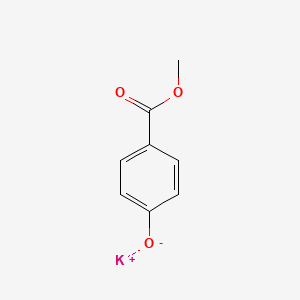
CAS 26112-07-2PubChem CID 23663677
Potassium Methylparaben
The CIR Expert Panel concluded that the following 20 parabens are safe in cosmetics in the present practices of use and concentration described in the safety assessment when the sum of the combined concentration of parabens in any given formulation does not exceed 0.8 %...Potassium Methylparaben... — Cosmetic Ingredient Review (CIR)
- IUPAC-Name
- potassium 4-methoxycarbonylphenolate
- Summenformel
- C8H7KO3
- Molekulargewicht
- 190.24 g/mol
- Exakte Masse
- 190.00322557 Da
- Topologische polare Oberfläche
- 49,4 Ų
- Wasserstoffbrücken-Donoren
- 0
- Wasserstoffbrücken-Akzeptoren
- 3
- Kovalente Einheiten
- 2
- Definierte Stereozentren
- 0
Auch bekannt als
UNII-M64U971IB0M64U971IB0EINECS 247-464-2Methylparaben, potassium saltBenzoic acid, 4-hydroxy-, methyl ester, potassium salt4-Hydroxybenzoic acid, methyl ester, potassium saltMETHYL P-HYDROXYBENZOATE POTASSIUM SALTMETHYL 4-HYDROXYBENZOATE POTASSIUM SALT
12 weitere gemeldete Namen
BENZOIC ACID, P-HYDROXY-, METHYL ESTER, POTASSIUM SALTBENZOIC ACID, 4-HYDROXY-, METHYL ESTER, POTASSIUM SALT (1:1)RefChem:175524POTASSIUM METHYLPARABEN [INCI]247-464-2Potassium methyl 4-oxidobenzoatepotassium;4-methoxycarbonylphenolateMETHYL 4-HYDROXYBENZOATE POTASSIUMpotassium 4-(methoxycarbonyl)phenolateMETHYL4-HYDROXYBENZOATEPOTASSIUMMSK2509KMOCBTMXJPWSHOD-UHFFFAOYSA-M
Kennungen in externen Datenbanken
- EPA DTXSID:DTXSID00949001
Am 2026-09-02 von NIH PubChem durch prüfsummengültigen CAS-Abgleich abgerufen. Chemische Eigenschaften ersetzen nicht die regulatorische Entscheidung auf dieser Seite.
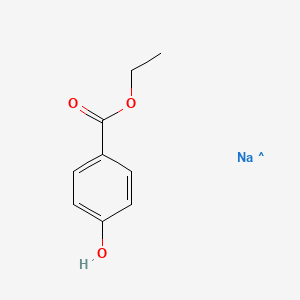
CAS 35285-68-8PubChem CID 52913806
SODIUM ETHYL p-HYDROXYBENZOATE
- Summenformel
- C9H10NaO3
- Molekulargewicht
- 189.16 g/mol
- Exakte Masse
- 189.05276346 Da
- Topologische polare Oberfläche
- 46,5 Ų
- Wasserstoffbrücken-Donoren
- 1
- Wasserstoffbrücken-Akzeptoren
- 3
- Kovalente Einheiten
- 2
- Definierte Stereozentren
- 0
Auch bekannt als
RefChem:1098791Benzoic acid, 4-hydroxy-, ethyl ester, sodium saltp-Hydroxybenzoic acid ethyl ester sodium saltSodium Ethyl Parabenp-Hydroxybenzoic acid ethyl ester sodium salt;Sodium 2-ethyl-4-hydroxybenzoate
Am 2026-09-02 von NIH PubChem durch prüfsummengültigen CAS-Abgleich abgerufen. Chemische Eigenschaften ersetzen nicht die regulatorische Entscheidung auf dieser Seite.
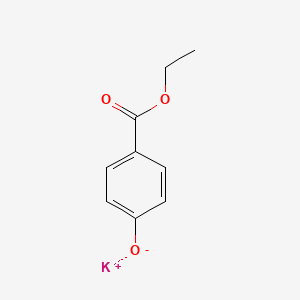
CAS 36457-19-9PubChem CID 23696798
Potassium Ethylparaben
The CIR Expert Panel concluded that the following 20 parabens are safe in cosmetics in the present practices of use and concentration described in the safety assessment when the sum of the combined concentration of parabens in any given formulation does not exceed 0.8 %...Potassium Ethylparaben... — Cosmetic Ingredient Review (CIR)
- IUPAC-Name
- potassium 4-ethoxycarbonylphenolate
- Summenformel
- C9H9KO3
- Molekulargewicht
- 204.26 g/mol
- Exakte Masse
- 204.01887563 Da
- Topologische polare Oberfläche
- 49,4 Ų
- Wasserstoffbrücken-Donoren
- 0
- Wasserstoffbrücken-Akzeptoren
- 3
- Kovalente Einheiten
- 2
- Definierte Stereozentren
- 0
Auch bekannt als
ethylparaben potassiumUNII-528JBB2994EINECS 253-048-1528JBB2994ETHYL P-HYDROXYBENZOATE POTASSIUM SALTP-HYDROXYBENZOIC ACID ETHYL ESTER POTASSIUM SALTRefChem:175473POTASSIUM ETHYLPARABEN [INCI]
9 weitere gemeldete Namen
BENZOIC ACID, 4-HYDROXY-, ETHYL ESTER, POTASSIUM SALT (1:1)Potassium ethyl 4-oxidobenzoatepotassium;4-ethoxycarbonylphenolateBenzoic acid, 4-hydroxy-, ethyl ester, potassium saltMSK2510KHFTYFFXNUVBSII-UHFFFAOYSA-MPotassium 4-(ethoxycarbonyl)phenolateETHYL 4-HYDROXYBENZOATE POTASSIUM SALTPotassium Ethyl-p-hydroxyl Benzoate Solution, 100pm
Kennungen in externen Datenbanken
- EPA DTXSID:DTXSID50189970
Am 2026-09-02 von NIH PubChem durch prüfsummengültigen CAS-Abgleich abgerufen. Chemische Eigenschaften ersetzen nicht die regulatorische Entscheidung auf dieser Seite.
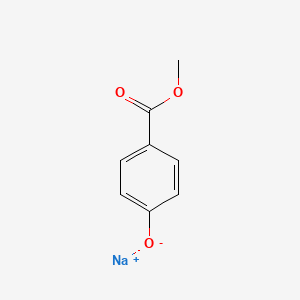
CAS 5026-62-0PubChem CID 23663626
Methylparaben Sodium
The CIR Expert Panel concluded that the following 20 parabens are safe in cosmetics in the present practices of use and concentration described in the safety assessment when the sum of the combined concentration of parabens in any given formulation does not exceed 0.8 %...Sodium Methylparaben... — Cosmetic Ingredient Review (CIR)
- IUPAC-Name
- sodium 4-methoxycarbonylphenolate
- Summenformel
- C8H7NaO3
- Molekulargewicht
- 174.13 g/mol
- Exakte Masse
- 174.02928836 Da
- Topologische polare Oberfläche
- 49,4 Ų
- Wasserstoffbrücken-Donoren
- 0
- Wasserstoffbrücken-Akzeptoren
- 3
- Kovalente Einheiten
- 2
- Definierte Stereozentren
- 0
Auch bekannt als
Paratexin msParidol mnaNipagin m sodiumsodium methyl parabenSolbrol m sodium saltCR6K9C2NHKMethylparaben, sodium saltNs 3500s
16 weitere gemeldete Namen
RefChem:158282225-714-1Sodium 4-(methoxycarbonyl)phenolateSodium methylparabenMethyl 4-hydroxybenzoate, sodium saltMethyl 4-hydroxybenzoate sodium saltSodium 4-carbomethoxyphenolateSodium methyl p-hydroxybenzoateMethylparaben sodium saltsodium;4-methoxycarbonylphenolateUNII-CR6K9C2NHKSodium Methyl ParahydroxybenzoateSodium methylparaben, 99%4-Hydroxybenzoic acid-methyl ester sodiumPreserval MSSolparol
Kennungen in externen Datenbanken
- ChEMBL:CHEMBL2106903
- EPA DTXSID:DTXSID1042156
Am 2026-09-02 von NIH PubChem durch prüfsummengültigen CAS-Abgleich abgerufen. Chemische Eigenschaften ersetzen nicht die regulatorische Entscheidung auf dieser Seite.
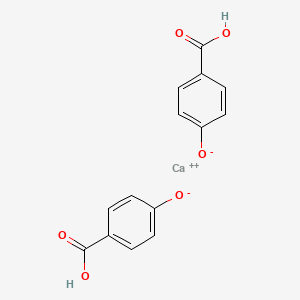
CAS 69959-44-0PubChem CID 54686127
Calcium bis(4-hydroxybenzoate)
- IUPAC-Name
- calcium bis(4-carboxyphenolate)
- Summenformel
- C14H10CaO6
- Molekulargewicht
- 314.30 g/mol
- Exakte Masse
- 314.0103289 Da
- Topologische polare Oberfläche
- 121,0 Ų
- Wasserstoffbrücken-Donoren
- 2
- Wasserstoffbrücken-Akzeptoren
- 6
- Kovalente Einheiten
- 3
- Definierte Stereozentren
- 0
Auch bekannt als
EINECS 274-235-4RefChem:122778274-235-4calcium;4-carboxyphenolateMSK2535CaCalcium Bis(4-Hydroxybenzoate) Solution, 100pm
Kennungen in externen Datenbanken
- EPA DTXSID:DTXSID30220234
Am 2026-09-02 von NIH PubChem durch prüfsummengültigen CAS-Abgleich abgerufen. Chemische Eigenschaften ersetzen nicht die regulatorische Entscheidung auf dieser Seite.
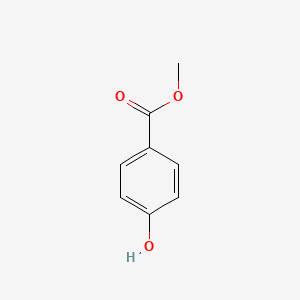
CAS 99-76-3PubChem CID 7456
Methylparaben
Methylparaben is a 4-hydroxybenzoate ester resulting from the formal condensation of the carboxy group of 4-hydroxybenzoic acid with methanol. It is the most frequently used antimicrobial preservative in cosmetics. It occurs naturally in several fruits, particularly in blueberries. It has a role as an antifungal agent, a neuroprotective agent, an antimicrobial food preservative and a plant metabolite. — ChEBI
- IUPAC-Name
- methyl 4-hydroxybenzoate
- Summenformel
- C8H8O3
- Molekulargewicht
- 152.15 g/mol
- Exakte Masse
- 152.047344113 Da
- XLogP3
- 2,0
- Topologische polare Oberfläche
- 46,5 Ų
- Wasserstoffbrücken-Donoren
- 1
- Wasserstoffbrücken-Akzeptoren
- 3
- Kovalente Einheiten
- 1
- Definierte Stereozentren
- 0
Auch bekannt als
Methyl parabenMethyl p-hydroxybenzoateNipaginTegosept MMoldexMaseptolMethyl parahydroxybenzoatep-Hydroxybenzoic acid methyl ester
16 weitere gemeldete Namen
Preserval MPreservalMetabenMethabenMetoxydeParidolSolbrolSeptosMethyl parasept4-Hydroxybenzoic acid methyl esterMethyl butexMethyl chemoseptp-Methoxycarbonylphenolp-CarbomethoxyphenolNipagin MBenzoic acid, 4-hydroxy-, methyl ester
Kennungen in externen Datenbanken
- ChEBI:CHEBI:31835
- ChEMBL:CHEMBL325372
- EPA DTXSID:DTXSID4022529
- PubMed:24130033
- PubMed:23032206
- PubMed:23028405
- PubMed:23009993
- PubMed:22967656
- PubMed:22967651
- PubMed:22928552
- PubMed:22917524
- PubMed:22897632
- PubMed:22887738
- PubMed:22814205
- PubMed:22790701
Am 2026-08-31 von NIH PubChem durch prüfsummengültigen CAS-Abgleich abgerufen. Chemische Eigenschaften ersetzen nicht die regulatorische Entscheidung auf dieser Seite.
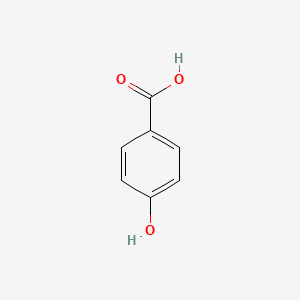
CAS 99-96-7PubChem CID 135
4-Hydroxybenzoic Acid
4-hydroxybenzoic acid is a monohydroxybenzoic acid that is benzoic acid carrying a hydroxy substituent at C-4 of the benzene ring. It has a role as a plant metabolite and an algal metabolite. It is a conjugate acid of a 4-hydroxybenzoate. — ChEBI
- IUPAC-Name
- 4-hydroxybenzoic acid
- Summenformel
- C7H6O3
- Molekulargewicht
- 138.12 g/mol
- Exakte Masse
- 138.031694049 Da
- XLogP3
- 1,6
- Topologische polare Oberfläche
- 57,5 Ų
- Wasserstoffbrücken-Donoren
- 2
- Wasserstoffbrücken-Akzeptoren
- 3
- Kovalente Einheiten
- 1
- Definierte Stereozentren
- 0
Auch bekannt als
p-Hydroxybenzoic acidp-Salicylic acid4-CarboxyphenolBenzoic acid, 4-hydroxy-Benzoic acid, p-hydroxy-para-Hydroxybenzoic acidp-OxybenzoesaureJG8Z55Y12H
16 weitere gemeldete Namen
NSC-4961FEMA NO. 3986CHEBI:30763CHEBI:17879RefChem:25955202-804-94-Hydroxybenzoatep-carboxyphenol4-hydroxy benzoic acidHydroxybenzoic acid4-HydroxybenzoesaeureParaben-acidp-Oxybenzoesaure [German]p-hydroxy benzoic acid4-hydroxy-benzoic acidAcido p-idrossibenzoico [Italian]
Kennungen in externen Datenbanken
- ChEBI:CHEBI:30763
- ChEMBL:CHEMBL441343
- EPA DTXSID:DTXSID3026647
- PubMed:36746253
- PubMed:32664952
- PubMed:32122340
- PubMed:26090578
- PubMed:24685503
- PubMed:24055644
- PubMed:23074910
- PubMed:23037998
- PubMed:23000746
- PubMed:22980106
- PubMed:22978207
- PubMed:22952860
Am 2026-08-31 von NIH PubChem durch prüfsummengültigen CAS-Abgleich abgerufen. Chemische Eigenschaften ersetzen nicht die regulatorische Entscheidung auf dieser Seite.
Weitere maßgebliche Stoffrecherche
Jeder Link durchsucht die jeweilige Quelle nach dieser Identität. Ein Link ist ein Recherchepfad und keine Behauptung, dass die Quelle einen exakten Eintrag enthält. Was jede Quelle ist und welches rechtliche Gewicht sie hat
Diesen Eintrag weiterverwenden
Amtliche Quelle und Geltungsbereich
Importiert aus dem Durchführungsbeschluss (EU) 2025/1175 der Kommission (Datensatzversion EU 2025/1175). Das Glossar liefert gebräuchliche Inhaltsstoffnamen für die nach Artikel 19 Absatz 1 Buchstabe g vorgeschriebene Inhaltsstoffliste; es ist keine Zulassungs- oder Sicherheitsliste.
Amtlichen Beschluss öffnen