
Amtlicher EU-KennzeichnungsnameGlossareintrag 24381
RIBOFLAVIN
Dieser Eintrag bestätigt einen amtlichen gebräuchlichen Inhaltsstoffnamen für die EU-Kennzeichnung kosmetischer Mittel. Er bestätigt für sich genommen nicht, dass der Stoff zulässig, unbeschränkt oder sicher ist.
Globale Belegübersicht
Die ermittelte Identität hat übereinstimmende regulatorische Belege in 3 von 13 indizierten Marktdatensätzen: 2 Ländereinträge und 1 EU-Anhangseinträge. Jedes Ergebnis und jede Belegslücke ist unten aufgeführt.
Geprüfte Märkte
13
Märkte mit Belegen
3
Belegslücken
10
Ermittelte Kennungen
4
Ermittelte Stoffidentität
CAS:83-88-5130-40-5
EC:201-507-1204-988-6
Einträge im Inhaltsstoffindex:
RIBOFLAVIN
Ph.-Eur.-Name: riboflavinum
Kosmetische Funktionen: COLORANT, SKIN CONDITIONING - MISCELLANEOUS
Riboflavin
Beschränkungshinweis aus dem Verzeichnis: IV/145
LACTOFLAVIN
Kosmetische Funktionen: COLORANT
Riboflavin
Beschränkungshinweis aus dem Verzeichnis: IV/145
SODIUM RIBOFLAVIN PHOSPHATE
Ph.-Eur.-Name: riboflavini natrii phosphas
Kosmetische Funktionen: SKIN CONDITIONING
Riboflavin 5'-(sodium hydrogen phosphate)
11 übereinstimmende oder gemeldete Namen
RIBOFLAVINriboflavinriboflavinumLACTOFLAVINRiboflavin [USAN:INN:JAN]SODIUM RIBOFLAVIN PHOSPHATEriboflavin 5'-phosphate sodiumriboflavini natrii phosphasRiboflavinLactoflavinRiboflavin (lactoflavin, vitamin B2)
Regulatorische Belege in allen 13 Märkten
Öffnen Sie jeden übereinstimmenden Eintrag, um Geltungsbereich, Konzentration, Bedingungen, Warnhinweise und die Version der amtlichen Quelle zu sehen.
Wischen oder scrollen Sie horizontal, um Datenabdeckung und nächste Schritte zu sehen.
| Markt | Ergebnis | Einträge | Datensatz | Bedeutung / nächster Schritt |
|---|---|---|---|---|
| European Union EU | Treffer: bedingte Positivliste | 1Eintrag öffnen 1 | Complete annex dataset Regulation (EC) 1223/2009 consolidated to 1 May 2026 | Prüfen Sie jeden verknüpften Eintrag und die genauen Bedingungen. |
| Great Britain GB | Permitted list with conditions | 1Eintrag öffnen 1 | Complete consolidated annex dataset GB retained Regulation 1223/2009 schedules, effective 15 August 2026 | Prüfen Sie jeden verknüpften Eintrag und die genauen Bedingungen. |
| Canada CA | Kein Treffer gefunden | 0 | Complete Hotlist snapshot Health Canada Cosmetic Ingredient Hotlist, 13 August 2025 | The Hotlist is an administrative compliance tool, not an exhaustive safety approval list. |
| New Zealand NZ | Permitted list with conditions | 1Eintrag öffnen 1 | Complete schedules dataset Cosmetic Products Group Standard schedules effective 1 January 2026 | Prüfen Sie jeden verknüpften Eintrag und die genauen Bedingungen. |
| ASEAN ASEAN | Kein Treffer gefunden | 0 | Complete regional annex dataset ASEAN Cosmetic Directive annexes 2026-1, 22 June 2026 | Regional annex coverage does not replace member-state implementation dates, notifications or national deviations. |
| China CN | Kein Treffer gefunden | 0 | Complete prohibited catalogues plus official-source workflow NMPA 2021 banned catalogues plus dynamic IECIC List I/List II system current since 2025 | IECIC listing is not blanket approval; absence may require the new cosmetic ingredient route, and restrictions are checked separately. |
| Japan JP | Kein Treffer gefunden | 0 | Complete Standards appendices dataset MHLW Standards for Cosmetics official English source and Japanese amendments checked for the imported snapshot | The Japanese text and subsequent notices are canonical; no local match is not a product-compliance conclusion. |
| South Korea KR | Kein Treffer gefunden | 0 | Complete current appendix dataset MFDS Notice 2026-19, effective 18 March 2026 | Korean source wording is canonical and other positive lists/notices may still apply to the formulation. |
| United States US | Kein Treffer gefunden | 0 | Complete enumerated federal ingredient rules eCFR Title 21 issue date 27 August 2026 | FDA has no general approved-cosmetic-ingredient catalogue; absence from these sections is not approval or proof of safety. |
| Australia AU | Kein Treffer gefunden | 0 | Complete cosmetic-relevant Poisons Standard subset plus official workflow Therapeutic Goods (Poisons Standard—June 2026) Instrument 2026 | An AICIS Inventory match is not cosmetic approval; no Inventory match can indicate a new, exempted, reported or confidential introduction. |
| Brazil BR | Kein Treffer gefunden | 0 | Complete prohibited dataset plus current restricted-list workflow ANVISA RDC 1.029/2026 and RDC 1.030/2026, published 15 June 2026 | RDC 1.030/2026 amends rather than replaces the prohibited baseline, and the second restricted-list revision was still under consultation in July 2026. |
| India IN | Kein Treffer gefunden | 0 | Complete current Part 2 dataset plus official workflow for Parts 1, 3 and 4 Cosmetics Rules 2020 plus current BIS IS 4707 parts (1:2020, 2:2025, 3:2025, 4:2022) | The standards are separate controlled publications; absence from a locally indexed excerpt is not permission. |
| Saudi Arabia SA | Kein Treffer gefunden | 0 | Complete official list index SFDA live prohibited/restricted lists, snapshot 30 August 2026 | No list match is not permission; Gulf/SFDA product, claim, notification and technical requirements still apply. |
Keine Marktzeilen entsprechen diesem Filter.
Übereinstimmende Markteinträge und Bedingungen
Great Britain
GB retained Regulation 1223/2009 schedules, effective 15 August 2026New Zealand
Cosmetic Products Group Standard schedules effective 1 January 2026Exakte Belege aus den Anhängen II–VI
Annex IVEintrag 145
Vollständigen regulatorischen Eintrag öffnenLACTOFLAVIN / RIBOFLAVIN
Warnhinweise: Purity criteria as set out in Commission Directive 95/45/EC (E101)
Chemische Identität und Eigenschaften
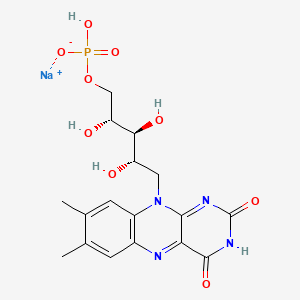
CAS 130-40-5PubChem CID 23666409
Riboflavin sodium phosphate
Riboflavin sodium phosphate is a vitamin B2 and a ribitol phosphate. It is functionally related to a riboflavin. — ChEBI
- IUPAC-Name
- sodium [(2R,3S,4S)-5-(7,8-dimethyl-2,4-dioxobenzo[g]pteridin-10-yl)-2,3,4-trihydroxypentyl] hydrogen phosphate
- Summenformel
- C17H20N4NaO9P
- Molekulargewicht
- 478.3 g/mol
- Exakte Masse
- 478.08655951 Da
- Topologische polare Oberfläche
- 204,0 Ų
- Wasserstoffbrücken-Donoren
- 5
- Wasserstoffbrücken-Akzeptoren
- 10
- Kovalente Einheiten
- 2
- Definierte Stereozentren
- 3
Auch bekannt als
RIBOFLAVIN PHOSPHATE SODIUMRiboflavin-5-phosphate sodiumRiboflavin 5'-monophosphate sodium saltRiboflavina 5 fosfato de sodioRiboflavine-5'-phosphate sodiumRiboflavin 5'-phosphate sodium anhydrousRiboflavin 5'-(dihydrogen phosphate), sodium salt (1:1)Flavin Mononucleotide Sodium Salt
16 weitere gemeldete Namen
Sodium Riboflavin PhosphateRIBOFLAVIN 5-PHOSPHATE SODIUMRiboflavin (phosphate sodium)957E53WV42NSC 759230Riboflavin monophosphate monosodium saltSodium (2R,3S,4S)-5-(7,8-dimethyl-2,4-dioxo-3,4-dihydrobenzo[g]pteridin-10(2H)-yl)-2,3,4-trihydroxypentyl hydrogen phosphateFMN-NaFLAVIN MONONUCLEOTIDE MONOSODIUM SALT [MI]Riboflavin sodium phosphate [JAN]Lactoflavin Phosphate Sodium SaltRiboflavin 5'-(dihydrogen phosphate), monosodium saltRiboflavin Phosphate Sodium Salt (~70%)Riboflavin-5'-phosphate sodiumRiboflavin Phosphate Sodium SaltRiboflavin sodium phosphate; riboflavin 5'-(sodium hydrogen phosphate)
Kennungen in externen Datenbanken
- ChEBI:CHEBI:32098
- EPA DTXSID:DTXSID80889330
- PubMed:5053
Belege aus weiteren wissenschaftlichen Datenbanken
NIH PubChem PUG-View
Exakter Kennungstreffer23666409
Attributed physical-property, hazard, environmental and use annotations.
- Physical Description: Exists as the dihydrate: Yellow solid; [Merck Index] Yellow to orange hygroscopic solid; [JECFA] Quelle: Haz-Map, Information on Hazardous Chemicals and Occupational Diseases
- Note: This chemical does not meet GHS hazard criteria for 97% (65 of 67) of all reports. Quelle: European Chemicals Agency (ECHA)
- GHS Hazard Statements: Not Classified; Reported as not meeting GHS hazard criteria by 65 of 67 companies (only 3% companies provided GHS information). For more detailed information, please visit ECHA C&L website. Quelle: European Chemicals Agency (ECHA)
- ECHA C&L Notifications Summary: Aggregated GHS information provided per 67 reports by companies from 2 notifications to the ECHA C&L Inventory.; Reported as not meeting GHS hazard criteria per 65 of 67 reports by companies.; There is 1 notification provided by 2 of 67 reports by companies with hazard statement code(s).; Information may vary between notifications depending on impurities, additives, and other factors. The percentage value in parenthesis indicates the notified classification ratio from companies that provide hazard codes. Only hazard codes with percentage values above 10% are shown. For more detailed information, please visit ECHA C&L website. Quelle: European Chemicals Agency (ECHA)
- Sources/Uses: A bioactive form of riboflavin; [Merck Index] Used as a nutritional supplement; [FDA] Used as a coloring agent for foods; [JECFA] Quelle: Haz-Map, Information on Hazardous Chemicals and Occupational Diseases
Zugeordnet durch: Existing checksum-valid CAS to unique PubChem CID match. Abgerufen: 2026-08-31. Quelleneintrag öffnen
Wissenschaftliche Klassifizierungen und Gefahrenannotationen liefern Kontext und ersetzen nicht die oben gezeigte marktspezifische regulatorische Entscheidung.
Weitere Quellenabdeckung und Trefferstatus
| Quelle | Ergebnis | Geprüft |
|---|---|---|
| NIH PubChem PUG-View | Exakter Treffer | 2026-08-31 |
Ein erfasster Nicht-Treffer ist ein nützlicher Beleg dafür, dass die Quelle geprüft wurde; er ist keine Behauptung, dass der Stoff anderswo nicht existiert.
Am 2026-09-02 von NIH PubChem durch prüfsummengültigen CAS-Abgleich abgerufen. Chemische Eigenschaften ersetzen nicht die regulatorische Entscheidung auf dieser Seite.
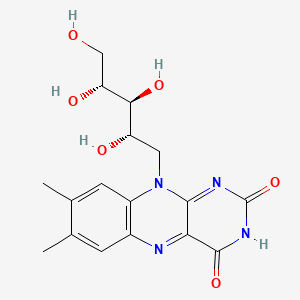
CAS 83-88-5PubChem CID 493570
Riboflavin
Riboflavin is D-Ribitol in which the hydroxy group at position 5 is substituted by a 7,8-dimethyl-2,4-dioxo-3,4-dihydrobenzo[g]pteridin-10(2H)-yl moiety. It is a nutritional factor found in milk, eggs, malted barley, liver, kidney, heart, and leafy vegetables, but the richest natural source is yeast. The free form occurs only in the retina of the eye, in whey, and in urine; its principal forms in tissues and cells are as flavin mononucleotide and flavin-adenine dinucleotide. It has a role as an antioxidant, a cofactor, a photosensitizing agent, an anti-inflammatory agent, a mouse metabolite, a plant metabolite, an Escherichia coli metabolite, a food colouring, a fundamental metabolite and a human urinary metabolite. It is a vitamin B2 and a flavin. It is a conjugate acid of a riboflavin(1-). — ChEBI
- IUPAC-Name
- 7,8-dimethyl-10-[(2S,3S,4R)-2,3,4,5-tetrahydroxypentyl]benzo[g]pteridine-2,4-dione
- Summenformel
- C17H20N4O6
- Molekulargewicht
- 376.4 g/mol
- Exakte Masse
- 376.13828437 Da
- XLogP3
- -1,5
- Topologische polare Oberfläche
- 155,0 Ų
- Wasserstoffbrücken-Donoren
- 5
- Wasserstoffbrücken-Akzeptoren
- 7
- Kovalente Einheiten
- 1
- Definierte Stereozentren
- 3
Auch bekannt als
vitamin B2RiboflavineLactoflavinVitamin GLactoflavineFlavaxinBeflavineBeflavin
16 weitere gemeldete Namen
RibodermRibipcaRibovelLactobeneRibocrisinaRiboflavinaRiboflavinumRibotoneVitaflavineFlaxainRibosynVitamin BiFlavin BBRussupteridine Yellow IIIVitasan B2HYRE
Kennungen in externen Datenbanken
- ChEBI:CHEBI:17015
- ChEMBL:CHEMBL1534
- EPA DTXSID:DTXSID8021777
- PubMed:37944868
- PubMed:34062077
- PubMed:33882315
- PubMed:33352258
- PubMed:26360969
- PubMed:23105845
- PubMed:23074417
- PubMed:23063183
- PubMed:23062003
- PubMed:23062001
- PubMed:23056435
- PubMed:23056269
Am 2026-08-31 von NIH PubChem durch prüfsummengültigen CAS-Abgleich abgerufen. Chemische Eigenschaften ersetzen nicht die regulatorische Entscheidung auf dieser Seite.
Weitere maßgebliche Stoffrecherche
Jeder Link durchsucht die jeweilige Quelle nach dieser Identität. Ein Link ist ein Recherchepfad und keine Behauptung, dass die Quelle einen exakten Eintrag enthält. Was jede Quelle ist und welches rechtliche Gewicht sie hat
Diesen Eintrag weiterverwenden
Amtliche Quelle und Geltungsbereich
Importiert aus dem Durchführungsbeschluss (EU) 2025/1175 der Kommission (Datensatzversion EU 2025/1175). Das Glossar liefert gebräuchliche Inhaltsstoffnamen für die nach Artikel 19 Absatz 1 Buchstabe g vorgeschriebene Inhaltsstoffliste; es ist keine Zulassungs- oder Sicherheitsliste.
Amtlichen Beschluss öffnen