
CAS
1 Eintrag
CAS 126-73-8
CAS 126-73-8 entspricht 1 EU-Anhangseintrag in den Anhängen II–VI der Verordnung (EG) Nr. 1223/2009.
Einträge zu CAS 126-73-8
1 insgesamtChemische Identität und Eigenschaften
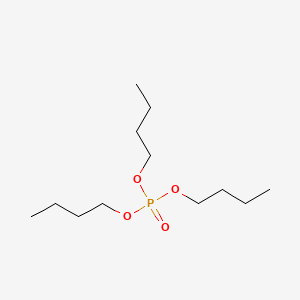
CAS 126-73-8PubChem CID 31357
Tributyl Phosphate
Tributyl phosphate is a trialkyl phosphate that is the tributyl ester of phosphoric acid. — ChEBI
- IUPAC-Name
- tributyl phosphate
- Summenformel
- C12H27O4P
- Molekulargewicht
- 266.31 g/mol
- Exakte Masse
- 266.16469634 Da
- XLogP3
- 2,9
- Topologische polare Oberfläche
- 44,8 Ų
- Wasserstoffbrücken-Donoren
- 0
- Wasserstoffbrücken-Akzeptoren
- 4
- Kovalente Einheiten
- 1
- Definierte Stereozentren
- 0
Auch bekannt als
Tri-n-butyl phosphateTributylphosphatePhosphoric acid tributyl esterTributylphosphatCelluphos 4tbpaDisflamoll TBTributilfosfato
16 weitere gemeldete Namen
TributylfosfaatTributoxyphosphine oxidePhosphoric acid, tributyl esterTributyle (phosphate de)Butyl phosphate, tri-TributylfosfatTri-N-butylphosphateButyl phosphate, ((BuO)3PO)MCS 249595UAS8YAF5Tributyl ester of phosphoric acidNSC-8484CHEBI:35019NSC8484tri-(n-butyl)-phosphateRefChem:190910
Kennungen in externen Datenbanken
- ChEBI:CHEBI:35019
- ChEMBL:CHEMBL1371096
- EPA DTXSID:DTXSID3021986
- PubMed:40389058
- PubMed:38603619
- PubMed:33367866
- PubMed:33049310
- PubMed:32662595
- PubMed:32105654
- PubMed:30974155
- PubMed:30966736
- PubMed:28282128
- PubMed:27146889
- PubMed:27018022
- PubMed:26778350
Belege aus weiteren wissenschaftlichen Datenbanken
NIH PubChem PUG-View
Exakter Kennungstreffer31357
Attributed physical-property, hazard, environmental and use annotations.
- Autoignition Temperature: 770 °F (USCG, 1999) Quelle: CAMEO Chemicals
- Autoignition Temperature: 410 °C Quelle: Hazardous Substances Data Bank (HSDB)
- Autoignition Temperature: >482 °C Quelle: ILO-WHO International Chemical Safety Cards (ICSCs)
- Boiling Point: 552 °F at 760 mmHg (NTP, 1992) Quelle: CAMEO Chemicals
- Boiling Point: 289 °C (decomposes) Quelle: Hazardous Substances Data Bank (HSDB)
- Boiling Point: 552 °F Quelle: Occupational Safety and Health Administration (OSHA)
- Boiling Point: 289 °C @760 [mm Hg] Quelle: PAC Chemical Database, U.S. Department of Energy
- Boiling Point: 552 °F (Decomposes) Quelle: The National Institute for Occupational Safety and Health (NIOSH)
- Color/Form: Colorless to pale-yellow liquid Quelle: Hazardous Substances Data Bank (HSDB)
- Density: 0.982 at 68 °F (USCG, 1999) - Less dense than water; will float Quelle: CAMEO Chemicals
- Density: 0.978 at 20 °C/20 °C Quelle: Hazardous Substances Data Bank (HSDB)
- Density: Bulk Density: 8.19 lb/gal Quelle: Hazardous Substances Data Bank (HSDB)
- Density: Relative density (water = 1): 0.98 Quelle: ILO-WHO International Chemical Safety Cards (ICSCs)
- Density: 0.982 at 68 °F Quelle: Occupational Safety and Health Administration (OSHA)
- Density: 0.9727 @25 °C Quelle: PAC Chemical Database, U.S. Department of Energy
- Density: 0.98 Quelle: The National Institute for Occupational Safety and Health (NIOSH)
- Flash Point: 295 °F (NTP, 1992) Quelle: CAMEO Chemicals
- Flash Point: 146 °C Quelle: Haz-Map, Information on Hazardous Chemicals and Occupational Diseases
- Flash Point: 146 °C (open cup) Quelle: Hazardous Substances Data Bank (HSDB)
- Flash Point: 295 °F (146 °C) (Open cup) Quelle: Hazardous Substances Data Bank (HSDB)
- Flash Point: 145 °C (293 °F) (Closed cup) Quelle: Hazardous Substances Data Bank (HSDB)
- Flash Point: 146 °C o.c. Quelle: ILO-WHO International Chemical Safety Cards (ICSCs)
- Flash Point: 295 °F (open cup) Quelle: Occupational Safety and Health Administration (OSHA)
- Flash Point: (oc) 295 °F Quelle: The National Institute for Occupational Safety and Health (NIOSH)
- LogP: log Kow = 4.00 Quelle: Hazardous Substances Data Bank (HSDB)
- LogP: 4.0 Quelle: ILO-WHO International Chemical Safety Cards (ICSCs)
- Melting Point: less than -112 °F (NTP, 1992) Quelle: CAMEO Chemicals
- Melting Point: Less than -80 °C Quelle: Hazardous Substances Data Bank (HSDB)
- Melting Point: <-112 °F Quelle: Occupational Safety and Health Administration (OSHA)
- Melting Point: -80 °C Quelle: PAC Chemical Database, U.S. Department of Energy
- Melting Point: -112 °F Quelle: The National Institute for Occupational Safety and Health (NIOSH)
- Odor: Odorless Quelle: Hazardous Substances Data Bank (HSDB)
- Physical Description: Tributyl phosphate is an odorless colorless to yellow liquid. Toxic by ingestion and inhalation. Quelle: CAMEO Chemicals
- Physical Description: Dry Powder; Liquid Quelle: EPA Chemical Data Reporting (CDR)
- Physical Description: Colorless to pale-yellow, odorless liquid; [NIOSH] Quelle: Haz-Map, Information on Hazardous Chemicals and Occupational Diseases
- Physical Description: COLOURLESS ODOURLESS VISCOUS LIQUID. Quelle: ILO-WHO International Chemical Safety Cards (ICSCs)
- Physical Description: Colorless to pale-yellow, odorless liquid. Quelle: Occupational Safety and Health Administration (OSHA)
- Physical Description: Colorless to pale-yellow, odorless liquid. Quelle: The National Institute for Occupational Safety and Health (NIOSH)
- Refractive Index: Index of refraction = 1.4224 at 25 °C Quelle: Hazardous Substances Data Bank (HSDB)
- Solubility: less than 1 mg/mL at 68.9 °F (NTP, 1992) Quelle: CAMEO Chemicals
- Solubility: In water, 280 mg/L at 25 °C Quelle: Hazardous Substances Data Bank (HSDB)
- Solubility: Soluble in diethyl ether, benzene, carbon disulfide; miscible with ethanol Quelle: Hazardous Substances Data Bank (HSDB)
- Solubility: Miscible with most solvents and diluents Quelle: Hazardous Substances Data Bank (HSDB)
- Solubility: Solubility in water: poor Quelle: ILO-WHO International Chemical Safety Cards (ICSCs)
- Solubility: 0.6% Quelle: The National Institute for Occupational Safety and Health (NIOSH)
- Vapor Pressure: 13.7 mmHg at 68 °F (NTP, 1992) Quelle: CAMEO Chemicals
- Vapor Pressure: 0.00113 [mmHg] Quelle: Haz-Map, Information on Hazardous Chemicals and Occupational Diseases
- Vapor Pressure: 1.13X10⁻³ mm Hg at 25 °C Quelle: Hazardous Substances Data Bank (HSDB)
- Vapor Pressure: Vapor pressure, Pa at 25 °C: 0.15 Quelle: ILO-WHO International Chemical Safety Cards (ICSCs)
- Vapor Pressure: 0.004 mmHg at 77 °F Quelle: Occupational Safety and Health Administration (OSHA)
- Vapor Pressure: 75 [mm Hg] @205 °C Quelle: PAC Chemical Database, U.S. Department of Energy
- Vapor Pressure: (77 °F): 0.004 mmHg Quelle: The National Institute for Occupational Safety and Health (NIOSH)
- Viscosity: 3.39 cP at 25 °C Quelle: Hazardous Substances Data Bank (HSDB)
- Exposure Routes: The substance can be absorbed into the body by inhalation of its vapour, through the skin and by ingestion. Quelle: ILO-WHO International Chemical Safety Cards (ICSCs)
- Exposure Routes: inhalation, ingestion, skin and/or eye contact Quelle: The National Institute for Occupational Safety and Health (NIOSH)
- First Aid: EYES: First check the victim for contact lenses and remove if present. Flush victim's eyes with water or normal saline solution for 20 to 30 minutes while simultaneously calling a hospital or poison control center. Do not put any ointments, oils, or medication in the victim's eyes without specific instructions from a physician. IMMEDIATELY transport the victim after flushing eyes to a hospital even if no symptoms (such as redness or irritation) develop.; SKIN: IMMEDIATELY flood affected skin with water while removing and isolating all contaminated clothing. Gently wash all affected skin areas thoroughly with soap and water. IMMEDIATELY call a hospital or poison control center even if no symptoms (such as redness or irritation) develop. IMMEDIATELY transport the victim to a hospital for treatment after washing the affected areas.; INHALATION: IMMEDIATELY leave the contaminated area; take deep breaths of fresh air. IMMEDIATELY call a physician and be prepared to transport the victim to a hospital even if no symptoms (such as wheezing, coughing, shortness of breath, or burning in the mouth, throat, or chest) develop. Provide proper respiratory protection to rescuers entering an unknow Quelle: CAMEO Chemicals
- First Aid: (General first aid procedures); Eye: Irrigate immediately - If this chemical contacts the eyes, immediately wash (irrigate) the eyes with large amounts of water, occasionally lifting the lower and upper lids. Get medical attention immediately.; Skin: Soap wash promptly - If this chemical contacts the skin, promptly wash the contaminated skin with soap and water. If this chemical penetrates the clothing, promptly remove the clothing and wash the skin with soap and water. Get medical attention promptly.; Breathing: Respiratory support; Swallow: Medical attention immediately - If this chemical has been swallowed, get medical attention immediately. Quelle: The National Institute for Occupational Safety and Health (NIOSH)
- Signal: Warning Quelle: Regulation (EC) No 1272/2008 of the European Parliament and of the Council
- GHS Hazard Statements: H302: Harmful if swallowed [Warning Acute toxicity, oral]; H315: Causes skin irritation [Warning Skin corrosion/irritation]; H351: Suspected of causing cancer [Warning Carcinogenicity] Quelle: Regulation (EC) No 1272/2008 of the European Parliament and of the Council
- Precautionary Statement Codes: P203, P264, P270, P280, P301+P317, P302+P352, P318, P321, P330, P332+P317, P362+P364, P405, and P501 (click each P-code to see the statement) Quelle: Regulation (EC) No 1272/2008 of the European Parliament and of the Council
- Signal: Warning Quelle: European Chemicals Agency (ECHA)
- GHS Hazard Statements: H302 (100%): Harmful if swallowed [Warning Acute toxicity, oral]; H315 (100%): Causes skin irritation [Warning Skin corrosion/irritation]; H351 (> 99.9%): Suspected of causing cancer [Warning Carcinogenicity]; H412 (19.6%): Harmful to aquatic life with long lasting effects [Hazardous to the aquatic environment, long-term hazard] Quelle: European Chemicals Agency (ECHA)
- Precautionary Statement Codes: P203, P264, P270, P273, P280, P301+P317, P302+P352, P318, P321, P330, P332+P317, P362+P364, P405, and P501 (click each P-code to see the statement) Quelle: European Chemicals Agency (ECHA)
- ECHA C&L Notifications Summary: Aggregated GHS information provided per 1091 reports by companies from 13 notifications to the ECHA C&L Inventory. Each notification may be associated with multiple companies.; Information may vary between notifications depending on impurities, additives, and other factors. The percentage value in parenthesis indicates the notified classification ratio from companies that provide hazard codes. Only hazard codes with percentage values above 10% are shown. For more detailed information, please visit ECHA C&L website. Quelle: European Chemicals Agency (ECHA)
- Signal: Danger Quelle: NITE-CMC
- GHS Hazard Statements: H302: Harmful if swallowed [Warning Acute toxicity, oral]; H315: Causes skin irritation [Warning Skin corrosion/irritation]; H318: Causes serious eye damage [Danger Serious eye damage/eye irritation]; H332: Harmful if inhaled [Warning Acute toxicity, inhalation]; H351: Suspected of causing cancer [Warning Carcinogenicity]; H371: May cause damage to organs [Warning Specific target organ toxicity, single exposure]; H373: May causes damage to organs through prolonged or repeated exposure [Warning Specific target organ toxicity, repeated exposure]; H401: Toxic to aquatic life [Hazardous to the aquatic environment, acute hazard]; H411: Toxic to aquatic life with long lasting effects [Hazardous to the aquatic environment, long-term hazard] Quelle: NITE-CMC
- Precautionary Statement Codes: P203, P260, P261, P264, P264+P265, P270, P271, P273, P280, P301+P317, P302+P352, P304+P340, P305+P354+P338, P308+P316, P317, P318, P319, P321, P330, P332+P317, P362+P364, P391, P405, and P501 (click each P-code to see the statement) Quelle: NITE-CMC
- GHS Hazard Statements: H401: Toxic to aquatic life [Hazardous to the aquatic environment, acute hazard]; H411: Toxic to aquatic life with long lasting effects [Hazardous to the aquatic environment, long-term hazard] Quelle: NITE-CMC
- Precautionary Statement Codes: P273, P391, and P501 (click each P-code to see the statement) Quelle: NITE-CMC
- NFPA Health Rating: 3 - Materials that, under emergency conditions, can cause serious or permanent injury. Quelle: Hazardous Substances Data Bank (HSDB)
- NFPA Fire Rating: 1 - Materials that must be preheated before ignition can occur. Materials require considerable preheating, under all ambient temperature conditions, before ignition and combustion can occur. Quelle: Hazardous Substances Data Bank (HSDB)
- NFPA Instability Rating: 0 - Materials that in themselves are normally stable, even under fire conditions. Quelle: Hazardous Substances Data Bank (HSDB)
- Target Organs: Eyes, skin, respiratory system Quelle: The National Institute for Occupational Safety and Health (NIOSH)
- Toxicity Summary: IDENTIFICATION AND USE: Tributyl phosphate is a colorless to pale-yellow odorless liquid. It is used as a plasticizer for cellulose esters, lacquers, plastics, and vinyl resins. Used in fire-resistant aircraft hydraulic fluids. Other uses include heat-exchange medium, solvent extraction of metal ions from solution of reactor products, solvent for nitrocellulose, cellulose acetate, pigment grinding assistant, antifoaming agent, dielectric. HUMAN EXPOSURE AND TOXICITY: Breathing vapors of tributyl phosphate causes irritation of mucous membranes and if inhalation is prolonged there can be general poisoning with paralysis. In contact with skin tributyl phosphate can cause irritation. Tributyl phosphate may cause irritation of the eyes, nose, and throat. It may also cause nausea and headache. In a series of 42 patients with furniture related dermatitis, a positive patch test reaction was seen in 1 patient. In vitro it acts as androgen receptor, and glucocorticoid receptor antagonist. ANIMAL STUDIES: Tributyl phosphate was not acutely toxic by dermal exposure in the rabbit and in the guinea pig. Application to either intact or abraded skin of rabbits and guinea pigs produced irritation w Quelle: Hazardous Substances Data Bank (HSDB)
- Environmental Bioconcentration: BCFs of 7.1-20 and 5.5-10 were reported in carp (Cyprinus carpio) which were exposed to tributyl phosphate at 6 and 60 ppb, respectively, over a 6-week period(1). The BCF of tributyl phosphate (exposure concentration of 3-4 ug/L) in killifish (Oryzias latipes) was found to be 30-35 and in goldfish (Carassius auratus) was found to be 6-11(2). According to a classification scheme(3), these BCFs suggest bioconcentration in aquatic organisms is low to moderate(SRC). Quelle: Hazardous Substances Data Bank (HSDB)
- Environmental Fate: TERRESTRIAL FATE: Based on a classification scheme(1), an estimated Koc value of 2400(SRC), determined from a structure estimation method(2), indicates that tributyl phosphate is expected to have slight mobility in soil(SRC). Volatilization of tributyl phosphate from moist soil surfaces is expected to be an important fate process(SRC) given an estimated Henry's Law constant of 1.4X10⁻⁶ atm-cu m/mole(SRC), based upon its vapor pressure, 1.13X10⁻³ mm Hg(3), and water solubility, 280 mg/L(4). However, adsorption to soil is expected to attenuate volatilization(SRC). Tributyl phosphate is not expected to volatilize from dry soil surfaces(SRC) based upon its vapor pressure(3). Biodegradation of 56-96% in activated sludge inoculum(4) and a 3% of theoretical BOD using activated sludge in the Japanese MITI test(5) suggest that biodegradation may be an important environmental fate process in soil(SRC). Quelle: Hazardous Substances Data Bank (HSDB)
- Environmental Fate: AQUATIC FATE: Based on a classification scheme(1), an estimated Koc value of 2400(SRC), determined from a structure estimation method(2), indicates that tributyl phosphate is expected to adsorb to suspended solids and sediment(SRC). Volatilization from water surfaces is expected(3) based upon an estimated Henry's Law constant of 1.4X10⁻⁶ atm-cu m/mole(SRC), derived from its vapor pressure, 1.13X10⁻³ mm Hg(4), and water solubility, 280 mg/L(5). Using this Henry's Law constant and an estimation method(3), volatilization half-lives for a model river and model lake are 40 and 300 days, respectively(SRC). Tributyl phosphate is not expected to undergo hydrolysis in the environment(SRC) due to estimated hydrolysis half-lives of 9.9 to 11.5 years at pH 9 to 5(2). According to a classification scheme(6), BCFs of 5.5-20 in carp(7), 30-35 in killifish and 6-11 in goldfish(8), suggest bioconcentration in aquatic organisms is low to moderate(SRC). Aqueous biodegradation test results for tributyl phosphate varied from negligible biodegradation(9-11) to 30-100% biodegradation(5,11). Quelle: Hazardous Substances Data Bank (HSDB)
- Environmental Fate: ATMOSPHERIC FATE: According to a model of gas/particle partitioning of semivolatile organic compounds in the atmosphere(1), tributyl phosphate, which has a vapor pressure of 1.13X10⁻³ mm Hg at 25 °C(2), is expected to exist solely as a vapor in the ambient atmosphere. Vapor-phase tributyl phosphate is degraded in the atmosphere by reaction with photochemically-produced hydroxyl radicals(SRC); the half-life for this reaction in air is estimated to be 4.4 hours(SRC), calculated from its rate constant of 7.9X10⁻¹¹ cu cm/molecule-sec at 25 °C(SRC) that was derived using a structure estimation method(3). Tributyl phosphate does not contain chromophores that absorb at wavelengths >290 nm(4) and, therefore, is not expected to be susceptible to direct photolysis by sunlight(SRC). Quelle: Hazardous Substances Data Bank (HSDB)
- Consumer Uses: Hydraulic fluids; Flame retardant; Not Known or Reasonably Ascertainable; Lubricating agent Quelle: EPA Chemical Data Reporting (CDR)
- Industry Uses: Lubricating agent; Hydraulic fluids; Plasticizer; Flame retardant; Not Known or Reasonably Ascertainable; Defoamer Quelle: EPA Chemical Data Reporting (CDR)
- Sources/Uses: Mainly used as a flame retardant in aircraft hydraulic fluid, which can contain 25 to 75% TBP; Also used as a solvent (rare earth extraction and nuclear fuel cycle), plasticizer, carrier for fluorescent dyes, and antifoam agent (cement casings for oil wells); [ACGIH] Used as an antifoaming agent (concrete, textile, and paper industries); [HSDB] Quelle: Haz-Map, Information on Hazardous Chemicals and Occupational Diseases
- Industrial Processes with risk of exposure: Petroleum Production and Refining [Category: Industry]; Pulp and Paper Processing [Category: Industry]; Textiles (Fiber & Fabric Manufacturing) [Category: Industry]; Metal Extraction and Refining [Category: Industry] Quelle: Haz-Map, Information on Hazardous Chemicals and Occupational Diseases
- Uses: Plasticizer for cellulose esters, lacquers, plastics, and vinyl resins. Quelle: Hazardous Substances Data Bank (HSDB)
- Uses: ... Used in fire-resistant aircraft hydraulic fluids. Quelle: Hazardous Substances Data Bank (HSDB)
- Uses: Heat-exchange medium, solvent extraction of metal ions from solution of reactor products, solvent for nitrocellulose, cellulose acetate, plasticizer, pigment grinding assistant, antifoam agent, dielectric. Quelle: Hazardous Substances Data Bank (HSDB)
- Uses: Extraction chromatography, in which the organic extractant is adsorbed on the surfaces of a fine, porous powder placed in a column, offers another excellent method for separating the actinide elements from each other. Useful cation extracting agents include ... n-tributyl phosphate. Quelle: Hazardous Substances Data Bank (HSDB)
- Uses: For more Uses (Complete) data for TRIBUTYL PHOSPHATE (10 total), please visit the HSDB record page. Quelle: Hazardous Substances Data Bank (HSDB)
Zugeordnet durch: Existing checksum-valid CAS to unique PubChem CID match. Abgerufen: 2026-08-31. Quelleneintrag öffnen
Wissenschaftliche Klassifizierungen und Gefahrenannotationen liefern Kontext und ersetzen nicht die oben gezeigte marktspezifische regulatorische Entscheidung.
Weitere Quellenabdeckung und Trefferstatus
| Quelle | Ergebnis | Geprüft |
|---|---|---|
| NIH PubChem PUG-View | Exakter Treffer | 2026-08-31 |
Ein erfasster Nicht-Treffer ist ein nützlicher Beleg dafür, dass die Quelle geprüft wurde; er ist keine Behauptung, dass der Stoff anderswo nicht existiert.
Am 2026-09-02 von NIH PubChem durch prüfsummengültigen CAS-Abgleich abgerufen. Chemische Eigenschaften ersetzen nicht die regulatorische Entscheidung auf dieser Seite.
Wie CAS 126-73-8 auf dieser Website verwendet wird
CAS 126-73-8 ist die Kennung des Chemical Abstracts Service, mit der diese Seite einem bestimmten Stoff zugeordnet wird. Im aktuellen Datenbestand hat 1 EU-Anhangseintrag diese Kennung; so können Sie gegenprüfen, ob derselbe Stoff in einem oder in mehreren regulatorischen Zusammenhängen auftaucht.
Nutzen Sie diese Seite, wenn eine Lieferantenspezifikation, ein Sicherheitsdatenblatt oder ein Rohstoffdossier CAS 126-73-8 nennt und Sie alle verknüpften Einträge der Anhänge II–VI an einem Ort sehen möchten. Die Eintragskarten oben sind der schnellste Weg zu Konzentrationsgrenzen, Warnhinweisen, Anhangszuordnung und Produktartbedingungen.
Häufig gestellte Fragen
Ein durch CAS 126-73-8 identifizierter Stoff kann in mehreren Anhängen der EU-Kosmetikverordnung vorkommen, wenn er in unterschiedlichen Zusammenhängen unterschiedlichen Bedingungen unterliegt. Ein Stoff kann beispielsweise nach Anhang III mit bestimmten Bedingungen beschränkt sein, und dieselbe CAS-Nummer kann auch in Anhang IV als zugelassener Farbstoff unter eigenen Eintragsbedingungen erscheinen. Jeder Eintrag muss einzeln geprüft werden.
Gleichen Sie die CAS-Nummer mit den Spezifikationsblättern und Analysenzertifikaten Ihrer Rohstoffe ab. Erscheint eine CAS-Nummer in Anhang II, prüfen Sie die Abwesenheit des Stoffs. Erscheint sie in Anhang III, prüfen Sie, ob Konzentrationsgrenzen und Produktartbedingungen in Ihrer Rezeptur eingehalten werden. Alle Anhangseinträge mit dieser CAS-Nummer sind oben aufgeführt.
Eine CAS-Nummer wird vom Chemical Abstracts Service (USA) vergeben und ist weltweit anerkannt. Eine EC-Nummer ist eine Kennung der Europäischen Kommission aus Verzeichnissen wie EINECS, ELINCS oder der NLP-Liste. Beide Kennungen können in Einträgen der EU-Kosmetikanhänge vorkommen. Manche Stoffe haben beide, manche nur eine, und einige ältere Einträge haben möglicherweise keine von beiden.
Der INCI-Checker akzeptiert Inhaltsstoffnamen, CAS-Nummern und EC-Nummern. Prüfen Sie diese CAS-Nummer direkt und gleichen Sie das Ergebnis anschließend mit den Spezifikationsblättern der Lieferanten und allen verknüpften Anhangsbedingungen ab.
Werkzeuge und nächste Schritte
Rezeptur prüfen
Eine vollständige INCI-Liste prüfen und anschließend mit CAS 126-73-8 Lieferantendokumente zu den gefundenen Stoffen gegenprüfen.
INCI-CheckerNach Name suchen
Nach INCI-Namen, Aliasen oder verwandten Kennungen suchen, die in Ihrer Dokumentation neben CAS 126-73-8 stehen.
Suche