
HOMOSALATE
Benzoic acid, 2-hydroxy-, 3,3,5-trimethylcyclohexyl ester / Homosalate
HOMOSALATE steht in Anhang VI als Eintrag der Positivliste für UV-Filter in kosmetischen Mitteln der EU. Höchstkonzentration in diesem Eintrag: 7,34 %.
Diesen Eintrag lesen
Homosalate was cut back in 2022 to face products only, at 7.34%, after the SCCS reassessed it. Body sunscreens that once used it as a bulk filter no longer have an entry to sit in.
- 7.34%, and only in face products, excluding propellant sprays.
- Body sunscreens and spray formats are outside the permitted product type entirely.
- 1 January 2025 stops non-compliant products being placed on the market; 1 July 2025 stops them being made available.
- The previous limit was 10% across products, so a reformulation is not a small adjustment.
The number changed and the product scope changed with it, and the second is the harder constraint. Homosalate may be used at up to 7.34% in face products, excluding propellant sprays. It has no permitted use in a body sunscreen at all, which is the format that previously accounted for most of its volume.
The route here is the usual one for a UV filter: an SCCS reassessment concluded that the earlier 10% was not supported for the exposure pattern of a whole-body product, and the entry was narrowed to a use the evidence covered. That is worth knowing when comparing markets, because a filter reduced in the EU on exposure grounds often remains at its old limit elsewhere.
The two dates work as they always do. From 1 January 2025 a non-compliant product may not be placed on the Union market by its manufacturer or importer; from 1 July 2025 it may not be made available by anyone, including a retailer holding stock bought before the first date.
Geprüft anhand von
Eintragsdetails
Höchstkonzentration
7,34 %
Sonstige Beschränkungen
From 1 January 2025 cosmetic products containing that substance and not complying with the conditions shall not be placed on the Union market. From 1 July 2025 cosmetic products containing that substance and not complying with the conditions shall not be made available on the Union market.
INCI-Glossarname
HOMOSALATE
Chemische Bezeichnung
Benzoic acid, 2-hydroxy-, 3,3,5-trimethylcyclohexyl ester / Homosalate
Chemische / IUPAC-Bezeichnung
Benzoic acid, 2-hydroxy-, 3,3,5-trimethylcyclohexyl ester / Homosalate
Regulatorische Informationen
SCCS-Gutachten
Identifizierte Inhaltsstoffe
Kerndaten
Chemische Identität und Eigenschaften
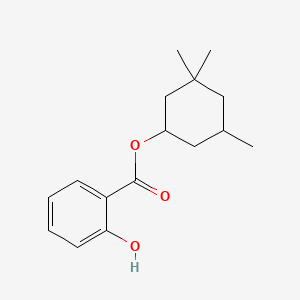
Homosalate
2-hydroxybenzoic acid (3,3,5-trimethylcyclohexyl) ester is a member of phenols and a benzoate ester. It is functionally related to a salicylic acid. — ChEBI
- IUPAC-Name
- (3,3,5-trimethylcyclohexyl) 2-hydroxybenzoate
- Summenformel
- C16H22O3
- Molekulargewicht
- 262.34 g/mol
- Exakte Masse
- 262.15689456 Da
- XLogP3
- 5,0
- Topologische polare Oberfläche
- 46,5 Ų
- Wasserstoffbrücken-Donoren
- 1
- Wasserstoffbrücken-Akzeptoren
- 3
- Kovalente Einheiten
- 1
- Definierte Stereozentren
- 0
Auch bekannt als
16 weitere gemeldete Namen
Kennungen in externen Datenbanken
- ChEBI:CHEBI:91642
- ChEMBL:CHEMBL1377575
- EPA DTXSID:DTXSID1026241
- PubMed:39159849
- PubMed:38381479
- PubMed:28551711
- PubMed:24004914
- PubMed:23769903
- PubMed:23062433
- PubMed:22884209
- PubMed:22749456
- PubMed:22669305
- PubMed:22612478
- PubMed:22214440
- PubMed:21872075
Belege aus weiteren wissenschaftlichen Datenbanken
NIH PubChem PUG-View
Attributed physical-property, hazard, environmental and use annotations.
- Boiling Point: 322 to 329 °F at 760 mmHg (NTP, 1992) Quelle: CAMEO Chemicals
- Density: 1.045 at 77 °F (NTP, 1992) - Denser than water; will sink Quelle: CAMEO Chemicals
- Flash Point: greater than 200 °F (NTP, 1992) Quelle: CAMEO Chemicals
- Physical Description: 3,3,5-trimethylcyclohexylsalicylate appears as viscous or light yellow to slightly tan liquid or oil. (NTP, 1992) Quelle: CAMEO Chemicals
- Solubility: Insoluble (<1 mg/ml at 79 °F) (NTP, 1992) Quelle: CAMEO Chemicals
- First Aid: EYES: First check the victim for contact lenses and remove if present. Flush victim's eyes with water or normal saline solution for 20 to 30 minutes while simultaneously calling a hospital or poison control center. Do not put any ointments, oils, or medication in the victim's eyes without specific instructions from a physician. IMMEDIATELY transport the victim after flushing eyes to a hospital even if no symptoms (such as redness or irritation) develop.; SKIN: IMMEDIATELY flood affected skin with water while removing and isolating all contaminated clothing. Gently wash all affected skin areas thoroughly with soap and water. If symptoms such as redness or irritation develop, IMMEDIATELY call a physician and be prepared to transport the victim to a hospital for treatment.; INHALATION: IMMEDIATELY leave the contaminated area; take deep breaths of fresh air. If symptoms (such as wheezing, coughing, shortness of breath, or burning in the mouth, throat, or chest) develop, call a physician and be prepared to transport the victim to a hospital. Provide proper respiratory protection to rescuers entering an unknown atmosphere. Whenever possible, Self-Contained Breathing Apparatus (SCBA) shou Quelle: CAMEO Chemicals
- Note: This chemical does not meet GHS hazard criteria for 67% (152 of 227) of all reports. Quelle: European Chemicals Agency (ECHA)
- Signal: Warning Quelle: European Chemicals Agency (ECHA)
- GHS Hazard Statements: H315 (16.7%): Causes skin irritation [Warning Skin corrosion/irritation]; H319 (16.7%): Causes serious eye irritation [Warning Serious eye damage/eye irritation]; H335 (16.7%): May cause respiratory irritation [Warning Specific target organ toxicity, single exposure; Respiratory tract irritation]; H361d (11.5%): Suspected of damaging the unborn child [Warning Reproductive toxicity]; H410 (11.5%): Very toxic to aquatic life with long lasting effects [Warning Hazardous to the aquatic environment, long-term hazard] Quelle: European Chemicals Agency (ECHA)
- Precautionary Statement Codes: P203, P261, P264, P264+P265, P271, P273, P280, P302+P352, P304+P340, P305+P351+P338, P318, P319, P321, P332+P317, P337+P317, P362+P364, P391, P403+P233, P405, and P501 (click each P-code to see the statement) Quelle: European Chemicals Agency (ECHA)
- ECHA C&L Notifications Summary: Aggregated GHS information provided per 227 reports by companies from 4 notifications to the ECHA C&L Inventory. Each notification may be associated with multiple companies.; Reported as not meeting GHS hazard criteria per 152 of 227 reports by companies.; There are 3 notifications provided by 75 of 227 reports by companies with hazard statement code(s).; Information may vary between notifications depending on impurities, additives, and other factors. The percentage value in parenthesis indicates the notified classification ratio from companies that provide hazard codes. Only hazard codes with percentage values above 10% are shown. For more detailed information, please visit ECHA C&L website. Quelle: European Chemicals Agency (ECHA)
- Industry Uses: Not Known or Reasonably Ascertainable Quelle: EPA Chemical Data Reporting (CDR)
Zugeordnet durch: Existing checksum-valid CAS to unique PubChem CID match. Abgerufen: 2026-08-31. Quelleneintrag öffnen
Wissenschaftliche Klassifizierungen und Gefahrenannotationen liefern Kontext und ersetzen nicht die oben gezeigte marktspezifische regulatorische Entscheidung.
Weitere Quellenabdeckung und Trefferstatus
| Quelle | Ergebnis | Geprüft |
|---|---|---|
| NIH PubChem PUG-View | Exakter Treffer | 2026-08-31 |
Ein erfasster Nicht-Treffer ist ein nützlicher Beleg dafür, dass die Quelle geprüft wurde; er ist keine Behauptung, dass der Stoff anderswo nicht existiert.
Am 2026-09-02 von NIH PubChem durch prüfsummengültigen CAS-Abgleich abgerufen. Chemische Eigenschaften ersetzen nicht die regulatorische Entscheidung auf dieser Seite.
Verzeichnisverknüpfungen für HOMOSALATE
Verwandte Einträge zu HOMOSALATE
Für diesen Eintrag gibt es nur wenige direkte Treffer; daher werden auch nahe liegende Einträge aus Anhang VI angezeigt.
Camphor benzalkonium methosulfate
PHENYLBENZIMIDAZOLE SULFONIC ACID
TEREPHTHALYLIDENE DICAMPHOR SULFONIC ACID
Butyl Methoxydibenzoylmethane
BENZYLIDENE CAMPHOR SULFONIC ACID
POLYACRYLAMIDOMETHYL BENZYLIDENE CAMPHOR
ETHYLHEXYL METHOXYCINNAMATE
Isoamyl p-Methoxycinnamate
Ethylhexyl Triazone
Was Anhang VI für HOMOSALATE bedeutet
HOMOSALATE ist ein zugelassener UV-Filter, der in Anhang VI der EU-Kosmetikverordnung (EG) Nr. 1223/2009 aufgeführt ist. Nur UV-Filter dieser Positivliste dürfen für den UV-Schutz in kosmetischen Mitteln der EU verwendet werden.
Die in diesem Eintrag festgelegte zulässige Höchstkonzentration gilt für das gebrauchsfertige Produkt. Einige UV-Filter sind auf bestimmte Anwendungsarten beschränkt oder erfordern Warnhinweise auf dem Etikett.
Dieser Eintrag ist zum Abgleich von Namen und Kennungen mit 1 Inhaltsstoff des CosIng-Verzeichnisses verknüpft. Die Seite zeigt außerdem 12 verwandte Anhangseinträge mit überschneidenden Kennungen, Anhangslogik oder Namensmustern.
Compliance-Checkliste
- Die Konzentration im gebrauchsfertigen Produkt darf nicht überschreiten: 7,34 %
- Prüfen Sie, ob der UV-Filter sowohl für Produkte, die auf der Haut verbleiben, als auch für abzuspülende Produkte zugelassen ist.
Häufig gestellte Fragen
Quellenhinweis zu Anhang VI, Eintrag HOMOSALATE
Diese Seite fasst einen Eintrag aus Anhang VI für HOMOSALATE aus öffentlichen Materialien der Europäischen Kommission zu kosmetischen Mitteln zusammen und ergänzt, soweit verfügbar, verknüpfte Treffer aus dem Verzeichnis oder bei Kennungen.
Nutzen Sie diese Eintragsseite, um die Bedingungen aus Anhang VI für HOMOSALATE zu prüfen; bestätigen Sie jede endgültige regulatorische Entscheidung jedoch anhand des aktuellen amtlichen Anhangswortlauts und der Quelldateien.
Werkzeuge und nächste Schritte
Rezeptur prüfen
Fügen Sie eine vollständige INCI-Liste ein, um HOMOSALATE und andere markierte EU-Anhangseinträge in einem Durchgang zu finden.
INCI-CheckerEinträge vergleichen
HOMOSALATE nebeneinander mit einem anderen Anhangseintrag vergleichen, um Unterschiede bei Beschränkungen, Konzentrationen und Anhangszuordnung zu prüfen.
VergleichenDen Anhang durchsuchen
Alle Einträge in Anhang VI ansehen und die regulatorischen Bedingungen der Stoffe in diesem Anhang vergleichen.
Anhang VI öffnen