
BUTYLPARABEN/PROPYLPARABEN/SODIUM PROPOYLPARABEN/SODIUM BUTYLPARABEN/POTASSIUM BUTYLPARABEN/POTASSIUM PROPYLPARABEN
Butyl 4-hydroxybenzoate and its salts Propyl 4-hydroxybenzoate and its salts
BUTYLPARABEN/PROPYLPARABEN/SODIUM PROPOYLPARABEN/SODIUM BUTYLPARABEN/POTASSIUM BUTYLPARABEN/POTASSIUM PROPYLPARABEN steht in Anhang V als Eintrag der Positivliste für Konservierungsstoffe in kosmetischen Mitteln der EU. Höchstkonzentration in diesem Eintrag: - 0,14% (as acid) for the sum of the individual concentrations - 0,8% (as acid) for mixtures of substances mentioned in entry 12 and 12a, here the sum of the individual concentrations of butyl and propylparaben and their salts does not exceed 0,14%.
Eintragsdetails
Höchstkonzentration
- 0,14% (as acid) for the sum of the individual concentrations - 0,8% (as acid) for mixtures of substances mentioned in entry 12 and 12a, here the sum of the individual concentrations of butyl and propylparaben and their salts does not exceed 0,14%
Sonstige Beschränkungen
Not to be used in leave-on products designed for application on the nappy area of children under three years of age.
Warnhinweise
For leave-on products designed for children under three years of age: "Do not use on the nappy area"
INCI-Glossarname
BUTYLPARABEN/PROPYLPARABEN/SODIUM PROPOYLPARABEN/SODIUM BUTYLPARABEN/POTASSIUM BUTYLPARABEN/POTASSIUM PROPYLPARABEN
Chemische Bezeichnung
Butyl 4-hydroxybenzoate and its salts Propyl 4-hydroxybenzoate and its salts
Chemische / IUPAC-Bezeichnung
Butyl 4-hydroxybenzoate and its salts Propyl 4-hydroxybenzoate and its salts (Butylparaben, propylparaben, sodium propylparaben, sodium butylparaben, potassium butylparaben, potassium propylparaben)
Regulatorische Informationen
SCCS-Gutachten
Identifizierte Inhaltsstoffe
Kerndaten
Chemische Identität und Eigenschaften
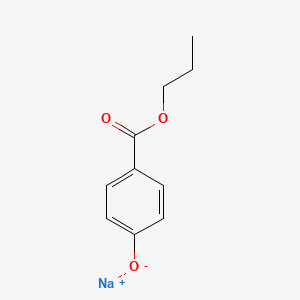
Propylparaben Sodium
The CIR Expert Panel concluded that the following 20 parabens are safe in cosmetics in the present practices of use and concentration described in the safety assessment when the sum of the combined concentration of parabens in any given formulation does not exceed 0.8 %...Sodium Propylparaben... — Cosmetic Ingredient Review (CIR)
- IUPAC-Name
- sodium 4-propoxycarbonylphenolate
- Summenformel
- C10H11NaO3
- Molekulargewicht
- 202.18 g/mol
- Exakte Masse
- 202.06058849 Da
- Topologische polare Oberfläche
- 49,4 Ų
- Wasserstoffbrücken-Donoren
- 0
- Wasserstoffbrücken-Akzeptoren
- 3
- Kovalente Einheiten
- 2
- Definierte Stereozentren
- 0
Auch bekannt als
16 weitere gemeldete Namen
Kennungen in externen Datenbanken
- ChEMBL:CHEMBL2107021
- EPA DTXSID:DTXSID3042348
Am 2026-09-02 von NIH PubChem durch prüfsummengültigen CAS-Abgleich abgerufen. Chemische Eigenschaften ersetzen nicht die regulatorische Entscheidung auf dieser Seite.
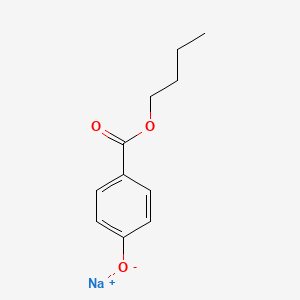
Butylparaben Sodium
The CIR Expert Panel concluded that the following 20 parabens are safe in cosmetics in the present practices of use and concentration described in the safety assessment when the sum of the combined concentration of parabens in any given formulation does not exceed 0.8 %...Sodium Butylparaben... — Cosmetic Ingredient Review (CIR)
- IUPAC-Name
- sodium 4-butoxycarbonylphenolate
- Summenformel
- C11H13NaO3
- Molekulargewicht
- 216.21 g/mol
- Exakte Masse
- 216.07623855 Da
- Topologische polare Oberfläche
- 49,4 Ų
- Wasserstoffbrücken-Donoren
- 0
- Wasserstoffbrücken-Akzeptoren
- 3
- Kovalente Einheiten
- 2
- Definierte Stereozentren
- 0
Auch bekannt als
16 weitere gemeldete Namen
Kennungen in externen Datenbanken
- EPA DTXSID:DTXSID10189971
Am 2026-09-02 von NIH PubChem durch prüfsummengültigen CAS-Abgleich abgerufen. Chemische Eigenschaften ersetzen nicht die regulatorische Entscheidung auf dieser Seite.
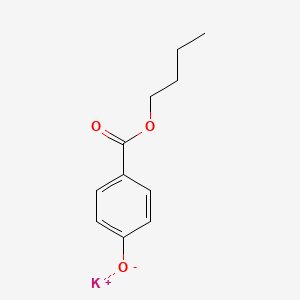
Potassium Butylparaben
The CIR Expert Panel concluded that the following 20 parabens are safe in cosmetics in the present practices of use and concentration described in the safety assessment when the sum of the combined concentration of parabens in any given formulation does not exceed 0.8 %...Potassium Butylparaben... — Cosmetic Ingredient Review (CIR)
- IUPAC-Name
- potassium 4-butoxycarbonylphenolate
- Summenformel
- C11H13KO3
- Molekulargewicht
- 232.32 g/mol
- Exakte Masse
- 232.05017576 Da
- Topologische polare Oberfläche
- 49,4 Ų
- Wasserstoffbrücken-Donoren
- 0
- Wasserstoffbrücken-Akzeptoren
- 3
- Kovalente Einheiten
- 2
- Definierte Stereozentren
- 0
Auch bekannt als
7 weitere gemeldete Namen
Kennungen in externen Datenbanken
- EPA DTXSID:DTXSID90191890
Am 2026-09-02 von NIH PubChem durch prüfsummengültigen CAS-Abgleich abgerufen. Chemische Eigenschaften ersetzen nicht die regulatorische Entscheidung auf dieser Seite.
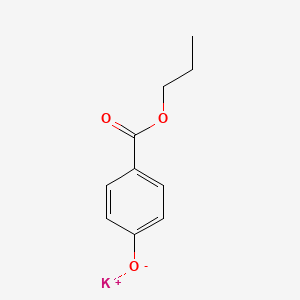
Potassium Propylparaben
The CIR Expert Panel concluded that the following 20 parabens are safe in cosmetics in the present practices of use and concentration described in the safety assessment when the sum of the combined concentration of parabens in any given formulation does not exceed 0.8 %...Potassium Propylparaben... — Cosmetic Ingredient Review (CIR)
- IUPAC-Name
- potassium 4-propoxycarbonylphenolate
- Summenformel
- C10H11KO3
- Molekulargewicht
- 218.29 g/mol
- Exakte Masse
- 218.03452569 Da
- Topologische polare Oberfläche
- 49,4 Ų
- Wasserstoffbrücken-Donoren
- 0
- Wasserstoffbrücken-Akzeptoren
- 3
- Kovalente Einheiten
- 2
- Definierte Stereozentren
- 0
Auch bekannt als
8 weitere gemeldete Namen
Kennungen in externen Datenbanken
- EPA DTXSID:DTXSID80233975
Am 2026-09-02 von NIH PubChem durch prüfsummengültigen CAS-Abgleich abgerufen. Chemische Eigenschaften ersetzen nicht die regulatorische Entscheidung auf dieser Seite.
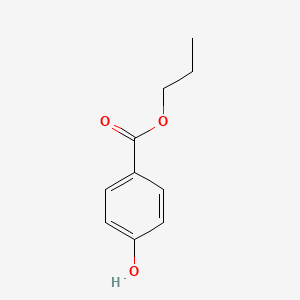
Propylparaben
Propylparaben is the benzoate ester that is the propyl ester of 4-hydroxybenzoic acid. Preservative typically found in many water-based cosmetics, such as creams, lotions, shampoos and bath products. Also used as a food additive. It has a role as an antimicrobial agent and an antifungal agent. It is a member of phenols, a benzoate ester and a paraben. It is functionally related to a propan-1-ol and a 4-hydroxybenzoic acid. — ChEBI
- IUPAC-Name
- propyl 4-hydroxybenzoate
- Summenformel
- C10H12O3
- Molekulargewicht
- 180.20 g/mol
- Exakte Masse
- 180.078644241 Da
- XLogP3
- 3,0
- Topologische polare Oberfläche
- 46,5 Ų
- Wasserstoffbrücken-Donoren
- 1
- Wasserstoffbrücken-Akzeptoren
- 3
- Kovalente Einheiten
- 1
- Definierte Stereozentren
- 0
Auch bekannt als
16 weitere gemeldete Namen
Kennungen in externen Datenbanken
- ChEBI:CHEBI:32063
- ChEMBL:CHEMBL194014
- EPA DTXSID:DTXSID4022527
- PubMed:23056216
- PubMed:23037998
- PubMed:23028405
- PubMed:22814205
- PubMed:22790701
- PubMed:22640822
- PubMed:22606064
- PubMed:22606022
- PubMed:22594253
- PubMed:22523455
- PubMed:22518310
- PubMed:22470890
Am 2026-08-31 von NIH PubChem durch prüfsummengültigen CAS-Abgleich abgerufen. Chemische Eigenschaften ersetzen nicht die regulatorische Entscheidung auf dieser Seite.
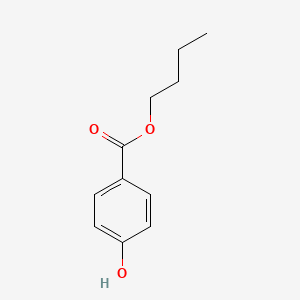
- IUPAC-Name
- butyl 4-hydroxybenzoate
- Summenformel
- C11H14O3
- Molekulargewicht
- 194.23 g/mol
- Exakte Masse
- 194.094294304 Da
- XLogP3
- 3,6
- Topologische polare Oberfläche
- 46,5 Ų
- Wasserstoffbrücken-Donoren
- 1
- Wasserstoffbrücken-Akzeptoren
- 3
- Kovalente Einheiten
- 1
- Definierte Stereozentren
- 0
Auch bekannt als
16 weitere gemeldete Namen
Kennungen in externen Datenbanken
- ChEBI:CHEBI:88542
- ChEMBL:CHEMBL459008
- EPA DTXSID:DTXSID3020209
- PubMed:39778647
- PubMed:39532263
- PubMed:37690743
- PubMed:37632306
- PubMed:36277366
- PubMed:35470536
- PubMed:34383603
- PubMed:32798586
- PubMed:31472229
- PubMed:31016361
- PubMed:30940137
- PubMed:30817981
Am 2026-08-31 von NIH PubChem durch prüfsummengültigen CAS-Abgleich abgerufen. Chemische Eigenschaften ersetzen nicht die regulatorische Entscheidung auf dieser Seite.
Verzeichnisverknüpfungen für BUTYLPARABEN/PROPYLPARABEN/SODIUM PROPOYLPARABEN/SODIUM BUTYLPARABEN/POTASSIUM BUTYLPARABEN/POTASSIUM PROPYLPARABEN
Verwandte Einträge zu BUTYLPARABEN/PROPYLPARABEN/SODIUM PROPOYLPARABEN/SODIUM BUTYLPARABEN/POTASSIUM BUTYLPARABEN/POTASSIUM PROPYLPARABEN
Für diesen Eintrag gibt es nur wenige direkte Treffer; daher werden auch nahe liegende Einträge aus Anhang V angezeigt.
4-HYDROXYBENZOIC ACID / METHYLPARABEN /POTASSIUM ETHYLPARABEN /POTASSIUM PARABEN /SODIUM METHYLPARA…
Dehydroacetic acid / SODIUM DEHYDROACETATE
SODIUM SULFITE / AMMONIUM BISULFITE / AMMONIUM SULFITE / POTASSIUM SULFITE / POTASSIUM hydrogen SUL…
FORMIC ACID / SODIUM FORMATE
o-Phenylphenol, Sodium o-Phenylphenate
Dibromohexamidine isethionate
SORBIC ACID / CALCIUM SORBATE / SODIUM SORBATE / POTASSIUM SORBATE
PHENYL MERCURIC ACETATE / PHENYL MERCURIC BENZOATE
SALICYLIC ACID, CALCIUM SALICYLATE, MAGNESIUM SALICYLATE, MEA- SALICYLATE, SODIUM SALICYLATE, POTAS…
UNDECYLENIC ACID / POTASSIUM UNDECYLENATE / SODIUM UNDECYLENATE / CALCIUM UNDECYLENATE / MEA-UNDECY…
Was Anhang V für BUTYLPARABEN/PROPYLPARABEN/SODIUM PROPOYLPARABEN/SODIUM BUTYLPARABEN/POTASSIUM BUTYLPARABEN/POTASSIUM PROPYLPARABEN bedeutet
BUTYLPARABEN/PROPYLPARABEN/SODIUM PROPOYLPARABEN/SODIUM BUTYLPARABEN/POTASSIUM BUTYLPARABEN/POTASSIUM PROPYLPARABEN ist ein zugelassener Konservierungsstoff, der in Anhang V der EU-Kosmetikverordnung (EG) Nr. 1223/2009 aufgeführt ist. Nur Stoffe dieser Positivliste dürfen in der EU als kosmetische Konservierungsstoffe verwendet werden.
Jeder Eintrag zu einem Konservierungsstoff legt zulässige Höchstkonzentrationen und den Anwendungsbereich fest. Die Konzentrationen dürfen das aufgeführte Maximum nicht überschreiten. Für einige Konservierungsstoffe sind Warnhinweise auf dem Produktetikett erforderlich.
Dieser Eintrag ist zum Abgleich von Namen und Kennungen mit 6 Inhaltsstoffen des CosIng-Verzeichnisses verknüpft. Die Seite zeigt außerdem 12 verwandte Anhangseinträge mit überschneidenden Kennungen, Anhangslogik oder Namensmustern.
Compliance-Checkliste
- Die Einsatzkonzentration darf nicht überschreiten: - 0,14% (as acid) for the sum of the individual concentrations - 0,8% (as acid) for mixtures of substances mentioned in entry 12 and 12a, here the sum of the individual concentrations of butyl and propylparaben and their salts does not exceed 0,14%
- Prüfen Sie, dass der Konservierungsstoff bei der zulässigen Konzentration in Ihrer Matrix wirksam ist.
- Bringen Sie den erforderlichen Warnhinweis auf dem Etikett an.
Häufig gestellte Fragen
Quellenhinweis zu Anhang V, Eintrag BUTYLPARABEN/PROPYLPARABEN/SODIUM PROPOYLPARABEN/SODIUM BUTYLPARABEN/POTASSIUM BUTYLPARABEN/POTASSIUM PROPYLPARABEN
Diese Seite fasst einen Eintrag aus Anhang V für BUTYLPARABEN/PROPYLPARABEN/SODIUM PROPOYLPARABEN/SODIUM BUTYLPARABEN/POTASSIUM BUTYLPARABEN/POTASSIUM PROPYLPARABEN aus öffentlichen Materialien der Europäischen Kommission zu kosmetischen Mitteln zusammen und ergänzt, soweit verfügbar, verknüpfte Treffer aus dem Verzeichnis oder bei Kennungen.
Nutzen Sie diese Eintragsseite, um die Bedingungen aus Anhang V für BUTYLPARABEN/PROPYLPARABEN/SODIUM PROPOYLPARABEN/SODIUM BUTYLPARABEN/POTASSIUM BUTYLPARABEN/POTASSIUM PROPYLPARABEN zu prüfen; bestätigen Sie jede endgültige regulatorische Entscheidung jedoch anhand des aktuellen amtlichen Anhangswortlauts und der Quelldateien.
Werkzeuge und nächste Schritte
Rezeptur prüfen
Fügen Sie eine vollständige INCI-Liste ein, um BUTYLPARABEN/PROPYLPARABEN/SODIUM PROPOYLPARABEN/SODIUM BUTYLPARABEN/POTASSIUM BUTYLPARABEN/POTASSIUM PROPYLPARABEN und andere markierte EU-Anhangseinträge in einem Durchgang zu finden.
INCI-CheckerEinträge vergleichen
BUTYLPARABEN/PROPYLPARABEN/SODIUM PROPOYLPARABEN/SODIUM BUTYLPARABEN/POTASSIUM BUTYLPARABEN/POTASSIUM PROPYLPARABEN nebeneinander mit einem anderen Anhangseintrag vergleichen, um Unterschiede bei Beschränkungen, Konzentrationen und Anhangszuordnung zu prüfen.
VergleichenDen Anhang durchsuchen
Alle Einträge in Anhang V ansehen und die regulatorischen Bedingungen der Stoffe in diesem Anhang vergleichen.
Anhang V öffnen