
QUININE
Cinchonan-9-ol, 6'-methoxy-, (8.alpha.,9R)- its salts
QUININE ist in Anhang III aufgeführt und darf nur unter den in diesem Eintrag genannten Bedingungen verwendet werden. Höchstkonzentration in diesem Eintrag: (a) 0.5% (as quinine base) (b) 0.2% (as quinine base).
Eintragsdetails
Höchstkonzentration
(a) 0.5% (as quinine base) (b) 0.2% (as quinine base)
Produktart
INCI-Glossarname
QUININE
Chemische Bezeichnung
Cinchonan-9-ol, 6'-methoxy-, (8.alpha.,9R)- its salts
Chemische / IUPAC-Bezeichnung
(8S,9R)-6'-Methoxycinchonan-9-ol
Regulatorische Informationen
Identifizierte Inhaltsstoffe
Kerndaten
Chemische Identität und Eigenschaften
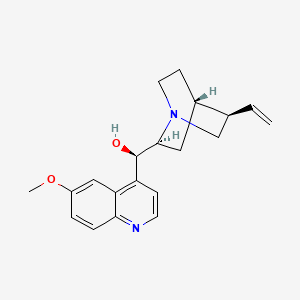
Quinine
Quinine is a cinchona alkaloid that is cinchonidine in which the hydrogen at the 6-position of the quinoline ring is substituted by methoxy. It has a role as a non-narcotic analgesic, an antimalarial and a muscle relaxant. It is a conjugate base of a quinine(1+). It derives from a hydride of an (8S)-cinchonan. — ChEBI
- IUPAC-Name
- (R)-[(2S,4S,5R)-5-ethenyl-1-azabicyclo[2.2.2]octan-2-yl]-(6-methoxyquinolin-4-yl)methanol
- Summenformel
- C20H24N2O2
- Molekulargewicht
- 324.4 g/mol
- Exakte Masse
- 324.183778013 Da
- XLogP3
- 2,9
- Topologische polare Oberfläche
- 45,6 Ų
- Wasserstoffbrücken-Donoren
- 1
- Wasserstoffbrücken-Akzeptoren
- 4
- Kovalente Einheiten
- 1
- Definierte Stereozentren
- 4
Auch bekannt als
16 weitere gemeldete Namen
Kennungen in externen Datenbanken
Belege aus weiteren wissenschaftlichen Datenbanken
NIH PubChem PUG-View
Attributed physical-property, hazard, environmental and use annotations.
- Color/Form: Triboluminescent, orthorhombic needles from absolute alcohol Quelle: Hazardous Substances Data Bank (HSDB)
- Color/Form: Bulky, white, amorphous powder or crystalline alkaloid Quelle: Hazardous Substances Data Bank (HSDB)
- Color/Form: CRYSTALS TURN BROWN ON EXPOSURE TO AIR Quelle: Hazardous Substances Data Bank (HSDB)
- Basic pKa: 8.56 Quelle: ChEMBL
- Basic pKa: 8.55 Quelle: ChEMBL
- Dissociation Constants: pK1 (18 °C) = 5.07; pK2 = 9.7 Quelle: Hazardous Substances Data Bank (HSDB)
- LogP: 3.44 Quelle: DrugBank
- LogP: log Kow = 3.44 Quelle: Hazardous Substances Data Bank (HSDB)
- LogP: 2.6 Quelle: Human Metabolome Database (HMDB)
- Melting Point: 57 °C Quelle: DrugBank
- Melting Point: 177 °C (some decomposition) Quelle: Hazardous Substances Data Bank (HSDB)
- Melting Point: Microcrystalline powder; mp: 57 °C; efflorescent; loses one water molecule in air, two water molecules over sulfuric acid; anhydrous at 125 °C /Quinine trihydrate/ Quelle: Hazardous Substances Data Bank (HSDB)
- Melting Point: 57 °C Quelle: Human Metabolome Database (HMDB)
- Odor: ODORLESS Quelle: Hazardous Substances Data Bank (HSDB)
- Physical Description: Solid Quelle: Human Metabolome Database (HMDB)
- Refractive Index: INDEX OF REFRACTION: 1.625 Quelle: Hazardous Substances Data Bank (HSDB)
- Solubility: 500 mg/L (at 15 °C) Quelle: DrugBank
- Solubility: In water, 500 mg/L at 15 °C Quelle: Hazardous Substances Data Bank (HSDB)
- Solubility: 1 g dissolves in: 1900 mL water, 760 mL boiling water Quelle: Hazardous Substances Data Bank (HSDB)
- Solubility: 1 g dissolves in: 80 mL benzene (18 mL at 50 °C), 1.2 mL chloroform, 250 mL dry ether, 20 mL glycerol, 0.8 mL alcohol, 1900 mL of 10% ammonia water; almost insoluble in petroleum ether Quelle: Hazardous Substances Data Bank (HSDB)
- Solubility: Soluble in ether, chloroform, carbon disulfide, glycerol, alkalies, and acids (with formation of salts) Quelle: Hazardous Substances Data Bank (HSDB)
- Solubility: Sol in pyrimidine Quelle: Hazardous Substances Data Bank (HSDB)
- Solubility: 3.34e-01 g/L Quelle: Human Metabolome Database (HMDB)
- pH: pH of saturated aqueous solution = 8.8 Quelle: Hazardous Substances Data Bank (HSDB)
- Carcinogen Classification: No indication of carcinogenicity to humans (not listed by IARC). Quelle: Toxin and Toxin Target Database (T3DB)
- Exposure Routes: Oral Quelle: Toxin and Toxin Target Database (T3DB)
- Signal: Danger Quelle: European Chemicals Agency (ECHA)
- GHS Hazard Statements: H302 (22.9%): Harmful if swallowed [Warning Acute toxicity, oral]; H315 (28.4%): Causes skin irritation [Warning Skin corrosion/irritation]; H317 (99.5%): May cause an allergic skin reaction [Warning Sensitization, Skin]; H319 (28.4%): Causes serious eye irritation [Warning Serious eye damage/eye irritation]; H334 (83.1%): May cause allergy or asthma symptoms or breathing difficulties if inhaled [Danger Sensitization, respiratory] Quelle: European Chemicals Agency (ECHA)
- Precautionary Statement Codes: P233, P260, P261, P264, P264+P265, P270, P271, P272, P280, P284, P301+P317, P302+P352, P304+P340, P305+P351+P338, P321, P330, P332+P317, P333+P317, P337+P317, P342+P316, P362+P364, P403, and P501 (click each P-code to see the statement) Quelle: European Chemicals Agency (ECHA)
- ECHA C&L Notifications Summary: Aggregated GHS information provided per 201 reports by companies from 10 notifications to the ECHA C&L Inventory. Each notification may be associated with multiple companies.; Information may vary between notifications depending on impurities, additives, and other factors. The percentage value in parenthesis indicates the notified classification ratio from companies that provide hazard codes. Only hazard codes with percentage values above 10% are shown. For more detailed information, please visit ECHA C&L website. Quelle: European Chemicals Agency (ECHA)
- Signal: Warning Quelle: Hazardous Chemical Information System (HCIS), Safe Work Australia
- GHS Hazard Statements: H302: Harmful if swallowed [Warning Acute toxicity, oral]; H317: May cause an allergic skin reaction [Warning Sensitization, Skin] Quelle: Hazardous Chemical Information System (HCIS), Safe Work Australia
- Precautionary Statement Codes: P261, P264, P270, P272, P280, P301+P317, P302+P352, P321, P330, P333+P317, P362+P364, and P501 (click each P-code to see the statement) Quelle: Hazardous Chemical Information System (HCIS), Safe Work Australia
- Signal: Danger Quelle: Hazardous Substances Data Bank (HSDB)
- GHS Hazard Statements: H315: Causes skin irritation [Warning Skin corrosion/irritation]; H317: May cause an allergic skin reaction [Warning Sensitization, Skin]; H319: Causes serious eye irritation [Warning Serious eye damage/eye irritation]; H334: May cause allergy or asthma symptoms or breathing difficulties if inhaled [Danger Sensitization, respiratory] Quelle: Hazardous Substances Data Bank (HSDB)
- Precautionary Statement Codes: P233, P260, P261, P264, P264+P265, P271, P272, P280, P284, P302+P352, P304+P340, P305+P351+P338, P321, P332+P317, P333+P317, P337+P317, P342+P316, P362+P364, P403, and P501 (click each P-code to see the statement) Quelle: Hazardous Substances Data Bank (HSDB)
- Health Effects: It is usual for quinine in therapeutic doses to cause cinchonism; in rare cases, it may even cause death (usually by pulmonary edema). Quinine can worsen hemoglobinuria, myasthenia gravis and optic neuritis. It can cause paralysis if accidentally injected into a nerve, and is extremely toxic in overdose[Wikipedia] Quelle: Toxin and Toxin Target Database (T3DB)
- Toxicity Summary: IDENTIFICATION AND USE: Quinine is a bulky, white, amorphous powder or crystalline alkaloid, used as medication: non-narcotic analgesics; antimalarial; central muscle relaxants. It is also used as flavor in carbonated beverages. HUMAN EXPOSURE AND TOXICITY: Serious hypersensitivity reactions, including anaphylactic shock, anaphylactoid reactions, urticaria, serious skin rashes, angioedema, facial edema, bronchospasm, and pruritus, have been reported with quinine. In addition, thrombocytopenia, hemolytic uremic syndrome/thrombotic thrombocytopenic purpura (HUS/TTP), immune thrombocytopenic purpura, blackwater fever, disseminated intravascular coagulation, leukopenia, neutropenia, granulomatous hepatitis, and acute interstitial nephritis have been reported and may also be due to hypersensitivity reactions to the drug. Potentially fatal cardiac arrhythmias, including torsades de pointes and ventricular fibrillation, have been reported rarely during quinine therapy. At least 1 case of fatal ventricular arrhythmia has been reported in a geriatric patient with preexisting prolonged QT interval treated with IV quinine sulfate for Plasmodium falciparum malaria. Visual impairment can range Quelle: Hazardous Substances Data Bank (HSDB)
- Toxicity Summary: The theorized mechanism of action for quinine and related anti-malarial drugs is that these drugs are toxic to the malaria parasite. Specifically, the drugs interfere with the parasite's ability to break down and digest hemoglobin. Consequently, the parasite starves and/or builds up toxic levels of partially degraded hemoglobin in itself. Quelle: Toxin and Toxin Target Database (T3DB)
- Uses: Medicine (antimalarial) as the alkaloid or as numerous salts and derivatives; flavoring in carbonated beverages Quelle: Hazardous Substances Data Bank (HSDB)
- Uses: Flavor in carbonated beverages. Quelle: Hazardous Substances Data Bank (HSDB)
- Uses: MEDICATION Quelle: Hazardous Substances Data Bank (HSDB)
- Uses: MEDICATION (VET) Quelle: Hazardous Substances Data Bank (HSDB)
- Uses: For more Uses (Complete) data for QUININE (8 total), please visit the HSDB record page. Quelle: Hazardous Substances Data Bank (HSDB)
- Uses: Use (kg; approx.) in Germany (2009): >5000; Use (kg) in USA (2002): 56800; Consumption (g per capita; approx.) in Germany (2009): 0.0611; Consumption (g per capita) in the USA (2002): 0.201; Calculated removal (%): 41.8 Quelle: NORMAN Suspect List Exchange
- Uses: For the treatment of malaria and leg cramps. Used as an antipyretic (fever-reducing), antimalarial, analgesic (painkilling), and anti-inflammatory. It is also used as a flavor component of tonic water and bitter lemon. Quelle: Toxin and Toxin Target Database (T3DB)
Zugeordnet durch: Existing checksum-valid CAS to unique PubChem CID match. Abgerufen: 2026-08-31. Quelleneintrag öffnen
Wissenschaftliche Klassifizierungen und Gefahrenannotationen liefern Kontext und ersetzen nicht die oben gezeigte marktspezifische regulatorische Entscheidung.
Weitere Quellenabdeckung und Trefferstatus
| Quelle | Ergebnis | Geprüft |
|---|---|---|
| NIH PubChem PUG-View | Exakter Treffer | 2026-08-31 |
Ein erfasster Nicht-Treffer ist ein nützlicher Beleg dafür, dass die Quelle geprüft wurde; er ist keine Behauptung, dass der Stoff anderswo nicht existiert.
Am 2026-08-31 von NIH PubChem durch prüfsummengültigen CAS-Abgleich abgerufen. Chemische Eigenschaften ersetzen nicht die regulatorische Entscheidung auf dieser Seite.
Verzeichnisverknüpfungen für QUININE
Verwandte Einträge zu QUININE
Für diesen Eintrag gibt es nur wenige direkte Treffer; daher werden auch nahe liegende Einträge aus Anhang III angezeigt.
(a) Alkali sulphides (b) Alkaline earth sulphides
ZINC ACETATE / ZINC CHLORIDE / ZINC GLUCONATE / ZINC GLUTAMATE
ZINC PHENOLSULFONATE
AMMONIUM MONOFLUOROPHOSPHATE
CALCIUM HYDROXIDE
Sodium monofluorophosphate
Was Anhang III für QUININE bedeutet
QUININE ist ein beschränkter Stoff nach Anhang III der EU-Kosmetikverordnung (EG) Nr. 1223/2009. Seine Verwendung in kosmetischen Mitteln ist nur unter den im obigen Eintrag genannten besonderen Bedingungen zulässig, einschließlich geltender Konzentrationsgrenzen, Beschränkungen der Produktart und erforderlicher Warnhinweise.
Wird dieser Stoff in einer Rezeptur verwendet, müssen alle Bedingungen – Höchstkonzentration, Produktbereich und Warnhinweise – gleichzeitig erfüllt sein. Die Einhaltung einer Bedingung hebt die anderen nicht auf.
Dieser Eintrag ist zum Abgleich von Namen und Kennungen mit 1 Inhaltsstoff des CosIng-Verzeichnisses verknüpft. Die Seite zeigt außerdem 12 verwandte Anhangseinträge mit überschneidenden Kennungen, Anhangslogik oder Namensmustern.
Compliance-Checkliste
- Stellen Sie sicher, dass die Konzentration in der Rezeptur nicht überschreitet: (a) 0.5% (as quinine base) (b) 0.2% (as quinine base)
- Prüfen Sie die Vereinbarkeit mit der Produktart: (a) Hair rinse-off products (b) Hair leave-on products
- Dokumentieren Sie die Verwendungsbedingungen in der Produktinformationsdatei (PIF).
Häufig gestellte Fragen
Quellenhinweis zu Anhang III, Eintrag QUININE
Diese Seite fasst einen Eintrag aus Anhang III für QUININE aus öffentlichen Materialien der Europäischen Kommission zu kosmetischen Mitteln zusammen und ergänzt, soweit verfügbar, verknüpfte Treffer aus dem Verzeichnis oder bei Kennungen.
Nutzen Sie diese Eintragsseite, um die Bedingungen aus Anhang III für QUININE zu prüfen; bestätigen Sie jede endgültige regulatorische Entscheidung jedoch anhand des aktuellen amtlichen Anhangswortlauts und der Quelldateien.
Werkzeuge und nächste Schritte
Rezeptur prüfen
Fügen Sie eine vollständige INCI-Liste ein, um QUININE und andere markierte EU-Anhangseinträge in einem Durchgang zu finden.
INCI-CheckerEinträge vergleichen
QUININE nebeneinander mit einem anderen Anhangseintrag vergleichen, um Unterschiede bei Beschränkungen, Konzentrationen und Anhangszuordnung zu prüfen.
VergleichenDen Anhang durchsuchen
Alle Einträge in Anhang III ansehen und die regulatorischen Bedingungen der Stoffe in diesem Anhang vergleichen.
Anhang III öffnen