
Citronellol
The consolidated GB Cosmetics Regulation lists this record in Annex III.
규제 판단 및 전체 조건
- 상태
- Restricted
- 법적 역할
- Binding rule
- 규제 요약
- The consolidated GB Cosmetics Regulation lists this record in Annex III.
- 조건 및 제한 사항
The presence of the substance must be indicated in the list of ingredients referred to in Article 19(1)(g) when its concentration exceeds: 0,001% in leave-on products 0,01% in rinse-off products
물질 정체
- 공식 출처상의 명칭
- Citronellol
- CAS
- 106-22-9; 26489-01-0
- EC
- 203-375-0; 247-737-6
- 정체 매핑
- name
- 연결된 원료
- CITRONELLOL
연결된 CosIng 정체 데이터
명칭 및 별칭
CosIng 설명: 3,7-Dimethyl-6-octen-1-ol
EU 목록 제한 사항 주석: III/86
기록된 화장품 기능: PERFUMING
기능 페이지:PERFUMING
전체 원료 프로필 보기이 정체의 시장 간 요약
현재 이 사이트에 있는 정확히 연결된 기록입니다. 시장이 없는 것은 가져온 정확한 일치 항목이 없다는 뜻이며, 해당 물질의 사용이 허용된다는 뜻이 아닙니다.
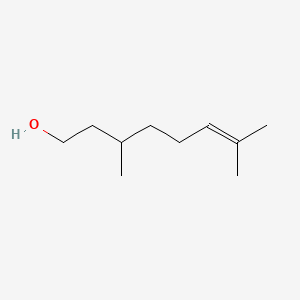
CAS 106-22-9의 검증된 화학 정보
Citronellol
(±)-β-citronellol has been reported in Ambrosiozyma monospora, Artemisia princeps, and other organisms with data available. — LOTUS - the natural products occurrence database
- IUPAC 명칭
- 3,7-dimethyloct-6-en-1-ol
- 분자식
- C10H20O
- 분자량
- 156.26 g/mol
- 정확한 질량
- 156.151415257 Da
- 단일 동위원소 질량
- 156.151415257 Da
- XLogP3
- 3.2
- 위상 극성 표면적
- 20.2 Ų
- 분자 복잡도
- 112.0
- 형식 전하
- 0
- 수소 결합 공여체
- 1
- 수소 결합 수용체
- 1
- 회전 가능 결합
- 5
- 중원자
- 11
- 공유결합 단위
- 1
PubChem에 보고된 명칭 및 동의어
보고된 명칭 16개 더 보기
외부 데이터베이스 식별자
- ChEBI:CHEBI:50462
- ChEMBL:CHEMBL395827
- EPA DTXSID:DTXSID3026726
- PubMed:32513280
- PubMed:31926054
- PubMed:29445768
- PubMed:27607409
- PubMed:26944432
- PubMed:26795242
- PubMed:26456648
- PubMed:26141506
- PubMed:25414073
- PubMed:23449869
- PubMed:22945026
- PubMed:21819085
고급 구조 통계
- 정의된 원자 입체중심
- 0
- 정의되지 않은 원자 입체중심
- 1
- 정의된 결합 입체중심
- 0
- 정의되지 않은 결합 입체중심
- 0
- 3D 파마코포어 특성
- 5
- 3D 고리
- 0
- 3D 소수성 부위
- 3
- 3D 수용체 특성
- 1
- 3D 공여체 특성
- 1
- 3D 음이온 중심
- 0
- 3D 양이온 중심
- 0
- 3D 형태이성질체
- 10
- 유효 3D 회전자
- 5.0
기계 판독 가능한 구조 식별자
- SMILES
CC(CCC=C(C)C)CCO- InChI
InChI=1S/C10H20O/c1-9(2)5-4-6-10(3)7-8-11/h5,10-11H,4,6-8H2,1-3H3- InChIKey
QMVPMAAFGQKVCJ-UHFFFAOYSA-N
추가 과학 데이터베이스의 근거
EMBL-EBI ChEBI
citronellol
A monoterpenoid that is oct-6-ene substituted by a hydroxy group at position 1 and methyl groups at positions 3 and 7.
- 처방
- C10H20O
- 평균 질량
- 156.269 g/mol
- 단일 동위원소 질량
- 156.15142 Da
- 형식 전하
- 0
- monoterpenoid — is a (CHEBI:25409)
- plant metabolite — has role (CHEBI:76924)
- plant metabolite — has role (CHEBI:76924)
- monoterpenoid — is a (CHEBI:25409)
- 20964319 출처: PubMed
추가 선별 명칭
이 출처의 상호 참조
- CAS: 106-22-9 — ChemIDplus
- CAS: 106-22-9 — NIST Chemistry WebBook
- REGISTRY_NUMBER: 1362474 — Reaxys
- MANUAL_X_REF: Citronellol — Wikipedia
매핑 기준: Exact CAS cross-reference in the ChEBI compound record. 출처 업데이트: 2015-08-17. 가져온 시각: 2026-08-31. 출처 기록 열기
NIH PubChem PUG-View
Attributed physical-property, hazard, environmental and use annotations.
- Boiling Point: 224 °C 출처: Hazardous Substances Data Bank (HSDB)
- Boiling Point: BP: 108-109 °C at 10 mm Hg; specific gravity: 1.4576 at 18/4 °C /(-)-Form/ 출처: Hazardous Substances Data Bank (HSDB)
- Boiling Point: 225 °C 출처: Joint FAO/WHO Expert Committee on Food Additives (JECFA)
- Color/Form: Colorless oily liquid 출처: Hazardous Substances Data Bank (HSDB)
- Density: 0.8550 g/cu cm at 20 °C 출처: Hazardous Substances Data Bank (HSDB)
- Density: 0.850-0.860 출처: Joint FAO/WHO Expert Committee on Food Additives (JECFA)
- LogP: log Kow = 3.91 출처: Hazardous Substances Data Bank (HSDB)
- Melting Point: <-20 °C 출처: Hazardous Substances Data Bank (HSDB)
- Odor: Fresh rosy odor 출처: Hazardous Substances Data Bank (HSDB)
- Odor: Rose odor 출처: Hazardous Substances Data Bank (HSDB)
- Physical Description: CBI; Liquid; Dry Powder; Liquid 출처: EPA Chemical Data Reporting (CDR)
- Physical Description: Colorless to pale yellow liquid with a sweet floral odor; [EPA BRADs] Colorless liquid with a rose-like odor; [Acros Organics MSDS] 출처: Haz-Map, Information on Hazardous Chemicals and Occupational Diseases
- Physical Description: colourless oily liquid; rose-like aroma 출처: Joint FAO/WHO Expert Committee on Food Additives (JECFA)
- Refractive Index: Index of refraction: 1.4559 at 20 °C 출처: Hazardous Substances Data Bank (HSDB)
- Refractive Index: 1.454-1.462 출처: Joint FAO/WHO Expert Committee on Food Additives (JECFA)
- Solubility: In water, 200 mg/L at 25 °C 출처: Hazardous Substances Data Bank (HSDB)
- Solubility: In water, 307 mg/L at 25 °C; 300 mg/L at 20 °C 출처: Hazardous Substances Data Bank (HSDB)
- Solubility: Soluble in fixed oils, propylene glycol; insoluble in glycerin 출처: Hazardous Substances Data Bank (HSDB)
- Solubility: Miscible in ethanol and ether /(+)-citronellol/; very soluble in ethanol and ether /(-)-citronellol/ 출처: Hazardous Substances Data Bank (HSDB)
- Solubility: Insoluble in glycerol; slightly soluble in water; soluble in most fixed oils, propylene glycol 출처: Joint FAO/WHO Expert Committee on Food Additives (JECFA)
- Solubility: soluble (in ethanol) 출처: Joint FAO/WHO Expert Committee on Food Additives (JECFA)
- Vapor Pressure: 0.04 [mmHg] 출처: Haz-Map, Information on Hazardous Chemicals and Occupational Diseases
- Vapor Pressure: 0.02 mm Hg at 25 °C 출처: Hazardous Substances Data Bank (HSDB)
- Viscosity: 11.1 mPa s (dynamic) at 20 °C; 5.33 mPa s (dynamic) at 40 °C 출처: Hazardous Substances Data Bank (HSDB)
- Signal: Warning 출처: European Chemicals Agency (ECHA)
- GHS Hazard Statements: H315 (95.7%): Causes skin irritation [Warning Skin corrosion/irritation]; H317 (99.6%): May cause an allergic skin reaction [Warning Sensitization, Skin]; H319 (65.1%): Causes serious eye irritation [Warning Serious eye damage/eye irritation]; H411 (15.8%): Toxic to aquatic life with long lasting effects [Hazardous to the aquatic environment, long-term hazard] 출처: European Chemicals Agency (ECHA)
- Precautionary Statement Codes: P261, P264, P264+P265, P272, P273, P280, P302+P352, P305+P351+P338, P321, P332+P317, P333+P317, P337+P317, P362+P364, P391, and P501 (click each P-code to see the statement) 출처: European Chemicals Agency (ECHA)
- ECHA C&L Notifications Summary: Aggregated GHS information provided per 1657 reports by companies from 29 notifications to the ECHA C&L Inventory. Each notification may be associated with multiple companies.; Information may vary between notifications depending on impurities, additives, and other factors. The percentage value in parenthesis indicates the notified classification ratio from companies that provide hazard codes. Only hazard codes with percentage values above 10% are shown. For more detailed information, please visit ECHA C&L website. 출처: European Chemicals Agency (ECHA)
- GHS Hazard Statements: H315 (100%): Causes skin irritation [Warning Skin corrosion/irritation]; H317 (100%): May cause an allergic skin reaction [Warning Sensitization, Skin]; H319 (17.5%): Causes serious eye irritation [Warning Serious eye damage/eye irritation] 출처: European Chemicals Agency (ECHA)
- Precautionary Statement Codes: P261, P264, P264+P265, P272, P280, P302+P352, P305+P351+P338, P321, P332+P317, P333+P317, P337+P317, P362+P364, and P501 (click each P-code to see the statement) 출처: European Chemicals Agency (ECHA)
- ECHA C&L Notifications Summary: Aggregated GHS information provided per 103 reports by companies from 4 notifications to the ECHA C&L Inventory. Each notification may be associated with multiple companies.; Information may vary between notifications depending on impurities, additives, and other factors. The percentage value in parenthesis indicates the notified classification ratio from companies that provide hazard codes. Only hazard codes with percentage values above 10% are shown. For more detailed information, please visit ECHA C&L website. 출처: European Chemicals Agency (ECHA)
- Signal: Warning 출처: Hazardous Substances Data Bank (HSDB)
- GHS Hazard Statements: H315: Causes skin irritation [Warning Skin corrosion/irritation]; H317: May cause an allergic skin reaction [Warning Sensitization, Skin]; H319: Causes serious eye irritation [Warning Serious eye damage/eye irritation]; H401: Toxic to aquatic life [Hazardous to the aquatic environment, acute hazard] 출처: Hazardous Substances Data Bank (HSDB)
- Precautionary Statement Codes: P261, P264, P264+P265, P272, P273, P280, P302+P352, P305+P351+P338, P321, P332+P317, P333+P317, P337+P317, P362+P364, and P501 (click each P-code to see the statement) 출처: Hazardous Substances Data Bank (HSDB)
- Toxicity Summary: IDENTIFICATION AND USE: Citronellol has been found in nature, and it has been reported in about 70 essential oils. It is registered for pesticide use in the USA but approved pesticide uses may change periodically and so federal, state and local authorities must be consulted for currently approved uses. It is also used in perfumery. HUMAN EXPOSURE AND TOXICITY: Adult male volunteers with no known allergic reactions were patch-tested on their back for 48 hr with 32% citronellol. After 48 hr, patches were removed and the skin was cleaned of any residual test material. Moderate irritation was observed. A patch test using a 1% concentration of citronellol in acetone gave a positive reaction in subjects allergic to citronella oil. ANIMAL STUDIES: Citronellol applied full strength to intact or abraded rabbit skin for 24 hr under occlusion was moderately irritating. Severe irritation was observed in rabbits and guinea pigs exposed to 100% compound (unoccluded) for 24, 48 or 72 hr. Citronellol was not mutagenic when tested in Salmonella typhimurium strains TA98 and TA100 in the presence and absence of metabolic activation. ECOTOXICITY STUDIES: Golden Orfe (Leuciscus idus) were exposed to th 출처: Hazardous Substances Data Bank (HSDB)
- Environmental Bioconcentration: An estimated BCF of 177 was calculated in fish for citronellol(SRC), using a log Kow of 3.91(1) and a regression-derived equation(2). According to a classification scheme(3), this BCF suggests the potential for bioconcentration in aquatic organisms is high(SRC), provided the compound is not metabolized by the organism(SRC). 출처: Hazardous Substances Data Bank (HSDB)
- Environmental Fate: TERRESTRIAL FATE: Based on a classification scheme(1), an estimated Koc value of 94(SRC), determined from a structure estimation method(2), indicates that citronellol is expected to have high mobility in soil(SRC). Volatilization of citronellol from moist soil surfaces is expected to be an important fate process(SRC) given an estimated Henry's Law constant of 2.1X10⁻⁵ atm-cu m/mole(SRC), derived from its vapor pressure, 0.02 mm Hg(3), and water solubility, 200 mg/L(4). Even though the vapor pressure is low environmentally at standard temperature and pressure, there is a detectable odor; therefore, citronellol may volatilize from dry soil(SRC). An 80-90% of Theoretical BOD using activated sludge in the OECD 301F test(5) suggests that biodegradation is an important environmental fate process in soil(SRC). Citronellol was also classified as readily biodegradable by the results of the OECD 301C test (modified MITI) with 65% degradation in 4 weeks(6) and by a DOC Method F test (100% biodegradation in 15 days)(6). Citronellol absorbs at wavelengths >290 nm(7) and, therefore, may be susceptible to direct photolysis on soil surfaces exposed to sunlight(SRC). 출처: Hazardous Substances Data Bank (HSDB)
- Environmental Fate: AQUATIC FATE: Based on a classification scheme(1), an estimated Koc value of 94(SRC), determined from a structure estimation method(2), indicates that citronellol is not expected to adsorb to suspended solids and sediment(SRC). Volatilization from water surfaces is expected(3) based upon an estimated Henry's Law constant of 2.1X10⁻⁵ atm-cu m/mole(SRC), derived from its vapor pressure, 0.02 mm Hg(4), and water solubility, 200 mg/L(5). Using this Henry's Law constant and an estimation method(3), volatilization half-lives for a model river and model lake are 2.4 and 21 days, respectively(SRC). According to a classification scheme(6), an estimated BCF of 177(SRC), from its log Kow of 3.91(7) and a regression-derived equation(2), suggests the potential for bioconcentration in aquatic organisms is high(SRC). An 80-90% of Theoretical BOD using activated sludge in the OECD 301F test(8) suggests that biodegradation is an important environmental fate process in water(SRC). Citronellol was also classified as readily biodegradable by the results of the OECD 301C test (modified MITI) with 65% degradation in 4 weeks(9) and by a DOC Method F test (100% biodegradation in 15 days)(9). Citronellol i 출처: Hazardous Substances Data Bank (HSDB)
- Environmental Fate: ATMOSPHERIC FATE: According to a model of gas/particle partitioning of semivolatile organic compounds in the atmosphere(1), citronellol, which has a vapor pressure of 0.02 mm Hg at 25 °C(2), is expected to exist solely as a vapor in the ambient atmosphere. Vapor-phase citronellol is degraded in the atmosphere by reaction with photochemically-produced hydroxyl radicals(SRC); the half-life for this reaction in air is estimated to be 2.3 hours(SRC), calculated from its rate constant of 1.70X10⁻¹⁰ cu cm/molecule-sec at 24 deg(3). Citronellol is also degraded in the atmosphere by reaction with ozone and nitrate radicals. The half-life for the reaction with ozone is estimated to be 1.1 hours(SRC), calculated from its rate constant of 2.4X10⁻¹⁶ cu cm/molecule-sec at 24 °C(3). The half-life for the reaction with nitrate radicals is estimated to be 4 minutes(SRC), calculated from its rate constant of 1.21X10⁻¹¹ cu cm/molecule-sec at 24 °C(4). The nitrate radical (NO3) is the dominant atmospheric oxidant during the night-time in most atmospheric environments(5), therefore, night-time degradation appears to be a major fate process for citronellol(SRC). Citronellol absorbs at wavelengths >290 출처: Hazardous Substances Data Bank (HSDB)
- Consumer Uses: Fragrance; Odor agents 출처: EPA Chemical Data Reporting (CDR)
- Industry Uses: Other; Intermediate; Odor agents; Fragrance 출처: EPA Chemical Data Reporting (CDR)
- Sources/Uses: l-Form: in rose and geranium oils; d-Form: in Ceylon and Java citronella oils; Used in perfumery; [Merck Index] Permitted for use as an inert ingredient in non-food pesticide products; [EPA] Present in over 30 essential oils, fruits, edible plants, wine, beer, and black tea; Active ingredient in pesticide used to control mites on agricultural crops, ornamentals, and landscapes; Also extensively used as fragrance (detergents, soaps, lotions, perfumes, etc.), as a flavoring agent, and component of citronella oil (used in candles, sprays, oils, and insect repellents); [EPA BRADs] 출처: Haz-Map, Information on Hazardous Chemicals and Occupational Diseases
- Industrial Processes with risk of exposure: Farming (Pesticides) [Category: Industry] 출처: Haz-Map, Information on Hazardous Chemicals and Occupational Diseases
- Uses: For citronellol (USEPA/OPP Pesticide Code: 167004) ACTIVE products with label matches. /SRP: Registered for use in the USA but approved pesticide uses may change periodically and so federal, state and local authorities must be consulted for currently approved uses./ 출처: Hazardous Substances Data Bank (HSDB)
- Uses: Reported uses (ppm):; Table: Reported uses (ppm): (Flavor and Extract Manufacturers' Association, 1994) [Table#6302] 출처: Hazardous Substances Data Bank (HSDB)
- Uses: In perfumery 출처: Hazardous Substances Data Bank (HSDB)
- Uses: Citronellol is one of the components responsible for the insect repellent properties of citronella oil ... Citronellol finds extensive use in floral fragrances and in flavors for citrus and other fruit notes. Its stability makes it particularly useful in fragrances for soaps, detergents, and other household products. Citronellol is also important as an intermediate in the synthesis of a number of other aroma chemicals ... Citronellol is the key feedstock for the synthesis of rose oxide. 출처: Hazardous Substances Data Bank (HSDB)
- Uses: Citronellol is one of the most widely used fragrance materials, particularly for rose notes and for floral compositions in general. As flavor material, citronellol is added for bouquetting purposes to citrus compositions. It is the starting material for numerous citronellyl esters and for hydroxydihydrocitronellol, an intermediate in the production of hydroxydihydrocitronellal. 출처: Hazardous Substances Data Bank (HSDB)
매핑 기준: Existing checksum-valid CAS to unique PubChem CID match. 가져온 시각: 2026-08-31. 출처 기록 열기
과학적 분류와 유해성 주석은 맥락을 제공할 뿐이며, 위에 표시된 시장별 규제 판단을 대체하지 않습니다.
추가 출처 적용 범위 및 일치 상태
| 출처 | 결과 | 확인됨 |
|---|---|---|
| EMBL-EBI ChEBI | 정확히 일치 | 2026-08-31 |
| NIH PubChem PUG-View | 정확히 일치 | 2026-08-31 |
기록된 불일치는 출처를 확인했다는 유용한 근거이며, 해당 물질이 다른 곳에 존재하지 않는다는 주장이 아닙니다.
체크섬이 유효한 CAS 일치를 통해 2026-09-02에 NIH PubChem에서 가져왔습니다. 화학적 특성은 이 페이지의 규제 판단을 대체하지 않습니다.
공식 출처 및 출처 정보
- 등록된 출처
- Great Britain Cosmetics Regulation — consolidated Annexes II–VI and amendments
- 출처 참조
- GB Cosmetics Regulation, Annex III, entry 86
- 출처 기록 ID
III-86- 출처 버전
- 2026-08-15
- 출처 언어
- English
- 번역 상태
- Original is English
- 시행일
- 2026-08-15
- 출처 업데이트
- 2026-08-19
- 스냅샷 확인
- 2026-08-30 04:51 UTC
- 검증 방법
- legislation.gov.uk XML table parse; {'II': 1758, 'III': 326, 'IV': 154, 'V': 57, 'VI': 34}
- SHA-256
e3a386d950f54c6e7a7f9e784d1bd46e52de725137e89d5630709824475215d8
등록된 데이터세트 주석
- 데이터세트 적용 범위
- Complete consolidated GB Annexes II–VI, with later amendments versioned separately
- 권위 관련 주석
- Binding GB schedules and versioned amendments to retained Regulation 1223/2009; applies to England, Wales and Scotland, not Northern Ireland
- 출처 라이선스
- Open Government Licence v3.0 / Crown copyright
- 저작자 표시
- Contains public sector information licensed under the Open Government Licence v3.0.
이 기록이 시장 데이터세트에서 차지하는 위치
상태 분포
현재 기록 2329건 중 517건에 조건 텍스트가 있습니다. 조건 필드가 비어 있는 경우 위의 기록 유형에 따라 해석되며, 제한 없는 사용에 대한 주장으로 전환되지 않습니다.
Great Britain 시장 맥락
Complete consolidated annex dataset
적용 범위 버전: GB retained Regulation 1223/2009 schedules, effective 15 August 2026
Current consolidated Annexes II–VI for England, Scotland and Wales.
확인 체크리스트
- Confirm INCI/CAS/EC identity.
- Review every current GB Annex II–VI match.
- Check commencement dates and later statutory instruments.
- Verify SCPN, responsible-person, safety-report and labelling duties.
공식 시장 출처
- Great Britain Cosmetics Regulation — consolidated Annexes II–VI and amendmentsBinding GB schedules and versioned amendments to retained Regulation 1223/2009; applies to England, Wales and Scotland, not Northern Ireland
확인 절차 및 기록 완전성
이 결과를 규제 준수 판단에 사용하기 전에
- “Citronellol”와(과) 모든 CAS/EC 식별자가 공급업체 규격서의 물질을 가리키는지 확인하세요.
- Confirm INCI/CAS/EC identity.
- Review every current GB Annex II–VI match.
- Check commencement dates and later statutory instruments.
- Verify SCPN, responsible-person, safety-report and labelling duties.
- 출처 버전을 기록하고, 제조, 신고 또는 시장 출시 전에 규제 기관을 다시 확인하세요.
이 기록에서 제공되는 필드
- 공식 물질 명칭제공됨
- CAS제공됨
- EC제공됨
- 별도의 조건 텍스트제공됨
- 시행일제공됨
- 스냅샷 해시 및 방법제공됨
이 페이지가 답하는 질문
안정적인 인용
Citronellol. GB Cosmetics Regulation, Annex III, entry 86. Great Britain. Source version 2026-08-15. CosIng Checker regulatory record: https://cosingchecker.com/ko/regulations/gb/records/6204/
법적 권위로서 규제 기관을 인용하세요. 이 페이지는 구조화된 근거 색인이자 확인 보조 도구이며, 공식 본문이나 전문적인 법률 평가를 대체하지 않습니다.
Great Britain의 해석 및 한계
This substance is not unrestricted: cosmetic use is subject to the conditions in the cited official record.
Check product type, body area, concentration, purity and warning requirements before deciding whether a formulation is compliant.
법적 역할 해석 방법
The cited row forms part of a binding rule or legally incorporated list for this market.
이 페이지의 근거
- 기록된 결과: Restricted
- 법적 역할: Binding rule
- 출처 버전: 2026-08-15
- 시행일: 2026-08-15
증명하지 않는 것
No annex match is not approval and does not cover Northern Ireland, which follows the applicable EU framework.
추가 공신력 있는 물질 조사
이 출처들 중 어느 것도 위의 시장 판단을 번복하지 않습니다.
Cosmetic Ingredient Review safety assessments
Expert Panel conclusions, assessed ingredient groups, use conditions, dates and report documents
Independent expert review considered by FDA; not a government approval or binding market rule
출처에서 이 정체 조사FDA Global Substance Registration System
UNII identifiers, preferred names, substance types, codes and public substance relationships
Identity registry only; UNII availability does not imply FDA review or approval
출처에서 이 정체 조사ILO/WHO International Chemical Safety Cards
Hazards, symptoms, first aid, storage, incompatibilities and physical properties for covered chemicals
International occupational chemical-safety reference; not cosmetic-use approval
출처에서 이 정체 조사Japan NITE-CHRIP
Chemical identity, Japanese and foreign legal lists, GHS hazards and exposure-related information
Chemical-management evidence; cosmetic status remains governed by the applicable MHLW standard and market rules
출처에서 이 정체 조사NIOSH Pocket Guide to Chemical Hazards
REL, PEL, IDLH, properties, exposure routes, symptoms, target organs, first aid and measurement methods for covered workplace chemicals
US occupational-health guidance and limits; not a cosmetic ingredient decision
출처에서 이 정체 조사OECD eChemPortal
Gateway to authority-owned physical-property, fate, ecotoxicity, toxicity, exposure and GHS records
Discovery gateway; each linked authority remains responsible for its data
출처에서 이 정체 조사US EPA CompTox CTX APIs
가져오기에 API 키 필요DTXSID identity, experimental and predicted properties, toxicity, bioactivity, exposure and environmental data
Scientific and computational evidence; predictions must remain labelled and do not determine cosmetic legality
출처에서 이 정체 조사