
URSODIOL
Cholan-24-oic acid, 3,7-dihydroxy-, 3-α, 5-β, 7-β)-
URSODIOL은(는) EU CosIng 목록에 등재되어 있지만, 이 페이지에는 아직 직접 연결된 부속서 기록이 없습니다.
시장별 규제 근거
여기에서 추적하는 시장 13곳 중 어느 곳에도 이 원료의 규칙이 가져와지지 않았습니다.
이는 이 목록에 관한 설명이지 법에 관한 설명이 아닙니다. 가져온 규칙이 없다는 것이 원료가 허용된다는 근거는 아닙니다. 규칙은 다른 명칭이나 식별자로, 또는 아직 이곳에 가져오지 않은 데이터세트에 존재할 수 있습니다.
URSODIOL의 목록 세부 정보
INCI 명칭
URSODIOL
설명
Cholan-24-oic acid, 3,7-dihydroxy-, 3-α, 5-β, 7-β)-
URSODIOL의 부속서 기록
주요 데이터
- SKIN CONDITIONING
Maintaining the skin in good condition.
- SKIN PROTECTING
Helping to avoid harmful effects to the skin from external factors.
화학적 정체 및 특성
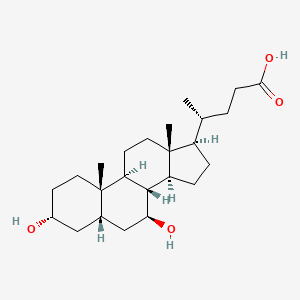
Ursodeoxycholic Acid
Ursodeoxycholic acid is a bile acid found in the bile of bears (Ursidae) as a conjugate with taurine. Used therapeutically, it prevents the synthesis and absorption of cholesterol and can lead to the dissolution of gallstones. It has a role as a mouse metabolite and a human metabolite. It is a C24-steroid, a dihydroxy-5beta-cholanic acid and a bile acid. It is a conjugate acid of an ursodeoxycholate. — ChEBI
- IUPAC 명칭
- (4R)-4-[(3R,5S,7S,8R,9S,10S,13R,14S,17R)-3,7-dihydroxy-10,13-dimethyl-2,3,4,5,6,7,8,9,11,12,14,15,16,17-tetradecahydro-1H-cyclopenta[a]phenanthren-17-yl]pentanoic acid
- 분자식
- C24H40O4
- 분자량
- 392.6 g/mol
- 정확한 질량
- 392.29265975 Da
- XLogP3
- 4.9
- 위상 극성 표면적
- 77.8 Ų
- 수소 결합 공여체
- 3
- 수소 결합 수용체
- 4
- 공유결합 단위
- 1
- 정의된 입체중심
- 10
다른 이름
보고된 명칭 16개 더 보기
외부 데이터베이스 식별자
- ChEBI:CHEBI:9907
- ChEMBL:CHEMBL1551
- EPA DTXSID:DTXSID6023731
- PubMed:38244730
- PubMed:38104874
- PubMed:37968239
- PubMed:36473578
- PubMed:36470304
- PubMed:34461081
- PubMed:34155936
- PubMed:34079822
- PubMed:33568795
- PubMed:32679164
- PubMed:32198087
- PubMed:31299240
추가 과학 데이터베이스의 근거
NIH PubChem PUG-View
Attributed physical-property, hazard, environmental and use annotations.
- LogP: 3 출처: DrugBank
- LogP: 3.00 출처: Human Metabolome Database (HMDB)
- Melting Point: 200-205 출처: DrugBank
- Melting Point: 203 °C 출처: Human Metabolome Database (HMDB)
- Physical Description: Solid 출처: Human Metabolome Database (HMDB)
- Solubility: 0.02 mg/mL 출처: Human Metabolome Database (HMDB)
- Note: This chemical does not meet GHS hazard criteria for 4.5% (2 of 44) of reports. 출처: European Chemicals Agency (ECHA)
- Signal: Warning 출처: European Chemicals Agency (ECHA)
- GHS Hazard Statements: H315 (95.5%): Causes skin irritation [Warning Skin corrosion/irritation]; H319 (95.5%): Causes serious eye irritation [Warning Serious eye damage/eye irritation] 출처: European Chemicals Agency (ECHA)
- Precautionary Statement Codes: P264, P264+P265, P280, P302+P352, P305+P351+P338, P321, P332+P317, P337+P317, and P362+P364 (click each P-code to see the statement) 출처: European Chemicals Agency (ECHA)
- ECHA C&L Notifications Summary: Aggregated GHS information provided per 44 reports by companies from 4 notifications to the ECHA C&L Inventory. Each notification may be associated with multiple companies.; Reported as not meeting GHS hazard criteria per 2 of 44 reports by companies.; There are 3 notifications provided by 42 of 44 reports by companies with hazard statement code(s).; Information may vary between notifications depending on impurities, additives, and other factors. The percentage value in parenthesis indicates the notified classification ratio from companies that provide hazard codes. Only hazard codes with percentage values above 10% are shown. For more detailed information, please visit ECHA C&L website. 출처: European Chemicals Agency (ECHA)
- Toxicity Summary: UDCA has been shown to have potentially toxic molecular properties. UDCA breaks down into toxic lithocholic acid. After being absorbed in the small intestine, UDCA undergoes hepatic conjugation. Beyond conjugation, UDCA does not experience further breakdown by the liver or intestinal mucosa. It becomes oxidized or reduced, yielding either 7-keto-lithocholic acid or lithocholic acid. Litcholic acid can be toxic to liver cells and even cause liver failure in those with compromised sulfation. It also leads to segmental bile duct injury, hepatocyte failure, and death. 출처: StatPearls
- Uses: Use (kg; approx.) in Germany (2009): >10000; Use (kg) in USA (2002): 6870; Consumption (g per capita; approx.) in Germany (2009): 0.122; Consumption (g per capita) in the USA (2002): 0.0244; Excretion rate: 1; Calculated removal (%): 73.4 출처: NORMAN Suspect List Exchange
매핑 기준: Existing checksum-valid CAS to unique PubChem CID match. 가져온 시각: 2026-08-31. 출처 기록 열기
과학적 분류와 유해성 주석은 맥락을 제공할 뿐이며, 위에 표시된 시장별 규제 판단을 대체하지 않습니다.
추가 출처 적용 범위 및 일치 상태
| 출처 | 결과 | 확인됨 |
|---|---|---|
| NIH PubChem PUG-View | 정확히 일치 | 2026-08-31 |
기록된 불일치는 출처를 확인했다는 유용한 근거이며, 해당 물질이 다른 곳에 존재하지 않는다는 주장이 아닙니다.
체크섬이 유효한 CAS 일치를 통해 2026-08-31에 NIH PubChem에서 가져왔습니다. 화학적 특성은 이 페이지의 규제 판단을 대체하지 않습니다.
공식 EU 원료 명칭 근거
이 원료 명칭은 공식 2025 EU 일반 원료 명칭 용어집과 정확히 일치합니다.
관련 목록 근거
처방 기능이 겹치는 원료
추가 공식 및 과학 출처
이 정체를 확인할 외부 데이터베이스 11개
각 링크는 해당 출처에서 이 정체를 검색합니다. 각 출처의 성격과 법적 비중
CosIng 목록에서 URSODIOL이(가) 나타나는 방식
CosIng 목록은 URSODIOL을(를) 화장품 원료로 나열하며, 이 페이지는 이를 부속서 기록 0건과 연결합니다. 목록 항목은 명칭과 식별자를 담고 있으며, 부속서 기록은 해당 물질이 EU 화장품 법령에서 사용금지, 사용제한 또는 허용 목록(포지티브 리스트)에 있는 위치를 보여 줍니다.
URSODIOL은(는) 공식 데이터에서 화장품 기능 2개로도 태그되어 있습니다. 기능 표시는 의도된 용도를 설명하지만, 처방 또는 표시 작업 전에 연결된 부속서 기록에 대한 규제 검토를 대체하지 않습니다.