
TRIDECYL ALCOHOL
Tridecan-1-ol
TRIDECYL ALCOHOL은(는) EU CosIng 목록에 등재되어 있지만, 이 페이지에는 아직 직접 연결된 부속서 기록이 없습니다.
시장별 규제 근거
여기에서 추적하는 시장 13곳 중 어느 곳에도 이 원료의 규칙이 가져와지지 않았습니다.
이는 이 목록에 관한 설명이지 법에 관한 설명이 아닙니다. 가져온 규칙이 없다는 것이 원료가 허용된다는 근거는 아닙니다. 규칙은 다른 명칭이나 식별자로, 또는 아직 이곳에 가져오지 않은 데이터세트에 존재할 수 있습니다.
TRIDECYL ALCOHOL의 목록 세부 정보
INCI 명칭
TRIDECYL ALCOHOL
설명
Tridecan-1-ol
TRIDECYL ALCOHOL의 부속서 기록
주요 데이터
- EMULSION STABILISING
Helping the process of emulsification and improving emulsion stability and shelf-life.
- FRAGRANCE
Imparting an odour or taste. Creating a perceivable pleasant smell and/or masking a bad smell.
- REFATTING
Replenishing the lipids of the hair or of the top layers of the skin.
- SKIN CONDITIONING
Maintaining the skin in good condition.
- SKIN CONDITIONING - EMOLLIENT
Acting as lubricants on the skin surface providing the skin with a soft and smooth appearance.
- VISCOSITY CONTROLLING
Increasing or decreasing the viscosity (thickness) of cosmetics.
화학적 정체 및 특성
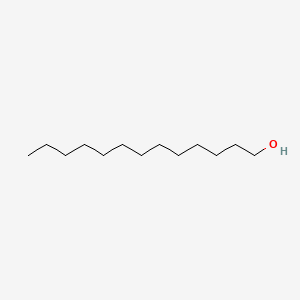
1-Tridecanol
Tridecan-1-ol is a long-chain primary fatty alcohol that is tridecane substituted by a hydroxy group at position 1. It has a role as a plant metabolite, a bacterial metabolite and a human metabolite. It is a tridecanol and a long-chain primary fatty alcohol. — ChEBI
- IUPAC 명칭
- tridecan-1-ol
- 분자식
- C13H28O
- 분자량
- 200.36 g/mol
- 정확한 질량
- 200.214015512 Da
- XLogP3
- 5.7
- 위상 극성 표면적
- 20.2 Ų
- 수소 결합 공여체
- 1
- 수소 결합 수용체
- 1
- 공유결합 단위
- 1
- 정의된 입체중심
- 0
다른 이름
보고된 명칭 16개 더 보기
외부 데이터베이스 식별자
- ChEBI:CHEBI:34123
- ChEMBL:CHEMBL24832
- EPA DTXSID:DTXSID2021947
- PubMed:27519768
- PubMed:22344206
- PubMed:22238638
- PubMed:22151413
- PubMed:21660258
- PubMed:20180993
- PubMed:19375495
- PubMed:19073034
- PubMed:17846563
- PubMed:17075724
- PubMed:16970491
- PubMed:16631777
추가 과학 데이터베이스의 근거
NIH PubChem PUG-View
Attributed physical-property, hazard, environmental and use annotations.
- Autoignition Temperature: 260 °C 출처: ILO-WHO International Chemical Safety Cards (ICSCs)
- Boiling Point: 525 °F at 760 mmHg (USCG, 1999) 출처: CAMEO Chemicals
- Boiling Point: 152 °C at 14 mm Hg 출처: Hazardous Substances Data Bank (HSDB)
- Boiling Point: 155.00 to 156.00 °C. @ 15.00 mm Hg 출처: Human Metabolome Database (HMDB)
- Boiling Point: 274 °C 출처: ILO-WHO International Chemical Safety Cards (ICSCs)
- Color/Form: WATER WHITE LIQ 출처: Hazardous Substances Data Bank (HSDB)
- Color/Form: Crystals from alcohol 출처: Hazardous Substances Data Bank (HSDB)
- Density: 0.846 at 68 °F (USCG, 1999) - Less dense than water; will float 출처: CAMEO Chemicals
- Density: VAPOR DENSITY: 6.9 (AIR= 1) /COMMERCIAL MIXTURE/ 출처: Hazardous Substances Data Bank (HSDB)
- Density: 0.8223 at 31 °C/4 °C 출처: Hazardous Substances Data Bank (HSDB)
- Density: Relative density (water = 1): 0.8 출처: ILO-WHO International Chemical Safety Cards (ICSCs)
- Flash Point: 250 °F (USCG, 1999) 출처: CAMEO Chemicals
- Flash Point: 121 °C 출처: Haz-Map, Information on Hazardous Chemicals and Occupational Diseases
- Flash Point: 250 °F (121 °C) (Open cup) 출처: Hazardous Substances Data Bank (HSDB)
- Flash Point: 121 °C o.c. (mixed isomers) 출처: ILO-WHO International Chemical Safety Cards (ICSCs)
- LogP: log Kow = 5.82 출처: Hazardous Substances Data Bank (HSDB)
- LogP: 8.52 출처: ILO-WHO International Chemical Safety Cards (ICSCs)
- Melting Point: 32.5 °C 출처: Hazardous Substances Data Bank (HSDB)
- Melting Point: Heat Fusion at Melting point = 4.5120X10+7 J/kmol (for the beta form) 출처: Hazardous Substances Data Bank (HSDB)
- Melting Point: 32.00 to 33.00 °C. @ 760.00 mm Hg 출처: Human Metabolome Database (HMDB)
- Melting Point: 30-32 °C 출처: ILO-WHO International Chemical Safety Cards (ICSCs)
- Odor: PLEASANT ODOR 출처: Hazardous Substances Data Bank (HSDB)
- Physical Description: Tridecanol is an oily liquid; colorless; mild, pleasant odor. Floats on water. (USCG, 1999) 출처: CAMEO Chemicals
- Physical Description: Liquid 출처: EPA Chemical Data Reporting (CDR)
- Physical Description: Colorless liquid or solid; [ICSC] White solid; [MSDSonline] 출처: Haz-Map, Information on Hazardous Chemicals and Occupational Diseases
- Physical Description: Colorless liquid with a pleasant odor; [HSDB] 출처: Haz-Map, Information on Hazardous Chemicals and Occupational Diseases
- Physical Description: Solid 출처: Human Metabolome Database (HMDB)
- Physical Description: COLOURLESS OILY LIQUID OR CRYSTALS. 출처: ILO-WHO International Chemical Safety Cards (ICSCs)
- Solubility: INSOL IN WATER; SOL IN ALCOHOL & IN ETHER /1-TRIDECANOL/ 출처: Hazardous Substances Data Bank (HSDB)
- Solubility: Sol in ethanol, ether 출처: Hazardous Substances Data Bank (HSDB)
- Solubility: Solubility in water, g/100ml at 20 °C: 0.01 (very poor) 출처: ILO-WHO International Chemical Safety Cards (ICSCs)
- Vapor Pressure: 3.62 mmHg at 260 °F (USCG, 1999) 출처: CAMEO Chemicals
- Vapor Pressure: 0.000436 [mmHg] 출처: Haz-Map, Information on Hazardous Chemicals and Occupational Diseases
- Vapor Pressure: 4.36X10⁻⁴ mm Hg at 25 °C 출처: Hazardous Substances Data Bank (HSDB)
- First Aid: EYES: promptly flush with clean water for at least 15 minutes and see a physician.; SKIN: wash exposed area with soap and water. (USCG, 1999) 출처: CAMEO Chemicals
- Note: This chemical does not meet GHS hazard criteria for 3.1% (75 of 2412) of reports. 출처: European Chemicals Agency (ECHA)
- Signal: Danger 출처: European Chemicals Agency (ECHA)
- GHS Hazard Statements: H315 (13.3%): Causes skin irritation [Warning Skin corrosion/irritation]; H318 (19.9%): Causes serious eye damage [Danger Serious eye damage/eye irritation]; H319 (12.7%): Causes serious eye irritation [Warning Serious eye damage/eye irritation]; H400 (72.8%): Very toxic to aquatic life [Warning Hazardous to the aquatic environment, acute hazard]; H410 (64.5%): Very toxic to aquatic life with long lasting effects [Warning Hazardous to the aquatic environment, long-term hazard] 출처: European Chemicals Agency (ECHA)
- Precautionary Statement Codes: P264, P264+P265, P273, P280, P302+P352, P305+P351+P338, P305+P354+P338, P317, P321, P332+P317, P337+P317, P362+P364, P391, and P501 (click each P-code to see the statement) 출처: European Chemicals Agency (ECHA)
- ECHA C&L Notifications Summary: Aggregated GHS information provided per 2412 reports by companies from 24 notifications to the ECHA C&L Inventory. Each notification may be associated with multiple companies.; Reported as not meeting GHS hazard criteria per 75 of 2412 reports by companies.; There are 23 notifications provided by 2337 of 2412 reports by companies with hazard statement code(s).; Information may vary between notifications depending on impurities, additives, and other factors. The percentage value in parenthesis indicates the notified classification ratio from companies that provide hazard codes. Only hazard codes with percentage values above 10% are shown. For more detailed information, please visit ECHA C&L website. 출처: European Chemicals Agency (ECHA)
- Note: This chemical does not meet GHS hazard criteria for 4.7% (33 of 709) of reports. 출처: European Chemicals Agency (ECHA)
- Signal: Warning 출처: European Chemicals Agency (ECHA)
- GHS Hazard Statements: H315 (25.4%): Causes skin irritation [Warning Skin corrosion/irritation]; H400 (95.1%): Very toxic to aquatic life [Warning Hazardous to the aquatic environment, acute hazard]; H412 (14.8%): Harmful to aquatic life with long lasting effects [Hazardous to the aquatic environment, long-term hazard] 출처: European Chemicals Agency (ECHA)
- Precautionary Statement Codes: P264, P273, P280, P302+P352, P321, P332+P317, P362+P364, P391, and P501 (click each P-code to see the statement) 출처: European Chemicals Agency (ECHA)
- ECHA C&L Notifications Summary: Aggregated GHS information provided per 709 reports by companies from 13 notifications to the ECHA C&L Inventory. Each notification may be associated with multiple companies.; Reported as not meeting GHS hazard criteria per 33 of 709 reports by companies.; There are 12 notifications provided by 676 of 709 reports by companies with hazard statement code(s).; Information may vary between notifications depending on impurities, additives, and other factors. The percentage value in parenthesis indicates the notified classification ratio from companies that provide hazard codes. Only hazard codes with percentage values above 10% are shown. For more detailed information, please visit ECHA C&L website. 출처: European Chemicals Agency (ECHA)
- NFPA Health Rating: 0 - Materials that, under emergency conditions, would offer no hazard beyond that of ordinary combustible materials. 출처: Hazardous Substances Data Bank (HSDB)
- NFPA Fire Rating: 1 - Materials that must be preheated before ignition can occur. Materials require considerable preheating, under all ambient temperature conditions, before ignition and combustion can occur. 출처: Hazardous Substances Data Bank (HSDB)
- NFPA Instability Rating: 0 - Materials that in themselves are normally stable, even under fire conditions. 출처: Hazardous Substances Data Bank (HSDB)
- Environmental Bioconcentration: An estimated BCF of 600 was calculated for 1-tridecanol(SRC), using a log Kow of 5.82(1) and a regression-derived equation(2). According to a classification scheme(3), this BCF suggests the potential for bioconcentration in aquatic organisms is high(SRC), provided the compound is not metabolized by the organism(SRC). 출처: Hazardous Substances Data Bank (HSDB)
- Environmental Fate: TERRESTRIAL FATE: Based on a classification scheme(1), an estimated Koc value of 35,000(SRC), determined from a log Kow of 5.82(2) and a regression-derived equation(3), indicates that 1-tridecanol is expected to be immobile in soil(SRC). Volatilization of 1-tridecanol from moist soil surfaces is expected to be an important fate process(SRC) given an estimated Henry's Law constant of 1.3X10⁻⁴ atm-cu m/mole(SRC), using a fragment constant estimation method(4). However, adsorption to soil is expected to attenuate volatilization(SRC). 1-Tridecanol is not expected to volatilize from dry soil surfaces(SRC) based upon a vapor pressure of 4.36X10⁻⁴ mm Hg(5). A biodegradation half life of 5.6 days(SRC) can be calculated, using a first order degradation rate of 5.2X10⁻³ 1/hr(6), suggesting that biodegradation may be an important environmental fate process in soil(SRC). 출처: Hazardous Substances Data Bank (HSDB)
- Environmental Fate: AQUATIC FATE: Based on a classification scheme(1), an estimated Koc value of 35,000(SRC), determined from a log Kow of 5.82(2) and a regression-derived equation(3), indicates that 1-tridecanol is expected to adsorb to suspended solids and sediment(SRC). Volatilization from water surfaces is expected(3) based upon an estimated Henry's Law constant of 1.3X10⁻⁴ atm-cu m/mole(SRC), developed using a fragment constant estimation method(4). Using this Henry's Law constant and an estimation method(3), volatilization half-lives for a model river and model lake are 14 hours and 8.5 days, respectively(SRC). However, volatilization from water surfaces is expected to be attenuated by adsorption to suspended solids and sediment in the water column. The estimated volatilization half-life from a model pond is 16 years if adsorption is considered(5). According to a classification scheme(6), an estimated BCF of 600(SRC), from its log Kow(2) and a regression-derived equation(7), suggests the potential for bioconcentration in aquatic organisms is high(SRC). A biodegradation half-life of 5.6 days(SRC) can be calculated, using a first order degradation rate of 5.2X10⁻³ 1/hr(8), suggesting that biodegra 출처: Hazardous Substances Data Bank (HSDB)
- Environmental Fate: ATMOSPHERIC FATE: According to a model of gas/particle partitioning of semivolatile organic compounds in the atmosphere(1), 1-tridecanol, which has a vapor pressure of 4.36X10⁻⁴ mm Hg at 25 °C(2), is expected to exist solely as a vapor in the ambient atmosphere. Vapor-phase 1-tridecanol is degraded in the atmosphere by reaction with photochemically-produced hydroxyl radicals(SRC); the half-life for this reaction in air is estimated to be 20 hours(SRC), calculated from its rate constant of 1.96X10⁻¹¹ cu cm/molecule-sec at 25 °C(SRC) that was derived using a structure estimation method(3). 출처: Hazardous Substances Data Bank (HSDB)
- Consumer Uses: Surfactant (surface active agent) 출처: EPA Chemical Data Reporting (CDR)
- Industry Uses: Surfactant (surface active agent) 출처: EPA Chemical Data Reporting (CDR)
- Sources/Uses: Used as a lubricant, antifoam agent, and chemical intermediate for detergents and other products; [HSDB] 출처: Haz-Map, Information on Hazardous Chemicals and Occupational Diseases
- Sources/Uses: Used as intermediate for plasticizers and other compounds; [HSDB] 출처: Haz-Map, Information on Hazardous Chemicals and Occupational Diseases
- Uses: CHEM INT FOR DITRIDECYL PHTHALATE PLASTICIZER; FOR ISODECYL TRIDECYL PHTHALATE PLASTICIZER; FOR DITRIDECYL MALEATE; FOR ETHOXYLATED TRIDECYL ALCOHOL; FOR ALKOXYLATED TRIDECYL ALCOHOL; FOR TRIDECYL PHOSPHITE; FOR TRIDECYL GLYCERYL ESTER SULFONATE; FOR TRIDECYL SULFATE SODIUM SALT; FOR TRIDECYL THIOGLYCOLATE; FOR DITRIDECYL SULFOSUCCINATE, SODIUM SALT; FOR TRIDECYL 3-MERCAPTOPROPIONATE 출처: Hazardous Substances Data Bank (HSDB)
- Uses: Esters for synthetic lubricants; detergents; antifoam agent; in other tridecyl compounds; perfumery /commercial mixt of isomers/ 출처: Hazardous Substances Data Bank (HSDB)
- Uses: Chemical intermediate for detergents-eg, its ethoxylate (as mixture) 출처: Hazardous Substances Data Bank (HSDB)
매핑 기준: Existing checksum-valid CAS to unique PubChem CID match. 가져온 시각: 2026-08-31. 출처 기록 열기
과학적 분류와 유해성 주석은 맥락을 제공할 뿐이며, 위에 표시된 시장별 규제 판단을 대체하지 않습니다.
추가 출처 적용 범위 및 일치 상태
| 출처 | 결과 | 확인됨 |
|---|---|---|
| NIH PubChem PUG-View | 정확히 일치 | 2026-08-31 |
기록된 불일치는 출처를 확인했다는 유용한 근거이며, 해당 물질이 다른 곳에 존재하지 않는다는 주장이 아닙니다.
체크섬이 유효한 CAS 일치를 통해 2026-08-31에 NIH PubChem에서 가져왔습니다. 화학적 특성은 이 페이지의 규제 판단을 대체하지 않습니다.
공식 EU 원료 명칭 근거
이 원료 명칭은 공식 2025 EU 일반 원료 명칭 용어집과 정확히 일치합니다.
관련 목록 근거
처방 기능이 겹치는 원료
추가 공식 및 과학 출처
이 정체를 확인할 외부 데이터베이스 11개
각 링크는 해당 출처에서 이 정체를 검색합니다. 각 출처의 성격과 법적 비중
CosIng 목록에서 TRIDECYL ALCOHOL이(가) 나타나는 방식
CosIng 목록은 TRIDECYL ALCOHOL을(를) 화장품 원료로 나열하며, 이 페이지는 이를 부속서 기록 0건과 연결합니다. 목록 항목은 명칭과 식별자를 담고 있으며, 부속서 기록은 해당 물질이 EU 화장품 법령에서 사용금지, 사용제한 또는 허용 목록(포지티브 리스트)에 있는 위치를 보여 줍니다.
TRIDECYL ALCOHOL은(는) 공식 데이터에서 화장품 기능 6개로도 태그되어 있습니다. 기능 표시는 의도된 용도를 설명하지만, 처방 또는 표시 작업 전에 연결된 부속서 기록에 대한 규제 검토를 대체하지 않습니다.