
MALTOL
Methyl hydroxypyrone
MALTOL은(는) EU CosIng 목록에 등재되어 있지만, 이 페이지에는 아직 직접 연결된 부속서 기록이 없습니다.
시장별 규제 근거
여기에서 추적하는 시장 13곳 중 어느 곳에도 이 원료의 규칙이 가져와지지 않았습니다.
이는 이 목록에 관한 설명이지 법에 관한 설명이 아닙니다. 가져온 규칙이 없다는 것이 원료가 허용된다는 근거는 아닙니다. 규칙은 다른 명칭이나 식별자로, 또는 아직 이곳에 가져오지 않은 데이터세트에 존재할 수 있습니다.
MALTOL의 목록 세부 정보
INCI 명칭
MALTOL
설명
Methyl hydroxypyrone
MALTOL의 부속서 기록
주요 데이터
화학적 정체 및 특성
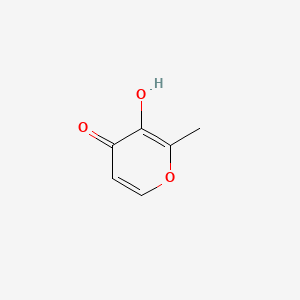
Maltol
Maltol is a white crystalline powder with a fragrant caramel-butterscotch odor. pH (5% aqueous solution) 5.3. (NTP, 1992) — CAMEO Chemicals
- IUPAC 명칭
- 3-hydroxy-2-methylpyran-4-one
- 분자식
- C6H6O3
- 분자량
- 126.11 g/mol
- 정확한 질량
- 126.031694049 Da
- XLogP3
- 0.4
- 위상 극성 표면적
- 46.5 Ų
- 수소 결합 공여체
- 1
- 수소 결합 수용체
- 3
- 공유결합 단위
- 1
- 정의된 입체중심
- 0
다른 이름
보고된 명칭 16개 더 보기
외부 데이터베이스 식별자
- ChEBI:CHEBI:69438
- ChEMBL:CHEMBL31422
- EPA DTXSID:DTXSID0025523
- PubMed:23007530
- PubMed:22831747
- PubMed:22826760
- PubMed:22687564
- PubMed:22569684
- PubMed:22542289
- PubMed:22504362
- PubMed:22476413
- PubMed:22461871
- PubMed:22417522
- PubMed:22315575
- PubMed:22296279
추가 과학 데이터베이스의 근거
NIH PubChem PUG-View
Attributed physical-property, hazard, environmental and use annotations.
- Boiling Point: 199 °F at 760 mmHg (Sublimes) (NTP, 1992) 출처: CAMEO Chemicals
- Boiling Point: Sublimes at 93 °C 출처: Hazardous Substances Data Bank (HSDB)
- Color/Form: Monoclinic prisms from chloroform, orthorhombic bypyramidal crystals + monoclinic prisms from 50% alcohol 출처: Hazardous Substances Data Bank (HSDB)
- Color/Form: White crystalline powder 출처: Hazardous Substances Data Bank (HSDB)
- Dissociation Constants: pKa = 8.6 출처: Hazardous Substances Data Bank (HSDB)
- LogP: log Kow = 0.09 출처: Hazardous Substances Data Bank (HSDB)
- LogP: 0.09 출처: Human Metabolome Database (HMDB)
- Melting Point: 324 to 327 °F (NTP, 1992) 출처: CAMEO Chemicals
- Melting Point: 161.5 °C 출처: Hazardous Substances Data Bank (HSDB)
- Melting Point: 161 - 162 °C 출처: Human Metabolome Database (HMDB)
- Odor: Fragrant, caramel-like odor 출처: Hazardous Substances Data Bank (HSDB)
- Odor: Characteristic caramel-butterscotch odor and suggestive of a fruity-strawberry aroma in dilute solution 출처: Hazardous Substances Data Bank (HSDB)
- Odor: Caramel-like odor, reminiscent of freshly baked cakes 출처: Hazardous Substances Data Bank (HSDB)
- Physical Description: Maltol is a white crystalline powder with a fragrant caramel-butterscotch odor. pH (5% aqueous solution) 5.3. (NTP, 1992) 출처: CAMEO Chemicals
- Physical Description: Other Solid; Dry Powder; Liquid 출처: EPA Chemical Data Reporting (CDR)
- Physical Description: Solid with a fragrant odor like caramel; [Merck Index] White powder; [Alfa Aesar MSDS] 출처: Haz-Map, Information on Hazardous Chemicals and Occupational Diseases
- Physical Description: Solid 출처: Human Metabolome Database (HMDB)
- Physical Description: White crystalline powder; Caramel-butterscotch aroma 출처: Joint FAO/WHO Expert Committee on Food Additives (JECFA)
- Solubility: 1 to 10 mg/mL at 72 °F (NTP, 1992) 출처: CAMEO Chemicals
- Solubility: In water, 10900 mg/L at 15 °C 출처: Hazardous Substances Data Bank (HSDB)
- Solubility: One gram dissolves in 82 mL water, 80 mL glycerin, 21 mL alcohol, 28 mL propylene glycol; Freely soluble in hot water, chloroform; sparingly soluble in benzene, ether, petroleum ether; soluble in alkali hydroxides giving yellow solutions 출처: Hazardous Substances Data Bank (HSDB)
- Solubility: 10.9 mg/mL at 15 °C 출처: Human Metabolome Database (HMDB)
- Solubility: Sparingly soluble in water, soluble in propylene glycol 출처: Joint FAO/WHO Expert Committee on Food Additives (JECFA)
- Solubility: Soluble (in ethanol) 출처: Joint FAO/WHO Expert Committee on Food Additives (JECFA)
- Vapor Pressure: 0.000507 [mmHg] 출처: Haz-Map, Information on Hazardous Chemicals and Occupational Diseases
- Vapor Pressure: 3.26X10⁻⁴ mm Hg at 25 °C (extrapolated from reduced pressure boiling point) 출처: Hazardous Substances Data Bank (HSDB)
- pH: pH of 0.5% aqueous solution = 5.3 출처: Hazardous Substances Data Bank (HSDB)
- First Aid: EYES: First check the victim for contact lenses and remove if present. Flush victim's eyes with water or normal saline solution for 20 to 30 minutes while simultaneously calling a hospital or poison control center. Do not put any ointments, oils, or medication in the victim's eyes without specific instructions from a physician. If symptoms (such as redness or irritation) develop, immediately transport the victim to a hospital.; SKIN: IMMEDIATELY flood affected skin with water while removing and isolating all contaminated clothing. Gently wash all affected skin areas thoroughly with soap and water. If symptoms such as redness or irritation develop, IMMEDIATELY call a physician and be prepared to transport the victim to a hospital for treatment.; INHALATION: IMMEDIATELY leave the contaminated area; take deep breaths of fresh air. If symptoms (such as wheezing, coughing, shortness of breath, or burning in the mouth, throat, or chest) develop, call a physician and be prepared to transport the victim to a hospital. Provide proper respiratory protection to rescuers entering an unknown atmosphere. Whenever possible, Self-Contained Breathing Apparatus (SCBA) should be used; if not availabl 출처: CAMEO Chemicals
- Note: This chemical does not meet GHS hazard criteria for 15.5% (303 of 1955) of reports. 출처: European Chemicals Agency (ECHA)
- Signal: Warning 출처: European Chemicals Agency (ECHA)
- GHS Hazard Statements: H302 (84.5%): Harmful if swallowed [Warning Acute toxicity, oral] 출처: European Chemicals Agency (ECHA)
- Precautionary Statement Codes: P264, P270, P301+P317, P330, and P501 (click each P-code to see the statement) 출처: European Chemicals Agency (ECHA)
- ECHA C&L Notifications Summary: Aggregated GHS information provided per 1955 reports by companies from 20 notifications to the ECHA C&L Inventory.; Reported as not meeting GHS hazard criteria per 303 of 1955 reports by companies.; There are 18 notifications provided by 1652 of 1955 reports by companies with hazard statement code(s).; Information may vary between notifications depending on impurities, additives, and other factors. The percentage value in parenthesis indicates the notified classification ratio from companies that provide hazard codes. Only hazard codes with percentage values above 10% are shown. For more detailed information, please visit ECHA C&L website. 출처: European Chemicals Agency (ECHA)
- Signal: Warning 출처: NITE-CMC
- GHS Hazard Statements: H302: Harmful if swallowed [Warning Acute toxicity, oral]; H341: Suspected of causing genetic defects [Warning Germ cell mutagenicity] 출처: NITE-CMC
- Precautionary Statement Codes: P203, P264, P270, P280, P301+P317, P318, P330, P405, and P501 (click each P-code to see the statement) 출처: NITE-CMC
- Signal: Warning 출처: Hazardous Substances Data Bank (HSDB)
- GHS Hazard Statements: H302: Harmful if swallowed [Warning Acute toxicity, oral]; H315: Causes skin irritation [Warning Skin corrosion/irritation]; H319: Causes serious eye irritation [Warning Serious eye damage/eye irritation]; H335: May cause respiratory irritation [Warning Specific target organ toxicity, single exposure; Respiratory tract irritation] 출처: Hazardous Substances Data Bank (HSDB)
- Precautionary Statement Codes: P261, P264, P264+P265, P270, P271, P280, P301+P317, P302+P352, P304+P340, P305+P351+P338, P319, P321, P330, P332+P317, P337+P317, P362+P364, P403+P233, P405, and P501 (click each P-code to see the statement) 출처: Hazardous Substances Data Bank (HSDB)
- Toxicity Summary: IDENTIFICATION AND USE: Maltol is a white crystalline powder. It is used as a flavoring agent, to impart "freshly baked" odor and flavor to breads and cakes. It is also used as medication. HUMAN EXPOSURE AND TOXICITY: Maltol at concentrations ranging from 0.1 to 1.5 umol/mL induced sister chromatid exchanges in human lymphocytes. It was suggested that these results were due to an indirect action of maltol and not to its direct reactivity with DNA. ANIMAL STUDIES: Eight female mice were fed a diet containing maltol at a level of 0.5% (w/w) for 21 weeks, calculated to provide an average daily intake of 750 mg/kg bw. At termination, no differences in general health, behavior, body-weight gain or relative liver weights were reported. Gross and microscopic examination revealed no histological abnormalities in the livers of the treated mice when compared with the controls. A three-generation study of reproductive toxicity was conducted, in which groups of 20 male and 20 female rats were given diets containing maltol at concentrations resulting in 100, 200 or 400 mg/kg bw per day. On day 134, animals of the F1 generation showed signs of sialodacryodenitis due to a contagious virus. No dea 출처: Hazardous Substances Data Bank (HSDB)
- Environmental Bioconcentration: An estimated BCF of 3 was calculated in fish for maltol(SRC), using a log Kow of 0.09(1) and a regression-derived equation(2). According to a classification scheme(3), this BCF suggests the potential for bioconcentration in aquatic organisms is low(SRC). 출처: Hazardous Substances Data Bank (HSDB)
- Environmental Fate: TERRESTRIAL FATE: Based on a classification scheme(1), an estimated Koc value of 1(SRC), determined from a structure estimation method(2), indicates that maltol is expected to have very high mobility in soil(SRC). Volatilization of maltol from moist soil surfaces is not expected to be an important fate process(SRC) given an estimated Henry's Law constant of 5.0X10⁻⁹ atm-cu m/mole(SRC), derived from its extrapolated vapor pressure, 3.26X10⁻⁴ mm Hg(2), and water solubility, 1.09X10+4 mg/L(3). Maltol is not expected to volatilize from dry soil surfaces(SRC) based upon its extrapolated vapor pressure(2); however, maltol does have a characteristic fragrant odor(4) even though it exists as a solid. Biodegradation data in soil were not available(SRC, 2016). 출처: Hazardous Substances Data Bank (HSDB)
- Environmental Fate: AQUATIC FATE: Based on a classification scheme(1), an estimated Koc value of 1(SRC), determined from a structure estimation method(2), indicates that maltol is not expected to adsorb to suspended solids and sediment(SRC). Volatilization from water surfaces is not expected(3) based upon an estimated Henry's Law constant of 5.0X10⁻⁹ atm-cu m/mole(SRC), derived from its extrapolated vapor pressure, 3.26X10⁻⁴ mm Hg(2), and water solubility, 1.09X10+4 mg/L(4). According to a classification scheme(5), an estimated BCF of 3(SRC), from its log Kow of 0.09(6) and a regression-derived equation(2), suggests the potential for bioconcentration in aquatic organisms is low(SRC). Biodegradation data in water were not available(SRC, 2016). Maltol is not expected to undergo hydrolysis in the environment due to the lack of functional groups that hydrolyze under environmental conditions(3). Maltol is an olefinic compound and olefins in surface waters exposed to sunlight react with photo-oxidants with a half-life on the order of 25 days(7). 출처: Hazardous Substances Data Bank (HSDB)
- Environmental Fate: ATMOSPHERIC FATE: According to a model of gas/particle partitioning of semivolatile organic compounds in the atmosphere(1), maltol, which has an extrapolated vapor pressure of 3.26X10⁻⁴ mm Hg at 25 °C(SRC), determined from a fragment constant method(2), is expected to exist solely as a vapor in the ambient atmosphere. Vapor-phase maltol is degraded in the atmosphere by reaction with photochemically-produced hydroxyl radicals(SRC); the half-life for this reaction in air is estimated to be 7.7 hours(SRC), calculated from its rate constant of 5.0X10⁻¹¹ cu cm/molecule-sec at 25 °C(SRC) that was derived using a structure estimation method(2). Vapor-phase maltol is also degraded in the atmosphere by reaction with ozone(SRC); the half-life for this reaction in air is estimated to be 21 hours(SRC), calculated from its rate constant of 1.3X10⁻¹⁷ cu cm/molecule-sec at 25 °C(SRC) that was derived using a structure estimation method(2). Maltol absorbs at wavelengths >290 nm(3) and, therefore, may be susceptible to direct photolysis by sunlight(SRC). 출처: Hazardous Substances Data Bank (HSDB)
- Consumer Uses: Fragrance 출처: EPA Chemical Data Reporting (CDR)
- Industry Uses: Fragrance; Flavoring and nutrient 출처: EPA Chemical Data Reporting (CDR)
- Sources/Uses: Present in the bark of young larch trees, pine needles, chicory, wood tars and oils, and roasted malt; Used as a flavoring agent (gives bread and cakes a freshly baked odor); [Merck Index] Used as a flavoring agent, nutritive sweetener, and processing aid for food; [FDA] Permitted for use as an inert ingredient in non-food pesticide products; [EPA] 출처: Haz-Map, Information on Hazardous Chemicals and Occupational Diseases
- Uses: Flavoring agent, to impart "freshly baked" odor and flavor to breads and cakes. 출처: Hazardous Substances Data Bank (HSDB)
- Uses: Reported uses (ppm):; Table: Reported uses (ppm): (Flavor and Extract Manufacturers' Association, 1994) [Table#8335] 출처: Hazardous Substances Data Bank (HSDB)
- Uses: MEDICATION 출처: Hazardous Substances Data Bank (HSDB)
매핑 기준: Existing checksum-valid CAS to unique PubChem CID match. 가져온 시각: 2026-08-31. 출처 기록 열기
과학적 분류와 유해성 주석은 맥락을 제공할 뿐이며, 위에 표시된 시장별 규제 판단을 대체하지 않습니다.
추가 출처 적용 범위 및 일치 상태
| 출처 | 결과 | 확인됨 |
|---|---|---|
| NIH PubChem PUG-View | 정확히 일치 | 2026-08-31 |
기록된 불일치는 출처를 확인했다는 유용한 근거이며, 해당 물질이 다른 곳에 존재하지 않는다는 주장이 아닙니다.
체크섬이 유효한 CAS 일치를 통해 2026-08-31에 NIH PubChem에서 가져왔습니다. 화학적 특성은 이 페이지의 규제 판단을 대체하지 않습니다.
공식 EU 원료 명칭 근거
이 원료 명칭은 공식 2025 EU 일반 원료 명칭 용어집과 정확히 일치합니다.
관련 목록 근거
처방 기능이 겹치는 원료
추가 공식 및 과학 출처
이 정체를 확인할 외부 데이터베이스 11개
각 링크는 해당 출처에서 이 정체를 검색합니다. 각 출처의 성격과 법적 비중
CosIng 목록에서 MALTOL이(가) 나타나는 방식
CosIng 목록은 MALTOL을(를) 화장품 원료로 나열하며, 이 페이지는 이를 부속서 기록 0건과 연결합니다. 목록 항목은 명칭과 식별자를 담고 있으며, 부속서 기록은 해당 물질이 EU 화장품 법령에서 사용금지, 사용제한 또는 허용 목록(포지티브 리스트)에 있는 위치를 보여 줍니다.
MALTOL은(는) 공식 데이터에서 화장품 기능 2개로도 태그되어 있습니다. 기능 표시는 의도된 용도를 설명하지만, 처방 또는 표시 작업 전에 연결된 부속서 기록에 대한 규제 검토를 대체하지 않습니다.