
DECANE
n-Decane
DECANE은(는) EU CosIng 목록에 등재되어 있지만, 이 페이지에는 아직 직접 연결된 부속서 기록이 없습니다.
시장별 규제 근거
여기에서 추적하는 시장 13곳 중 어느 곳에도 이 원료의 규칙이 가져와지지 않았습니다.
이는 이 목록에 관한 설명이지 법에 관한 설명이 아닙니다. 가져온 규칙이 없다는 것이 원료가 허용된다는 근거는 아닙니다. 규칙은 다른 명칭이나 식별자로, 또는 아직 이곳에 가져오지 않은 데이터세트에 존재할 수 있습니다.
DECANE의 목록 세부 정보
INCI 명칭
DECANE
설명
n-Decane
DECANE의 부속서 기록
주요 데이터
- FRAGRANCE
Imparting an odour or taste. Creating a perceivable pleasant smell and/or masking a bad smell.
- PLASTICISER
Softening and making supple synthetic polymers that otherwise could not be easily deformed, spread or worked out.
- SOLVENT
Dissolving other components of cosmetics. Solvents are usually liquids (aqueous and nonaqueous).
- VISCOSITY CONTROLLING
Increasing or decreasing the viscosity (thickness) of cosmetics.
화학적 정체 및 특성
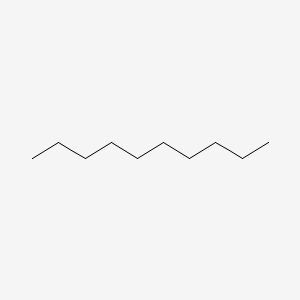
- IUPAC 명칭
- decane
- 분자식
- C10H22
- 분자량
- 142.28 g/mol
- 정확한 질량
- 142.172150702 Da
- XLogP3
- 5.0
- 위상 극성 표면적
- 0.0 Ų
- 수소 결합 공여체
- 0
- 수소 결합 수용체
- 0
- 공유결합 단위
- 1
- 정의된 입체중심
- 0
다른 이름
보고된 명칭 16개 더 보기
외부 데이터베이스 식별자
- ChEBI:CHEBI:41808
- ChEMBL:CHEMBL134537
- EPA DTXSID:DTXSID6024913
- PubMed:28003437
- PubMed:23046253
- PubMed:23008235
- PubMed:22998553
- PubMed:22985106
- PubMed:22974715
- PubMed:22966229
- PubMed:22958854
- PubMed:22957584
- PubMed:22953777
- PubMed:22946889
- PubMed:22894689
추가 과학 데이터베이스의 근거
NIH PubChem PUG-View
Attributed physical-property, hazard, environmental and use annotations.
- Autoignition Temperature: 410 °F (USCG, 1999) 출처: CAMEO Chemicals
- Autoignition Temperature: 410 °F (210 °C) 출처: Hazardous Substances Data Bank (HSDB)
- Autoignition Temperature: 210 °C 출처: ILO-WHO International Chemical Safety Cards (ICSCs)
- Boiling Point: 345.4 °F at 760 mmHg (NTP, 1992) 출처: CAMEO Chemicals
- Boiling Point: 174.1 °C 출처: Hazardous Substances Data Bank (HSDB)
- Boiling Point: 173.00 to 175.00 °C. @ 760.00 mm Hg 출처: Human Metabolome Database (HMDB)
- Boiling Point: 174.2 °C 출처: ILO-WHO International Chemical Safety Cards (ICSCs)
- Boiling Point: 174.15 °C @760 [mm Hg] 출처: PAC Chemical Database, U.S. Department of Energy
- Color/Form: Colorless liquid 출처: Hazardous Substances Data Bank (HSDB)
- Density: 0.73 at 60 °F (USCG, 1999) - Less dense than water; will float 출처: CAMEO Chemicals
- Density: 0.7255 g/cu cm at 25 °C 출처: Hazardous Substances Data Bank (HSDB)
- Density: Relative density (water = 1): 0.7 출처: ILO-WHO International Chemical Safety Cards (ICSCs)
- Density: 0.7266 @25 °C 출처: PAC Chemical Database, U.S. Department of Energy
- Flash Point: 115 °F (NTP, 1992) 출처: CAMEO Chemicals
- Flash Point: 46.0 °C (114.8 °F) - closed cup 출처: Hazardous Substances Data Bank (HSDB)
- Flash Point: 115 °F (46 °C)(Closed cup) 출처: Hazardous Substances Data Bank (HSDB)
- Flash Point: 46 °C c.c. 출처: ILO-WHO International Chemical Safety Cards (ICSCs)
- LogP: log Kow = 5.01 출처: Hazardous Substances Data Bank (HSDB)
- LogP: 5.010 출처: Human Metabolome Database (HMDB)
- LogP: 5.98 (estimated) 출처: ILO-WHO International Chemical Safety Cards (ICSCs)
- Melting Point: -21.5 °F (NTP, 1992) 출처: CAMEO Chemicals
- Melting Point: -29.7 °C 출처: Hazardous Substances Data Bank (HSDB)
- Melting Point: -31.00 to -28.00 °C. @ 760.00 mm Hg 출처: Human Metabolome Database (HMDB)
- Melting Point: -29.7 °C 출처: ILO-WHO International Chemical Safety Cards (ICSCs)
- Melting Point: -29.6 °C 출처: PAC Chemical Database, U.S. Department of Energy
- Physical Description: N-decane appears as a colorless liquid. Flash point 115 °F. Less dense than water and insoluble in water. Vapors heavier than air. In high concentrations its vapors may be narcotic. Used as a solvent and to make other chemicals. 출처: CAMEO Chemicals
- Physical Description: Liquid 출처: EPA Chemical Data Reporting (CDR)
- Physical Description: Colorless liquid with a gasoline-like odor; [CHEMINFO] 출처: Haz-Map, Information on Hazardous Chemicals and Occupational Diseases
- Physical Description: Liquid 출처: Human Metabolome Database (HMDB)
- Physical Description: COLOURLESS LIQUID WITH CHARACTERISTIC ODOUR. 출처: ILO-WHO International Chemical Safety Cards (ICSCs)
- Refractive Index: Index of refraction: 1.4102 at 20 °C 출처: Hazardous Substances Data Bank (HSDB)
- Solubility: less than 1 mg/mL at 70 °F (NTP, 1992) 출처: CAMEO Chemicals
- Solubility: In water, 5.20X10⁻² mg/L at 25 °C 출처: Hazardous Substances Data Bank (HSDB)
- Solubility: In distilled water, 0.009 mg/L at 20 °C; in salt water, 0.087 mg/L at 20 °C 출처: Hazardous Substances Data Bank (HSDB)
- Solubility: Miscible with ethanol; soluble in ether; slightly soluble in carbon tetrachloride 출처: Hazardous Substances Data Bank (HSDB)
- Solubility: Solubility in water: none 출처: ILO-WHO International Chemical Safety Cards (ICSCs)
- Vapor Pressure: 1 mmHg at 61.7 °F ; 2.7 mmHg at 68 °F; 10 mmHg at 131.7 °F (NTP, 1992) 출처: CAMEO Chemicals
- Vapor Pressure: 1.43 [mmHg] 출처: Haz-Map, Information on Hazardous Chemicals and Occupational Diseases
- Vapor Pressure: 1.43 mm Hg at 25 °C 출처: Hazardous Substances Data Bank (HSDB)
- Vapor Pressure: Vapor pressure, kPa at 25 °C: 0.17 출처: ILO-WHO International Chemical Safety Cards (ICSCs)
- Vapor Pressure: 1.43 [mm Hg] @25 °C 출처: PAC Chemical Database, U.S. Department of Energy
- Viscosity: 2.188 mPa s at -25 °C; 1.277 mPa s at 0 °C; 0.838 mPa s at 25 °C; 0.598 mPa s at 50 °C; 0.453 mPa s at 75 °C; 0.359 mPa s at 100 °C 출처: Hazardous Substances Data Bank (HSDB)
- Carcinogen Classification: No indication of carcinogenicity to humans (not listed by IARC). 출처: Toxin and Toxin Target Database (T3DB)
- Exposure Routes: The substance can be absorbed into the body by inhalation and by ingestion. 출처: ILO-WHO International Chemical Safety Cards (ICSCs)
- First Aid: EYES: First check the victim for contact lenses and remove if present. Flush victim's eyes with water or normal saline solution for 20 to 30 minutes while simultaneously calling a hospital or poison control center. Do not put any ointments, oils, or medication in the victim's eyes without specific instructions from a physician. IMMEDIATELY transport the victim after flushing eyes to a hospital even if no symptoms (such as redness or irritation) develop.; SKIN: IMMEDIATELY flood affected skin with water while removing and isolating all contaminated clothing. Gently wash all affected skin areas thoroughly with soap and water. If symptoms such as redness or irritation develop, IMMEDIATELY call a physician and be prepared to transport the victim to a hospital for treatment.; INHALATION: IMMEDIATELY leave the contaminated area; take deep breaths of fresh air. If symptoms (such as wheezing, coughing, shortness of breath, or burning in the mouth, throat, or chest) develop, call a physician and be prepared to transport the victim to a hospital. Provide proper respiratory protection to rescuers entering an unknown atmosphere. Whenever possible, Self-Contained Breathing Apparatus (SCBA) shou 출처: CAMEO Chemicals
- ERG2024, Guide 128 (n-Decane): General First Aid:; · Call 911 or emergency medical service.; · Ensure that medical personnel are aware of the material(s) involved, take precautions to protect themselves and avoid contamination.; · Move victim to fresh air if it can be done safely.; · Administer oxygen if breathing is difficult.; · If victim is not breathing:; -- DO NOT perform mouth-to-mouth resuscitation; the victim may have ingested or inhaled the substance.; -- If equipped and pulse detected, wash face and mouth, then give artificial respiration using a proper respiratory medical device (bag-valve mask, pocket mask equipped with a one-way valve or other device).; -- If no pulse detected or no respiratory medical device available, provide continuous compressions. Conduct a pulse check every two minutes or monitor for any signs of spontaneous respirations.; · Remove and isolate contaminated clothing and shoes.; · For minor skin contact, avoid spreading material on unaffected skin.; · In case of contact with substance, remove immediately by flushing skin or eyes with running water for at least 20 minutes.; · For severe burns, immediate medical attention is required.; · Effects of exposure (inhalation, ingestion, 출처: Emergency Response Guidebook (ERG)
- Note: This chemical does not meet GHS hazard criteria for 0.1% (2 of 1869) of reports. 출처: European Chemicals Agency (ECHA)
- Signal: Danger 출처: European Chemicals Agency (ECHA)
- GHS Hazard Statements: H226 (91.6%): Flammable liquid and vapor [Warning Flammable liquids]; H304 (92.5%): May be fatal if swallowed and enters airways [Danger Aspiration hazard] 출처: European Chemicals Agency (ECHA)
- Precautionary Statement Codes: P210, P233, P240, P241, P242, P243, P280, P301+P316, P303+P361+P353, P331, P370+P378, P403+P235, P405, and P501 (click each P-code to see the statement) 출처: European Chemicals Agency (ECHA)
- ECHA C&L Notifications Summary: Aggregated GHS information provided per 1869 reports by companies from 18 notifications to the ECHA C&L Inventory. Each notification may be associated with multiple companies.; Reported as not meeting GHS hazard criteria per 2 of 1869 reports by companies.; There are 17 notifications provided by 1867 of 1869 reports by companies with hazard statement code(s).; Information may vary between notifications depending on impurities, additives, and other factors. The percentage value in parenthesis indicates the notified classification ratio from companies that provide hazard codes. Only hazard codes with percentage values above 10% are shown. For more detailed information, please visit ECHA C&L website. 출처: European Chemicals Agency (ECHA)
- GHS Hazard Statements: H226 (100%): Flammable liquid and vapor [Warning Flammable liquids]; H304 (100%): May be fatal if swallowed and enters airways [Danger Aspiration hazard] 출처: European Chemicals Agency (ECHA)
- ECHA C&L Notifications Summary: The GHS information provided by 1 company from 1 notification to the ECHA C&L Inventory. 출처: European Chemicals Agency (ECHA)
- Signal: Danger 출처: NITE-CMC
- GHS Hazard Statements: H226: Flammable liquid and vapor [Warning Flammable liquids]; H304: May be fatal if swallowed and enters airways [Danger Aspiration hazard] 출처: NITE-CMC
- Precautionary Statement Codes: P210, P233, P240, P241, P242, P243, P280, P301+P316, P303+P361+P353, P331, P370+P378, P403+P235, P405, and P501 (click each P-code to see the statement) 출처: NITE-CMC
- Signal: Warning 출처: NITE-CMC
- GHS Hazard Statements: H226: Flammable liquid and vapor [Warning Flammable liquids] 출처: NITE-CMC
- NFPA Health Rating: 1 - Materials that, under emergency conditions, can cause significant irritation. 출처: Hazardous Substances Data Bank (HSDB)
- NFPA Fire Rating: 2 - Materials that must be moderately heated or exposed to relatively high ambient temperatures before ignition can occur. Materials would not under normal conditions form hazardous atmospheres with air, but under high ambient temperatures or under moderate heating could release vapor in sufficient quantities to produce hazardous atmospheres with air. 출처: Hazardous Substances Data Bank (HSDB)
- NFPA Instability Rating: 0 - Materials that in themselves are normally stable, even under fire conditions. 출처: Hazardous Substances Data Bank (HSDB)
- Toxicity Summary: IDENTIFICATION AND USE: Decane is a colorless liquid. It is used in organic synthesis, as a solvent, standardized hydrocarbon, and in jet-fuel research. HUMAN EXPOSURE AND TOXICITY: In tests with human subjects, solutions as strong as 30% produced no irritation when applied to skin and left for 24 hr. Decane is a simple asphyxiant and causes CNS depression in high concentrations. ANIMAL STUDIES: Rats exposed to decane vapor have been examined for lens opacities, but no cataracts were found. Rats exposed to 0.2 mL of decane by inhalation died within 24 hr by pulmonary edema and hemorrhaging. Decane is highly lipid-soluble and causes pulmonary pneumonitis when aspired into lungs. Animals showed signs of dyspnea, tachypnea, and cyanosis. In rats exposed by inhalation decane caused some limited, but statistically significant neurobehavioral effects at 5 g/cu m, with no effects at 1.5 g/cu m. Exposure of rats to 540 ppm of decane 18 hr/day, 7 days/week for 57 days stimulated weight gains and decreased the total white blood count, but no bone marrow changes or other organ changes were noted. Dermal application of undiluted decane to mice (0.1-0.15 g per mouse, 3 times a week for 50 weeks 출처: Hazardous Substances Data Bank (HSDB)
- Environmental Bioconcentration: An estimated BCF of 40 was calculated in fish for n-decane(SRC), using a log Kow of 5.01(1) and a regression-derived equation(2). According to a classification scheme(2), this BCF suggests the potential for bioconcentration in aquatic organisms is moderate(SRC). 출처: Hazardous Substances Data Bank (HSDB)
- Environmental Fate: TERRESTRIAL FATE: Based on a classification scheme(1), an estimated Koc value of 1500(SRC), determined from a structure estimation method(2), indicates that n-decane is expected to have low mobility in soil(SRC). Volatilization of n-decane from moist soil surfaces is expected to be an important fate process(SRC) given an estimated Henry's Law constant of 5.15 atm-cu m/mole(SRC) derived from its vapor pressure, 1.43 mm Hg(3), and water solubility, 0.052 mg/L(4). n-Decane is expected to volatilize from dry soil surfaces(SRC) based upon its vapor pressure. Biodegradation studies in soil have observed volatilization to be a more important removal process than biodegradation for n-decane(5,6). A 77-85.8% of theoretical biodegradation using activated sludge in several OECD 301F tests indicates n-decane is readily biodegradable(7) and suggests that biodegradation is an important environmental fate process in soil(SRC). 출처: Hazardous Substances Data Bank (HSDB)
- Environmental Fate: AQUATIC FATE: Based on a classification scheme(1), an estimated Koc value of 1500(SRC), determined from a structure estimation method(2), indicates that n-decane is expected to adsorb to suspended solids and sediment(SRC). Volatilization from water surfaces is expected(3) based upon an estimated Henry's Law constant of 5.15 atm-cu m/mole(SRC), derived from its vapor pressure, 1.43 mm Hg(4), and water solubility, 0.052 mg/L(5). Using this Henry's Law constant and an estimation method(3), volatilization half-lives for a model river and model lake are 3.5 hours and 4.7 days, respectively(SRC). According to a classification scheme(6), an estimated BCF of 40(SRC), from its log Kow of 5.01(7) and a regression-derived equation(2), suggests the potential for bioconcentration in aquatic organisms is moderate(SRC). A 77-85.8% of theoretical biodegradation using activated sludge in several OECD 301F tests indicates n-decane is readily biodegradable(8) and suggests that biodegradation is an important environmental fate process in water(SRC). Die-away tests using sea-water from the Narragansett Bay and radio-labeled decane showed that 71-82% of the radio-labeled n-decane was mineralized to 14CO 출처: Hazardous Substances Data Bank (HSDB)
- Environmental Fate: ATMOSPHERIC FATE: According to a model of gas/particle partitioning of semivolatile organic compounds in the atmosphere(1), n-decane, which has a vapor pressure of 1.43 mm Hg at 25 °C(2), is expected to exist solely as a vapor in the ambient atmosphere. Vapor-phase n-decane is degraded in the atmosphere by reaction with photochemically-produced hydroxyl radicals(SRC); the half-life for this reaction in air is estimated to be 35 hours(SRC), calculated from its rate constant of 1.1X10⁻¹¹ cu cm/molecule-sec at 25 °C(3). Vapor-phase n-decane is also degraded in the atmosphere by reaction with nitrate radicals(SRC); the half-life for this reaction in air is estimated to be 124 days(SRC), calculated from its rate constant of 2.59X10⁻¹⁶ cu cm/molecule-sec at 25 °C(4). n-Decane has been detected in rain and snow samples(5,6) suggesting that n-decane may be removed from the air by wet deposition(SRC). n-Decane does not contain chromophores that absorb at wavelengths >290 nm(7) and, therefore, is not expected to be susceptible to direct photolysis by sunlight(SRC). 출처: Hazardous Substances Data Bank (HSDB)
- Consumer Uses: Not Known or Reasonably Ascertainable 출처: EPA Chemical Data Reporting (CDR)
- Industry Uses: Other; Fuel agents; Fuel; Not Known or Reasonably Ascertainable; Intermediate 출처: EPA Chemical Data Reporting (CDR)
- Sources/Uses: Used as a solvent, intermediate, and jet engine fuel standard; [HSDB] Used in rubber and paper industries; [CHEMINFO] 출처: Haz-Map, Information on Hazardous Chemicals and Occupational Diseases
- Industrial Processes with risk of exposure: Pulp and Paper Processing [Category: Industry] 출처: Haz-Map, Information on Hazardous Chemicals and Occupational Diseases
- Uses: Organic synthesis, solvent, standardized hydrocarbon, in jet-fuel research. 출처: Hazardous Substances Data Bank (HSDB)
- Uses: STANDARDIZATION OF AIRCRAFT ENGINE CARBURETORS; CALIBRATION OF JET ENGINE NOZZLES 출처: Hazardous Substances Data Bank (HSDB)
- Uses: Component of engine fuel. 출처: Hazardous Substances Data Bank (HSDB)
- Uses: N-Decane is found in common oregano. 출처: Toxin and Toxin Target Database (T3DB)
매핑 기준: Existing checksum-valid CAS to unique PubChem CID match. 가져온 시각: 2026-08-31. 출처 기록 열기
과학적 분류와 유해성 주석은 맥락을 제공할 뿐이며, 위에 표시된 시장별 규제 판단을 대체하지 않습니다.
추가 출처 적용 범위 및 일치 상태
| 출처 | 결과 | 확인됨 |
|---|---|---|
| NIH PubChem PUG-View | 정확히 일치 | 2026-08-31 |
기록된 불일치는 출처를 확인했다는 유용한 근거이며, 해당 물질이 다른 곳에 존재하지 않는다는 주장이 아닙니다.
체크섬이 유효한 CAS 일치를 통해 2026-08-31에 NIH PubChem에서 가져왔습니다. 화학적 특성은 이 페이지의 규제 판단을 대체하지 않습니다.
공식 EU 원료 명칭 근거
이 원료 명칭은 공식 2025 EU 일반 원료 명칭 용어집과 정확히 일치합니다.
관련 목록 근거
처방 기능이 겹치는 원료
추가 공식 및 과학 출처
이 정체를 확인할 외부 데이터베이스 11개
각 링크는 해당 출처에서 이 정체를 검색합니다. 각 출처의 성격과 법적 비중
CosIng 목록에서 DECANE이(가) 나타나는 방식
CosIng 목록은 DECANE을(를) 화장품 원료로 나열하며, 이 페이지는 이를 부속서 기록 0건과 연결합니다. 목록 항목은 명칭과 식별자를 담고 있으며, 부속서 기록은 해당 물질이 EU 화장품 법령에서 사용금지, 사용제한 또는 허용 목록(포지티브 리스트)에 있는 위치를 보여 줍니다.
DECANE은(는) 공식 데이터에서 화장품 기능 4개로도 태그되어 있습니다. 기능 표시는 의도된 용도를 설명하지만, 처방 또는 표시 작업 전에 연결된 부속서 기록에 대한 규제 검토를 대체하지 않습니다.