
CHLORAMINE T
Benzenesulfonamide, N-chloro-4-methyl-, sodium salt
CHLORAMINE T은(는) 이 페이지에서 EU 부속서 기록 1건과 연결되어 있습니다. 목록 주석: III/5.
시장별 규제 근거
이 매트릭스는 검증된 원료 규칙과 매핑은 되었지만 아직 가져오지 않은 출처를 구분합니다. 가져온 규칙이 없다는 것이 해당 원료가 허용된다는 의미는 아닙니다.
모든 열을 보려면 가로로 스와이프하거나 스크롤하세요.
| 시장 | 근거 상태 | 기록 | 출처 언어 |
|---|---|---|---|
| European Union | 근거 연결됨 Restricted entry found 이 근거 열기 | 1 | English and EU languages |
| Great Britain | 근거 연결됨 Restricted 이 근거 열기 | 1 | English |
| Canada | 근거 연결됨 Prohibited 이 근거 열기 | 1 | English and French |
| New Zealand | 근거 연결됨 Restricted 이 근거 열기 | 1 | English |
| ASEAN | 근거 연결됨 Restricted 이 근거 열기 | 1 | English and national languages |
| China | 출처 매핑됨 Official source mapped; ingredient rule not imported | 0 | Chinese with selected English material |
| Japan | 근거 연결됨 Restricted 이 근거 열기 | 1 | Japanese; official English translation available |
| South Korea | 근거 연결됨 Restricted 이 근거 열기 | 1 | Korean with some English names |
| United States | 출처 매핑됨 Official source mapped; ingredient rule not imported | 0 | English |
| Australia | 출처 매핑됨 Official source mapped; ingredient rule not imported | 0 | English |
| Brazil | 출처 매핑됨 Official source mapped; ingredient rule not imported | 0 | Portuguese with INCI crosswalks |
| India | 근거 연결됨 Restricted 이 근거 열기 | 1 | English and Hindi |
| Saudi Arabia | 근거 연결됨 Restricted 이 근거 열기 | 1 | Arabic and English |
CHLORAMINE T의 목록 세부 정보
INCI 명칭
CHLORAMINE T
설명
Benzenesulfonamide, N-chloro-4-methyl-, sodium salt
CHLORAMINE T의 부속서 기록
주요 데이터
화학적 정체 및 특성
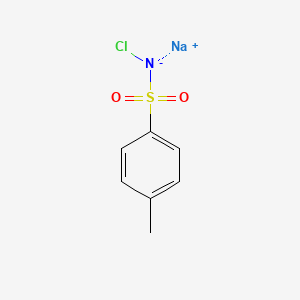
Chloramine-T
Chloramine T is an organic sodium salt derivative of toluene-4-sulfonamide with a chloro substituent in place of an amino hydrogen. It has a role as a disinfectant, an allergen and an antifouling biocide. It contains a chloro(p-tolylsulfonyl)azanide. — ChEBI
- IUPAC 명칭
- sodium chloro-(4-methylphenyl)sulfonylazanide
- 분자식
- C7H7ClNNaO2S
- 분자량
- 227.64 g/mol
- 정확한 질량
- 226.9783716 Da
- 위상 극성 표면적
- 43.5 Ų
- 수소 결합 공여체
- 0
- 수소 결합 수용체
- 3
- 공유결합 단위
- 2
- 정의된 입체중심
- 0
다른 이름
보고된 명칭 16개 더 보기
외부 데이터베이스 식별자
- ChEBI:CHEBI:53767
- ChEMBL:CHEMBL1697734
- EPA DTXSID:DTXSID6040321
추가 과학 데이터베이스의 근거
NIH PubChem PUG-View
Attributed physical-property, hazard, environmental and use annotations.
- Color/Form: White or slightly yellow crystals or crystalline powder 출처: Hazardous Substances Data Bank (HSDB)
- Density: Density (trihydrate): 1.4 g/cm³ 출처: ILO-WHO International Chemical Safety Cards (ICSCs)
- Flash Point: 192 °C c.c. (trihydrate) 출처: ILO-WHO International Chemical Safety Cards (ICSCs)
- LogP: log Kow = 0.84 /Estimated/ 출처: Hazardous Substances Data Bank (HSDB)
- LogP: 0.84 (estimated) 출처: ILO-WHO International Chemical Safety Cards (ICSCs)
- Melting Point: 170-177 °C decomposes 출처: Hazardous Substances Data Bank (HSDB)
- Odor: Slight odor of chlorine 출처: Hazardous Substances Data Bank (HSDB)
- Physical Description: CBI 출처: EPA Chemical Data Reporting (CDR)
- Physical Description: White or slightly yellow crystals or crystalline powder; [HSDB] 출처: Haz-Map, Information on Hazardous Chemicals and Occupational Diseases
- Physical Description: WHITE SOLID IN VARIOUS FORMS WITH CHARACTERISTIC ODOUR. 출처: ILO-WHO International Chemical Safety Cards (ICSCs)
- Solubility: Insoluble in benzene, chloroform, and ether; decomposed by alcohol 출처: Hazardous Substances Data Bank (HSDB)
- Solubility: Soluble in water. 출처: Hazardous Substances Data Bank (HSDB)
- Solubility: Solubility in water, g/100ml at 25 °C: (good, trihydrate) 출처: ILO-WHO International Chemical Safety Cards (ICSCs)
- Exposure Routes: The substance can be absorbed into the body by inhalation of its aerosol and by ingestion. 출처: ILO-WHO International Chemical Safety Cards (ICSCs)
- Signal: Danger 출처: Regulation (EC) No 1272/2008 of the European Parliament and of the Council
- GHS Hazard Statements: H302: Harmful if swallowed [Warning Acute toxicity, oral]; H314: Causes severe skin burns and eye damage [Danger Skin corrosion/irritation]; H334: May cause allergy or asthma symptoms or breathing difficulties if inhaled [Danger Sensitization, respiratory] 출처: Regulation (EC) No 1272/2008 of the European Parliament and of the Council
- Precautionary Statement Codes: P233, P260, P264, P270, P271, P280, P284, P301+P317, P301+P330+P331, P302+P361+P354, P304+P340, P305+P354+P338, P316, P321, P330, P342+P316, P363, P403, P405, and P501 (click each P-code to see the statement) 출처: Regulation (EC) No 1272/2008 of the European Parliament and of the Council
- Signal: Danger 출처: European Chemicals Agency (ECHA)
- GHS Hazard Statements: H302 (100%): Harmful if swallowed [Warning Acute toxicity, oral]; H314 (100%): Causes severe skin burns and eye damage [Danger Skin corrosion/irritation]; H317 (34.9%): May cause an allergic skin reaction [Warning Sensitization, Skin]; H318 (34.9%): Causes serious eye damage [Danger Serious eye damage/eye irritation]; H334 (100%): May cause allergy or asthma symptoms or breathing difficulties if inhaled [Danger Sensitization, respiratory] 출처: European Chemicals Agency (ECHA)
- Precautionary Statement Codes: P233, P260, P261, P264, P264+P265, P270, P271, P272, P280, P284, P301+P317, P301+P330+P331, P302+P352, P302+P361+P354, P304+P340, P305+P354+P338, P316, P317, P321, P330, P333+P317, P342+P316, P362+P364, P363, P403, P405, and P501 (click each P-code to see the statement) 출처: European Chemicals Agency (ECHA)
- ECHA C&L Notifications Summary: Aggregated GHS information provided per 298 reports by companies from 6 notifications to the ECHA C&L Inventory. Each notification may be associated with multiple companies.; Information may vary between notifications depending on impurities, additives, and other factors. The percentage value in parenthesis indicates the notified classification ratio from companies that provide hazard codes. Only hazard codes with percentage values above 10% are shown. For more detailed information, please visit ECHA C&L website. 출처: European Chemicals Agency (ECHA)
- Signal: Danger 출처: Hazardous Chemical Information System (HCIS), Safe Work Australia
- GHS Hazard Statements: H302: Harmful if swallowed [Warning Acute toxicity, oral]; H314: Causes severe skin burns and eye damage [Danger Skin corrosion/irritation]; H317: May cause an allergic skin reaction [Warning Sensitization, Skin]; H334: May cause allergy or asthma symptoms or breathing difficulties if inhaled [Danger Sensitization, respiratory] 출처: Hazardous Chemical Information System (HCIS), Safe Work Australia
- Precautionary Statement Codes: P233, P260, P261, P264, P270, P271, P272, P280, P284, P301+P317, P301+P330+P331, P302+P352, P302+P361+P354, P304+P340, P305+P354+P338, P316, P321, P330, P333+P317, P342+P316, P362+P364, P363, P403, P405, and P501 (click each P-code to see the statement) 출처: Hazardous Chemical Information System (HCIS), Safe Work Australia
- Consumer Uses: Other 출처: EPA Chemical Data Reporting (CDR)
- Industry Uses: Preservative 출처: EPA Chemical Data Reporting (CDR)
- Sources/Uses: Occupational asthma reported in janitors, brewery workers, and chemical workers; [Malo] Allergic contact dermatitis in housekeeping workers; [Marks] 출처: Haz-Map, Information on Hazardous Chemicals and Occupational Diseases
- Industrial Processes with risk of exposure: Using Disinfectants or Biocides [Category: Clean] 출처: Haz-Map, Information on Hazardous Chemicals and Occupational Diseases
- Uses: For chloramine t (USEPA/OPP Pesticide Code: 076502) there are 0 labels match. /SRP: Not registered for current use in the U.S., but approved pesticide uses may change periodically and so federal, state and local authorities must be consulted for currently approved uses./ 출처: Hazardous Substances Data Bank (HSDB)
- Uses: Detection of bromate and halogens; antibacterial; VET: antiseptic (topical). 출처: Hazardous Substances Data Bank (HSDB)
- Uses: Antiseptic /Trihydrate/ 출처: Hazardous Substances Data Bank (HSDB)
- Uses: Chloramines are no longer employed for irrigation of wounds... but are used in the emergency sterilization of drinking water and for sanitization. /Chloramines/ 출처: Hazardous Substances Data Bank (HSDB)
- Uses: Tosylchloramide sodium is an organic chlorine compound with an available chlorine content of 28-30% and is intended for use in fish farming for prevention and control of bacterial gill disease. 출처: Hazardous Substances Data Bank (HSDB)
매핑 기준: Existing checksum-valid CAS to unique PubChem CID match. 가져온 시각: 2026-08-31. 출처 기록 열기
과학적 분류와 유해성 주석은 맥락을 제공할 뿐이며, 위에 표시된 시장별 규제 판단을 대체하지 않습니다.
추가 출처 적용 범위 및 일치 상태
| 출처 | 결과 | 확인됨 |
|---|---|---|
| NIH PubChem PUG-View | 정확히 일치 | 2026-08-31 |
기록된 불일치는 출처를 확인했다는 유용한 근거이며, 해당 물질이 다른 곳에 존재하지 않는다는 주장이 아닙니다.
체크섬이 유효한 CAS 일치를 통해 2026-08-31에 NIH PubChem에서 가져왔습니다. 화학적 특성은 이 페이지의 규제 판단을 대체하지 않습니다.
공식 EU 원료 명칭 근거
이 원료 명칭은 공식 2025 EU 일반 원료 명칭 용어집과 정확히 일치합니다.
시장마다 이 물질에 대한 입장이 다릅니다. 이 물질에 대한 규칙이 있는 시장 9곳 중 일부에서는 사용금지이고 다른 일부에서는 조건부로 허용됩니다.
관련 목록 근거
처방 기능이 겹치는 원료
추가 공식 및 과학 출처
이 정체를 확인할 외부 데이터베이스 11개
각 링크는 해당 출처에서 이 정체를 검색합니다. 각 출처의 성격과 법적 비중
CosIng 목록에서 CHLORAMINE T이(가) 나타나는 방식
CosIng 목록은 CHLORAMINE T을(를) 화장품 원료로 나열하며, 이 페이지는 이를 부속서 기록 1건과 연결합니다. 목록 항목은 명칭과 식별자를 담고 있으며, 부속서 기록은 해당 물질이 EU 화장품 법령에서 사용금지, 사용제한 또는 허용 목록(포지티브 리스트)에 있는 위치를 보여 줍니다.
CHLORAMINE T은(는) 공식 데이터에서 화장품 기능 1개로도 태그되어 있습니다. 기능 표시는 의도된 용도를 설명하지만, 처방 또는 표시 작업 전에 연결된 부속서 기록에 대한 규제 검토를 대체하지 않습니다.