
DIETHYL MALONATE
Diethyl propanedioate
DIETHYL MALONATE은(는) EU CosIng 목록에 등재되어 있지만, 이 페이지에는 아직 직접 연결된 부속서 기록이 없습니다.
시장별 규제 근거
여기에서 추적하는 시장 13곳 중 어느 곳에도 이 원료의 규칙이 가져와지지 않았습니다.
이는 이 목록에 관한 설명이지 법에 관한 설명이 아닙니다. 가져온 규칙이 없다는 것이 원료가 허용된다는 근거는 아닙니다. 규칙은 다른 명칭이나 식별자로, 또는 아직 이곳에 가져오지 않은 데이터세트에 존재할 수 있습니다.
DIETHYL MALONATE의 목록 세부 정보
INCI 명칭
DIETHYL MALONATE
설명
Diethyl propanedioate
DIETHYL MALONATE의 부속서 기록
주요 데이터
화학적 정체 및 특성
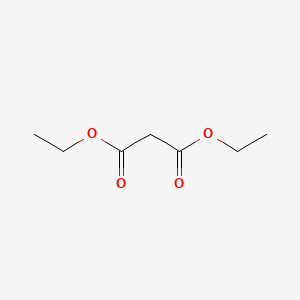
- IUPAC 명칭
- diethyl propanedioate
- 분자식
- C7H12O4
- 분자량
- 160.17 g/mol
- 정확한 질량
- 160.07355886 Da
- XLogP3
- 1.0
- 위상 극성 표면적
- 52.6 Ų
- 수소 결합 공여체
- 0
- 수소 결합 수용체
- 4
- 공유결합 단위
- 1
- 정의된 입체중심
- 0
다른 이름
보고된 명칭 16개 더 보기
외부 데이터베이스 식별자
- ChEBI:CHEBI:167785
- ChEMBL:CHEMBL177114
- EPA DTXSID:DTXSID7021863
- PubMed:23019483
- PubMed:22849645
- PubMed:22592977
- PubMed:22551457
- PubMed:22489113
- PubMed:22347059
- PubMed:22247714
- PubMed:22241067
- PubMed:22169871
- PubMed:22103799
- PubMed:22083389
- PubMed:21999212
추가 과학 데이터베이스의 근거
EMBL-EBI ChEBI
Ethyl malonate
- 처방
- C7H12O4
- 평균 질량
- 160.169 g/mol
- 단일 동위원소 질량
- 160.07356 Da
- 형식 전하
- 0
- dicarboxylic acid — is a (CHEBI:35692)
- dicarboxylic acid — is a (CHEBI:35692)
추가 선별 명칭
이 출처의 상호 참조
- CAS: 105-53-3 — ChemIDplus
- MANUAL_X_REF: 13863636 — ChemSpider
- MANUAL_X_REF: HMDB0029573 — HMDB
매핑 기준: Exact CAS cross-reference in the ChEBI compound record. 가져온 시각: 2026-08-31. 출처 기록 열기
NIH PubChem PUG-View
Attributed physical-property, hazard, environmental and use annotations.
- Autoignition Temperature: 435 °C 출처: ILO-WHO International Chemical Safety Cards (ICSCs)
- Boiling Point: 200 °C 출처: Hazardous Substances Data Bank (HSDB)
- Boiling Point: 199.00 to 200.00 °C. @ 760.00 mm Hg 출처: Human Metabolome Database (HMDB)
- Boiling Point: 199 °C 출처: ILO-WHO International Chemical Safety Cards (ICSCs)
- Boiling Point: 199-200 °C 출처: Joint FAO/WHO Expert Committee on Food Additives (JECFA)
- Boiling Point: 198.9 °C @760 [mm Hg] 출처: PAC Chemical Database, U.S. Department of Energy
- Color/Form: Colorless liquid 출처: Hazardous Substances Data Bank (HSDB)
- Color/Form: Clear, colorless liquid 출처: Hazardous Substances Data Bank (HSDB)
- Density: 1.0551 g/cu cm at 20 °C 출처: Hazardous Substances Data Bank (HSDB)
- Density: Density (at 20 °C): 1.06 g/cm³ 출처: ILO-WHO International Chemical Safety Cards (ICSCs)
- Density: Relative density of the vapour/air-mixture at 20 °C (air = 1): 1.00 출처: ILO-WHO International Chemical Safety Cards (ICSCs)
- Density: 1.053-1.056 출처: Joint FAO/WHO Expert Committee on Food Additives (JECFA)
- Density: 1.055 @ 20°C 출처: PAC Chemical Database, U.S. Department of Energy
- Flash Point: 200 °F (93 °C) (open cup) 출처: Hazardous Substances Data Bank (HSDB)
- Flash Point: 85 °C c.c. 출처: ILO-WHO International Chemical Safety Cards (ICSCs)
- LogP: log Kow = 0.96 출처: Hazardous Substances Data Bank (HSDB)
- LogP: 0.96 출처: Human Metabolome Database (HMDB)
- LogP: 0.96 출처: ILO-WHO International Chemical Safety Cards (ICSCs)
- Melting Point: -50 °C 출처: Hazardous Substances Data Bank (HSDB)
- Melting Point: -50 °C 출처: Human Metabolome Database (HMDB)
- Melting Point: -50 °C 출처: ILO-WHO International Chemical Safety Cards (ICSCs)
- Melting Point: -49.8 °C 출처: PAC Chemical Database, U.S. Department of Energy
- Odor: Sweet ester odor 출처: Hazardous Substances Data Bank (HSDB)
- Odor: Slightly aromatic, pleasant odor 출처: Hazardous Substances Data Bank (HSDB)
- Odor: Aroma of ripe fruit, peach, cut grass 출처: Hazardous Substances Data Bank (HSDB)
- Physical Description: Liquid; Other Solid; Liquid 출처: EPA Chemical Data Reporting (CDR)
- Physical Description: Colorless liquid with a sweet ester odor; [Hawley] 출처: Haz-Map, Information on Hazardous Chemicals and Occupational Diseases
- Physical Description: Liquid 출처: Human Metabolome Database (HMDB)
- Physical Description: COLOURLESS LIQUID. 출처: ILO-WHO International Chemical Safety Cards (ICSCs)
- Physical Description: colourless liquid with slightly fruity odour 출처: Joint FAO/WHO Expert Committee on Food Additives (JECFA)
- Refractive Index: Index of Refraction: 1.4139 at 20 °C 출처: Hazardous Substances Data Bank (HSDB)
- Refractive Index: 1.412-1.416 출처: Joint FAO/WHO Expert Committee on Food Additives (JECFA)
- Solubility: In water, 20 g/L at 20 °C 출처: Hazardous Substances Data Bank (HSDB)
- Solubility: Miscible with ethanol, ether; very soluble in acetone, benzene 출처: Hazardous Substances Data Bank (HSDB)
- Solubility: Soluble in chloroform 출처: Hazardous Substances Data Bank (HSDB)
- Solubility: Soluble in fixed oils, propylene glycol; insoluble in glycerin, mineral oil at 200 °C 출처: Hazardous Substances Data Bank (HSDB)
- Solubility: 23.2 mg/mL at 37 °C 출처: Human Metabolome Database (HMDB)
- Solubility: Solubility in water, g/l at 20 °C: 20 (moderate) 출처: ILO-WHO International Chemical Safety Cards (ICSCs)
- Solubility: soluble in most fixed oils and propylene glycol; slightly soluble in alcohol and water; insoluble in glycine and mineral oil 출처: Joint FAO/WHO Expert Committee on Food Additives (JECFA)
- Solubility: 1 mL in 1.5 mL 60% alcohol (in ethanol) 출처: Joint FAO/WHO Expert Committee on Food Additives (JECFA)
- Vapor Pressure: 0.26 [mmHg] 출처: Haz-Map, Information on Hazardous Chemicals and Occupational Diseases
- Vapor Pressure: 0.19 mm Hg at 25 °C 출처: Hazardous Substances Data Bank (HSDB)
- Vapor Pressure: Vapor pressure, Pa at 25 °C: 36 출처: ILO-WHO International Chemical Safety Cards (ICSCs)
- Vapor Pressure: 1 [mm Hg] @40 °C 출처: PAC Chemical Database, U.S. Department of Energy
- Viscosity: 1.86 centistokes at 25 °C 출처: Hazardous Substances Data Bank (HSDB)
- Note: This chemical does not meet GHS hazard criteria for 2.7% (69 of 2532) of reports. 출처: European Chemicals Agency (ECHA)
- Signal: Warning 출처: European Chemicals Agency (ECHA)
- GHS Hazard Statements: H319 (96.9%): Causes serious eye irritation [Warning Serious eye damage/eye irritation] 출처: European Chemicals Agency (ECHA)
- Precautionary Statement Codes: P264+P265, P280, P305+P351+P338, and P337+P317 (click each P-code to see the statement) 출처: European Chemicals Agency (ECHA)
- ECHA C&L Notifications Summary: Aggregated GHS information provided per 2532 reports by companies from 18 notifications to the ECHA C&L Inventory.; Reported as not meeting GHS hazard criteria per 69 of 2532 reports by companies.; There are 16 notifications provided by 2463 of 2532 reports by companies with hazard statement code(s).; Information may vary between notifications depending on impurities, additives, and other factors. The percentage value in parenthesis indicates the notified classification ratio from companies that provide hazard codes. Only hazard codes with percentage values above 10% are shown. For more detailed information, please visit ECHA C&L website. 출처: European Chemicals Agency (ECHA)
- Signal: Warning 출처: NITE-CMC
- GHS Hazard Statements: H227: Combustible liquid [Warning Flammable liquids]; H319: Causes serious eye irritation [Warning Serious eye damage/eye irritation]; H402: Harmful to aquatic life [Hazardous to the aquatic environment, acute hazard] 출처: NITE-CMC
- Precautionary Statement Codes: P210, P264+P265, P273, P280, P305+P351+P338, P337+P317, P370+P378, P403, and P501 (click each P-code to see the statement) 출처: NITE-CMC
- Signal: Warning 출처: Hazardous Substances Data Bank (HSDB)
- GHS Hazard Statements: H227: Combustible liquid [Warning Flammable liquids]; H402: Harmful to aquatic life [Hazardous to the aquatic environment, acute hazard] 출처: Hazardous Substances Data Bank (HSDB)
- Precautionary Statement Codes: P210, P273, P280, P370+P378, P403, and P501 (click each P-code to see the statement) 출처: Hazardous Substances Data Bank (HSDB)
- NFPA Health Rating: 1 - Materials that, under emergency conditions, can cause significant irritation. 출처: Hazardous Substances Data Bank (HSDB)
- NFPA Fire Rating: 2 - Materials that must be moderately heated or exposed to relatively high ambient temperatures before ignition can occur. Materials would not under normal conditions form hazardous atmospheres with air, but under high ambient temperatures or under moderate heating could release vapor in sufficient quantities to produce hazardous atmospheres with air. 출처: Hazardous Substances Data Bank (HSDB)
- NFPA Instability Rating: 0 - Materials that in themselves are normally stable, even under fire conditions. 출처: Hazardous Substances Data Bank (HSDB)
- Cosmetic Ingredient Review Finding(s): Safe in the present practices of use and concentration. Ingredient, concentration, and use information are available in documents discoverable at https://cir-reports.cir-safety.org 출처: Cosmetic Ingredient Review (CIR)
- Toxicity Summary: IDENTIFICATION AND USE: Diethyl malonate is used in chemical synthesis. It is also used in food, beverages, and in fragrances. HUMAN STUDIES: A maximization test was reported in 23 volunteers. 4% of the test substance in petrolatum produced no sensitization reactions. Tested at 4% in petrolatum it produced no irritation after a 48-hr closed-patch test on human subjects. ANIMAL STUDIES: Diethyl malonate causes moderate irritation to rabbit's eyes and is non-irritating to rabbit's skin. Application of 0.005 mL of undiluted diethyl malonate to the rabbit cornea caused severe burning. Diethyl malonate fed to rats for 90 days at more than 100 times the equivalent of the human daily dietary intake (averaging 35.93 mg/kg bw per day for males and 41.14 mg/kg bw per day for females) had no adverse effects. The maximum time for inhalation of the concentrated vapor of diethyl malonate by rats without deaths was found to be 8 hr. Mutagenicity test in Salmonella typhimurium TA98, TA 100, TA 1535, TA 1537, TA 1538 was negative with and without activation at concentrations of 8, 40, 200, 1000, 5000 ug/plate 5000 ug/plate (maximal concentration). 출처: Hazardous Substances Data Bank (HSDB)
- Environmental Bioconcentration: An estimated BCF of 3 was calculated in fish for diethyl malonate(SRC), using a log Kow of 0.96(1) and a regression-derived equation(2). According to a classification scheme(3), this BCF suggests the potential for bioconcentration in aquatic organisms is low(SRC). 출처: Hazardous Substances Data Bank (HSDB)
- Environmental Fate: TERRESTRIAL FATE: Based on a classification scheme(1), an estimated Koc value of 10(SRC), determined from a structure estimation method(2), indicates that diethyl malonate is expected to have very high mobility in soil(SRC). Volatilization of diethyl malonate from moist soil surfaces may occur(SRC) given an estimated Henry's Law constant of 2.0X10⁻⁶ atm-cu m/mole(SRC), derived from its vapor pressure, 0.19 mm Hg(3), and water solubility, 2.0X10+4 mg/L(4). In chemical stimulant studies simulating chemical warfare agents, diethyl malonate deposited to dry soil and foliar surfaces was rapidly lost through volatilization processes with observed half-lives on soil of about 2 hours (fast) to 5-16 hours (residual material)(4); foliar half-lives ranged from 1 to 242 hours(5). Two screening studies found diethyl malonate to be readily biodegradable(6,7). An 86% of theoretical BOD in two weeks using activated sludge in the Japanese MITI test(6) suggests that biodegradation is an important environmental fate process in soil(SRC). 출처: Hazardous Substances Data Bank (HSDB)
- Environmental Fate: AQUATIC FATE: Based on a classification scheme(1), an estimated Koc value of 10(SRC), determined from a structure estimation method(2), indicates that diethyl malonate is not expected to adsorb to suspended solids and sediment(SRC). Volatilization from water surfaces is expected(3) based upon an estimated Henry's Law constant of 2.0X10⁻⁶ atm-cu m/mole(SRC), derived from its vapor pressure, 0.19 mm Hg(4), and water solubility, 2.0X10+4 mg/L(5). Using this Henry's Law constant and an estimation method(3), volatilization half-lives for a model river and model lake are 23 and 173 days, respectively(SRC). According to a classification scheme(6), an estimated BCF of 3(SRC), from its log Kow of 0.96(7) and a regression-derived equation(2), suggests the potential for bioconcentration in aquatic organisms is low(SRC). Two screening studies found diethyl malonate to be readily biodegradable(8,9). An 86% of theoretical BOD in two weeks using activated sludge in the Japanese MITI test(8) suggests that biodegradation is an important environmental fate process in water(SRC). Diethyl malonate hydrolyzes readily in neutral and alkaline water, but slowly in acidic water(10). Respective hydrolysis h 출처: Hazardous Substances Data Bank (HSDB)
- Environmental Fate: ATMOSPHERIC FATE: According to a model of gas/particle partitioning of semivolatile organic compounds in the atmosphere(1), diethyl malonate, which has a vapor pressure of 0.19 mm Hg at 25 °C(2), is expected to exist solely as a vapor in the ambient atmosphere. Vapor-phase diethyl malonate is degraded in the atmosphere by reaction with photochemically-produced hydroxyl radicals(SRC); the half-life for this reaction in air is estimated to be 3.1 days(SRC), calculated from its rate constant of 3.4X10⁻¹² cu cm/molecule-sec at 25 °C(SRC) that was derived using a structure estimation method(3). Diethyl malonate contains chromophores that absorb at wavelengths >290 nm(4) and, therefore, may be susceptible to direct photolysis by sunlight(SRC). 출처: Hazardous Substances Data Bank (HSDB)
- Consumer Uses: Chemical reaction regulator; Fragrance 출처: EPA Chemical Data Reporting (CDR)
- Industry Uses: Processing aids not otherwise specified; Chemical reaction regulator; Flavoring and nutrient; Intermediate; Fragrance 출처: EPA Chemical Data Reporting (CDR)
- Cosmetic Ingredient Review Link: CIR ingredient: Diethyl Malonate 출처: Cosmetic Ingredient Review (CIR)
- Sources/Uses: Used to make barbiturates and pigments and as a flavoring; [Hawley] Used to make agrochemicals and industrial chemicals; [eChemPortal: SIDSUNEP] 출처: Haz-Map, Information on Hazardous Chemicals and Occupational Diseases
- Uses: Dimethyl and diethyl malonates are widely used for the production of vitamins, pharmaceuticals, agrochemicals, fragrances, and dyes. 출처: Hazardous Substances Data Bank (HSDB)
- Uses: Manufacture of barbiturates. 출처: Hazardous Substances Data Bank (HSDB)
- Uses: Table: Reported uses (ppm): [Table#8510] 출처: Hazardous Substances Data Bank (HSDB)
- Uses: Diethyl malonate was used to investigate Knoevenagel condensation reactions in microreactor using zeolite catalysts obtained by grafting amino groups onto NaX and CsNaX zeolites. It may be used in the synthesis of diethyl benzylidenemalonate by base catalyzed Knoevenagel condensation with benzaldehyde. It may be used in the synthesis of a-aryl malonates 출처: Hazardous Substances Data Bank (HSDB)
- Uses: Table: Concentration in final product (%) [Table#8511] 출처: Hazardous Substances Data Bank (HSDB)
매핑 기준: Existing checksum-valid CAS to unique PubChem CID match. 가져온 시각: 2026-08-31. 출처 기록 열기
과학적 분류와 유해성 주석은 맥락을 제공할 뿐이며, 위에 표시된 시장별 규제 판단을 대체하지 않습니다.
추가 출처 적용 범위 및 일치 상태
| 출처 | 결과 | 확인됨 |
|---|---|---|
| EMBL-EBI ChEBI | 정확히 일치 | 2026-08-31 |
| NIH PubChem PUG-View | 정확히 일치 | 2026-08-31 |
기록된 불일치는 출처를 확인했다는 유용한 근거이며, 해당 물질이 다른 곳에 존재하지 않는다는 주장이 아닙니다.
체크섬이 유효한 CAS 일치를 통해 2026-08-31에 NIH PubChem에서 가져왔습니다. 화학적 특성은 이 페이지의 규제 판단을 대체하지 않습니다.
공식 EU 원료 명칭 근거
이 원료 명칭은 공식 2025 EU 일반 원료 명칭 용어집과 정확히 일치합니다.
관련 목록 근거
처방 기능이 겹치는 원료
추가 공식 및 과학 출처
이 정체를 확인할 외부 데이터베이스 11개
각 링크는 해당 출처에서 이 정체를 검색합니다. 각 출처의 성격과 법적 비중
CosIng 목록에서 DIETHYL MALONATE이(가) 나타나는 방식
CosIng 목록은 DIETHYL MALONATE을(를) 화장품 원료로 나열하며, 이 페이지는 이를 부속서 기록 0건과 연결합니다. 목록 항목은 명칭과 식별자를 담고 있으며, 부속서 기록은 해당 물질이 EU 화장품 법령에서 사용금지, 사용제한 또는 허용 목록(포지티브 리스트)에 있는 위치를 보여 줍니다.
DIETHYL MALONATE은(는) 공식 데이터에서 화장품 기능 1개로도 태그되어 있습니다. 기능 표시는 의도된 용도를 설명하지만, 처방 또는 표시 작업 전에 연결된 부속서 기록에 대한 규제 검토를 대체하지 않습니다.