
METHYL LAURATE
Methyl laurate
METHYL LAURATE은(는) EU CosIng 목록에 등재되어 있지만, 이 페이지에는 아직 직접 연결된 부속서 기록이 없습니다.
시장별 규제 근거
여기에서 추적하는 시장 13곳 중 어느 곳에도 이 원료의 규칙이 가져와지지 않았습니다.
이는 이 목록에 관한 설명이지 법에 관한 설명이 아닙니다. 가져온 규칙이 없다는 것이 원료가 허용된다는 근거는 아닙니다. 규칙은 다른 명칭이나 식별자로, 또는 아직 이곳에 가져오지 않은 데이터세트에 존재할 수 있습니다.
METHYL LAURATE의 목록 세부 정보
INCI 명칭
METHYL LAURATE
설명
Methyl laurate
METHYL LAURATE의 부속서 기록
주요 데이터
- PERFUMING
Used for perfume and aromatic raw materials.
- SKIN CONDITIONING
Maintaining the skin in good condition.
- SKIN CONDITIONING - EMOLLIENT
Acting as lubricants on the skin surface providing the skin with a soft and smooth appearance.
화학적 정체 및 특성
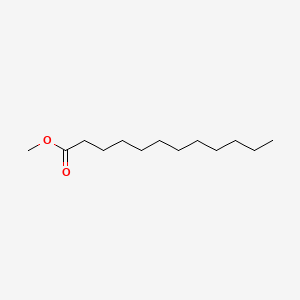
Methyl Laurate
Methyl laurate is a fatty acid methyl ester of lauric acid. It has a role as a metabolite. It is a fatty acid methyl ester and a dodecanoate ester. — ChEBI
- IUPAC 명칭
- methyl dodecanoate
- 분자식
- C13H26O2
- 분자량
- 214.34 g/mol
- 정확한 질량
- 214.193280068 Da
- XLogP3
- 5.8
- 위상 극성 표면적
- 26.3 Ų
- 수소 결합 공여체
- 0
- 수소 결합 수용체
- 2
- 공유결합 단위
- 1
- 정의된 입체중심
- 0
다른 이름
보고된 명칭 16개 더 보기
외부 데이터베이스 식별자
- ChEBI:CHEBI:87494
- ChEMBL:CHEMBL1894365
- EPA DTXSID:DTXSID5026889
- PubMed:27633901
- PubMed:22975784
- PubMed:22885112
- PubMed:22649385
- PubMed:22238638
- PubMed:22163873
- PubMed:21057946
- PubMed:20129777
- PubMed:20104349
- PubMed:19876644
- PubMed:19572886
- PubMed:18788736
추가 과학 데이터베이스의 근거
NIH PubChem PUG-View
Attributed physical-property, hazard, environmental and use annotations.
- Boiling Point: 267 °C 출처: Hazardous Substances Data Bank (HSDB)
- Boiling Point: 148.00 °C. @ 18.00 mm Hg 출처: Human Metabolome Database (HMDB)
- Boiling Point: 261-262 °C 출처: Joint FAO/WHO Expert Committee on Food Additives (JECFA)
- Color/Form: COLORLESS LIQUID 출처: Hazardous Substances Data Bank (HSDB)
- Color/Form: Water-white liquid 출처: Hazardous Substances Data Bank (HSDB)
- Density: 0.8702 @ 20 °C/4 °C 출처: Hazardous Substances Data Bank (HSDB)
- Density: 0.863-0.872 출처: Joint FAO/WHO Expert Committee on Food Additives (JECFA)
- LogP: log Kow= 5.41 출처: Hazardous Substances Data Bank (HSDB)
- LogP: 5.41 출처: Human Metabolome Database (HMDB)
- Melting Point: 5.2 °C 출처: Hazardous Substances Data Bank (HSDB)
- Melting Point: 5 °C 출처: Human Metabolome Database (HMDB)
- Odor: FATTY, FLORAL ODOR REMINISCENT OF WINE 출처: Hazardous Substances Data Bank (HSDB)
- Odor: OILY, WINEY, FATTY ODOR 출처: Hazardous Substances Data Bank (HSDB)
- Physical Description: Liquid; Dry Powder; Liquid; CBI 출처: EPA Chemical Data Reporting (CDR)
- Physical Description: Water-white liquid; mp = 4.8 deg C; [Hawley] Colorless liquid; [MSDSonline] 출처: Haz-Map, Information on Hazardous Chemicals and Occupational Diseases
- Physical Description: Liquid 출처: Human Metabolome Database (HMDB)
- Physical Description: colourless to pale yellow liquid with a fatty, floral, winey odour 출처: Joint FAO/WHO Expert Committee on Food Additives (JECFA)
- Refractive Index: Index of refraction: 1.4301 @ 25 °C/D 출처: Hazardous Substances Data Bank (HSDB)
- Refractive Index: index of refraction: 1.4319 @ 20 °C/D 출처: Hazardous Substances Data Bank (HSDB)
- Refractive Index: 1.430-1.438 출처: Joint FAO/WHO Expert Committee on Food Additives (JECFA)
- Solubility: Insol in water; miscible with ethyl alcohol, ether, acetone 출처: Hazardous Substances Data Bank (HSDB)
- Solubility: SOL IN MOST COMMON ORGANIC SOLVENTS 출처: Hazardous Substances Data Bank (HSDB)
- Solubility: soluble in most organic solvents; insoluble in water 출처: Joint FAO/WHO Expert Committee on Food Additives (JECFA)
- Solubility: (in ethanol) 출처: Joint FAO/WHO Expert Committee on Food Additives (JECFA)
- Vapor Pressure: 0.00411 [mmHg] 출처: Haz-Map, Information on Hazardous Chemicals and Occupational Diseases
- Vapor Pressure: 4.11X10⁻³ mm Hg @ 25 °C 출처: Hazardous Substances Data Bank (HSDB)
- Carcinogen Classification: No indication of carcinogenicity to humans (not listed by IARC). 출처: Toxin and Toxin Target Database (T3DB)
- Note: This chemical does not meet GHS hazard criteria for 12.2% (52 of 426) of reports. 출처: European Chemicals Agency (ECHA)
- Signal: Warning 출처: European Chemicals Agency (ECHA)
- GHS Hazard Statements: H400 (74.6%): Very toxic to aquatic life [Warning Hazardous to the aquatic environment, acute hazard]; H411 (65.5%): Toxic to aquatic life with long lasting effects [Hazardous to the aquatic environment, long-term hazard] 출처: European Chemicals Agency (ECHA)
- Precautionary Statement Codes: P273, P391, and P501 (click each P-code to see the statement) 출처: European Chemicals Agency (ECHA)
- ECHA C&L Notifications Summary: Aggregated GHS information provided per 426 reports by companies from 10 notifications to the ECHA C&L Inventory. Each notification may be associated with multiple companies.; Reported as not meeting GHS hazard criteria per 52 of 426 reports by companies.; There are 9 notifications provided by 374 of 426 reports by companies with hazard statement code(s).; Information may vary between notifications depending on impurities, additives, and other factors. The percentage value in parenthesis indicates the notified classification ratio from companies that provide hazard codes. Only hazard codes with percentage values above 10% are shown. For more detailed information, please visit ECHA C&L website. 출처: European Chemicals Agency (ECHA)
- Signal: Warning 출처: NITE-CMC
- GHS Hazard Statements: H400: Very toxic to aquatic life [Warning Hazardous to the aquatic environment, acute hazard]; H410: Very toxic to aquatic life with long lasting effects [Warning Hazardous to the aquatic environment, long-term hazard] 출처: NITE-CMC
- Precautionary Statement Codes: P273, P391, and P501 (click each P-code to see the statement) 출처: NITE-CMC
- GHS Hazard Statements: H336: May cause drowsiness or dizziness [Warning Specific target organ toxicity, single exposure; Narcotic effects]; H400: Very toxic to aquatic life [Warning Hazardous to the aquatic environment, acute hazard]; H410: Very toxic to aquatic life with long lasting effects [Warning Hazardous to the aquatic environment, long-term hazard] 출처: NITE-CMC
- Precautionary Statement Codes: P261, P271, P273, P304+P340, P319, P391, P403+P233, P405, and P501 (click each P-code to see the statement) 출처: NITE-CMC
- GHS Hazard Statements: H315: Causes skin irritation [Warning Skin corrosion/irritation]; H320: Causes eye irritation [Warning Serious eye damage/eye irritation]; H336: May cause drowsiness or dizziness [Warning Specific target organ toxicity, single exposure; Narcotic effects]; H400: Very toxic to aquatic life [Warning Hazardous to the aquatic environment, acute hazard]; H411: Toxic to aquatic life with long lasting effects [Hazardous to the aquatic environment, long-term hazard] 출처: NITE-CMC
- Precautionary Statement Codes: P261, P264, P264+P265, P271, P273, P280, P302+P352, P304+P340, P305+P351+P338, P319, P321, P332+P317, P337+P317, P362+P364, P391, P403+P233, P405, and P501 (click each P-code to see the statement) 출처: NITE-CMC
- Environmental Bioconcentration: An estimated BCF of 290 was calculated for methyl dodecanoate(SRC) using a log Kow of 5.41(1) and a regression-derived equation(2). According to a classification scheme(3), the estimated BCF suggests the potential for bioconcentration in aquatic organisms is high. However, bioconcentration studies on compounds which are structurally similar(4,5) suggests that bioconcentration may be lower than that indicated by the regression-derived equation due to the ability of aquatic organisms to readily metabolize this class of compounds(SRC). 출처: Hazardous Substances Data Bank (HSDB)
- Environmental Fate: TERRESTRIAL FATE: Based on a classification scheme(1), an estimated Koc value of 1,600(SRC), determined from a structure estimation method(2), indicates that methyl dodecanoate is expected to be immobile in soil(SRC). Volatilization of methyl dodecanoate from moist soil surfaces is expected to be an important fate process(SRC) given an estimated Henry's Law constant of 0.003 atm-cu m/mole(SRC), using a fragment constant estimation method(3). However, adsorption to soil is expected to attenuate volatilization(SRC). Methyl dodecanoate is not expected to volatilize from dry soil surfaces(SRC) based upon a vapor pressure of 0.004 mm Hg(4). Methyl dodecanoate is expected to rapidly biodegrade in aerobic soils by analogy to structurally similar long-chain fatty acid esters(5-7). 출처: Hazardous Substances Data Bank (HSDB)
- Environmental Fate: AQUATIC FATE: Based on a classification scheme(1), an estimated Koc value of 1,600(SRC), determined from a structure estimation method(2), indicates that methyl dodecanoate is expected to adsorb to suspended solids and sediment in water(SRC). Volatilization from water surfaces is expected(3) based upon an estimated Henry's Law constant of 0.003 atm-cu m/mole(SRC), developed using a fragment constant estimation method(4). Volatilization half-lives for a model river and model lake are 5 hours and 6 days, respectively(SRC), using an estimation method(3). However, volatilization from water surfaces is expected to be attenuated by adsorption to suspended solids and sediment in the water column(SRC). The volatilization half-life from a model pond is estimated to be about 56 hours ignoring adsorption; when considering maximum adsorption the volatilization half-life increases to 14 days(5). According to a classification scheme(6), an estimated BCF of 290(SRC) from its log Kow of 5.41(12) and a regression-derived equation(7), suggests the potential for bioconcentration in aquatic organisms is high although it may be lower than that indicated due to the expected rapid metabolism rate for thi 출처: Hazardous Substances Data Bank (HSDB)
- Environmental Fate: ATMOSPHERIC FATE: According to a model of gas/particle partitioning of semivolatile organic compounds in the atmosphere(1), methyl dodecanoate, which has a vapor pressure of 0.0041 mm Hg at 25 °C(2), will exist in solely as a vapor in the ambient atmosphere. Vapor-phase methyl dodecanoate is degraded in the atmosphere by reaction with photochemically-produced hydroxyl radicals(SRC); the half-life for this reaction in air is estimated to be 29 hours(SRC) from its estimated rate constant of 1.3X10⁻¹¹ cu cm/molecule-sec at 25 °C(3). 출처: Hazardous Substances Data Bank (HSDB)
- Consumer Uses: Binder; Softener and conditioner; Not Known or Reasonably Ascertainable; Emulsifier 출처: EPA Chemical Data Reporting (CDR)
- Industry Uses: Lubricating agent; Binder; Other; Solvent; Softener and conditioner; Intermediate; Emulsifier; Not Known or Reasonably Ascertainable 출처: EPA Chemical Data Reporting (CDR)
- Sources/Uses: Made from coconut oil; [Hawley] Used as a flavoring agent and as an intermediate for detergents, emulsifiers, wetting agents, stabilizers, lubricants, plasticizers, textiles, alkanolamides, fatty alcohols, and acids; [HSDB] 출처: Haz-Map, Information on Hazardous Chemicals and Occupational Diseases
- Uses: Intermediate for detergents, emulsifiers, wetting agents, stabilizers, lubricants, plasticizers, textiles, flavoring 출처: Hazardous Substances Data Bank (HSDB)
- Uses: CHEM INT-EG, FOR ALKANOLAMIDES, FATTY ALCOHOLS & ACIDS 출처: Hazardous Substances Data Bank (HSDB)
- Uses: FLAVORING AGENT, EG, IN BAKED GOODS & ICE CREAM 출처: Hazardous Substances Data Bank (HSDB)
매핑 기준: Existing checksum-valid CAS to unique PubChem CID match. 가져온 시각: 2026-08-31. 출처 기록 열기
과학적 분류와 유해성 주석은 맥락을 제공할 뿐이며, 위에 표시된 시장별 규제 판단을 대체하지 않습니다.
추가 출처 적용 범위 및 일치 상태
| 출처 | 결과 | 확인됨 |
|---|---|---|
| NIH PubChem PUG-View | 정확히 일치 | 2026-08-31 |
기록된 불일치는 출처를 확인했다는 유용한 근거이며, 해당 물질이 다른 곳에 존재하지 않는다는 주장이 아닙니다.
체크섬이 유효한 CAS 일치를 통해 2026-08-31에 NIH PubChem에서 가져왔습니다. 화학적 특성은 이 페이지의 규제 판단을 대체하지 않습니다.
공식 EU 원료 명칭 근거
이 원료 명칭은 공식 2025 EU 일반 원료 명칭 용어집과 정확히 일치합니다.
관련 목록 근거
처방 기능이 겹치는 원료
추가 공식 및 과학 출처
이 정체를 확인할 외부 데이터베이스 11개
각 링크는 해당 출처에서 이 정체를 검색합니다. 각 출처의 성격과 법적 비중
CosIng 목록에서 METHYL LAURATE이(가) 나타나는 방식
CosIng 목록은 METHYL LAURATE을(를) 화장품 원료로 나열하며, 이 페이지는 이를 부속서 기록 0건과 연결합니다. 목록 항목은 명칭과 식별자를 담고 있으며, 부속서 기록은 해당 물질이 EU 화장품 법령에서 사용금지, 사용제한 또는 허용 목록(포지티브 리스트)에 있는 위치를 보여 줍니다.
METHYL LAURATE은(는) 공식 데이터에서 화장품 기능 3개로도 태그되어 있습니다. 기능 표시는 의도된 용도를 설명하지만, 처방 또는 표시 작업 전에 연결된 부속서 기록에 대한 규제 검토를 대체하지 않습니다.