
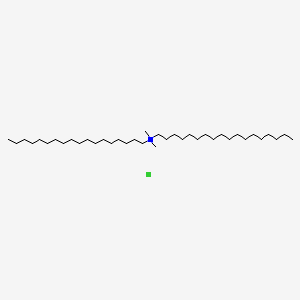
CAS 107-64-2PubChem CID 7879
Distearyldimethylammonium chloride
- IUPAC 명칭
- dimethyl(dioctadecyl)azanium chloride
- 분자식
- C38H80ClN
- 분자량
- 586.5 g/mol
- 정확한 질량
- 585.5979293 Da
- 위상 극성 표면적
- 0.0 Ų
- 수소 결합 공여체
- 0
- 수소 결합 수용체
- 1
- 공유결합 단위
- 2
- 정의된 입체중심
- 0
다른 이름
DIMETHYLDIOCTADECYLAMMONIUM CHLORIDEDimethyldistearylammonium chlorideVarisoft 100Aliquat 207Quaternium-5Surfroyal DSACCation DSGenamin DSAC
보고된 명칭 16개 더 보기
Quartamin D 86Quartamin DM 86PArosurf TA 100Arquad R 40Dehyquart DAMQuaternium 5Sokalan 9200Adogen TA 100Dioctadecyldimethylammonium chlorideCedequat TD 75Varisoft TA 100DODA(Cl)Kemamine Q 9702CLPAmmonyx 2200P100KD 83Dimethyl dioctadecyl ammonium chloride
외부 데이터베이스 식별자
- EPA DTXSID:DTXSID8026771
추가 과학 데이터베이스의 근거
NIH PubChem PUG-View
식별자 정확히 일치7879
Attributed physical-property, hazard, environmental and use annotations.
- Color/Form: Powder 출처: Hazardous Substances Data Bank (HSDB)
- Density: Density (at 88 °C): 0.84 g/cm³ 출처: ILO-WHO International Chemical Safety Cards (ICSCs)
- LogP: log Kow= 3.80 출처: Hazardous Substances Data Bank (HSDB)
- Physical Description: Solid; [ICSC] Faintly beige flakes; [MSDSonline] 출처: Haz-Map, Information on Hazardous Chemicals and Occupational Diseases
- Physical Description: POWDER. 출처: ILO-WHO International Chemical Safety Cards (ICSCs)
- Solubility: Virtually insoluble in water. 출처: Hazardous Substances Data Bank (HSDB)
- Solubility: Solubility in water: none 출처: ILO-WHO International Chemical Safety Cards (ICSCs)
- Vapor Pressure: Vapor pressure, Pa at 25 °C: 출처: ILO-WHO International Chemical Safety Cards (ICSCs)
- Signal: Danger 출처: Regulation (EC) No 1272/2008 of the European Parliament and of the Council
- GHS Hazard Statements: H318: Causes serious eye damage [Danger Serious eye damage/eye irritation]; H400: Very toxic to aquatic life [Warning Hazardous to the aquatic environment, acute hazard]; H410: Very toxic to aquatic life with long lasting effects [Warning Hazardous to the aquatic environment, long-term hazard] 출처: Regulation (EC) No 1272/2008 of the European Parliament and of the Council
- Precautionary Statement Codes: P264+P265, P273, P280, P305+P354+P338, P317, P391, and P501 (click each P-code to see the statement) 출처: Regulation (EC) No 1272/2008 of the European Parliament and of the Council
- Signal: Danger 출처: European Chemicals Agency (ECHA)
- GHS Hazard Statements: H318 (100%): Causes serious eye damage [Danger Serious eye damage/eye irritation]; H400 (100%): Very toxic to aquatic life [Warning Hazardous to the aquatic environment, acute hazard]; H410 (100%): Very toxic to aquatic life with long lasting effects [Warning Hazardous to the aquatic environment, long-term hazard] 출처: European Chemicals Agency (ECHA)
- Precautionary Statement Codes: P264+P265, P273, P280, P305+P354+P338, P317, P391, and P501 (click each P-code to see the statement) 출처: European Chemicals Agency (ECHA)
- ECHA C&L Notifications Summary: Aggregated GHS information provided per 219 reports by companies from 5 notifications to the ECHA C&L Inventory. Each notification may be associated with multiple companies.; Information may vary between notifications depending on impurities, additives, and other factors. The percentage value in parenthesis indicates the notified classification ratio from companies that provide hazard codes. Only hazard codes with percentage values above 10% are shown. For more detailed information, please visit ECHA C&L website. 출처: European Chemicals Agency (ECHA)
- Signal: Danger 출처: NITE-CMC
- GHS Hazard Statements: H315: Causes skin irritation [Warning Skin corrosion/irritation]; H318: Causes serious eye damage [Danger Serious eye damage/eye irritation]; H361: Suspected of damaging fertility or the unborn child [Warning Reproductive toxicity]; H400: Very toxic to aquatic life [Warning Hazardous to the aquatic environment, acute hazard]; H410: Very toxic to aquatic life with long lasting effects [Warning Hazardous to the aquatic environment, long-term hazard] 출처: NITE-CMC
- Precautionary Statement Codes: P203, P264, P264+P265, P273, P280, P302+P352, P305+P354+P338, P317, P318, P321, P332+P317, P362+P364, P391, P405, and P501 (click each P-code to see the statement) 출처: NITE-CMC
- GHS Hazard Statements: Not Classified 출처: NITE-CMC
- Signal: Danger 출처: Hazardous Chemical Information System (HCIS), Safe Work Australia
- Environmental Bioconcentration: An estimated BCF of 71 was calculated for dimethyldioctadecylammonium chloride(SRC), using a log Kow of 3.80(1) and a regression-derived equation(2). According to a classification scheme(3), this BCF suggests the potential for bioconcentration in aquatic organisms is low. 출처: Hazardous Substances Data Bank (HSDB)
- Environmental Fate: TERRESTRIAL FATE: Based on a classification scheme(1), an estimated Koc value of 1X10+10(SRC), determined from a log Kow of 3.80(2) and a regression-derived equation(3), indicates that dimethyldioctadecylammonium chloride is expected to be immobile in soil(SRC). Volatilization of dimethyldioctadecylammonium chloride from moist soil surfaces is not expected to be an important fate process(SRC) given an estimated Henry's Law constant of 6.4X10⁻⁸ atm-cu m/mole(SRC), using a fragment constant estimation method(4). Dimethyldioctadecylammonium chloride is not expected to volatilize from dry soil surfaces(SRC) based upon an estimated vapor pressure of 2.6X10⁻¹⁷ mm Hg(SRC), determined from a fragment constant method(5). In an OECD screening test, at a 2.5 mg/l concentration, dimethyldioctadecylammonium chloride degradation reaches over 90% in 2-4 days and at 10 mg/l concentration, a Zahn-Wellen test found degradation is nearly complete in 10 days(2). 출처: Hazardous Substances Data Bank (HSDB)
- Environmental Fate: AQUATIC FATE: Based on a classification scheme(1), an estimated Koc value of 1X10+10(SRC), determined from a log Kow of 3.80(2) and a regression-derived equation(3), indicates that dimethyldioctadecylammonium chloride is expected to adsorb to suspended solids and sediment in water(SRC). Volatilization from water surfaces is not expected(3) based upon an estimated Henry's Law constant of 6.4X10⁻⁸ atm-cu m/mole(SRC), developed using a fragment constant estimation method(4). According to a classification scheme(5), an estimated BCF of 71(SRC), from a log Kow(2) and a regression-derived equation(6), suggests the potential for bioconcentration in aquatic organisms is moderate. Dimethyldioctadecylammonium chloride biodegradation in river water is found to take place in 4.9-13.8 days(7,8), and an OECD and Zahn-Wellens screening test found degradation takes place in 2-10 days(2). 출처: Hazardous Substances Data Bank (HSDB)
- Environmental Fate: ATMOSPHERIC FATE: According to a model of gas/particle partitioning of semivolatile organic compounds in the atmosphere(1), dimethyldioctadecylammonium chloride, which has an estimated vapor pressure of 2.6X10⁻¹⁷ mm Hg at 25 °C(SRC), using a fragment constant estimation method(2), is expected to exist solely in the particulate phase. Particulate-phase dimethyldioctadecylammonium chloride may be removed from the air by wet and dry deposition(SRC). 출처: Hazardous Substances Data Bank (HSDB)
- Sources/Uses: Used as fabric softener (retail, commercial, and textile mills), surfactant (i.e. hair rinses and cosmetics), and flocculating agent; [HSDB] Used in Germany to activate organic clays (bentonites); [eChemPortal: SIDSUNEP] 출처: Haz-Map, Information on Hazardous Chemicals and Occupational Diseases
- Industrial Processes with risk of exposure: Textiles (Printing, Dyeing, or Finishing) [Category: Industry]; Dressing Hair [Category: Other] 출처: Haz-Map, Information on Hazardous Chemicals and Occupational Diseases
- Uses: SURFACTANT; LAUNDRY SOFTENER 출처: Hazardous Substances Data Bank (HSDB)
- Uses: IN HAIR RINSE FORMULATIONS 출처: Hazardous Substances Data Bank (HSDB)
- Uses: FABRIC SOFTENER FOR RETAIL, COMMERCIAL & TEXTILE MILLS 출처: Hazardous Substances Data Bank (HSDB)
- Uses: CATIONIC SURFACTANT IN COSMETIC PRODUCTS-EG, CREME RINSES 출처: Hazardous Substances Data Bank (HSDB)
- Uses: For more Uses (Complete) data for DIMETHYLDIOCTADECYLAMMONIUM CHLORIDE (6 total), please visit the HSDB record page. 출처: Hazardous Substances Data Bank (HSDB)
매핑 기준: Existing checksum-valid CAS to unique PubChem CID match. 가져온 시각: 2026-08-31. 출처 기록 열기
과학적 분류와 유해성 주석은 맥락을 제공할 뿐이며, 위에 표시된 시장별 규제 판단을 대체하지 않습니다.
추가 출처 적용 범위 및 일치 상태
| 출처 | 결과 | 확인됨 |
|---|---|---|
| EMBL-EBI ChEBI | 정확히 일치하는 기록 없음 | 2026-08-31 |
| NIH PubChem PUG-View | 정확히 일치 | 2026-08-31 |
기록된 불일치는 출처를 확인했다는 유용한 근거이며, 해당 물질이 다른 곳에 존재하지 않는다는 주장이 아닙니다.
체크섬이 유효한 CAS 일치를 통해 2026-08-31에 NIH PubChem에서 가져왔습니다. 화학적 특성은 이 페이지의 규제 판단을 대체하지 않습니다.