
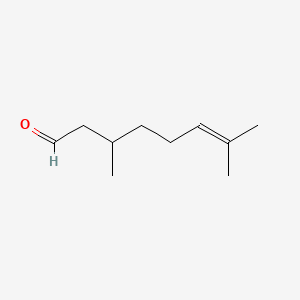
Citronellal
Citronellal is a monoterpenoid, the main component of citronella oil which gives it its distinctive lemon aroma. It has a role as a metabolite and an antifungal agent. It is an aldehyde and a monoterpenoid. — ChEBI
- IUPAC 명칭
- 3,7-dimethyloct-6-enal
- 분자식
- C10H18O
- 분자량
- 154.25 g/mol
- 정확한 질량
- 154.135765193 Da
- XLogP3
- 3.0
- 위상 극성 표면적
- 17.1 Ų
- 수소 결합 공여체
- 0
- 수소 결합 수용체
- 1
- 공유결합 단위
- 1
- 정의된 입체중심
- 0
다른 이름
보고된 명칭 16개 더 보기
외부 데이터베이스 식별자
- ChEBI:CHEBI:47856
- ChEMBL:CHEMBL447944
- EPA DTXSID:DTXSID3041790
- PubMed:34813134
- PubMed:29844252
- PubMed:29445768
- PubMed:29248742
- PubMed:29070885
- PubMed:28954074
- PubMed:27607409
- PubMed:27569025
- PubMed:27038267
- PubMed:26447139
- PubMed:25827167
- PubMed:25513961
추가 과학 데이터베이스의 근거
EMBL-EBI ChEBI
citronellal
A monoterpenoid, the main component of citronella oil which gives it its distinctive lemon aroma.
- 처방
- C10H18O
- 평균 질량
- 154.253 g/mol
- 단일 동위원소 질량
- 154.13577 Da
- 형식 전하
- 0
- monoterpenoid — is a (CHEBI:25409)
- aldehyde — is a (CHEBI:17478)
- metabolite — has role (CHEBI:25212)
- antifungal agent — has role (CHEBI:35718)
- metabolite — has role (CHEBI:25212)
- antifungal agent — has role (CHEBI:35718)
- monoterpenoid — is a (CHEBI:25409)
- aldehyde — is a (CHEBI:17478)
추가 선별 명칭
이 출처의 상호 참조
- CAS: 106-23-0 — NIST Chemistry WebBook
- CAS: 106-23-0 — ChemIDplus
- CAS: 106-23-0 — KEGG COMPOUND
- REGISTRY_NUMBER: 1209447 — Beilstein
- REGISTRY_NUMBER: 1521962 — Gmelin
- REGISTRY_NUMBER: 1720789 — Beilstein
- MANUAL_X_REF: C17384 — KEGG COMPOUND
- MANUAL_X_REF: Citronellal — Wikipedia
매핑 기준: Exact CAS cross-reference in the ChEBI compound record. 출처 업데이트: 2019-08-19. 가져온 시각: 2026-08-31. 출처 기록 열기
NIH PubChem PUG-View
Attributed physical-property, hazard, environmental and use annotations.
- Boiling Point: 205 °C 출처: Hazardous Substances Data Bank (HSDB)
- Boiling Point: 206.00 to 207.00 °C. @ 760.00 mm Hg 출처: Human Metabolome Database (HMDB)
- Boiling Point: 206 °C 출처: Joint FAO/WHO Expert Committee on Food Additives (JECFA)
- Color/Form: Needles or orthorhombic crystals 출처: Hazardous Substances Data Bank (HSDB)
- Color/Form: Colorless to slightly yellow liquid 출처: Hazardous Substances Data Bank (HSDB)
- Density: 0.853 g/cu cm at 20 °C 출처: Hazardous Substances Data Bank (HSDB)
- Density: 0.850-0.860 출처: Joint FAO/WHO Expert Committee on Food Additives (JECFA)
- Flash Point: 165 °F (74 °C) (CLOSED CUP) 출처: Hazardous Substances Data Bank (HSDB)
- Melting Point: 147 °C 출처: Hazardous Substances Data Bank (HSDB)
- Odor: Intense lemon-citronella-rose odor 출처: Hazardous Substances Data Bank (HSDB)
- Physical Description: Liquid 출처: EPA Chemical Data Reporting (CDR)
- Physical Description: Colorless to slightly yellow liquid with a strong flowery lemon odor; [HSDB] 출처: Haz-Map, Information on Hazardous Chemicals and Occupational Diseases
- Physical Description: Solid 출처: Human Metabolome Database (HMDB)
- Physical Description: colourless to slightly yellow liquid; intense lemon-citronella-rose aroma 출처: Joint FAO/WHO Expert Committee on Food Additives (JECFA)
- Refractive Index: Index of refraction: 1.446 at 20 °C/D 출처: Hazardous Substances Data Bank (HSDB)
- Refractive Index: 1.446-1.456 출처: Joint FAO/WHO Expert Committee on Food Additives (JECFA)
- Solubility: Slightly soluble in water 출처: Hazardous Substances Data Bank (HSDB)
- Solubility: Soluble in ethanol 출처: Hazardous Substances Data Bank (HSDB)
- Solubility: Insoluble in water, glycerol; slightly soluble in propylene glycol; soluble in fixed oils 출처: Joint FAO/WHO Expert Committee on Food Additives (JECFA)
- Solubility: soluble (in ethanol) 출처: Joint FAO/WHO Expert Committee on Food Additives (JECFA)
- Vapor Pressure: 0.28 [mmHg] 출처: Haz-Map, Information on Hazardous Chemicals and Occupational Diseases
- Vapor Pressure: VP: 5 mm Hg, temp not specified 출처: Hazardous Substances Data Bank (HSDB)
- Note: This chemical does not meet GHS hazard criteria for < 0.1% (1 of 2050) of reports. 출처: European Chemicals Agency (ECHA)
- Signal: Warning 출처: European Chemicals Agency (ECHA)
- GHS Hazard Statements: H315 (> 99.9%): Causes skin irritation [Warning Skin corrosion/irritation]; H317 (97.5%): May cause an allergic skin reaction [Warning Sensitization, Skin]; H319 (99.4%): Causes serious eye irritation [Warning Serious eye damage/eye irritation]; H411 (77.9%): Toxic to aquatic life with long lasting effects [Hazardous to the aquatic environment, long-term hazard] 출처: European Chemicals Agency (ECHA)
- Precautionary Statement Codes: P261, P264, P264+P265, P272, P273, P280, P302+P352, P305+P351+P338, P321, P332+P317, P333+P317, P337+P317, P362+P364, P391, and P501 (click each P-code to see the statement) 출처: European Chemicals Agency (ECHA)
- ECHA C&L Notifications Summary: Aggregated GHS information provided per 2050 reports by companies from 17 notifications to the ECHA C&L Inventory. Each notification may be associated with multiple companies.; Reported as not meeting GHS hazard criteria per 1 of 2050 reports by companies.; There are 16 notifications provided by 2049 of 2050 reports by companies with hazard statement code(s).; Information may vary between notifications depending on impurities, additives, and other factors. The percentage value in parenthesis indicates the notified classification ratio from companies that provide hazard codes. Only hazard codes with percentage values above 10% are shown. For more detailed information, please visit ECHA C&L website. 출처: European Chemicals Agency (ECHA)
- Signal: Warning 출처: NITE-CMC
- GHS Hazard Statements: H227: Combustible liquid [Warning Flammable liquids] 출처: NITE-CMC
- Precautionary Statement Codes: P210, P280, P370+P378, P403, and P501 (click each P-code to see the statement) 출처: NITE-CMC
- Signal: Warning 출처: Hazardous Substances Data Bank (HSDB)
- GHS Hazard Statements: H227: Combustible liquid [Warning Flammable liquids]; H315: Causes skin irritation [Warning Skin corrosion/irritation]; H317: May cause an allergic skin reaction [Warning Sensitization, Skin]; H319: Causes serious eye irritation [Warning Serious eye damage/eye irritation]; H335: May cause respiratory irritation [Warning Specific target organ toxicity, single exposure; Respiratory tract irritation]; H401: Toxic to aquatic life [Hazardous to the aquatic environment, acute hazard]; H411: Toxic to aquatic life with long lasting effects [Hazardous to the aquatic environment, long-term hazard] 출처: Hazardous Substances Data Bank (HSDB)
- Precautionary Statement Codes: P210, P261, P264, P264+P265, P271, P272, P273, P280, P302+P352, P304+P340, P305+P351+P338, P319, P321, P332+P317, P333+P317, P337+P317, P362+P364, P370+P378, P391, P403, P403+P233, P405, and P501 (click each P-code to see the statement) 출처: Hazardous Substances Data Bank (HSDB)
- NFPA Health Rating: 0 - Materials that, under emergency conditions, would offer no hazard beyond that of ordinary combustible materials. 출처: Hazardous Substances Data Bank (HSDB)
- NFPA Fire Rating: 2 - Materials that must be moderately heated or exposed to relatively high ambient temperatures before ignition can occur. Materials would not under normal conditions form hazardous atmospheres with air, but under high ambient temperatures or under moderate heating could release vapor in sufficient quantities to produce hazardous atmospheres with air. 출처: Hazardous Substances Data Bank (HSDB)
- NFPA Instability Rating: 0 - Materials that in themselves are normally stable, even under fire conditions. 출처: Hazardous Substances Data Bank (HSDB)
- Toxicity Summary: IDENTIFICATION AND USE: Citronellal is a colorless to slightly yellow liquid with an intense lemon odor. It is used as a flavoring agent and insect repellant. It has been tested as a medication. HUMAN EXPOSURE AND TOXICITY: A maximization test was carried out on 25 volunteers. The material was tested at a concentration of 4% in petrolatum and produced no sensitization reactions. Three cases of eczematous contact-type hypersensitivity to oils of citronella have been recorded. In two instances detailed patch-test studies were made with the ingredients of oil of citronella and some related substances. The essential allergen in oil of citronella was reported to be citronellal. ANIMAL STUDIES: Citronellal applied full strength to intact or abraded rabbit skin for 24 hr under occlusion was moderately irritating. Citronellal injected into white leghorn embryos caused dose-dependent teratogenesis. Morphological malformation occurred mainly in the craniofacial area. Citronellal produced antinociceptive effects in mice and was a strong skin sensitizer in guinea pigs. Mutagenicity was evaluated by the Salmonella/microsome assay (TA97a, TA98, TA100 and TA102 tester strains), without and with m 출처: Hazardous Substances Data Bank (HSDB)
- Environmental Bioconcentration: An estimated BCF of 160 was calculated in fish for citronellal(SRC), using a log Kow of 3.83(1) and a regression-derived equation(2). According to a classification scheme(3), this BCF suggests the potential for bioconcentration in aquatic organisms is high(SRC). 출처: Hazardous Substances Data Bank (HSDB)
- Environmental Fate: TERRESTRIAL FATE: Based on a classification scheme(1), an estimated Koc value of 650(SRC), determined from a log Kow of 3.83(2) and a regression-derived equation(3), indicates that citronellal is expected to have low mobility in soil(SRC). Volatilization of citronellal from moist soil surfaces may be an important fate process(SRC) given an estimated Henry's Law constant of 2.62X10⁻⁴ atm-cu m/mole(SRC), using a fragment constant estimation method(4). Even though the vapor pressure is low environmentally at standard temperature and pressure, estimated as 0.25 mm Hg at 25 °C(SRC), determined from a fragment constant method(3), there is a detectable odor; therefore, citronellal may volatilize from dry soil. Utilizing a Modified Sturm test, 83% biodegradation occurred in 4 weeks(5) suggesting that biodegradation is an important environmental fate process in soil(SRC). 출처: Hazardous Substances Data Bank (HSDB)
- Environmental Fate: AQUATIC FATE: Based on a classification scheme(1), an estimated Koc value of 650(SRC), determined from a log Kow of 3.83(2) and a regression-derived equation(3), indicates that citronellal may adsorb to suspended solids and sediment(SRC). Volatilization from water surfaces is expected(4) based upon an estimated Henry's Law constant of 2.62X10⁻⁴ atm-cu m/mole(SRC), developed using a fragment constant estimation method(5). Using this Henry's Law constant and an estimation method(4), volatilization half-lives for a model river and model lake are 8 hours and 6 days, respectively(SRC). According to a classification scheme(6), an estimated BCF of 160(SRC), from its log Kow(2) and a regression-derived equation(3), suggests the potential for bioconcentration in aquatic organisms is high(SRC). Utilizing a Modified Sturm test, 83% biodegradation occurred in 4 weeks(7) suggesting that biodegradation is an important environmental fate process in water(SRC). 출처: Hazardous Substances Data Bank (HSDB)
- Environmental Fate: ATMOSPHERIC FATE: According to a model of gas/particle partitioning of semivolatile organic compounds in the atmosphere(1), citronellal, which has an estimated vapor pressure of 0.25 mm Hg at 25 °C(SRC), determined from a fragment constant method(2), is expected to exist solely as a vapor in the ambient atmosphere. Vapor-phase citronellal is degraded in the atmosphere by reaction with photochemically-produced hydroxyl radicals(SRC); the half-life for this reaction in air is estimated to be 3 hours(SRC), calculated from its rate constant of 1.2X10⁻¹⁰ cu cm/molecule-sec at 25 °C(SRC) that was derived using a structure estimation method(3). The rate constant for the vapor-phase reaction of citronellal with ozone has been estimated as 4.3X10⁻¹⁶ cu cm/molecule-sec at 25 °C(SRC) that was derived using a structure estimation method(3). This corresponds to an atmospheric half-life of about 40 minutes at an atmospheric concentration of 7X10+11 ozone molecules per cu cm(4). Citronellal contains chromophores that absorb at wavelengths >290 nm(5) and, therefore, may be susceptible to direct photolysis by sunlight(SRC). 출처: Hazardous Substances Data Bank (HSDB)
- Consumer Uses: Fragrance 출처: EPA Chemical Data Reporting (CDR)
- Industry Uses: Fragrance 출처: EPA Chemical Data Reporting (CDR)
- Sources/Uses: Main component of citronella oil; Present in many other volatile oils; [Merck Index] Used as flavoring agent, insect repellent, fragrance (soaps, detergents, creams, lotions, and perfumes), and chemical intermediate for citronellol and hydroxycitronellal; [HSDB] 출처: Haz-Map, Information on Hazardous Chemicals and Occupational Diseases
- Uses: In soap perfumes; insect repellant. 출처: Hazardous Substances Data Bank (HSDB)
- Uses: Citronellal is used in small amounts for scenting soaps and detergents. Its principal application is in the preparation of isopulegol, citronellol, and hydroxycitronellal. 출처: Hazardous Substances Data Bank (HSDB)
- Uses: Among the plant families with promising essential oils used as repellents, Cymbopogon spp., Ocimum spp. and Eucalyptus spp. are the most cited. Individual compounds present in these mixtures with high repellent activity include alpha-pinene, limonene, citronellol, citronellal, camphor and thymol. Finally, although from an economical point of view synthetic chemicals are still more frequently used as repellents than essential oils, these natural products have the potential to provide efficient, and safer repellents for humans and the environment. 출처: Hazardous Substances Data Bank (HSDB)
- Uses: MEDICATION 출처: Hazardous Substances Data Bank (HSDB)
- Uses: Reported uses (ppm):; Table: Reported uses (ppm): (Flavor and Extract Manufacturers' Association, 1994) [Table#1696] 출처: Hazardous Substances Data Bank (HSDB)
매핑 기준: Existing checksum-valid CAS to unique PubChem CID match. 가져온 시각: 2026-08-31. 출처 기록 열기
과학적 분류와 유해성 주석은 맥락을 제공할 뿐이며, 위에 표시된 시장별 규제 판단을 대체하지 않습니다.
추가 출처 적용 범위 및 일치 상태
| 출처 | 결과 | 확인됨 |
|---|---|---|
| EMBL-EBI ChEBI | 정확히 일치 | 2026-08-31 |
| NIH PubChem PUG-View | 정확히 일치 | 2026-08-31 |
기록된 불일치는 출처를 확인했다는 유용한 근거이며, 해당 물질이 다른 곳에 존재하지 않는다는 주장이 아닙니다.
체크섬이 유효한 CAS 일치를 통해 2026-08-31에 NIH PubChem에서 가져왔습니다. 화학적 특성은 이 페이지의 규제 판단을 대체하지 않습니다.