
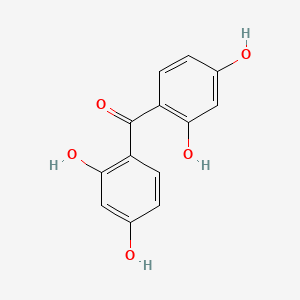
CAS 131-55-5PubChem CID 8571
2,2',4,4'-Tetrahydroxybenzophenone
- IUPAC 명칭
- bis(2,4-dihydroxyphenyl)methanone
- 분자식
- C13H10O5
- 분자량
- 246.21 g/mol
- 정확한 질량
- 246.05282342 Da
- XLogP3
- 2.4
- 위상 극성 표면적
- 98.0 Ų
- 수소 결합 공여체
- 4
- 수소 결합 수용체
- 5
- 공유결합 단위
- 1
- 정의된 입체중심
- 0
다른 이름
Benzophenone-2Methanone, bis(2,4-dihydroxyphenyl)-Uvinol D-50Uvinul D-502,4,2',4'-TetrahydroxybenzophenonePRR8K3H9VN2,2',4,4'-hydroxybenophenoneBENZOPHENONE, 2,2',4,4'-TETRAHYDROXY-
보고된 명칭 16개 더 보기
NSC-38556RefChem:566254205-028-9benzophenone 22,2',4,4'-Tetrehydroxybenzophenone4mgcNSC 385562,2',4,4'-Tetrahydroxy-benzophenonedi2,4-dihydroxyphenyl ketone2,4,4'-TetrahydroxybenzophenoneBP_282, 2',4,4'-tetrahydroxybenzophenoneAC-10378AS-136152,2',4,4'-Tetrahydroxybenzophenone, 97%SR-01000199334
외부 데이터베이스 식별자
추가 과학 데이터베이스의 근거
NIH PubChem PUG-View
식별자 정확히 일치8571
Attributed physical-property, hazard, environmental and use annotations.
- Boiling Point: 491 °C 출처: Hazardous Substances Data Bank (HSDB)
- Color/Form: Yellow needles 출처: Hazardous Substances Data Bank (HSDB)
- Color/Form: Light yellow powder 출처: Hazardous Substances Data Bank (HSDB)
- Density: 1.21 g/cu cm at 25 °C 출처: Hazardous Substances Data Bank (HSDB)
- Melting Point: 198.8 °C 출처: Hazardous Substances Data Bank (HSDB)
- Solubility: In water, 8,821 mg/L at 24.99 °C 출처: Hazardous Substances Data Bank (HSDB)
- Solubility: In water, <1 g/100 mL at 30 °C 출처: Hazardous Substances Data Bank (HSDB)
- Solubility: Very soluble in acetone, diethyl ether, ethanol 출처: Hazardous Substances Data Bank (HSDB)
- Solubility: Ethyl acetate 10, methanol 50, methyl ethyl ketone 22, toluene < 1 (all g/100 ml at 25 °C) 출처: Hazardous Substances Data Bank (HSDB)
- Note: This chemical does not meet GHS hazard criteria for 3.3% (13 of 393) of reports. 출처: European Chemicals Agency (ECHA)
- Signal: Warning 출처: European Chemicals Agency (ECHA)
- GHS Hazard Statements: H302 (96.4%): Harmful if swallowed [Warning Acute toxicity, oral]; H315 (33.8%): Causes skin irritation [Warning Skin corrosion/irritation]; H317 (32.1%): May cause an allergic skin reaction [Warning Sensitization, Skin]; H319 (60.6%): Causes serious eye irritation [Warning Serious eye damage/eye irritation]; H335 (32.6%): May cause respiratory irritation [Warning Specific target organ toxicity, single exposure; Respiratory tract irritation]; H412 (26.5%): Harmful to aquatic life with long lasting effects [Hazardous to the aquatic environment, long-term hazard] 출처: European Chemicals Agency (ECHA)
- Precautionary Statement Codes: P261, P264, P264+P265, P270, P271, P272, P273, P280, P301+P317, P302+P352, P304+P340, P305+P351+P338, P319, P321, P330, P332+P317, P333+P317, P337+P317, P362+P364, P403+P233, P405, and P501 (click each P-code to see the statement) 출처: European Chemicals Agency (ECHA)
- ECHA C&L Notifications Summary: Aggregated GHS information provided per 393 reports by companies from 13 notifications to the ECHA C&L Inventory. Each notification may be associated with multiple companies.; Reported as not meeting GHS hazard criteria per 13 of 393 reports by companies.; There are 12 notifications provided by 380 of 393 reports by companies with hazard statement code(s).; Information may vary between notifications depending on impurities, additives, and other factors. The percentage value in parenthesis indicates the notified classification ratio from companies that provide hazard codes. Only hazard codes with percentage values above 10% are shown. For more detailed information, please visit ECHA C&L website. 출처: European Chemicals Agency (ECHA)
- Signal: Warning 출처: Hazardous Substances Data Bank (HSDB)
- GHS Hazard Statements: H302: Harmful if swallowed [Warning Acute toxicity, oral]; H315: Causes skin irritation [Warning Skin corrosion/irritation]; H319: Causes serious eye irritation [Warning Serious eye damage/eye irritation]; H335: May cause respiratory irritation [Warning Specific target organ toxicity, single exposure; Respiratory tract irritation] 출처: Hazardous Substances Data Bank (HSDB)
- Precautionary Statement Codes: P261, P264, P264+P265, P270, P271, P280, P301+P317, P302+P352, P304+P340, P305+P351+P338, P319, P321, P330, P332+P317, P337+P317, P362+P364, P403+P233, P405, and P501 (click each P-code to see the statement) 출처: Hazardous Substances Data Bank (HSDB)
- Cosmetic Ingredient Review Finding(s): Safe in the present practices of use and concentration. Ingredient, concentration, and use information are available in documents discoverable at https://cir-reports.cir-safety.org 출처: Cosmetic Ingredient Review (CIR)
- Toxicity Summary: IDENTIFICATION AND USE: Benzophenone-2 (BP2) is used as UV filter in a personal care products. Benzophenone-2 is commonly used in cosmetic products and food container plastics to filter out ultraviolet light. HUMAN STUDIES: Sensitization against benzophenone-2 has been reported. BP2, may disturb thyroid hormone homeostasis by inhibiting or inactivating thyroid peroxidase, effects that are even more pronounced in the absence of iodide. ANIMAL STUDIES: Benzophenone-2 was estrogenic in vitro and in the rat uterotropic assay. BP2 was shown to bind to the estrogen receptors. Benzophenone-2 was reported to be positive for mutagenicity using Salmonella typhimurium strains TA98, TA100, TA1535, and TA1537 with metabolic activation. An in vitro cytogenic assay was used to evaluate the ability of Benzophenone-2 to induce sister chromatid exchange (SCE) and chromosome aberrations (CA) in L5178Y mouse lymphoma cells. Benzophenone-2 does not directly induce significant SCE or CA increases but does, under metabolic activation, induce these changes. Benzophenone-2 induced an increase in mutations at the TK locus in L5178Y mouse lymphoma cells only for highly toxic doses with or without metabolic a 출처: Hazardous Substances Data Bank (HSDB)
- Environmental Bioconcentration: An average BCF of 1.9 was calculated in fish for benzophenone-2, using fathead minnows (Pimephales promelas) which were exposed over 15-day period to 0.01-3.1 ug/g body weight(1). According to a classification scheme(2), this BCF suggests that bioconcentration in aquatic organisms is low(SRC). 출처: Hazardous Substances Data Bank (HSDB)
- Environmental Fate: TERRESTRIAL FATE: Based on a classification scheme(1), an estimated Koc value of 3200(SRC), determined from a structure estimation method(2), indicates that benzophenone-2 is expected to have slight mobility in soil(SRC). The estimated pKa1 and pKa2 values of benzophenone-2 are 7.1 and 7.9, respectively(3), indicating that this compound will exist partially in the anion form in the environment and anions generally do not adsorb more strongly to soils containing organic carbon and clay than their neutral counterparts(4). Volatilization of the neutral species of benzophenone-2 from moist soil surfaces is not expected to be an important fate process(SRC) given an estimated Henry's Law constant of 3.6X10⁻¹⁶ atm-cu m/mole(SRC), using a fragment constant estimation method(5). Benzophenone-2 is not expected to volatilize from dry soil surfaces(SRC) based upon an estimated vapor pressure of 1.6X10⁻¹¹ mm Hg at 25 °C(SRC), determined from a fragment constant method(2). Biodegradation data in soil were not available(SRC, 2017) 출처: Hazardous Substances Data Bank (HSDB)
- Environmental Fate: AQUATIC FATE: Based on a classification scheme(1), an estimated Koc value of 3200(SRC), determined from a structure estimation method(2), indicates that benzophenone-2 is expected to adsorb to suspended solids and sediment(SRC). Volatilization of teh neutral species from water surfaces is not expected(3) based upon an estimated Henry's Law constant of 3.6X10⁻¹⁶ atm-cu m/mole(SRC), developed using a fragment constant estimation method(4). The estimated pKa1 and pKa2 values of benzophenone-2 are 7.1 and 7.9, respectively(5) indicate benzophenone-2 will exist partially in the anion form at pH values of 5 to 9 and, therefore, volatilization from water surfaces is not expected to be an important fate process(SRC). According to a classification scheme(6), a BCF of 1.9(7) suggests that bioconcentration in aquatic organisms is low(SRC). Biodegradation data in water were not available(SRC, 2017). 출처: Hazardous Substances Data Bank (HSDB)
- Environmental Fate: ATMOSPHERIC FATE: According to a model of gas/particle partitioning of semivolatile organic compounds in the atmosphere(1), benzophenone-2, which has an estimated vapor pressure of 1.6X10⁻¹¹ mm Hg at 25 °C(SRC), determined from a fragment constant method(2), is expected to exist solely in the particulate phase in the ambient atmosphere. Particulate-phase benzophenone-2 may be removed from the air by wet and dry deposition(SRC). Benzophenone-2 absorbs UV light at wavelengths approximately 350 nm(3) and, therefore, may be susceptible to direct photolysis by sunlight(SRC). 출처: Hazardous Substances Data Bank (HSDB)
- Cosmetic Ingredient Review Link: CIR ingredient: Benzophenone-2 출처: Cosmetic Ingredient Review (CIR)
- Uses: Additives such as benzophenone-2 are commonly used in cosmetic products and food container plastics to filter out ultraviolet light... 출처: Hazardous Substances Data Bank (HSDB)
매핑 기준: Existing checksum-valid CAS to unique PubChem CID match. 가져온 시각: 2026-08-31. 출처 기록 열기
과학적 분류와 유해성 주석은 맥락을 제공할 뿐이며, 위에 표시된 시장별 규제 판단을 대체하지 않습니다.
추가 출처 적용 범위 및 일치 상태
| 출처 | 결과 | 확인됨 |
|---|---|---|
| NIH PubChem PUG-View | 정확히 일치 | 2026-08-31 |
기록된 불일치는 출처를 확인했다는 유용한 근거이며, 해당 물질이 다른 곳에 존재하지 않는다는 주장이 아닙니다.
체크섬이 유효한 CAS 일치를 통해 2026-08-31에 NIH PubChem에서 가져왔습니다. 화학적 특성은 이 페이지의 규제 판단을 대체하지 않습니다.