
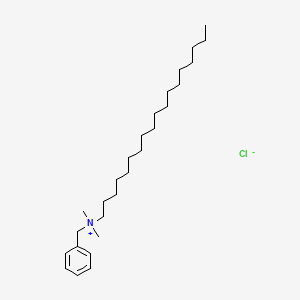
CAS 122-19-0PubChem CID 31204
Benzyldimethylstearylammonium chloride
Benzyldimethyloctadecylammonium chloride appears as white solid or thick liquid with a mild odor. (USCG, 1999) — CAMEO Chemicals
- IUPAC 명칭
- benzyl-dimethyl-octadecylazanium chloride
- 분자식
- C27H50ClN
- 분자량
- 424.1 g/mol
- 정확한 질량
- 423.3631783 Da
- 위상 극성 표면적
- 0.0 Ų
- 수소 결합 공여체
- 0
- 수소 결합 수용체
- 1
- 공유결합 단위
- 2
- 정의된 입체중심
- 0
다른 이름
Stearyldimethylbenzylammonium chlorideStearalkonium chlorideStebacStedbacOrthosan MBCarsoquat sdq-25Quaternol 1Benzyldimethyloctadecylammonium chloride
보고된 명칭 16개 더 보기
Ammonyx 4Carsoquat sdq-85Ammonyx CA specialIntexsan SB-85Ammonyx 490Barquat SB-25Intexan SB-85Algene SC 25Triton X-40Ammonyx 4002Triton CG 500Alkaquat DMB-STJ Soft C 4Varisoft SDC 85Incroquat SDQ 25Ammonyx 485
외부 데이터베이스 식별자
- ChEMBL:CHEMBL118663
- EPA DTXSID:DTXSID2025139
추가 과학 데이터베이스의 근거
NIH PubChem PUG-View
식별자 정확히 일치31204
Attributed physical-property, hazard, environmental and use annotations.
- Boiling Point: DECOMP @ 120 °C 출처: Hazardous Substances Data Bank (HSDB)
- Color/Form: WHITE, CRYSTALLINE POWDER 출처: Hazardous Substances Data Bank (HSDB)
- Color/Form: SOLID OR VISCOUS LIQ, WHITE 출처: Hazardous Substances Data Bank (HSDB)
- Density: greater than 1.1 at 68 °F (USCG, 1999) 출처: CAMEO Chemicals
- Density: GREATER THAN 1.1 @ 20 °C (SOLID) 출처: Hazardous Substances Data Bank (HSDB)
- LogP: log Kow= 3.23 출처: Hazardous Substances Data Bank (HSDB)
- Physical Description: Benzyldimethyloctadecylammonium chloride appears as white solid or thick liquid with a mild odor. (USCG, 1999) 출처: CAMEO Chemicals
- Physical Description: Other Solid; CBI 출처: EPA Chemical Data Reporting (CDR)
- Physical Description: White solid or viscous liquid; [HSDB] White crystalline powder; [MSDSonline] 출처: Haz-Map, Information on Hazardous Chemicals and Occupational Diseases
- Solubility: less than 1 mg/mL at 70 °F (NTP, 1992) 출처: CAMEO Chemicals
- Solubility: SOL IN WATER, CHLOROFORM, BENZENE, ACETONE, XYLENE 출처: Hazardous Substances Data Bank (HSDB)
- First Aid: EYES: First check the victim for contact lenses and remove if present. Flush victim's eyes with water or normal saline solution for 20 to 30 minutes while simultaneously calling a hospital or poison control center. Do not put any ointments, oils, or medication in the victim's eyes without specific instructions from a physician. IMMEDIATELY transport the victim after flushing eyes to a hospital even if no symptoms (such as redness or irritation) develop.; SKIN: IMMEDIATELY flood affected skin with water while removing and isolating all contaminated clothing. Gently wash all affected skin areas thoroughly with soap and water. If symptoms such as redness or irritation develop, IMMEDIATELY call a physician and be prepared to transport the victim to a hospital for treatment.; INHALATION: IMMEDIATELY leave the contaminated area; take deep breaths of fresh air. If symptoms (such as wheezing, coughing, shortness of breath, or burning in the mouth, throat, or chest) develop, call a physician and be prepared to transport the victim to a hospital. Provide proper respiratory protection to rescuers entering an unknown atmosphere. Whenever possible, Self-Contained Breathing Apparatus (SCBA) shou 출처: CAMEO Chemicals
- Note: This chemical does not meet GHS hazard criteria for 5.4% (32 of 591) of reports. 출처: European Chemicals Agency (ECHA)
- Signal: Danger 출처: European Chemicals Agency (ECHA)
- GHS Hazard Statements: H302 (86.5%): Harmful if swallowed [Warning Acute toxicity, oral]; H314 (84.3%): Causes severe skin burns and eye damage [Danger Skin corrosion/irritation]; H318 (83.9%): Causes serious eye damage [Danger Serious eye damage/eye irritation] 출처: European Chemicals Agency (ECHA)
- Precautionary Statement Codes: P260, P264, P264+P265, P270, P280, P301+P317, P301+P330+P331, P302+P361+P354, P304+P340, P305+P354+P338, P316, P317, P321, P330, P363, P405, and P501 (click each P-code to see the statement) 출처: European Chemicals Agency (ECHA)
- ECHA C&L Notifications Summary: Aggregated GHS information provided per 591 reports by companies from 21 notifications to the ECHA C&L Inventory. Each notification may be associated with multiple companies.; Reported as not meeting GHS hazard criteria per 32 of 591 reports by companies.; There are 20 notifications provided by 559 of 591 reports by companies with hazard statement code(s).; Information may vary between notifications depending on impurities, additives, and other factors. The percentage value in parenthesis indicates the notified classification ratio from companies that provide hazard codes. Only hazard codes with percentage values above 10% are shown. For more detailed information, please visit ECHA C&L website. 출처: European Chemicals Agency (ECHA)
- Signal: Danger 출처: NITE-CMC
- GHS Hazard Statements: H302: Harmful if swallowed [Warning Acute toxicity, oral]; H314: Causes severe skin burns and eye damage [Danger Skin corrosion/irritation]; H318: Causes serious eye damage [Danger Serious eye damage/eye irritation] 출처: NITE-CMC
- Precautionary Statement Codes: P260, P264, P264+P265, P270, P280, P301+P317, P301+P330+P331, P302+P361+P354, P304+P340, P305+P354+P338, P316, P317, P321, P330, P363, P405, and P501 (click each P-code to see the statement) 출처: NITE-CMC
- Signal: Danger 출처: Hazardous Chemical Information System (HCIS), Safe Work Australia
- GHS Hazard Statements: H302: Harmful if swallowed [Warning Acute toxicity, oral]; H312: Harmful in contact with skin [Warning Acute toxicity, dermal]; H314: Causes severe skin burns and eye damage [Danger Skin corrosion/irritation]; H330: Fatal if inhaled [Danger Acute toxicity, inhalation] 출처: Hazardous Chemical Information System (HCIS), Safe Work Australia
- Precautionary Statement Codes: P260, P264, P270, P271, P280, P284, P301+P317, P301+P330+P331, P302+P352, P302+P361+P354, P304+P340, P305+P354+P338, P316, P317, P320, P321, P330, P362+P364, P363, P403+P233, P405, and P501 (click each P-code to see the statement) 출처: Hazardous Chemical Information System (HCIS), Safe Work Australia
- Cosmetic Ingredient Review Finding(s): Safe in the present practices of use and concentration. Ingredient, concentration, and use information are available in documents discoverable at https://cir-reports.cir-safety.org 출처: Cosmetic Ingredient Review (CIR)
- Environmental Bioconcentration: An estimated BCF of 71 was calculated for benzyldimethylstearylammonium chloride(SRC), using a log Kow of 3.23(1) and a regression-derived equation(2). According to a classification scheme(3), this BCF suggests the potential for bioconcentration in aquatic organisms is moderate. 출처: Hazardous Substances Data Bank (HSDB)
- Environmental Fate: TERRESTRIAL FATE: Based on a classification scheme(1), an estimated Koc value of 3X10+7(SRC), determined from a structure estimation method(2), indicates that benzyldimethylstearylammonium chloride is expected to be immobile in soil(SRC). Volatilization of benzyldimethylstearylammonium chloride from moist soil surfaces is not expected to be an important fate process(SRC) given an estimated Henry's Law constant of 4.2X10⁻¹¹ atm-cu m/mole(SRC), using a fragment constant estimation method(3). Benzyldimethylstearylammonium chloride is not expected to volatilize from dry soil surfaces(SRC) based upon an estimated vapor pressure of 1.2X10⁻¹³ mm Hg(SRC), determined from a fragment constant method(4). 출처: Hazardous Substances Data Bank (HSDB)
- Environmental Fate: AQUATIC FATE: Based on a classification scheme(1), an estimated Koc value of 3X10+7(SRC), determined from an estimation method(2), indicates that benzyldimethylstearylammonium chloride is expected to adsorb to suspended solids and sediment in water(SRC). Volatilization from water surfaces is not expected(3) based upon an estimated Henry's Law constant of 4.2X10⁻¹¹ atm-cu m/mole(SRC), developed using a fragment constant estimation method(4). According to a classification scheme(5), an estimated BCF of 71(SRC), from its log Kow of 3.23(2) and a regression-derived equation(6), suggests the potential for bioconcentration in aquatic organisms is moderate. Using the SCAS method and the OECD Confirmatory test, 94 and 95% benzyldimethylstearylammonium chloride was degraded, respectively(8), suggesting that biodegradability in water is likely to be important(SRC). 출처: Hazardous Substances Data Bank (HSDB)
- Environmental Fate: ATMOSPHERIC FATE: According to a model of gas/particle partitioning of semivolatile organic compounds in the atmosphere(1), benzyldimethylstearylammonium chloride, which has an estimated vapor pressure of 1.2X10⁻¹³ mm Hg at 25 °C(SRC), using a fragment constant estimation method(2), is expected to exist in the particulate phase in the ambient atmosphere. Particulate-phase benzyldimethylstearylammonium chloride may be removed from the air by wet and dry deposition(SRC). 출처: Hazardous Substances Data Bank (HSDB)
- Consumer Uses: Surfactant (surface active agent) 출처: EPA Chemical Data Reporting (CDR)
- Industry Uses: Surfactant (surface active agent); Other 출처: EPA Chemical Data Reporting (CDR)
- Cosmetic Ingredient Review Link: CIR ingredient: Stearalkonium Chloride 출처: Cosmetic Ingredient Review (CIR)
- Sources/Uses: Used as a cationic surfactant, wetting agent, emulsifier, germicide, fungicide, disinfectant, and slimicide; Used in industrial cleaners, emulsion polymerization processes, paper and textile processing, hair colors and conditioners (softener), lipsticks and lotions (emollient), textiles (softener), hair sprays (antistatic agent), and contraceptive formulations; [HSDB] Quaternary ammonium compounds are also used as algaecides/slimicides (swimming pools, industrial water reservoirs, and farm ponds), antiseptics for cleaning wounds, antistatic agents for textiles, softeners for paper products, and pigment dispersers; [IPCS-PIMs] 출처: Haz-Map, Information on Hazardous Chemicals and Occupational Diseases
- Industrial Processes with risk of exposure: Pulp and Paper Processing [Category: Industry]; Textiles (Fiber & Fabric Manufacturing) [Category: Industry]; Using Disinfectants or Biocides [Category: Clean]; Dressing Hair [Category: Other] 출처: Haz-Map, Information on Hazardous Chemicals and Occupational Diseases
- Uses: CATIONIC SURFACTANT 출처: Hazardous Substances Data Bank (HSDB)
- Uses: SOFTENERS; WETTING AGENTS; EMULSIFIERS; SOME GRADES ARE GERMICIDES, FUNGICIDES, DISINFECTANTS, & SLIMICIDES. /AMMONYX/ 출처: Hazardous Substances Data Bank (HSDB)
- Uses: Industrial and institutional cleaners, various detergents, emulsion polymerization processes, paper and textile processing. 출처: Hazardous Substances Data Bank (HSDB)
- Uses: SOFTENER IN COSMETICS, EG, HAIR COLORS & CONDITIONERS; EMOLLIENT, EG, FOR LIPSTICKS, LOTIONS & TOILETRIES; TEXTILE SOFTENER; ANTISTATIC AGENT, EG, FOR AEROSOL HAIR SPRAYS; CHEM INT FOR SURFACE-MODIFIED CLAYS 출처: Hazardous Substances Data Bank (HSDB)
- Uses: Contraceptive formulations 출처: Hazardous Substances Data Bank (HSDB)
매핑 기준: Existing checksum-valid CAS to unique PubChem CID match. 가져온 시각: 2026-08-31. 출처 기록 열기
과학적 분류와 유해성 주석은 맥락을 제공할 뿐이며, 위에 표시된 시장별 규제 판단을 대체하지 않습니다.
추가 출처 적용 범위 및 일치 상태
| 출처 | 결과 | 확인됨 |
|---|---|---|
| NIH PubChem PUG-View | 정확히 일치 | 2026-08-31 |
기록된 불일치는 출처를 확인했다는 유용한 근거이며, 해당 물질이 다른 곳에 존재하지 않는다는 주장이 아닙니다.
체크섬이 유효한 CAS 일치를 통해 2026-08-31에 NIH PubChem에서 가져왔습니다. 화학적 특성은 이 페이지의 규제 판단을 대체하지 않습니다.