
공식 EU 표시명용어집 항목 27036
SODIUM SULFANILATE
이 기록은 EU 화장품 표시에 사용하는 공식 일반 원료 명칭을 확인해 줍니다. 그것만으로는 해당 물질이 허용되거나 제한이 없거나 안전하다는 것이 확인되지 않습니다.
글로벌 근거 요약
확인된 정체는 색인된 시장 데이터세트 13개 중 6개에서 일치하는 규제 근거가 있습니다: 국가 기록 6건과 EU 부속서 기록 0건. 모든 결과와 근거 부족 사항은 아래에 나열되어 있습니다.
확인한 시장
13
근거가 있는 시장
6
근거 부족
7
확인된 식별자
4
확인된 물질 정체
CAS:515-74-2121-57-3
EC:208-208-5204-482-5
원료 색인 기록:
일치 또는 보고된 명칭 6개
SODIUM SULFANILATE4-Aminobenzenesulfonic acid (Sulfanilic acid) and its salts, when used as a substance in hair dye products4-Aminobenzenesulfonic acid (sulfanilic acid) and its salts, when used as a substance in hair dye products对氨基苯磺酸(磺胺酸)及其盐类 — 4-Aminobenzenesulfonic acid (Sulfanilic acid) (CAS No. 121-57-3 / CAS No. 515-74-2) and its saltsÁcido 4-aminobenzenossulfônico e seus sais, quando usado como substância que entra na composição de corantes capilares4-Aminobenzenesulfonic acid (Sulfanilic acid) and its salts (CAS No. 121-57-3/515-74-2), when used as a substance in hair dye products.
13개 시장 전체의 규제 근거
일치하는 각 기록을 열어 범위, 농도, 조건, 경고 문구 및 공식 출처 버전을 확인하세요.
데이터세트 범위와 다음 조치를 보려면 가로로 스와이프하거나 스크롤하세요.
| 시장 | 결과 | 기록 | 데이터세트 | 의미 / 다음 조치 |
|---|---|---|---|---|
| European Union EU | 일치하는 항목 없음 | 0 | Complete annex dataset Regulation (EC) 1223/2009 consolidated to 1 May 2026 | No annex match only means that these five annexes did not return a match; CosIng identity data and other EU obligations still need review. |
| Great Britain GB | Prohibited | 1기록 열기 1 | Complete consolidated annex dataset GB retained Regulation 1223/2009 schedules, effective 15 August 2026 | 연결된 모든 기록과 정확한 조건을 검토하세요. |
| Canada CA | 일치하는 항목 없음 | 0 | Complete Hotlist snapshot Health Canada Cosmetic Ingredient Hotlist, 13 August 2025 | The Hotlist is an administrative compliance tool, not an exhaustive safety approval list. |
| New Zealand NZ | Prohibited | 1기록 열기 1 | Complete schedules dataset Cosmetic Products Group Standard schedules effective 1 January 2026 | 연결된 모든 기록과 정확한 조건을 검토하세요. |
| ASEAN ASEAN | 일치하는 항목 없음 | 0 | Complete regional annex dataset ASEAN Cosmetic Directive annexes 2026-1, 22 June 2026 | Regional annex coverage does not replace member-state implementation dates, notifications or national deviations. |
| China CN | Prohibited | 1기록 열기 1 | Complete prohibited catalogues plus official-source workflow NMPA 2021 banned catalogues plus dynamic IECIC List I/List II system current since 2025 | 연결된 모든 기록과 정확한 조건을 검토하세요. |
| Japan JP | 일치하는 항목 없음 | 0 | Complete Standards appendices dataset MHLW Standards for Cosmetics official English source and Japanese amendments checked for the imported snapshot | The Japanese text and subsequent notices are canonical; no local match is not a product-compliance conclusion. |
| South Korea KR | 일치하는 항목 없음 | 0 | Complete current appendix dataset MFDS Notice 2026-19, effective 18 March 2026 | Korean source wording is canonical and other positive lists/notices may still apply to the formulation. |
| United States US | 일치하는 항목 없음 | 0 | Complete enumerated federal ingredient rules eCFR Title 21 issue date 27 August 2026 | FDA has no general approved-cosmetic-ingredient catalogue; absence from these sections is not approval or proof of safety. |
| Australia AU | 일치하는 항목 없음 | 0 | Complete cosmetic-relevant Poisons Standard subset plus official workflow Therapeutic Goods (Poisons Standard—June 2026) Instrument 2026 | An AICIS Inventory match is not cosmetic approval; no Inventory match can indicate a new, exempted, reported or confidential introduction. |
| Brazil BR | Prohibited | 1기록 열기 1 | Complete prohibited dataset plus current restricted-list workflow ANVISA RDC 1.029/2026 and RDC 1.030/2026, published 15 June 2026 | 연결된 모든 기록과 정확한 조건을 검토하세요. |
| India IN | Prohibited | 1기록 열기 1 | Complete current Part 2 dataset plus official workflow for Parts 1, 3 and 4 Cosmetics Rules 2020 plus current BIS IS 4707 parts (1:2020, 2:2025, 3:2025, 4:2022) | 연결된 모든 기록과 정확한 조건을 검토하세요. |
| Saudi Arabia SA | Prohibited | 1기록 열기 1 | Complete official list index SFDA live prohibited/restricted lists, snapshot 30 August 2026 | 연결된 모든 기록과 정확한 조건을 검토하세요. |
이 필터와 일치하는 시장 행이 없습니다.
일치하는 시장 기록 및 조건
New Zealand
Cosmetic Products Group Standard schedules effective 1 January 2026China
NMPA 2021 banned catalogues plus dynamic IECIC List I/List II system current since 2025Brazil
ANVISA RDC 1.029/2026 and RDC 1.030/2026, published 15 June 2026India
Cosmetics Rules 2020 plus current BIS IS 4707 parts (1:2020, 2:2025, 3:2025, 4:2022)Saudi Arabia
SFDA live prohibited/restricted lists, snapshot 30 August 2026화학적 정체 및 특성
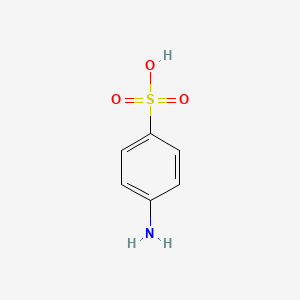
CAS 121-57-3PubChem CID 8479
Sulfanilic acid
4-aminobenzenesulfonic acid is an aminobenzenesulfonic acid that is aniline sulfonated at the para-position. It has a role as a xenobiotic, an allergen, a xenobiotic metabolite and an environmental contaminant. It is a conjugate acid of a 4-aminobenzenesulfonate. — ChEBI
- IUPAC 명칭
- 4-aminobenzenesulfonic acid
- 분자식
- C6H7NO3S
- 분자량
- 173.19 g/mol
- 정확한 질량
- 173.01466426 Da
- XLogP3
- -0.6
- 위상 극성 표면적
- 88.8 Ų
- 수소 결합 공여체
- 2
- 수소 결합 수용체
- 4
- 공유결합 단위
- 1
- 정의된 입체중심
- 0
다른 이름
Sulphanilic acidp-Aminobenzenesulfonic acidAniline-4-sulfonic acidAniline-p-sulfonic acidSulfanilsaeureAniline-p-sulphonic acidp-Aminophenylsulfonic acidp-Anilinesulfonic acid
보고된 명칭 16개 더 보기
Kyselina sulfanilovap-sulfoaniline4-Sulfoaniline4-Sulfanilic acidNSC 7170CCRIS 4576CHEBI:27500HSDB 5590EINECS 204-482-51-aminobenzene-4-sulfonic acidAI3-15414UNII-434Z8C2635NSC-71704-aminophenylsulfonic acidp-aminobenzene sulfonic acid434Z8C2635
외부 데이터베이스 식별자
- ChEBI:CHEBI:27500
- ChEMBL:CHEMBL1566888
- EPA DTXSID:DTXSID6024464
- PubMed:22798828
- PubMed:22750687
- PubMed:22719384
- PubMed:22706451
- PubMed:22701692
- PubMed:22666289
- PubMed:22609751
- PubMed:22586486
- PubMed:22579405
- PubMed:22574013
- PubMed:22567567
- PubMed:22558436
추가 과학 데이터베이스의 근거
NIH PubChem PUG-View
식별자 정확히 일치8479
Attributed physical-property, hazard, environmental and use annotations.
- Color/Form: Orthorhombic plates or monoclinic from water 출처: Hazardous Substances Data Bank (HSDB)
- Density: 1.485 at 77 °F (NTP, 1992) - Denser than water; will sink 출처: CAMEO Chemicals
- Density: 1.485 at 25 °C/4 °C 출처: Hazardous Substances Data Bank (HSDB)
- Density: 1.49 g/cm³ 출처: ILO-WHO International Chemical Safety Cards (ICSCs)
- Density: 1.485 @25 °C 출처: PAC Chemical Database, U.S. Department of Energy
- Dissociation Constants: pKa = 3.25 at 25 °C; pKa = 3.34 at 15 °C 출처: Hazardous Substances Data Bank (HSDB)
- LogP: log Kow = -2.16 출처: Hazardous Substances Data Bank (HSDB)
- LogP: -0.9 출처: ILO-WHO International Chemical Safety Cards (ICSCs)
- Melting Point: Decomposes without melting at 550 °F (NTP, 1992) 출처: CAMEO Chemicals
- Melting Point: 288 °C decomposes without melting 출처: Hazardous Substances Data Bank (HSDB)
- Physical Description: 4-aminobenzene sulfonic acid appears as white powder with faint purple tinge. Grayish-white flat crystals. Becomes anhydrous at around 212 °F. Low toxicity (used medicinally). 출처: CAMEO Chemicals
- Physical Description: Dry Powder 출처: EPA Chemical Data Reporting (CDR)
- Physical Description: Greyish-white solid; [Hawley] White to grey solid; [ICSC] Light grey fine crystals and fragments; [MSDSonline] 출처: Haz-Map, Information on Hazardous Chemicals and Occupational Diseases
- Physical Description: WHITE POWDER OR WHITE-TO-GREY CRYSTALS. 출처: ILO-WHO International Chemical Safety Cards (ICSCs)
- Solubility: less than 1 mg/mL at 68 °F (NTP, 1992) 출처: CAMEO Chemicals
- Solubility: Insoluble in ethanol and ether 출처: Hazardous Substances Data Bank (HSDB)
- Solubility: Soluble in fuming hydrochloric acid 출처: Hazardous Substances Data Bank (HSDB)
- Solubility: Slowly sol in water: about 1% at 20 °C, about 1.45% at 30 °C, about 1.94% at 40 °C 출처: Hazardous Substances Data Bank (HSDB)
- Solubility: In water, 10.68 g/L at 20 °C; 14.68 g/L at 30 °C 출처: Hazardous Substances Data Bank (HSDB)
- Solubility: Solubility in water: poor 출처: ILO-WHO International Chemical Safety Cards (ICSCs)
- Vapor Pressure: 0.0000002 [mmHg] 출처: Haz-Map, Information on Hazardous Chemicals and Occupational Diseases
- First Aid: EYES: First check the victim for contact lenses and remove if present. Flush victim's eyes with water or normal saline solution for 20 to 30 minutes while simultaneously calling a hospital or poison control center. Do not put any ointments, oils, or medication in the victim's eyes without specific instructions from a physician. IMMEDIATELY transport the victim after flushing eyes to a hospital even if no symptoms (such as redness or irritation) develop.; SKIN: IMMEDIATELY flood affected skin with water while removing and isolating all contaminated clothing. Gently wash all affected skin areas thoroughly with soap and water. If symptoms such as redness or irritation develop, IMMEDIATELY call a physician and be prepared to transport the victim to a hospital for treatment.; INHALATION: IMMEDIATELY leave the contaminated area; take deep breaths of fresh air. If symptoms (such as wheezing, coughing, shortness of breath, or burning in the mouth, throat, or chest) develop, call a physician and be prepared to transport the victim to a hospital. Provide proper respiratory protection to rescuers entering an unknown atmosphere. Whenever possible, Self-Contained Breathing Apparatus (SCBA) shou 출처: CAMEO Chemicals
- Signal: Warning 출처: Regulation (EC) No 1272/2008 of the European Parliament and of the Council
- GHS Hazard Statements: H315: Causes skin irritation [Warning Skin corrosion/irritation]; H317: May cause an allergic skin reaction [Warning Sensitization, Skin]; H319: Causes serious eye irritation [Warning Serious eye damage/eye irritation] 출처: Regulation (EC) No 1272/2008 of the European Parliament and of the Council
- Precautionary Statement Codes: P261, P264, P264+P265, P272, P280, P302+P352, P305+P351+P338, P321, P332+P317, P333+P317, P337+P317, P362+P364, and P501 (click each P-code to see the statement) 출처: Regulation (EC) No 1272/2008 of the European Parliament and of the Council
- Signal: Warning 출처: European Chemicals Agency (ECHA)
- GHS Hazard Statements: H315 (98.6%): Causes skin irritation [Warning Skin corrosion/irritation]; H317 (98.6%): May cause an allergic skin reaction [Warning Sensitization, Skin]; H319 (99.8%): Causes serious eye irritation [Warning Serious eye damage/eye irritation] 출처: European Chemicals Agency (ECHA)
- Precautionary Statement Codes: P261, P264, P264+P265, P272, P280, P302+P352, P305+P351+P338, P321, P332+P317, P333+P317, P337+P317, P362+P364, and P501 (click each P-code to see the statement) 출처: European Chemicals Agency (ECHA)
- ECHA C&L Notifications Summary: Aggregated GHS information provided per 442 reports by companies from 9 notifications to the ECHA C&L Inventory. Each notification may be associated with multiple companies.; Information may vary between notifications depending on impurities, additives, and other factors. The percentage value in parenthesis indicates the notified classification ratio from companies that provide hazard codes. Only hazard codes with percentage values above 10% are shown. For more detailed information, please visit ECHA C&L website. 출처: European Chemicals Agency (ECHA)
- GHS Hazard Statements: Not Classified 출처: NITE-CMC
- Signal: Warning 출처: NITE-CMC
- GHS Hazard Statements: H317: May cause an allergic skin reaction [Warning Sensitization, Skin]; H319: Causes serious eye irritation [Warning Serious eye damage/eye irritation] 출처: NITE-CMC
- Precautionary Statement Codes: P261, P264+P265, P272, P280, P302+P352, P305+P351+P338, P321, P333+P317, P337+P317, P362+P364, and P501 (click each P-code to see the statement) 출처: NITE-CMC
- Signal: Warning 출처: Hazardous Chemical Information System (HCIS), Safe Work Australia
- Environmental Bioconcentration: An estimated BCF of 3 was calculated in fish for sulfanilic acid(SRC), using a log Kow of -2.16(1) and a regression-derived equation(2). According to a classification scheme(3), this BCF suggests the potential for bioconcentration in aquatic organisms is low(SRC). 출처: Hazardous Substances Data Bank (HSDB)
- Environmental Fate: TERRESTRIAL FATE: Based on a classification scheme(1), an estimated Koc value of 10(SRC), determined from a structure estimation method(2), indicates that sulfanilic acid is expected to have very high mobility in soil(SRC). The pKa of sulfanilic acid is 3.25 at 25 °C(3), indicating that this compound will partially exist in anion form in the environment and anions generally do not adsorb more strongly to soils containing organic carbon and clay than their neutral counterparts(4). Volatilization of sulfanilic acid from moist soil surfaces is not expected to be an important fate process(SRC) given an estimated Henry's Law constant of 8.9X10⁻¹³ atm-cu m/mole(SRC), using a fragment constant estimation method(2). Sulfanilic acid is not expected to volatilize from dry soil surfaces(SRC) based upon an estimated vapor pressure of 1X10⁻⁹ mm Hg at 25 °C(SRC), determined from a fragment constant method(2). Based on results of the majority of eight separate laboratory determinations, it can be concluded that sulfanilic acid is not readily biodegradable(5). Sulfanilic acid, present at 100 mg/L, reached 8% of its theoretical BOD in 2 weeks using an activated sludge inoculum at 30 mg/L in the Jap 출처: Hazardous Substances Data Bank (HSDB)
- Environmental Fate: AQUATIC FATE: Based on a classification scheme(1), an estimated Koc value of 10(SRC), determined from a structure estimation method(2), indicates that sulfanilic acid is not expected to adsorb to suspended solids and sediment(SRC). Volatilization from water surfaces is not expected(3) based upon an estimated Henry's Law constant of 8.9X10⁻¹³ atm-cu m/mole(SRC), developed using a fragment constant estimation method(2). According to a classification scheme(4), an estimated BCF of 3(SRC), from a log Kow of -2.16(5) and a regression-derived equation(2), suggests the potential for bioconcentration in aquatic organisms is low(SRC). Sulfanilic acid absorbs UV light at wavelengths >290 nm(6) and may be susceptible to direct photolysis in sunlit water(SRC). Based on results of the majority of eight separate laboratory determinations, it can be concluded that sulfanilic acid is not readily biodegradable(7). Sulfanilic acid, present at 100 mg/L, reached 8% of its theoretical BOD in 2 weeks using an activated sludge inoculum at 30 mg/L in the Japanese MITI test(8) which also indicates the compound is not readily biodegradable(SRC). 출처: Hazardous Substances Data Bank (HSDB)
- Environmental Fate: ATMOSPHERIC FATE: According to a model of gas/particle partitioning of semivolatile organic compounds in the atmosphere(1), sulfanilic acid, which has an estimated vapor pressure of 1X10⁻⁹ mm Hg at 25 °C(SRC), determined from a fragment constant method(2), is expected to exist solely in the particulate phase in the ambient atmosphere. Particulate-phase sulfanilic acid may be removed from the air by wet or dry deposition(SRC). Sulfanilic acid absorbs UV light at wavelengths >290 nm(3), and therefore may be susceptible to direct photolysis by sunlight(SRC). 출처: Hazardous Substances Data Bank (HSDB)
- Industry Uses: Intermediate; Plasticizer; Brightener 출처: EPA Chemical Data Reporting (CDR)
- Sources/Uses: Used to make dyes and other organic chemicals; Also used as an analytical reagent (Ehrlich's reagent and determination of nitrites) and antibacterial; [Merck Index] Used in the paper, pulp, board, and polymer industries; Used as an additive to construction materials and foodstuffs; [IUCLID] 출처: Haz-Map, Information on Hazardous Chemicals and Occupational Diseases
- Industrial Processes with risk of exposure: Pulp and Paper Processing [Category: Industry] 출처: Haz-Map, Information on Hazardous Chemicals and Occupational Diseases
- Uses: Manufacture of various dyes and organic chemicals; as reagent in analytical chemistry (Ehrlich's reagent, determination of nitrites) 출처: Hazardous Substances Data Bank (HSDB)
- Uses: Intermediate in the production of dyes, pesticides, pharmaceuticals. 출처: Hazardous Substances Data Bank (HSDB)
- Uses: CHEM INT FOR DYES (ESP AZO DYES), EG, C.I. ACID ORANGE 24 출처: Hazardous Substances Data Bank (HSDB)
- Uses: CHEM INT FOR ANALGESICS AND OTHER ORG CHEMS 출처: Hazardous Substances Data Bank (HSDB)
- Uses: For more Uses (Complete) data for SULFANILIC ACID (6 total), please visit the HSDB record page. 출처: Hazardous Substances Data Bank (HSDB)
- Uses: Substance listed with specific concentration in tattoo ink and/or permanent make up according to EU Commission Regulation 2020/2081. The concentration limit (by weight) is 0.0005%. 출처: NORMAN Suspect List Exchange
매핑 기준: Existing checksum-valid CAS to unique PubChem CID match. 가져온 시각: 2026-08-31. 출처 기록 열기
과학적 분류와 유해성 주석은 맥락을 제공할 뿐이며, 위에 표시된 시장별 규제 판단을 대체하지 않습니다.
추가 출처 적용 범위 및 일치 상태
| 출처 | 결과 | 확인됨 |
|---|---|---|
| NIH PubChem PUG-View | 정확히 일치 | 2026-08-31 |
기록된 불일치는 출처를 확인했다는 유용한 근거이며, 해당 물질이 다른 곳에 존재하지 않는다는 주장이 아닙니다.
체크섬이 유효한 CAS 일치를 통해 2026-08-31에 NIH PubChem에서 가져왔습니다. 화학적 특성은 이 페이지의 규제 판단을 대체하지 않습니다.
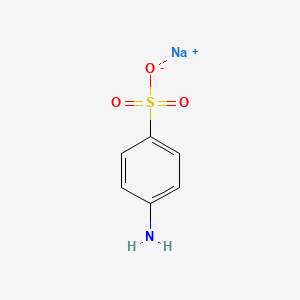
CAS 515-74-2PubChem CID 23664644
Sodium sulfanilate
- IUPAC 명칭
- sodium 4-aminobenzenesulfonate
- 분자식
- C6H6NNaO3S
- 분자량
- 195.17 g/mol
- 정확한 질량
- 194.99660851 Da
- 위상 극성 표면적
- 91.6 Ų
- 수소 결합 공여체
- 1
- 수소 결합 수용체
- 4
- 공유결합 단위
- 2
- 정의된 입체중심
- 0
다른 이름
Sodium sulphanilate4-Amino-benzenesulfonic acid monosodium saltBenzenesulfonic acid, 4-amino-, monosodium saltEINECS 208-208-5Sulfanilic acid monosodium saltCCRIS 7446Sulfanilic Acid Sodium Salt4-Aminobenzenesulfonic acid, sodium salt
보고된 명칭 16개 더 보기
4-Aminobenzenesulfonic acid, monosodium salt9YJ2Q81720EC 208-208-5Benzenesulfonic acid, 4-amino-, sodium salt (1:1)4SulfoanilinNapSulfanilsaeure NaSulfanilsaure Na SalzRefChem:8878944Aminobenzol1sulfonsaeureNaSodium 4aminobenzenesulfonate4AminobenzolsulfonsaeureNaSalzAnilin4sulfonsaure NatriumsalzSODIUM SULFANILATE [INCI]4Aminobenzolsulfonsaure Natriumsalz4Aminobenzenesulfonic acid, sodium salt4Aminobenzenesulfonic acid, monosodium salt
외부 데이터베이스 식별자
- ChEMBL:CHEMBL3183582
- EPA DTXSID:DTXSID5029184
체크섬이 유효한 CAS 일치를 통해 2026-09-02에 NIH PubChem에서 가져왔습니다. 화학적 특성은 이 페이지의 규제 판단을 대체하지 않습니다.
추가 공신력 있는 물질 조사
각 링크는 해당 출처에서 이 정체를 검색합니다. 링크는 조사 경로일 뿐이며, 그 출처에 정확히 일치하는 기록이 있다는 주장이 아닙니다. 각 출처의 성격과 법적 비중
공식 출처 및 범위
집행위원회 시행결정 (EU) 2025/1175(데이터세트 버전 EU 2025/1175)에서 가져왔습니다. 이 용어집은 제19조 제1항 (g)호에서 요구하는 성분 목록에 사용할 일반 원료 명칭을 제공하며, 승인 또는 안전성 목록이 아닙니다.
공식 결정 열기