
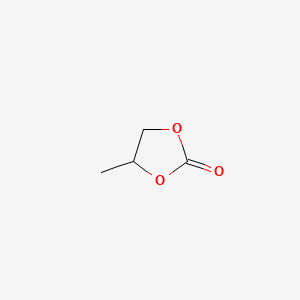
CAS 108-32-7PubChem CID 7924
Propylene Carbonate
Propylene carbonate is an organic molecular entity. — ChEBI
- IUPAC 명칭
- 4-methyl-1,3-dioxolan-2-one
- 분자식
- C4H6O3
- 분자량
- 102.09 g/mol
- 정확한 질량
- 102.031694049 Da
- XLogP3
- -0.4
- 위상 극성 표면적
- 35.5 Ų
- 수소 결합 공여체
- 0
- 수소 결합 수용체
- 3
- 공유결합 단위
- 1
- 정의된 입체중심
- 0
다른 이름
1,2-Propylene carbonate1,2-Propanediol cyclic carbonateArconate 5000Texacar PCCyclic propylene carbonate1,2-Propanediol carbonate1,3-Dioxolan-2-one, 4-methyl-Propylene glycol cyclic carbonate
보고된 명칭 16개 더 보기
Dipropylene carbonate1-Methylethylene carbonate1,2-Propanediyl carbonateCyclic 1,2-propylene carbonateCyclic methylethylene carbonate4-Methyl-2-oxo-1,3-dioxolaneCarbonic acid, propylene esterPropylenester kyseliny uhliciteCarbonic acid cyclic methylethylene esterCarbonic acid, cyclic propylene etherNSC-117848D08K3S51ERefChem:6175203-572-14-Methyldioxalone-2Carbonic acid, cyclic propylene ester
외부 데이터베이스 식별자
- ChEBI:CHEBI:231185
- ChEMBL:CHEMBL1733973
- EPA DTXSID:DTXSID2026789
- PubMed:22547987
- PubMed:21384941
- PubMed:21120531
- PubMed:21110041
- PubMed:20605517
- PubMed:19938180
- PubMed:12688767
- PubMed:12495327
추가 과학 데이터베이스의 근거
NIH PubChem PUG-View
식별자 정확히 일치7924
Attributed physical-property, hazard, environmental and use annotations.
- Boiling Point: 241.6 °C 출처: Hazardous Substances Data Bank (HSDB)
- Boiling Point: 242 °C @760 [mm Hg] 출처: PAC Chemical Database, U.S. Department of Energy
- Color/Form: Colorless liquid 출처: Hazardous Substances Data Bank (HSDB)
- Color/Form: Clear, colorless liquid 출처: Hazardous Substances Data Bank (HSDB)
- Density: 1.2047 g/cu cm at 20 °C 출처: Hazardous Substances Data Bank (HSDB)
- Density: 1.2047 @ 20°C 출처: PAC Chemical Database, U.S. Department of Energy
- Flash Point: 116 °C (241 °F) - closed cup 출처: Hazardous Substances Data Bank (HSDB)
- Flash Point: 275 °F (135 °C) (closed cup) 출처: Hazardous Substances Data Bank (HSDB)
- LogP: log Kow = -0.41 출처: Hazardous Substances Data Bank (HSDB)
- Melting Point: -48.8 °C 출처: Hazardous Substances Data Bank (HSDB)
- Melting Point: -48.8 °C 출처: PAC Chemical Database, U.S. Department of Energy
- Odor: Odorless 출처: Hazardous Substances Data Bank (HSDB)
- Odor: Weak odor 출처: Hazardous Substances Data Bank (HSDB)
- Physical Description: Liquid; Liquid; Other Solid; CBI 출처: EPA Chemical Data Reporting (CDR)
- Physical Description: Colorless odorless liquid; [Hawley] Somewhat hygroscopic; [CHEMINFO] 출처: Haz-Map, Information on Hazardous Chemicals and Occupational Diseases
- Refractive Index: Index of refraction: 1.4189 at 20 °C/D 출처: Hazardous Substances Data Bank (HSDB)
- Solubility: In water, 1.75X10+5 mg/L at 25 °C 출처: Hazardous Substances Data Bank (HSDB)
- Solubility: Very soluble in ethanol, ether, acetone, benzene 출처: Hazardous Substances Data Bank (HSDB)
- Solubility: Miscible with chloroform and ethyl acetate; moderately soluble in carbon tetrachloride 출처: Hazardous Substances Data Bank (HSDB)
- Vapor Pressure: 0.04 [mmHg] 출처: Haz-Map, Information on Hazardous Chemicals and Occupational Diseases
- Vapor Pressure: 0.045 mm Hg at 25 °C 출처: Hazardous Substances Data Bank (HSDB)
- Vapor Pressure: 0.75 [mm Hg] @43 °C 출처: PAC Chemical Database, U.S. Department of Energy
- Signal: Warning 출처: Regulation (EC) No 1272/2008 of the European Parliament and of the Council
- GHS Hazard Statements: H319: Causes serious eye irritation [Warning Serious eye damage/eye irritation] 출처: Regulation (EC) No 1272/2008 of the European Parliament and of the Council
- Precautionary Statement Codes: P264+P265, P280, P305+P351+P338, and P337+P317 (click each P-code to see the statement) 출처: Regulation (EC) No 1272/2008 of the European Parliament and of the Council
- Note: This chemical does not meet GHS hazard criteria for < 0.1% (2 of 4143) of reports. 출처: European Chemicals Agency (ECHA)
- Signal: Warning 출처: European Chemicals Agency (ECHA)
- GHS Hazard Statements: H319 (> 99.9%): Causes serious eye irritation [Warning Serious eye damage/eye irritation] 출처: European Chemicals Agency (ECHA)
- Precautionary Statement Codes: P264+P265, P280, P305+P351+P338, and P337+P317 (click each P-code to see the statement) 출처: European Chemicals Agency (ECHA)
- ECHA C&L Notifications Summary: Aggregated GHS information provided per 4143 reports by companies from 7 notifications to the ECHA C&L Inventory.; Reported as not meeting GHS hazard criteria per 2 of 4143 reports by companies.; There are 6 notifications provided by 4141 of 4143 reports by companies with hazard statement code(s).; Information may vary between notifications depending on impurities, additives, and other factors. The percentage value in parenthesis indicates the notified classification ratio from companies that provide hazard codes. Only hazard codes with percentage values above 10% are shown. For more detailed information, please visit ECHA C&L website. 출처: European Chemicals Agency (ECHA)
- Signal: Warning 출처: NITE-CMC
- GHS Hazard Statements: H319: Causes serious eye irritation [Warning Serious eye damage/eye irritation] 출처: NITE-CMC
- Precautionary Statement Codes: P264+P265, P280, P305+P351+P338, and P337+P317 (click each P-code to see the statement) 출처: NITE-CMC
- Signal: Warning 출처: Hazardous Chemical Information System (HCIS), Safe Work Australia
- NFPA Health Rating: 1 - Materials that, under emergency conditions, can cause significant irritation. 출처: Hazardous Substances Data Bank (HSDB)
- NFPA Fire Rating: 1 - Materials that must be preheated before ignition can occur. Materials require considerable preheating, under all ambient temperature conditions, before ignition and combustion can occur. 출처: Hazardous Substances Data Bank (HSDB)
- NFPA Instability Rating: 1 - Materials that in themselves are normally stable but that can become unstable at elevated temperatures and pressures. 출처: Hazardous Substances Data Bank (HSDB)
- Cosmetic Ingredient Review Finding(s): Safe in the present practices of use and concentration. Ingredient, concentration, and use information are available in documents discoverable at https://cir-reports.cir-safety.org 출처: Cosmetic Ingredient Review (CIR)
- Toxicity Summary: IDENTIFICATION AND USE: PROPYLENE CARBONATE is a colorless liquid. Propylene carbonate is used in paints as a high-boiling solvent and film-forming auxiliary, especially in poly(vinyl fluoride) and poly(vinylidene fluoride) systems. It is also employed as an auxiliary in the pigment and dye industry. It is also used In lithium batteries, to decrease sulfur dioxide vapor pressure and increase electrolyte solubility and ionic conductivity. HUMAN EXPOSURE AND TOXICITY: In clinical studies, undiluted propylene carbonate caused moderate skin irritation, whereas 5 and 10% propylene carbonate in aqueous solution produced no skin irritation or sensitization. Cosmetic products or gels containing 0.54-20% propylene carbonate were essentially nonsensitizing and, at most, moderately irritating to human skin. Products formulated with 1.51-20% propylene carbonate were generally nonphototoxic and nonphotosensitizing. However, one product containing 20% propylene carbonate may have produced a low level photoallergic reaction in 1 of 25 subjects tested. ANIMAL STUDIES: The undiluted material was a slight irritant to the skin and a moderate irritant to the rabbit eye. In an acute dermal toxicity stu 출처: Hazardous Substances Data Bank (HSDB)
- Environmental Bioconcentration: An estimated BCF of 3 was calculated in fish for propylene carbonate(SRC), using a log Kow of -0.41(1) and a regression-derived equation(2). According to a classification scheme(3), this BCF suggests the potential for bioconcentration in aquatic organisms is low(SRC). 출처: Hazardous Substances Data Bank (HSDB)
- Environmental Fate: TERRESTRIAL FATE: Based on a classification scheme(1), an estimated Koc value of 5(SRC), determined from a structure estimation method(2), indicates that propylene carbonate is expected to have very high mobility in soil(SRC). Volatilization of propylene carbonate from moist soil surfaces is not expected to be an important fate process(SRC) given an estimated Henry's Law constant of 3.5X10⁻⁸ atm-cu m/mole(SRC), based upon its vapor pressure, 0.045 mm Hg(3), and water solubility, 1.75X10+5 mg/L(4). Propylene carbonate is not expected to volatilize from dry soil surfaces(SRC) based upon its vapor pressure(3). A 79% of theoretical BOD using activated sludge in the Japanese MITI test(5) suggests that biodegradation is an important environmental fate process in soil(SRC). 출처: Hazardous Substances Data Bank (HSDB)
- Environmental Fate: AQUATIC FATE: Based on a classification scheme(1), an estimated Koc value of 5(SRC), determined from a structure estimation method(2), indicates that propylene carbonate is not expected to adsorb to suspended solids and sediment(SRC). Volatilization from water surfaces is not expected(3) based upon an estimated Henry's Law constant of 3.5X10⁻⁸ atm-cu m/mole(SRC), derived from its vapor pressure, 0.045 mm Hg(4), and water solubility, 1.75X10+5 mg/L(5). Propylene carbonate may undergo hydrolysis in the environment due to functional groups that hydrolyze under environmental conditions(3). According to a classification scheme(6), an estimated BCF of 3(SRC), from its log Kow of -0.41(7) and a regression-derived equation(2), suggests the potential for bioconcentration in aquatic organisms is low(SRC). A 79% of theoretical BOD using activated sludge in the Japanese MITI test(8) suggests that biodegradation is an important environmental fate process in water(SRC). 출처: Hazardous Substances Data Bank (HSDB)
- Environmental Fate: ATMOSPHERIC FATE: According to a model of gas/particle partitioning of semivolatile organic compounds in the atmosphere(1), propylene carbonate, which has a vapor pressure of 0.045 mm Hg at 25 °C(2), is expected to exist solely as a vapor in the ambient atmosphere. Vapor-phase propylene carbonate is degraded in the atmosphere by reaction with photochemically-produced hydroxyl radicals(SRC); the half-life for this reaction in air is estimated to be 4 days(SRC), calculated from its rate constant of 3.8X10⁻¹² cu cm/molecule-sec at 25 °C(SRC) that was derived using a structure estimation method(3). Propylene carbonate contains chromophores that absorb at wavelengths >290 nm(4) and, therefore, may be susceptible to direct photolysis by sunlight(SRC). 출처: Hazardous Substances Data Bank (HSDB)
- Consumer Uses: Monomers; Conductive agent; Solvent; Other; Cleaning agent; Not Known or Reasonably Ascertainable; Filler; Viscosity modifiers 출처: EPA Chemical Data Reporting (CDR)
- Industry Uses: Dispersing agent; Conductive agent; Solvent; Other; Monomers; Plating agent; Cleaning agent; Viscosity modifiers; Not Known or Reasonably Ascertainable; Waterproofing agent; Filler; Diluent; Ion exchange agent; Etching agent; Chelating agent; Surface modifier 출처: EPA Chemical Data Reporting (CDR)
- Cosmetic Ingredient Review Link: CIR ingredient: Propylene Carbonate 출처: Cosmetic Ingredient Review (CIR)
- Sources/Uses: Used for carbon dioxide recovery and solvent extraction; Also used in lithium batteries, as a plasticizer, in natural gas purification, and as a synthetic fiber spinning solvent; [HSDB] Used as a solvent in surface coatings, paint removers, cosmetics, personal care products, cleaners, degreasers, dyes, fibers, plastics, wood-binder resins, and photochromic solutions; Also used as a solvent to bake enamels, a reactive diluent for urethanes and epoxy resins, a dispersant for lubricants and greases, a binder for foundry sand and moulds, a cleaner in electronics, and as a water scavenger; [CHEMINFO] 출처: Haz-Map, Information on Hazardous Chemicals and Occupational Diseases
- Industrial Processes with risk of exposure: Molding and Core Making [Category: Foundry]; Petroleum Production and Refining [Category: Industry]; Battery Manufacturing [Category: Industry]; Textiles (Fiber & Fabric Manufacturing) [Category: Industry]; Painting (Solvents) [Category: Paint]; Plastic Composites Manufacturing [Category: Industry] 출처: Haz-Map, Information on Hazardous Chemicals and Occupational Diseases
- Activities with risk of exposure: Ceramics making [Category: Hobbies]; Enameling [Category: Hobbies] 출처: Haz-Map, Information on Hazardous Chemicals and Occupational Diseases
- Uses: Propylene carbonate is used in paints as a high-boiling solvent and film-forming auxiliary, especially in poly(vinyl fluoride) and poly(vinylidene fluoride) systems. It is also employed as an auxiliary in the pigment and dye industry. 출처: Hazardous Substances Data Bank (HSDB)
- Uses: Solvent extraction, plasticizer, organic synthesis, natural gas purification, synthetic fiber spinning solvent. 출처: Hazardous Substances Data Bank (HSDB)
- Uses: In CO2 recovery 출처: Hazardous Substances Data Bank (HSDB)
- Uses: In lithium batteries, to decrease sulfur dioxide vapor pressure and increase electrolyte solubility and ionic conductivity. 출처: Hazardous Substances Data Bank (HSDB)
- Uses: Commercially produced primary cells have counterelectrodes made of manganese dioxide, iron sulfide, carbon fluoride (CFx), or graphite loaded with sulfur dioxide or thionyl chloride, and electrolytes consisting of lithium salts (LiAsF6, LiClO4, LiI, LiSO3CF3) dissolved in aprotic organic solvents such as propylene carbonate or dimethoxyethane. 출처: Hazardous Substances Data Bank (HSDB)
매핑 기준: Existing checksum-valid CAS to unique PubChem CID match. 가져온 시각: 2026-08-31. 출처 기록 열기
과학적 분류와 유해성 주석은 맥락을 제공할 뿐이며, 위에 표시된 시장별 규제 판단을 대체하지 않습니다.
추가 출처 적용 범위 및 일치 상태
| 출처 | 결과 | 확인됨 |
|---|---|---|
| NIH PubChem PUG-View | 정확히 일치 | 2026-08-31 |
기록된 불일치는 출처를 확인했다는 유용한 근거이며, 해당 물질이 다른 곳에 존재하지 않는다는 주장이 아닙니다.
체크섬이 유효한 CAS 일치를 통해 2026-08-31에 NIH PubChem에서 가져왔습니다. 화학적 특성은 이 페이지의 규제 판단을 대체하지 않습니다.