
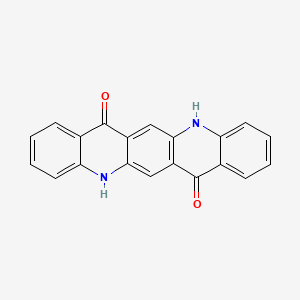
CAS 1047-16-1PubChem CID 13976
Quinacridone
Quinacridone is an organonitrogen heterocyclic compound and an organic heterotetracyclic compound. — ChEBI
- IUPAC 명칭
- 5,12-dihydroquinolino[2,3-b]acridine-7,14-dione
- 분자식
- C20H12N2O2
- 분자량
- 312.3 g/mol
- 정확한 질량
- 312.089877630 Da
- XLogP3
- 4.0
- 위상 극성 표면적
- 58.2 Ų
- 수소 결합 공여체
- 2
- 수소 결합 수용체
- 4
- 공유결합 단위
- 1
- 정의된 입체중심
- 0
다른 이름
CINQUASIA REDMonastral RedQuinacridone violetMonastral Violet RSunfast VioletCinquasia Red BCinquasia Red YMonastral Red B
보고된 명칭 16개 더 보기
Monastral Red YMonastrol Red YPermanent MagentaPaliogen Red BGCinquasia Violet RDark violetSunfast Red 19Cinquasia VioletQuinacridone RedQuinacridone Red MCPermanent Red E 3BQuinacridone Violet MCPV Fast Red E 3BPV Fast Red E 5BHostaperm Red Violet ERHostaperm Red E 3B
외부 데이터베이스 식별자
추가 과학 데이터베이스의 근거
EMBL-EBI ChEBI
식별자 정확히 일치CHEBI:174977
Quinacridone
- 처방
- C20H12N2O2
- 평균 질량
- 312.328 g/mol
- 단일 동위원소 질량
- 312.08988 Da
- 형식 전하
- 0
- organonitrogen heterocyclic compound — is a (CHEBI:38101)
- organic heterotetracyclic compound — is a (CHEBI:38163)
- organonitrogen heterocyclic compound — is a (CHEBI:38101)
- organic heterotetracyclic compound — is a (CHEBI:38163)
추가 선별 명칭
5,12-dihydroquinolino[2,3-b]acridine-7,14-dione
이 출처의 상호 참조
- CAS: 1047-16-1 — ChemIDplus
- MANUAL_X_REF: 13369 — ChemSpider
- MANUAL_X_REF: HMDB0034058 — HMDB
매핑 기준: Exact CAS cross-reference in the ChEBI compound record. 가져온 시각: 2026-08-31. 출처 기록 열기
NIH PubChem PUG-View
식별자 정확히 일치13976
Attributed physical-property, hazard, environmental and use annotations.
- Color/Form: Red to violet solid with blueish or yellowish tint depending upon crystalline form. 출처: Hazardous Substances Data Bank (HSDB)
- Color/Form: particle characteristics: thin plates 출처: Hazardous Substances Data Bank (HSDB)
- Density: 1.5 출처: Hazardous Substances Data Bank (HSDB)
- LogP: 1.9 (estimated) 출처: Hazardous Substances Data Bank (HSDB)
- Melting Point: 390 °C 출처: Human Metabolome Database (HMDB)
- Physical Description: Liquid; Other Solid; Dry Powder; Other Solid; CBI 출처: EPA Chemical Data Reporting (CDR)
- Physical Description: Red to violet solid; Bluish or yellowish tint depending of form; [HSDB] Red odorless powder; [MSDSonline] 출처: Haz-Map, Information on Hazardous Chemicals and Occupational Diseases
- Physical Description: Solid 출처: Human Metabolome Database (HMDB)
- Refractive Index: Refractive index: quinacridine red (gamma), n(Na) Av. 2.04; quinacridine red (beta), Av. 2.02 출처: Hazardous Substances Data Bank (HSDB)
- Solubility: Insoluble in water 출처: Hazardous Substances Data Bank (HSDB)
- Solubility: Insoluble in organic solvents and dispersion media. 출처: Hazardous Substances Data Bank (HSDB)
- Note: This chemical does not meet GHS hazard criteria for 99.6% (760 of 763) of all reports. 출처: European Chemicals Agency (ECHA)
- GHS Hazard Statements: Not Classified; Reported as not meeting GHS hazard criteria by 760 of 763 companies (only 0.4% companies provided GHS information). For more detailed information, please visit ECHA C&L website. 출처: European Chemicals Agency (ECHA)
- ECHA C&L Notifications Summary: Aggregated GHS information provided per 763 reports by companies from 4 notifications to the ECHA C&L Inventory.; Reported as not meeting GHS hazard criteria per 760 of 763 reports by companies.; There are 2 notifications provided by 3 of 763 reports by companies with hazard statement code(s).; Information may vary between notifications depending on impurities, additives, and other factors. The percentage value in parenthesis indicates the notified classification ratio from companies that provide hazard codes. Only hazard codes with percentage values above 10% are shown. For more detailed information, please visit ECHA C&L website. 출처: European Chemicals Agency (ECHA)
- Environmental Bioconcentration: Cinquasia red should not bioconcentrate, since it is insoluble, and therefore, will not be taken up into the body. 출처: Hazardous Substances Data Bank (HSDB)
- Environmental Fate: Much of cinquasia red will be bound up in the components of landfills, junkyards, and general dump sites. 출처: Hazardous Substances Data Bank (HSDB)
- Environmental Fate: Terrestrial: The insolubility of cinquasia red will cause it to collect in soils and sediments. 출처: Hazardous Substances Data Bank (HSDB)
- Environmental Fate: Aquatic: Due to its insolubility, cinquasia red may reside in the water column for a substantial period, long enough to become part of deep sea sediments. 출처: Hazardous Substances Data Bank (HSDB)
- Consumer Uses: Pigment 출처: EPA Chemical Data Reporting (CDR)
- Industry Uses: Pigment 출처: EPA Chemical Data Reporting (CDR)
- Sources/Uses: Used as pigment (paints, printing inks, plastics, rubber, alkyd resin enamels, textile emulsion inks, textiles, nitrocellulose, vinyl, and acrylic lacquers) and sensitizing dye in color photo electrophoresis; Used to tone and make other pigments; [HSDB] 출처: Haz-Map, Information on Hazardous Chemicals and Occupational Diseases
- Industrial Processes with risk of exposure: Painting (Pigments, Binders, and Biocides) [Category: Paint]; Textiles (Printing, Dyeing, or Finishing) [Category: Industry] 출처: Haz-Map, Information on Hazardous Chemicals and Occupational Diseases
- Uses: PAINTS, PRINTING INKS, PLASTICS, RUBBER 출처: Hazardous Substances Data Bank (HSDB)
- Uses: Cinquasia red is used a sensitizing dye in color photoelectrophoresis. 출처: Hazardous Substances Data Bank (HSDB)
- Uses: Pigment in textiles 출처: Hazardous Substances Data Bank (HSDB)
- Uses: As colorants for plastics, quinacridone pigments may be used in all resins except nylon-66 and polystyrene./Quinacridone Pigments/ 출처: Hazardous Substances Data Bank (HSDB)
- Uses: For more Uses (Complete) data for CINQUASIA RED (9 total), please visit the HSDB record page. 출처: Hazardous Substances Data Bank (HSDB)
- Uses: Plastics -> Typical concentration range in plastic materials -> 2% 출처: NORMAN Suspect List Exchange
매핑 기준: Existing checksum-valid CAS to unique PubChem CID match. 가져온 시각: 2026-08-31. 출처 기록 열기
과학적 분류와 유해성 주석은 맥락을 제공할 뿐이며, 위에 표시된 시장별 규제 판단을 대체하지 않습니다.
추가 출처 적용 범위 및 일치 상태
| 출처 | 결과 | 확인됨 |
|---|---|---|
| EMBL-EBI ChEBI | 정확히 일치 | 2026-08-31 |
| NIH PubChem PUG-View | 정확히 일치 | 2026-08-31 |
기록된 불일치는 출처를 확인했다는 유용한 근거이며, 해당 물질이 다른 곳에 존재하지 않는다는 주장이 아닙니다.
체크섬이 유효한 CAS 일치를 통해 2026-08-31에 NIH PubChem에서 가져왔습니다. 화학적 특성은 이 페이지의 규제 판단을 대체하지 않습니다.