
CAS 124-22-1PubChem CID 13583
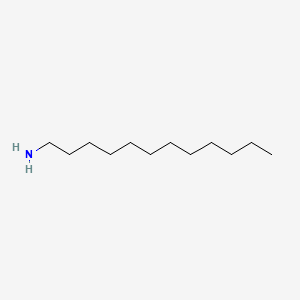
Dodecylamine
Dodecanamine appears as a yellow liquid with an ammonia-like odor. Insoluble in water and less dense than water. Hence floats on water. Contact may irritate skin, eyes and mucous membranes. May be toxic by ingestion, inhalation or skin absorption. Used to make other chemicals. — CAMEO Chemicals
- IUPAC 명칭
- dodecan-1-amine
- 분자식
- C12H27N
- 분자량
- 185.35 g/mol
- 정확한 질량
- 185.214349865 Da
- XLogP3
- 5.3
- 위상 극성 표면적
- 26.0 Ų
- 수소 결합 공여체
- 1
- 수소 결합 수용체
- 1
- 공유결합 단위
- 1
- 정의된 입체중심
- 0
다른 이름
1-DodecanamineLaurylamine1-Aminododecanen-DodecylamineLauramineNissan amine BBAlamine 4Monododecylamine
보고된 명칭 16개 더 보기
n-LaurylamineLaurinamineArmeen 12DKemamine P690Amine BBFarmin 20DLauryl amineYWY9OD6A2KRefChem:135511204-690-6Dodecanamine1-Dodecylaminen-dodecyl amineAmine 12dodecane, 1-amino-Armeen 12D; Farmin 20D; HAN 12
외부 데이터베이스 식별자
- ChEBI:CHEBI:193593
- ChEMBL:CHEMBL109904
- EPA DTXSID:DTXSID3021984
- PubMed:22983592
- PubMed:22966696
- PubMed:22850398
- PubMed:22840533
- PubMed:22776375
- PubMed:22683185
- PubMed:22672980
- PubMed:22608148
- PubMed:22543313
- PubMed:22530924
- PubMed:22515233
- PubMed:22441100
추가 과학 데이터베이스의 근거
NIH PubChem PUG-View
식별자 정확히 일치13583
Attributed physical-property, hazard, environmental and use annotations.
- Boiling Point: 259 °C 출처: Hazardous Substances Data Bank (HSDB)
- Boiling Point: 259 °C 출처: ILO-WHO International Chemical Safety Cards (ICSCs)
- Color/Form: OIL 출처: Hazardous Substances Data Bank (HSDB)
- Density: 0.8015 g/cu cm @ 20 °C/4 °C 출처: Hazardous Substances Data Bank (HSDB)
- Density: 0.81 g/cm³ 출처: ILO-WHO International Chemical Safety Cards (ICSCs)
- Flash Point: 352 °F (COC) 출처: Hazardous Substances Data Bank (HSDB)
- LogP: 4.76 출처: ILO-WHO International Chemical Safety Cards (ICSCs)
- Melting Point: 28.3 °C 출처: Hazardous Substances Data Bank (HSDB)
- Melting Point: 28 °C 출처: ILO-WHO International Chemical Safety Cards (ICSCs)
- Odor: AMINE ODOR 출처: Hazardous Substances Data Bank (HSDB)
- Physical Description: Dodecanamine appears as a yellow liquid with an ammonia-like odor. Insoluble in water and less dense than water. Hence floats on water. Contact may irritate skin, eyes and mucous membranes. May be toxic by ingestion, inhalation or skin absorption. Used to make other chemicals. 출처: CAMEO Chemicals
- Physical Description: Other Solid; Liquid 출처: EPA Chemical Data Reporting (CDR)
- Physical Description: White solid; mp = 28 deg C; [ICSC] Oil with an amine odor; mp = 28.3 deg C; [HSDB] Yellow liquid with an odor of ammonia; [CAMEO] White low-melting solid; mp 28-30 deg C; [MSDSonline] 출처: Haz-Map, Information on Hazardous Chemicals and Occupational Diseases
- Physical Description: WHITE CRYSTALLINE POWDER WITH CHARACTERISTIC ODOUR. 출처: ILO-WHO International Chemical Safety Cards (ICSCs)
- Refractive Index: Index of refraction: 1.4421 @ 20 °C/D 출처: Hazardous Substances Data Bank (HSDB)
- Solubility: Miscible in ethanol, ethyl ether, and benzene. 출처: Hazardous Substances Data Bank (HSDB)
- Solubility: In water, 0.078 g/l at 25 °C and pH 11.8. 출처: Hazardous Substances Data Bank (HSDB)
- Solubility: Solubility in water: poor 출처: ILO-WHO International Chemical Safety Cards (ICSCs)
- Vapor Pressure: 0.00805 [mmHg] 출처: Haz-Map, Information on Hazardous Chemicals and Occupational Diseases
- Vapor Pressure: 8.05X10⁻³ mm Hg at 25 °C 출처: Hazardous Substances Data Bank (HSDB)
- Exposure Routes: The substance can be absorbed into the body by ingestion. 출처: ILO-WHO International Chemical Safety Cards (ICSCs)
- First Aid: Excerpt from ERG Guide 153 [Substances - Toxic and/or Corrosive (Combustible)]:; Refer to the "General First Aid" section. Specific First Aid: For corrosives, in case of contact, immediately flush skin or eyes with running water for at least 30 minutes. Additional flushing may be required. Removal of solidified molten material from skin requires medical assistance. (ERG, 2024) 출처: CAMEO Chemicals
- Note: This chemical does not meet GHS hazard criteria for 3.7% (32 of 855) of reports. 출처: European Chemicals Agency (ECHA)
- Signal: Danger 출처: European Chemicals Agency (ECHA)
- GHS Hazard Statements: H290 (52.4%): May be corrosive to metals [Warning Corrosive to Metals]; H302 (14.2%): Harmful if swallowed [Warning Acute toxicity, oral]; H304 (79.3%): May be fatal if swallowed and enters airways [Danger Aspiration hazard]; H314 (96.3%): Causes severe skin burns and eye damage [Danger Skin corrosion/irritation]; H318 (14.6%): Causes serious eye damage [Danger Serious eye damage/eye irritation]; H335 (82%): May cause respiratory irritation [Warning Specific target organ toxicity, single exposure; Respiratory tract irritation]; H373 (82%): May causes damage to organs through prolonged or repeated exposure [Warning Specific target organ toxicity, repeated exposure]; H400 (90.2%): Very toxic to aquatic life [Warning Hazardous to the aquatic environment, acute hazard]; H410 (79.5%): Very toxic to aquatic life with long lasting effects [Warning Hazardous to the aquatic environment, long-term hazard] 출처: European Chemicals Agency (ECHA)
- Precautionary Statement Codes: P234, P260, P261, P264, P264+P265, P270, P271, P273, P280, P301+P316, P301+P317, P301+P330+P331, P302+P361+P354, P304+P340, P305+P354+P338, P316, P317, P319, P321, P330, P331, P363, P390, P391, P403+P233, P405, P406, and P501 (click each P-code to see the statement) 출처: European Chemicals Agency (ECHA)
- ECHA C&L Notifications Summary: Aggregated GHS information provided per 855 reports by companies from 26 notifications to the ECHA C&L Inventory. Each notification may be associated with multiple companies.; Reported as not meeting GHS hazard criteria per 32 of 855 reports by companies.; There are 25 notifications provided by 823 of 855 reports by companies with hazard statement code(s).; Information may vary between notifications depending on impurities, additives, and other factors. The percentage value in parenthesis indicates the notified classification ratio from companies that provide hazard codes. Only hazard codes with percentage values above 10% are shown. For more detailed information, please visit ECHA C&L website. 출처: European Chemicals Agency (ECHA)
- Signal: Danger 출처: Hazardous Chemical Information System (HCIS), Safe Work Australia
- GHS Hazard Statements: H302: Harmful if swallowed [Warning Acute toxicity, oral]; H304: May be fatal if swallowed and enters airways [Danger Aspiration hazard]; H314: Causes severe skin burns and eye damage [Danger Skin corrosion/irritation]; H335: May cause respiratory irritation [Warning Specific target organ toxicity, single exposure; Respiratory tract irritation]; H373: May causes damage to organs through prolonged or repeated exposure [Warning Specific target organ toxicity, repeated exposure] 출처: Hazardous Chemical Information System (HCIS), Safe Work Australia
- Precautionary Statement Codes: P260, P261, P264, P270, P271, P280, P301+P316, P301+P317, P301+P330+P331, P302+P361+P354, P304+P340, P305+P354+P338, P316, P319, P321, P330, P331, P363, P403+P233, P405, and P501 (click each P-code to see the statement) 출처: Hazardous Chemical Information System (HCIS), Safe Work Australia
- Cosmetic Ingredient Review Conclusion: The safety of Lauramine and Stearamine has not been documented and substantiated. The CIR Expert Panel cannot conclude whether these ingredients are safe for use in cosmetic products until the appropriate safety data have been obtained and evaluated. 출처: Cosmetic Ingredient Review (CIR)
- Cosmetic Ingredient Review Finding(s): The available data are insufficient to support safety 출처: Cosmetic Ingredient Review (CIR)
- Environmental Bioconcentration: An estimated BCF of 2,400 was calculated for dodecylamine(SRC), using an estimated log Kow of 4.8(1,SRC) and a regression-derived equation(2). According to a classification scheme(3), this BCF suggests the potential for bioconcentration in aquatic organisms is very high. 출처: Hazardous Substances Data Bank (HSDB)
- Environmental Fate: TERRESTRIAL FATE: Based on a classification scheme(1), an estimated Koc value of 9,300(SRC) determined from an estimated log Kow of 4.8(2,SRC) and a regression-derived equation(3) indicates that dodecylamine is expected to be immobile in soil(SRC). A pKa of 10.63(4) indicates dodecylamine will exist predominately in the protonated form at environmental pHs and as a result, volatilization from moist soil surfaces is not expected to be an important fate process(SRC). Dodecylamine is not expected to volatilize from dry soil surfaces(SRC) based upon a vapor pressure of 8.05X10⁻³ mm Hg(5). A 60% of theoretical BOD in an activated sludge inoculum over a 12 day incubation period suggests that dodecylamine may biodegrade in soil(6). 출처: Hazardous Substances Data Bank (HSDB)
- Environmental Fate: AQUATIC FATE: Based on a classification scheme(1), an estimated Koc value of 9,300(SRC) determined from an estimated log Kow of 4.8(2,SRC) and a regression-derived equation(3) indicates that dodecylamine is expected to adsorb to suspended solids and sediment in the water column(SRC). A pKa of 10.63(4) indicates that volatilization from water surfaces is not expected to be an important fate process since this compound will exist predominately in the protonated form at environmental pHs(SRC). According to a classification scheme(5), an estimated BCF of 2,400(3,SRC), from an estimated log Kow(2,SRC), suggests the potential for bioconcentration in aquatic organisms is very high(SRC). A 60% of theoretical BOD in an activated sludge inoculum over a 12 day incubation period, suggests that dodecylamine may biodegrade in water(6). 출처: Hazardous Substances Data Bank (HSDB)
- Environmental Fate: ATMOSPHERIC FATE: According to a model of gas/particle partitioning of semivolatile organic compounds in the atmosphere(1), dodecylamine, which has a vapor pressure of 8.05X10⁻³ mm Hg at 25 °C(2), is expected to exist solely as a vapor in the ambient atmosphere. Vapor-phase dodecylamine is degraded in the atmosphere by reaction with photochemically-produced hydroxyl radicals(SRC); the half-life for this reaction in air is estimated to be 8.4 hours(SRC) from its rate constant of 4.6X10⁻¹¹ cu cm/molecule-sec estimated using a structure estimation method(3). 출처: Hazardous Substances Data Bank (HSDB)
- Industry Uses: Intermediate 출처: EPA Chemical Data Reporting (CDR)
- Cosmetic Ingredient Review Link: CIR ingredient: Lauramine 출처: Cosmetic Ingredient Review (CIR)
- Sources/Uses: Used in cationic surfactants and to make dodecylguanidine acetate (fungicide); [HSDB] Used in dye and pigment production and as a surfactant for non-metallic mineral mining and quarrying; [EPA ChAMPS] 출처: Haz-Map, Information on Hazardous Chemicals and Occupational Diseases
- Industrial Processes with risk of exposure: Metal Extraction and Refining [Category: Industry] 출처: Haz-Map, Information on Hazardous Chemicals and Occupational Diseases
- Uses: CHEM INT FOR THE FUNGICIDE, DODECYLGUANIDINE ACETATE; CHEM INT FOR CATIONIC SURFACTANTS 출처: Hazardous Substances Data Bank (HSDB)
- Uses: Cationic surface-active agent. 출처: Hazardous Substances Data Bank (HSDB)
매핑 기준: Existing checksum-valid CAS to unique PubChem CID match. 가져온 시각: 2026-08-31. 출처 기록 열기
과학적 분류와 유해성 주석은 맥락을 제공할 뿐이며, 위에 표시된 시장별 규제 판단을 대체하지 않습니다.
추가 출처 적용 범위 및 일치 상태
| 출처 | 결과 | 확인됨 |
|---|---|---|
| NIH PubChem PUG-View | 정확히 일치 | 2026-08-31 |
기록된 불일치는 출처를 확인했다는 유용한 근거이며, 해당 물질이 다른 곳에 존재하지 않는다는 주장이 아닙니다.
체크섬이 유효한 CAS 일치를 통해 2026-08-31에 NIH PubChem에서 가져왔습니다. 화학적 특성은 이 페이지의 규제 판단을 대체하지 않습니다.