
CAS 123-91-1
CAS 123-91-1은(는) 규정 1223/2009의 부속서 II–VI에 걸쳐 EU 부속서 기록 1건과 일치합니다.
CAS 123-91-1의 기록
1 총화학적 정체 및 특성
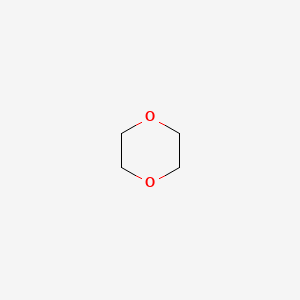
1,4-Dioxane
1,4-Dioxane is a clear liquid that easily dissolves in water. It is used primarily as a solvent in the manufacture of chemicals and as a laboratory reagent; 1,4-dioxane also has various other uses that take advantage of its solvent properties. 1,4-Dioxane is a trace contaminant of some chemicals used in cosmetics, detergents, and shampoos. However, manufacturers now reduce 1,4-dioxane from these chemicals to low levels before these chemicals are made into products used in the home. — Agency for Toxic Substances and Disease Registry (ATSDR)
- IUPAC 명칭
- 1,4-dioxane
- 분자식
- C4H8O2
- 분자량
- 88.11 g/mol
- 정확한 질량
- 88.052429494 Da
- XLogP3
- -0.3
- 위상 극성 표면적
- 18.5 Ų
- 수소 결합 공여체
- 0
- 수소 결합 수용체
- 2
- 공유결합 단위
- 1
- 정의된 입체중심
- 0
다른 이름
보고된 명칭 16개 더 보기
외부 데이터베이스 식별자
- ChEBI:CHEBI:47032
- ChEMBL:CHEMBL453716
- EPA DTXSID:DTXSID4020533
- PubMed:40323311
- PubMed:39192018
- PubMed:37258237
- PubMed:33693819
- PubMed:30155721
- PubMed:29553459
- PubMed:23062789
- PubMed:23025400
- PubMed:23012939
- PubMed:23007610
- PubMed:22997701
- PubMed:22987591
추가 과학 데이터베이스의 근거
NIH PubChem PUG-View
Attributed physical-property, hazard, environmental and use annotations.
- Autoignition Temperature: 356 °F (USCG, 1999) 출처: CAMEO Chemicals
- Autoignition Temperature: Autoignition temperature, 356 °F, (180 °C) 출처: Hazardous Substances Data Bank (HSDB)
- Autoignition Temperature: 180 °C 출처: ILO-WHO International Chemical Safety Cards (ICSCs)
- Boiling Point: 214 °F at 760 mmHg (NTP, 1992) 출처: CAMEO Chemicals
- Boiling Point: 101.2 °C 출처: Hazardous Substances Data Bank (HSDB)
- Boiling Point: 101 °C 출처: ILO-WHO International Chemical Safety Cards (ICSCs)
- Boiling Point: 214 °F 출처: Occupational Safety and Health Administration (OSHA)
- Boiling Point: 101.5 °C @760 [mm Hg] 출처: PAC Chemical Database, U.S. Department of Energy
- Boiling Point: 214 °F 출처: The National Institute for Occupational Safety and Health (NIOSH)
- Color/Form: Colorless liquid or solid (below 53 degrees F) 출처: Hazardous Substances Data Bank (HSDB)
- Density: 1.036 at 68 °F (USCG, 1999) - Denser than water; will sink 출처: CAMEO Chemicals
- Density: 1.0337 g/cu cm at 20 °C 출처: Hazardous Substances Data Bank (HSDB)
- Density: Relative density (water = 1): 1.03 출처: ILO-WHO International Chemical Safety Cards (ICSCs)
- Density: 1.03 출처: Occupational Safety and Health Administration (OSHA)
- Density: 1.0337 @ 20°C 출처: PAC Chemical Database, U.S. Department of Energy
- Density: 1.03 출처: The National Institute for Occupational Safety and Health (NIOSH)
- Flash Point: 54 °F (NTP, 1992) 출처: CAMEO Chemicals
- Flash Point: 18 °C 출처: Haz-Map, Information on Hazardous Chemicals and Occupational Diseases
- Flash Point: 65 °F (18.3 °C) (Open cup) 출처: Hazardous Substances Data Bank (HSDB)
- Flash Point: 12 °C c.c. 출처: ILO-WHO International Chemical Safety Cards (ICSCs)
- Flash Point: 55 °F 출처: Occupational Safety and Health Administration (OSHA)
- Flash Point: 55 °F 출처: The National Institute for Occupational Safety and Health (NIOSH)
- LogP: log Kow = -0.27 출처: Hazardous Substances Data Bank (HSDB)
- LogP: -0.27 출처: ILO-WHO International Chemical Safety Cards (ICSCs)
- Melting Point: 53.2 °F (NTP, 1992) 출처: CAMEO Chemicals
- Melting Point: 11.75 °C 출처: Hazardous Substances Data Bank (HSDB)
- Melting Point: 12 °C 출처: ILO-WHO International Chemical Safety Cards (ICSCs)
- Melting Point: 53 °F 출처: Occupational Safety and Health Administration (OSHA)
- Melting Point: 11.7 °C 출처: PAC Chemical Database, U.S. Department of Energy
- Melting Point: 53 °F 출처: The National Institute for Occupational Safety and Health (NIOSH)
- Odor: Faint pleasant odor 출처: Hazardous Substances Data Bank (HSDB)
- Odor: Mild, ether-like odor 출처: Hazardous Substances Data Bank (HSDB)
- Odor: The odor of dioxane in low concentrations is faint and generally inoffensive and has been described as being somewhat alcoholic. 출처: Hazardous Substances Data Bank (HSDB)
- Physical Description: Dioxane appears as a clear colorless liquid with a faint ethereal odor. Flash point 55 °F. Slightly denser than water and soluble in water. Vapors heavier than air. Susceptible to autooxidation to form peroxides. 출처: CAMEO Chemicals
- Physical Description: Liquid; Other Solid; Liquid 출처: EPA Chemical Data Reporting (CDR)
- Physical Description: Colorless liquid or solid (below 53 degrees F) with a mild, ether-like odor; [NIOSH] 출처: Haz-Map, Information on Hazardous Chemicals and Occupational Diseases
- Physical Description: COLOURLESS LIQUID WITH CHARACTERISTIC ODOUR. 출처: ILO-WHO International Chemical Safety Cards (ICSCs)
- Physical Description: Colorless liquid or solid (below 53 °F) with a mild, ether-like odor. 출처: Occupational Safety and Health Administration (OSHA)
- Physical Description: Colorless liquid or solid (below 53 °F) with a mild, ether-like odor. 출처: The National Institute for Occupational Safety and Health (NIOSH)
- Refractive Index: Index of refraction: 1.4224 20 °C 출처: Hazardous Substances Data Bank (HSDB)
- Solubility: greater than or equal to 100 mg/mL at 68 °F (NTP, 1992) 출처: CAMEO Chemicals
- Solubility: In water, >800 g/L at 25 °C 출처: Hazardous Substances Data Bank (HSDB)
- Solubility: Miscible with most organic solvents 출처: Hazardous Substances Data Bank (HSDB)
- Solubility: Miscible with aromatic hydrocarbons and oils. 출처: Hazardous Substances Data Bank (HSDB)
- Solubility: Solubility in water: miscible 출처: ILO-WHO International Chemical Safety Cards (ICSCs)
- Solubility: Miscible 출처: The National Institute for Occupational Safety and Health (NIOSH)
- Vapor Pressure: 29 mmHg at 68 °F ; 37 mmHg at 77 °F (NTP, 1992) 출처: CAMEO Chemicals
- Vapor Pressure: 38.1 [mmHg] 출처: Haz-Map, Information on Hazardous Chemicals and Occupational Diseases
- Vapor Pressure: 38.1 mm Hg at 25 °C 출처: Hazardous Substances Data Bank (HSDB)
- Vapor Pressure: Vapor pressure, kPa at 20 °C: 3.9 출처: ILO-WHO International Chemical Safety Cards (ICSCs)
- Vapor Pressure: 29 mmHg 출처: Occupational Safety and Health Administration (OSHA)
- Vapor Pressure: 75 [mm Hg] @39.6 °C 출처: PAC Chemical Database, U.S. Department of Energy
- Vapor Pressure: 29 mmHg 출처: The National Institute for Occupational Safety and Health (NIOSH)
- Viscosity: 0.0120 centipoise at 25 °C 출처: Hazardous Substances Data Bank (HSDB)
- Viscosity: 1.17 mm²/s at 25 °C 출처: ILO-WHO International Chemical Safety Cards (ICSCs)
- IARC Carcinogenic Agent: 1,4-Dioxane 출처: International Agency for Research on Cancer (IARC)
- IARC Carcinogenic Classes: Group 2B: Possibly carcinogenic to humans 출처: International Agency for Research on Cancer (IARC)
- IARC Monographs: Volume 11: (1976) Cadmium, Nickel, Some Epoxides, Miscellaneous Industrial Chemicals and General Considerations on Volatile Anaesthetics; Volume Sup 7: Overall Evaluations of Carcinogenicity: An Updating of IARC Monographs Volumes 1 to 42, 1987; 440 pages; ISBN 92-832-1411-0 (out of print); Volume 71: (1999) Re-evaluation of Some Organic Chemicals, Hydrazine and Hydrogen Peroxide (Part 1, Part 2, Part 3) 출처: International Agency for Research on Cancer (IARC)
- Publication Year: 1999 출처: International Agency for Research on Cancer (IARC)
- Evaluation Year: 1998 출처: International Agency for Research on Cancer (IARC)
- Substance: 1,4-Dioxane 출처: NTP Technical Reports
- NTP Technical Report: TR-080: Bioassay of 1,4-Dioxane for Possible Carcinogenicity (CASRN 123-91-1) (1978 ) 출처: NTP Technical Reports
- Peer Review Date: 03/07/78 출처: NTP Technical Reports
- Conclusion for Male Rat: Clear Evidence 출처: NTP Technical Reports
- Conclusion for Female Rat: Clear Evidence 출처: NTP Technical Reports
- Conclusion for Male Mice: Clear Evidence 출처: NTP Technical Reports
- Conclusion for Female Mice: Clear Evidence 출처: NTP Technical Reports
- Exposure Routes: The substance can be absorbed into the body by inhalation of its vapour and through the skin. 출처: ILO-WHO International Chemical Safety Cards (ICSCs)
- Exposure Routes: inhalation, skin absorption, ingestion, skin and/or eye contact 출처: The National Institute for Occupational Safety and Health (NIOSH)
- Exposure Routes: Oral (L1189) ; inhalation (L1189) ; dermal (L1189) 출처: Toxin and Toxin Target Database (T3DB)
- First Aid: EYES: First check the victim for contact lenses and remove if present. Flush victim's eyes with water or normal saline solution for 20 to 30 minutes while simultaneously calling a hospital or poison control center. Do not put any ointments, oils, or medication in the victim's eyes without specific instructions from a physician. IMMEDIATELY transport the victim after flushing eyes to a hospital even if no symptoms (such as redness or irritation) develop.; SKIN: IMMEDIATELY flood affected skin with water while removing and isolating all contaminated clothing. Gently wash all affected skin areas thoroughly with soap and water. IMMEDIATELY call a hospital or poison control center even if no symptoms (such as redness or irritation) develop. IMMEDIATELY transport the victim to a hospital for treatment after washing the affected areas.; INHALATION: IMMEDIATELY leave the contaminated area; take deep breaths of fresh air. IMMEDIATELY call a physician and be prepared to transport the victim to a hospital even if no symptoms (such as wheezing, coughing, shortness of breath, or burning in the mouth, throat, or chest) develop. Provide proper respiratory protection to rescuers entering an unknow 출처: CAMEO Chemicals
- ERG2024, Guide 127 (Dioxane): General First Aid:; · Call 911 or emergency medical service.; · Ensure that medical personnel are aware of the material(s) involved, take precautions to protect themselves and avoid contamination.; · Move victim to fresh air if it can be done safely.; · Administer oxygen if breathing is difficult.; · If victim is not breathing:; -- DO NOT perform mouth-to-mouth resuscitation; the victim may have ingested or inhaled the substance.; -- If equipped and pulse detected, wash face and mouth, then give artificial respiration using a proper respiratory medical device (bag-valve mask, pocket mask equipped with a one-way valve or other device).; -- If no pulse detected or no respiratory medical device available, provide continuous compressions. Conduct a pulse check every two minutes or monitor for any signs of spontaneous respirations.; · Remove and isolate contaminated clothing and shoes.; · For minor skin contact, avoid spreading material on unaffected skin.; · In case of contact with substance, remove immediately by flushing skin or eyes with running water for at least 20 minutes.; · For severe burns, immediate medical attention is required.; · Effects of exposure (inhalation, ingestion, 출처: Emergency Response Guidebook (ERG)
- First Aid: (General first aid procedures); Eye: Irrigate immediately - If this chemical contacts the eyes, immediately wash (irrigate) the eyes with large amounts of water, occasionally lifting the lower and upper lids. Get medical attention immediately.; Skin: Water wash promptly - If this chemical contacts the skin, promptly wash the contaminated skin with water. If this chemical penetrates the clothing, promptly remove the clothing and wash the skin with water. If irritation persists after washing, get medical attention.; Breathing: Respiratory support; Swallow: Medical attention immediately - If this chemical has been swallowed, get medical attention immediately. 출처: The National Institute for Occupational Safety and Health (NIOSH)
- Signal: Danger 출처: Regulation (EC) No 1272/2008 of the European Parliament and of the Council
- GHS Hazard Statements: H225: Highly Flammable liquid and vapor [Danger Flammable liquids]; H319: Causes serious eye irritation [Warning Serious eye damage/eye irritation]; H335: May cause respiratory irritation [Warning Specific target organ toxicity, single exposure; Respiratory tract irritation]; H350: May cause cancer [Danger Carcinogenicity] 출처: Regulation (EC) No 1272/2008 of the European Parliament and of the Council
- Precautionary Statement Codes: P203, P210, P233, P240, P241, P242, P243, P261, P264+P265, P271, P280, P303+P361+P353, P304+P340, P305+P351+P338, P318, P319, P337+P317, P370+P378, P403+P233, P403+P235, P405, and P501 (click each P-code to see the statement) 출처: Regulation (EC) No 1272/2008 of the European Parliament and of the Council
- Signal: Danger 출처: European Chemicals Agency (ECHA)
- GHS Hazard Statements: H225 (100%): Highly Flammable liquid and vapor [Danger Flammable liquids]; H319 (100%): Causes serious eye irritation [Warning Serious eye damage/eye irritation]; H335 (> 99.9%): May cause respiratory irritation [Warning Specific target organ toxicity, single exposure; Respiratory tract irritation]; H350 (22.3%): May cause cancer [Danger Carcinogenicity]; H351 (76.1%): Suspected of causing cancer [Warning Carcinogenicity] 출처: European Chemicals Agency (ECHA)
- Precautionary Statement Codes: P203, P210, P233, P240, P241, P242, P243, P261, P264+P265, P271, P280, P303+P361+P353, P304+P340, P305+P351+P338, P318, P319, P337+P317, P370+P378, P403+P233, P403+P235, P405, and P501 (click each P-code to see the statement) 출처: European Chemicals Agency (ECHA)
- ECHA C&L Notifications Summary: Aggregated GHS information provided per 1577 reports by companies from 50 notifications to the ECHA C&L Inventory. Each notification may be associated with multiple companies.; Information may vary between notifications depending on impurities, additives, and other factors. The percentage value in parenthesis indicates the notified classification ratio from companies that provide hazard codes. Only hazard codes with percentage values above 10% are shown. For more detailed information, please visit ECHA C&L website. 출처: European Chemicals Agency (ECHA)
- Signal: Danger 출처: NITE-CMC
- GHS Hazard Statements: H225: Highly Flammable liquid and vapor [Danger Flammable liquids]; H319: Causes serious eye irritation [Warning Serious eye damage/eye irritation]; H332: Harmful if inhaled [Warning Acute toxicity, inhalation]; H335: May cause respiratory irritation [Warning Specific target organ toxicity, single exposure; Respiratory tract irritation]; H336: May cause drowsiness or dizziness [Warning Specific target organ toxicity, single exposure; Narcotic effects]; H350: May cause cancer [Danger Carcinogenicity]; H372: Causes damage to organs through prolonged or repeated exposure [Danger Specific target organ toxicity, repeated exposure] 출처: NITE-CMC
- Precautionary Statement Codes: P203, P210, P233, P240, P241, P242, P243, P260, P261, P264, P264+P265, P270, P271, P280, P303+P361+P353, P304+P340, P305+P351+P338, P317, P318, P319, P337+P317, P370+P378, P403+P233, P403+P235, P405, and P501 (click each P-code to see the statement) 출처: NITE-CMC
- GHS Hazard Statements: H350: May cause cancer [Danger Carcinogenicity] 출처: NITE-CMC
- Precautionary Statement Codes: P203, P280, P318, P405, and P501 (click each P-code to see the statement) 출처: NITE-CMC
- Health Effects: 1,4-Dioxane for short period of time cause eye and nose irritation at low levels, and severe kidney and liver effects and possibly death at very high levels. For long-term exposure, studies in animals have shown that breathing vapors of 1,4-dioxane, swallowing liquid 1,4-dioxane or contaminated drinking water, or having skin contact with liquid 1,4-dioxane affects mainly the liver and kidneys. Studies in workers did not indicate whether 1,4-dioxane causes cancer, but animal studies suggest that it is a probable human carcinogen. (L1189) 출처: Toxin and Toxin Target Database (T3DB)
- NFPA Health Rating: 2 - Materials that, under emergency conditions, can cause temporary incapacitation or residual injury. 출처: Hazardous Substances Data Bank (HSDB)
- NFPA Fire Rating: 3 - Liquids and solids that can be ignited under almost all ambient temperature conditions. Materials produce hazardous atmospheres with air under almost all ambient temperatures or, though unaffected by ambient temperatures, are readily ignited under almost all conditions. 출처: Hazardous Substances Data Bank (HSDB)
- NFPA Instability Rating: 1 - Materials that in themselves are normally stable but that can become unstable at elevated temperatures and pressures. 출처: Hazardous Substances Data Bank (HSDB)
- Target Organs: Cancer, Developmental (effects while organs are developing), Hepatic (Liver), Ocular (Eyes), Renal (Urinary System or Kidneys), Respiratory (From the Nose to the Lungs) 출처: Agency for Toxic Substances and Disease Registry (ATSDR)
- Target Organs: Hepatic; Nervous; Respiratory; Urinary 출처: EPA Integrated Risk Information System (IRIS)
- Target Organs: Eyes, skin, respiratory system, liver, kidneys 출처: The National Institute for Occupational Safety and Health (NIOSH)
- Toxicity Summary: IDENTIFICATION AND USE: 1,4-Dioxane is a colorless liquid or solid. It is used as a stabilizer for chlorinated solvents, particularly, 1,1,1-trichloroethane. 1,4-Dioxane is used as a solvent for cellulose acetate, ethyl cellulose, benzyl cellulose, resins, oils, waxes, and fats; in spectroscopic and photometric measurements; and in the pulping of wood. Other uses of 1,4-dioxane include the manufacture of adhesives, cements, deodorant fumigants, cosmetics, drugs, cleaning preparations, magnetic tape, plastic, rubber, insecticides, and herbicides, and as a chemical intermediate, as a polymerization catalyst, in the purification of drugs, and in the extraction of animal and vegetable oils. In the laboratory, it is used in the preparation of histological sections for microscopic examination and as a liquid scintillation counting medium. HUMAN EXPOSURE AND TOXICITY: Short-term inhalation exposure to 1,4-dioxane may cause irritation of the eyes, nose, throat, and lungs. Symptoms of acute exposure include coughing, drowsiness, vertigo, headache, nausea, vomiting, stomach pains, coma, and death. There is a report of a fatal case of acute poisoning by inhalation that led to hepatic and rena 출처: Hazardous Substances Data Bank (HSDB)
- Toxicity Summary: Though the mechanism of toxicity of 1,4-dioxane has not yet been elucidated, it is known that its carcinogenic effects are caused by a non-genotoxic mechanism that is most likely cytotoxic in nature. (L1189, L1881) 출처: Toxin and Toxin Target Database (T3DB)
- Environmental Bioconcentration: Using OECD Guideline 305C (Bioaccumulation: Test for the Degree of Bioconcentration in Fish) with 1 and 10 ppm concentrations 1,4-dioxane, BCF values of 0.2-0.7 were measured using carp (Cyprinus carpio) which were exposed over a 6-week period(1). According to a classification scheme(2), these BCF values suggest the potential for bioconcentration in aquatic organisms is low(SRC). 출처: Hazardous Substances Data Bank (HSDB)
- Environmental Fate: TERRESTRIAL FATE: Based on a classification scheme(1), measured Koc values of 29(2) and 17(3) indicate that 1,4-dioxane is expected to have very high mobility in soil(SRC). Volatilization of 1,4-dioxane from moist soil surfaces is expected to be an important fate process(SRC) given a Henry's Law constant of 4.8X10⁻⁶ atm-cu m/mole(4). 1,4-Dioxane is expected to volatilize from dry soil surfaces(SRC) based upon a vapor pressure of 38.1 mm Hg at 25 °C(5). A 0% of theoretical BOD using activated sludge in the Japanese MITI test(6) suggests that 1,4-dioxane is not readily biodegradable(SRC). Other screening study results indicate that 1,4-dioxane is resistant to biodegradation and slow to biodegrade(7). Using soil microcosms 1,4-dioxane was not biodegraded within 120 days and, therefore, considered recalcitrant(8). 1,4-Dioxane did not biodegrade in most of 20 environmental samples (rivers waters, soils, activated sludge), but it was degradable in soils collected from drainage areas of a chemical factory within 33 days, presumably due to acclimation(9). 출처: Hazardous Substances Data Bank (HSDB)
- Environmental Fate: AQUATIC FATE: Based on a classification scheme(1), measured Koc values of 29(2) and 17(3) indicate that 1,4-dioxane is not expected to adsorb to suspended solids and sediment(SRC). Volatilization from water surfaces is expected(4) based upon a Henry's Law constant of 4.8X10⁻⁶ atm-cu m/mole(5). Using this Henry's Law constant and an estimation method(4), volatilization half-lives for a model river and model lake are 7.3 and 56 days, respectively(SRC). According to a classification scheme(6), a BCF range of 0.2-0.7 measured in carp (Cyprinus carpio)(7) suggests the potential for bioconcentration in aquatic organisms is low(SRC). A 0% of theoretical BOD using activated sludge in the Japanese MITI test(7) suggests that 1,4-dioxane is not readily biodegradable(SRC). Other screening studies have found 1,4-dioxane to be resistant to biodegradation and slow to biodegrade(8) and to be recalcitrant(9). 1,4-Dioxane is considered non-biodegradable under conventional bio-treatment technologies based on results of wastewater treatment monitoring data(10). 1,4-Dioxane is a very weak absorber of UV light(11)and results of aqueous photolysis studies(12) suggest that direct photolyis is not an impor 출처: Hazardous Substances Data Bank (HSDB)
- Environmental Fate: ATMOSPHERIC FATE: According to a model of gas/particle partitioning of semivolatile organic compounds in the atmosphere(1), 1,4-dioxane, which has a vapor pressure of 38.1 mm Hg at 25 °C(2), is expected to exist solely as a vapor in the ambient atmosphere. Vapor-phase 1,4-dioxane is degraded in the atmosphere by reaction with photochemically-produced hydroxyl radicals(SRC); the half-life for this reaction in air is estimated to be 33 hours(SRC), calculated from its rate constant of 1.18X10⁻¹¹ cu cm/molecule-sec at 25 °C(3). 1,4-Dioxane is a very weak absorber of UV light(4). Results of aqueous photolysis studies(5) suggest that direct photolysis is not an important environmental fate process(SRC). 출처: Hazardous Substances Data Bank (HSDB)
- Consumer Uses: Other; Solvent 출처: EPA Chemical Data Reporting (CDR)
- Industry Uses: Processing aids not otherwise specified; Other; Solvent; Laboratory chemicals; Intermediate; Cleaning agent 출처: EPA Chemical Data Reporting (CDR)
- Uses: 1,4-Dioxane is used as a solvent for cellulose acetate, ethyl cellulose, benzyl cellulose, resins, oils, waxes, some dyes, and other organic and inorganic compounds. 출처: EPA Hazardous Air Pollutants
- Sources/Uses: Used as a solvent for cellulose esters, ethers, and other organic chemicals; [ACGIH] Used as a solvent in resins, polymers, oils, waxes, dyes, wood pulping, adhesives, varnishes lacquers, paints, and cosmetics; [HSDB] 출처: Haz-Map, Information on Hazardous Chemicals and Occupational Diseases
- Industrial Processes with risk of exposure: Metal Degreasing [Category: Clean]; Textiles (Fiber & Fabric Manufacturing) [Category: Industry]; Painting (Solvents) [Category: Paint]; Plastic Composites Manufacturing [Category: Industry] 출처: Haz-Map, Information on Hazardous Chemicals and Occupational Diseases
- Uses: Stabilizer in chlorinated solvents. Organic solvent for cellulose acetate, ethyl cellulose, benzyl cellulose, resins, oils, waxes, oil and spirit-soluble dyes, and many other organic as well as some inorganic compounds. 출처: Hazardous Substances Data Bank (HSDB)
- Uses: The largest single use of 1,4-dioxane is the stabilization of 1,1,1-trichloroethane against chemical attack by aluminum. 출처: Hazardous Substances Data Bank (HSDB)
- Uses: Historically, 1,4-dioxane has been used as a stabilizer for the solvent 1,1,1-trichloroethane. However, this use is no longer expected to be important due to the 1990 Amendments to the Clean Air Act and the Montreal Protocol, which mandate the eventual phase-out of 1,1,1-trichloroethane production in the U.S. 출처: Hazardous Substances Data Bank (HSDB)
- Uses: Dioxane is used as a solvent in the formulation of inks, coatings, and adhesives, and as solvent for extracting animal and vegetable oils. As a chemical intermediate, dioxane reaction products are useful as insecticides, herbicides, plasticizers, and monomers. The oxonium complexes of dioxane with salts, mineral acids, halogens, and sulfur trioxide are used as catalysts and as reagents for anhydrous acid reactions, brominations, and sulfonations. In the laboratory, dioxane is useful as a cryoscopic solvent for molecular mass determinations and as a stable reaction medium for diverse reactions. 출처: Hazardous Substances Data Bank (HSDB)
- Uses: For more Uses (Complete) data for 1,4-DIOXANE (8 total), please visit the HSDB record page. 출처: Hazardous Substances Data Bank (HSDB)
- Uses: 1,4-Dioxane is primarily used in solvent applications for the manufacturing sector; however, it is also found in fumigants and automotive coolant. 1,4-Dioxane is a byproduct of the ethoxylation process in cosmetics manufacturing, thus many products on the market today contain 1,4-dioxane in very small amounts. However, some cosmetics, detergents, and shampoos may contain 1,4-dioxane at levels higher than recommended by the FDA for other products. 1,4-Dioxane can also be found in tap water, so human exposure to 1,4-dioxane may also occur during activities such as showering, bathing, and laundering. (L1189, L1880) 출처: Toxin and Toxin Target Database (T3DB)
매핑 기준: Existing checksum-valid CAS to unique PubChem CID match. 가져온 시각: 2026-08-31. 출처 기록 열기
과학적 분류와 유해성 주석은 맥락을 제공할 뿐이며, 위에 표시된 시장별 규제 판단을 대체하지 않습니다.
추가 출처 적용 범위 및 일치 상태
| 출처 | 결과 | 확인됨 |
|---|---|---|
| NIH PubChem PUG-View | 정확히 일치 | 2026-08-31 |
기록된 불일치는 출처를 확인했다는 유용한 근거이며, 해당 물질이 다른 곳에 존재하지 않는다는 주장이 아닙니다.
체크섬이 유효한 CAS 일치를 통해 2026-09-02에 NIH PubChem에서 가져왔습니다. 화학적 특성은 이 페이지의 규제 판단을 대체하지 않습니다.
이 사이트에서 CAS 123-91-1을(를) 사용하는 방식
CAS 123-91-1은(는) 이 페이지를 특정 물질에 고정하는 데 사용하는 Chemical Abstracts Service 식별자입니다. 현재 데이터세트에서는 EU 부속서 기록 1건이 이 식별자를 공유하며, 같은 물질이 하나의 규제 맥락에 나타나는지 여러 맥락에 나타나는지 교차 확인하는 데 도움이 됩니다.
공급업체 규격서, SDS 또는 원료 문서에 CAS 123-91-1이(가) 제시되어 있고 연결된 모든 부속서 II–VI 기록을 한곳에서 확인해야 할 때 이 페이지를 이용하세요. 위의 항목 카드는 농도 한도, 경고 문구, 부속서 위치 및 제품 유형 조건을 가장 빠르게 확인하는 방법입니다.