
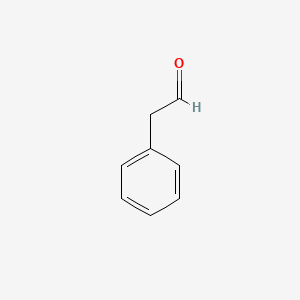
Phenylacetaldehyde
Phenylacetaldehyde is an aldehyde that consists of acetaldehyde bearing a methyl substituent; the parent member of the phenylacetaldehyde class of compounds. It has a role as a mouse metabolite, a Saccharomyces cerevisiae metabolite, an Escherichia coli metabolite and a human metabolite. It is a member of phenylacetaldehydes and an alpha-CH2-containing aldehyde. — ChEBI
- IUPAC 명칭
- 2-phenylacetaldehyde
- 분자식
- C8H8O
- 분자량
- 120.15 g/mol
- 정확한 질량
- 120.057514874 Da
- XLogP3
- 1.8
- 위상 극성 표면적
- 17.1 Ų
- 수소 결합 공여체
- 0
- 수소 결합 수용체
- 1
- 공유결합 단위
- 1
- 정의된 입체중심
- 0
다른 이름
보고된 명칭 16개 더 보기
외부 데이터베이스 식별자
- ChEBI:CHEBI:16424
- ChEMBL:CHEMBL1233464
- EPA DTXSID:DTXSID3021483
- PubMed:26795242
- PubMed:23019481
- PubMed:22998013
- PubMed:22818888
- PubMed:22711028
- PubMed:22656242
- PubMed:22645543
- PubMed:22639900
- PubMed:22611362
- PubMed:22606270
- PubMed:22606125
- PubMed:22591108
추가 과학 데이터베이스의 근거
NIH PubChem PUG-View
Attributed physical-property, hazard, environmental and use annotations.
- Boiling Point: 195 °C 출처: DrugBank
- Boiling Point: 195 °C 출처: Joint FAO/WHO Expert Committee on Food Additives (JECFA)
- Density: 1.023-1.045 출처: Joint FAO/WHO Expert Committee on Food Additives (JECFA)
- LogP: 1.78 출처: DrugBank
- LogP: 1.78 출처: Human Metabolome Database (HMDB)
- Melting Point: 33.5 °C 출처: DrugBank
- Melting Point: 120.5 - 121.5 °C 출처: Human Metabolome Database (HMDB)
- Physical Description: Colorless oily liquid that polymerizes and becomes thicker on standing; Odor like lilac and hyacinth; mp = 33-34 deg C; [Merck Index] Colorless to yellow liquid; [Acros Organics MSDS] 출처: Haz-Map, Information on Hazardous Chemicals and Occupational Diseases
- Physical Description: Solid 출처: Human Metabolome Database (HMDB)
- Physical Description: Colourless to slighty yellow oily liquid; very powerful and penetrating pungent green floral and sweet odour of hyacinth type 출처: Joint FAO/WHO Expert Committee on Food Additives (JECFA)
- Refractive Index: 1.524-1.545 출처: Joint FAO/WHO Expert Committee on Food Additives (JECFA)
- Solubility: Slightly soluble in water; insoluble in water; soluble in oils, propylene glycol 출처: Joint FAO/WHO Expert Committee on Food Additives (JECFA)
- Solubility: 1 mL in 2 mL 80% ethanol (in ethanol) 출처: Joint FAO/WHO Expert Committee on Food Additives (JECFA)
- Vapor Pressure: 0.39 [mmHg] 출처: Haz-Map, Information on Hazardous Chemicals and Occupational Diseases
- Carcinogen Classification: Not listed by IARC. 출처: Toxin and Toxin Target Database (T3DB)
- Signal: Danger 출처: European Chemicals Agency (ECHA)
- GHS Hazard Statements: H302 (99.8%): Harmful if swallowed [Warning Acute toxicity, oral]; H314 (80%): Causes severe skin burns and eye damage [Danger Skin corrosion/irritation]; H317 (96.8%): May cause an allergic skin reaction [Warning Sensitization, Skin]; H318 (78.6%): Causes serious eye damage [Danger Serious eye damage/eye irritation] 출처: European Chemicals Agency (ECHA)
- Precautionary Statement Codes: P260, P261, P264, P264+P265, P270, P272, P280, P301+P317, P301+P330+P331, P302+P352, P302+P361+P354, P304+P340, P305+P354+P338, P316, P317, P321, P330, P333+P317, P362+P364, P363, P405, and P501 (click each P-code to see the statement) 출처: European Chemicals Agency (ECHA)
- ECHA C&L Notifications Summary: Aggregated GHS information provided per 1836 reports by companies from 21 notifications to the ECHA C&L Inventory. Each notification may be associated with multiple companies.; Information may vary between notifications depending on impurities, additives, and other factors. The percentage value in parenthesis indicates the notified classification ratio from companies that provide hazard codes. Only hazard codes with percentage values above 10% are shown. For more detailed information, please visit ECHA C&L website. 출처: European Chemicals Agency (ECHA)
- Sources/Uses: Permitted for use as an inert ingredient in non-food pesticide products; [EPA] Used in perfumery and as an intermediate in organic synthesis; [Merck Index] Used as flavoring agent or adjuvant; [FDA] 출처: Haz-Map, Information on Hazardous Chemicals and Occupational Diseases
- Uses: This is an endogenously produced metabolite found in the human body. It is used in metabolic reactions, catabolic reactions or waste generation. 출처: Toxin and Toxin Target Database (T3DB)
매핑 기준: Existing checksum-valid CAS to unique PubChem CID match. 가져온 시각: 2026-08-31. 출처 기록 열기
과학적 분류와 유해성 주석은 맥락을 제공할 뿐이며, 위에 표시된 시장별 규제 판단을 대체하지 않습니다.
추가 출처 적용 범위 및 일치 상태
| 출처 | 결과 | 확인됨 |
|---|---|---|
| NIH PubChem PUG-View | 정확히 일치 | 2026-08-31 |
기록된 불일치는 출처를 확인했다는 유용한 근거이며, 해당 물질이 다른 곳에 존재하지 않는다는 주장이 아닙니다.
체크섬이 유효한 CAS 일치를 통해 2026-08-31에 NIH PubChem에서 가져왔습니다. 화학적 특성은 이 페이지의 규제 판단을 대체하지 않습니다.