
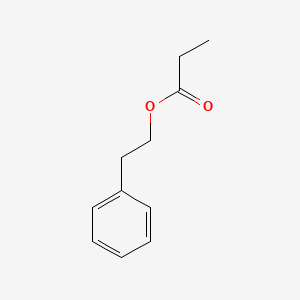
CAS 122-70-3PubChem CID 31225
2-Phenylethyl propionate
2-Phenylethyl propanoate is a member of benzenes. — ChEBI
- IUPAC 명칭
- 2-phenylethyl propanoate
- 분자식
- C11H14O2
- 분자량
- 178.23 g/mol
- 정확한 질량
- 178.099379685 Da
- XLogP3
- 2.8
- 위상 극성 표면적
- 26.3 Ų
- 수소 결합 공여체
- 0
- 수소 결합 수용체
- 2
- 공유결합 단위
- 1
- 정의된 입체중심
- 0
다른 이름
Phenethyl propionatePropanoic acid, 2-phenylethyl esterPhenylethyl propionateCaswell No. 655DFEMA No. 2867UNII-9VFI60EUHWNSC-404457HSDB 7428
보고된 명칭 16개 더 보기
EINECS 204-567-7phenyl ethyl propionateEPA Pesticide Chemical Code 102601BRN 2097455AI3-18544Phenylethanol propanoateFEMA 2867PHENETHYL PROPIONATE [FHFI]PHENETHYL PROPIONATE [HSDB]3-06-00-01709 (Beilstein Handbook Reference)PHENYL ETHYL PROPIONATE [FCC]2Phenethylpropionate2Phenethyl propionate2Phenylethyl propanoateRefChem:890812-Phenylethyl propanoic acid
외부 데이터베이스 식별자
- ChEBI:CHEBI:173825
- ChEMBL:CHEMBL1867360
- EPA DTXSID:DTXSID6035156
- PubMed:22406565
- PubMed:21864158
- PubMed:20204614
- PubMed:18570373
- PubMed:18381775
추가 과학 데이터베이스의 근거
NIH PubChem PUG-View
식별자 정확히 일치31225
Attributed physical-property, hazard, environmental and use annotations.
- Boiling Point: 244.00 to 245.00 °C. @ 760.00 mm Hg 출처: Human Metabolome Database (HMDB)
- Boiling Point: 244-245 °C 출처: Joint FAO/WHO Expert Committee on Food Additives (JECFA)
- Color/Form: Colorless liquid 출처: Hazardous Substances Data Bank (HSDB)
- Density: 1.02 at 25/25 °C 출처: Hazardous Substances Data Bank (HSDB)
- Density: 1.010-1.021 출처: Joint FAO/WHO Expert Committee on Food Additives (JECFA)
- Melting Point: < 25 °C 출처: Human Metabolome Database (HMDB)
- Odor: Flower fruit odor 출처: Hazardous Substances Data Bank (HSDB)
- Physical Description: Liquid 출처: EPA Chemical Data Reporting (CDR)
- Physical Description: Colorless liquid with an odor of flowers or fruit; [HSDB] 출처: Haz-Map, Information on Hazardous Chemicals and Occupational Diseases
- Physical Description: Solid 출처: Human Metabolome Database (HMDB)
- Physical Description: Colourless or yellowish slighty oily liquid; very sweet odour reminiscent of red rose with a fruity undertone 출처: Joint FAO/WHO Expert Committee on Food Additives (JECFA)
- Refractive Index: 1.489-1.499 출처: Joint FAO/WHO Expert Committee on Food Additives (JECFA)
- Solubility: Miscible with alcohols and ether 출처: Hazardous Substances Data Bank (HSDB)
- Solubility: Insoluble in water; soluble in oils 출처: Joint FAO/WHO Expert Committee on Food Additives (JECFA)
- Solubility: Miscible at room temperature (in ethanol) 출처: Joint FAO/WHO Expert Committee on Food Additives (JECFA)
- Vapor Pressure: 0.05 [mmHg] 출처: Haz-Map, Information on Hazardous Chemicals and Occupational Diseases
- Note: This chemical does not meet GHS hazard criteria for 100% (1564 of 1564) of all reports. 출처: European Chemicals Agency (ECHA)
- GHS Hazard Statements: Not Classified; Reported as not meeting GHS hazard criteria by 1564 of 1564 companies. For more detailed information, please visit ECHA C&L website. 출처: European Chemicals Agency (ECHA)
- ECHA C&L Notifications Summary: Aggregated GHS information provided per 1564 reports by companies from 1 notifications to the ECHA C&L Inventory.; Reported as not meeting GHS hazard criteria per 1564 of 1564 reports by companies.; There are 0 notifications provided by 0 of 1564 reports by companies with hazard statement code(s).; Information may vary between notifications depending on impurities, additives, and other factors. The percentage value in parenthesis indicates the notified classification ratio from companies that provide hazard codes. Only hazard codes with percentage values above 10% are shown. For more detailed information, please visit ECHA C&L website. 출처: European Chemicals Agency (ECHA)
- Environmental Bioconcentration: An estimated BCF of 46 was calculated for 2-phenethyl propionate(SRC), using an estimated log Kow of 3.06(1) and a regression-derived equation(2). According to a classification scheme(3), this BCF suggests the potential for bioconcentration in aquatic organisms is moderate(SRC). 출처: Hazardous Substances Data Bank (HSDB)
- Environmental Fate: TERRESTRIAL FATE: Based on a classification scheme(1), an estimated Koc value of 476(SRC), determined from a structure estimation method(2), indicates that 2-phenethyl propionate is expected to have moderate mobility in soil(SRC). Volatilization of 2-phenethyl propionate from moist soil surfaces is expected to be an important fate process(SRC) given an estimated Henry's Law constant of 2.5X10⁻⁵ atm-cu m/mole(SRC), using a fragment constant estimation method(3). 2-Phenethyl propionate is not expected to volatilize from dry soil surfaces(SRC) based upon an estimated vapor pressure of 0.051 mm Hg(SRC), determined from a fragment constant method(4). Biodegradation data for 2-phenethyl propionate were not available(SRC, 2006); however, biodegradation is expected to be an important environmental fate process because of the presence of an easily biodegraded ester functional group(5). 출처: Hazardous Substances Data Bank (HSDB)
- Environmental Fate: AQUATIC FATE: Based on a classification scheme(1), an estimated Koc value of 476(SRC,2006), determined from a structure estimation method(2), indicates that 2-phenethyl propionate is expected to adsorb to suspended solids and sediment(SRC). Volatilization from water surfaces is expected(3) based upon an estimated Henry's Law constant of 2.5X10⁻⁵ atm-cu m/mole(SRC), developed using a fragment constant estimation method(4). Volatilization half-lives for a model river and model lake are 7 and 82 days, respectively(SRC). According to a classification scheme(5), an estimated BCF of 46(SRC), from an estimated log Kow of 3.06(6) and a regression-derived equation(7), suggests the potential for bioconcentration in aquatic organisms is moderate(SRC). Biodegradation data for 2-phenethyl propionate were not available(SRC, 2006); however, biodegradation is expected to be an important environmental fate process because of the presence of an easily biodegraded ester functional group(8). Hydrolysis under alkaline conditions may be an important environmental fate process, given an estimated base-catalyzed hydrolysis half-life of 63 days at pH 8(9). 출처: Hazardous Substances Data Bank (HSDB)
- Environmental Fate: ATMOSPHERIC FATE: According to a model of gas/particle partitioning of semivolatile organic compounds in the atmosphere(1), 2-phenethyl propionate, which has an estimated vapor pressure of 0.051 mm Hg at 25 °C(SRC), determined from a fragment constant method(2), is expected to exist solely in the vapor-phase in the ambient atmosphere. Vapor-phase 2-phenethyl propionate is degraded in the atmosphere by reaction with photochemically-produced hydroxyl radicals. The half-life for this reaction in air is estimated as 2 days(SRC), from its rate constant of 8.3X10⁻¹² cu cm/molecule-sec at 25 °C(SRC), derived using a structure estimation method(3). 출처: Hazardous Substances Data Bank (HSDB)
- Industry Uses: Fragrance 출처: EPA Chemical Data Reporting (CDR)
- Sources/Uses: Used as an insect attractant of Japanese beetles in orchards; [HSDB] Used as flavoring agent or adjuvant; [ToxPlanet: FDA] 출처: Haz-Map, Information on Hazardous Chemicals and Occupational Diseases
- Uses: For phenethyl propionate (USEPA/OPP Pesticide Code: 102601) ACTIVE products with label matches. /SRP: Registered for use in the U.S. but approved pesticide uses may change periodically and so federal, state and local authorities must be consulted for currently approved uses./ 출처: Hazardous Substances Data Bank (HSDB)
- Uses: ...Used widely for monitoring new infestations of the Japanese beetle Popillia japonica and for removal trapping in orchards. 출처: Hazardous Substances Data Bank (HSDB)
매핑 기준: Existing checksum-valid CAS to unique PubChem CID match. 가져온 시각: 2026-08-31. 출처 기록 열기
과학적 분류와 유해성 주석은 맥락을 제공할 뿐이며, 위에 표시된 시장별 규제 판단을 대체하지 않습니다.
추가 출처 적용 범위 및 일치 상태
| 출처 | 결과 | 확인됨 |
|---|---|---|
| NIH PubChem PUG-View | 정확히 일치 | 2026-08-31 |
기록된 불일치는 출처를 확인했다는 유용한 근거이며, 해당 물질이 다른 곳에 존재하지 않는다는 주장이 아닙니다.
체크섬이 유효한 CAS 일치를 통해 2026-08-31에 NIH PubChem에서 가져왔습니다. 화학적 특성은 이 페이지의 규제 판단을 대체하지 않습니다.