
CAS 122-39-4
CAS 122-39-4은(는) 규정 1223/2009의 부속서 II–VI에 걸쳐 EU 부속서 기록 1건과 일치합니다.
CAS 122-39-4의 기록
1 총화학적 정체 및 특성
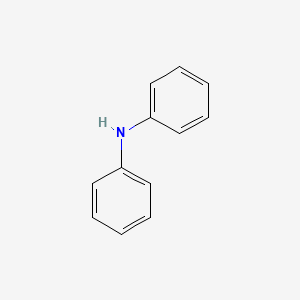
Diphenylamine
Diphenylamine is an aromatic amine containing two phenyl substituents. It has been used as a fungicide for the treatment of superficial scald in apples and pears, but is no longer approved for this purpose within the European Union. It has a role as a ferroptosis inhibitor, an antioxidant, a radical scavenger, a carotogenesis inhibitor, an EC 1.3.99.29 [phytoene desaturase (zeta-carotene-forming)] inhibitor and an antifungal agrochemical. It is an aromatic amine, a secondary amino compound and a bridged diphenyl fungicide. — ChEBI
- IUPAC 명칭
- N-phenylaniline
- 분자식
- C12H11N
- 분자량
- 169.22 g/mol
- 정확한 질량
- 169.089149355 Da
- XLogP3
- 3.5
- 위상 극성 표면적
- 12.0 Ų
- 수소 결합 공여체
- 1
- 수소 결합 수용체
- 1
- 공유결합 단위
- 1
- 정의된 입체중심
- 0
다른 이름
보고된 명칭 16개 더 보기
외부 데이터베이스 식별자
- ChEBI:CHEBI:4640
- ChEMBL:CHEMBL38688
- EPA DTXSID:DTXSID4021975
- PubMed:25622337
- PubMed:25028461
- PubMed:22889607
- PubMed:22868159
- PubMed:22684718
- PubMed:22682933
- PubMed:22649790
- PubMed:22645627
- PubMed:22609852
- PubMed:22608425
- PubMed:22588514
- PubMed:22579651
추가 과학 데이터베이스의 근거
NIH PubChem PUG-View
Attributed physical-property, hazard, environmental and use annotations.
- Autoignition Temperature: 1175 °F (USCG, 1999) 출처: CAMEO Chemicals
- Autoignition Temperature: 1173 °F (634 °C) 출처: Hazardous Substances Data Bank (HSDB)
- Autoignition Temperature: 634 °C 출처: ILO-WHO International Chemical Safety Cards (ICSCs)
- Boiling Point: 576 °F at 760 mmHg (NTP, 1992) 출처: CAMEO Chemicals
- Boiling Point: 302 °C 출처: Hazardous Substances Data Bank (HSDB)
- Boiling Point: 302.00 °C. @ 760.00 mm Hg 출처: Human Metabolome Database (HMDB)
- Boiling Point: 302 °C 출처: ILO-WHO International Chemical Safety Cards (ICSCs)
- Boiling Point: 576 °F 출처: Occupational Safety and Health Administration (OSHA)
- Boiling Point: 302 °C @760 [mm Hg] 출처: PAC Chemical Database, U.S. Department of Energy
- Boiling Point: 576 °F 출처: The National Institute for Occupational Safety and Health (NIOSH)
- Color/Form: Monoclinic leaflets from dilute alcohol 출처: Hazardous Substances Data Bank (HSDB)
- Color/Form: Crystals 출처: Hazardous Substances Data Bank (HSDB)
- Color/Form: Colorless, tan, amber, or brown crystalline solid. 출처: Hazardous Substances Data Bank (HSDB)
- Density: 1.068 at 141.8 °F (USCG, 1999) - Denser than water; will sink 출처: CAMEO Chemicals
- Density: 1.16 출처: Hazardous Substances Data Bank (HSDB)
- Density: 1.2 g/cm³ 출처: ILO-WHO International Chemical Safety Cards (ICSCs)
- Density: 1.16 출처: Occupational Safety and Health Administration (OSHA)
- Density: 1.158 @ 22°C 출처: PAC Chemical Database, U.S. Department of Energy
- Density: 1.16 출처: The National Institute for Occupational Safety and Health (NIOSH)
- Dissociation Constants: pKa = 0.78 @ 24 °C 출처: Hazardous Substances Data Bank (HSDB)
- Flash Point: 307 °F (NTP, 1992) 출처: CAMEO Chemicals
- Flash Point: 307 °F 출처: Haz-Map, Information on Hazardous Chemicals and Occupational Diseases
- Flash Point: 153 °C OC 출처: Hazardous Substances Data Bank (HSDB)
- Flash Point: 153 °C c.c. 출처: ILO-WHO International Chemical Safety Cards (ICSCs)
- Flash Point: 307 °F 출처: Occupational Safety and Health Administration (OSHA)
- Flash Point: 307 °F 출처: The National Institute for Occupational Safety and Health (NIOSH)
- LogP: log Kow = 3.50 출처: Hazardous Substances Data Bank (HSDB)
- LogP: 3.50 출처: Human Metabolome Database (HMDB)
- LogP: 3.5 출처: ILO-WHO International Chemical Safety Cards (ICSCs)
- Melting Point: 129 to 131 °F (NTP, 1992) 출처: CAMEO Chemicals
- Melting Point: 53-54 °C 출처: Hazardous Substances Data Bank (HSDB)
- Melting Point: 52 - 54 °C 출처: Human Metabolome Database (HMDB)
- Melting Point: 53 °C 출처: ILO-WHO International Chemical Safety Cards (ICSCs)
- Melting Point: 127 °F 출처: Occupational Safety and Health Administration (OSHA)
- Melting Point: 53.2 °C 출처: PAC Chemical Database, U.S. Department of Energy
- Melting Point: 127 °F 출처: The National Institute for Occupational Safety and Health (NIOSH)
- Odor: Pleasant, floral odor. 출처: Hazardous Substances Data Bank (HSDB)
- Physical Description: Diphenylamine is a light tan to brown solid with a pleasant odor. Sinks in water. (USCG, 1999) 출처: CAMEO Chemicals
- Physical Description: Liquid; CBI; Large Crystals; Wet Solid; Dry Powder 출처: EPA Chemical Data Reporting (CDR)
- Physical Description: Colorless, tan, amber, or brown crystalline solid with a pleasant, floral odor. (fungicide); [NIOSH] 출처: Haz-Map, Information on Hazardous Chemicals and Occupational Diseases
- Physical Description: Solid 출처: Human Metabolome Database (HMDB)
- Physical Description: COLOURLESS CRYSTALS WITH CHARACTERISTIC ODOUR. 출처: ILO-WHO International Chemical Safety Cards (ICSCs)
- Physical Description: Colorless, tan, amber, or brown crystalline solid with a pleasant, floral odor. 출처: Occupational Safety and Health Administration (OSHA)
- Physical Description: Colorless, tan, amber, or brown crystalline solid with a pleasant, floral odor. [fungicide] 출처: The National Institute for Occupational Safety and Health (NIOSH)
- Solubility: less than 1 mg/mL at 61 °F (NTP, 1992) 출처: CAMEO Chemicals
- Solubility: 1 g dissolves in 2.2 ml of alcohol, 4 ml propyl alcohol; Freely sol in benzene, ether, glacial acetic acid, carbon disulfide. 출처: Hazardous Substances Data Bank (HSDB)
- Solubility: Very sol in ethanol, acetone, benzene, carbon tetrachloride, pyridine, ethyl acetate; sol in ether, acetic acid; slightly sol in chloroform 출처: Hazardous Substances Data Bank (HSDB)
- Solubility: Soluble in oxygenated and aromatic solvents 출처: Hazardous Substances Data Bank (HSDB)
- Solubility: In water, 53 mg/liter @ 20 °C 출처: Hazardous Substances Data Bank (HSDB)
- Solubility: 0.053 mg/mL at 20 °C 출처: Human Metabolome Database (HMDB)
- Solubility: Solubility in water: very poor 출처: ILO-WHO International Chemical Safety Cards (ICSCs)
- Solubility: 0.03% 출처: The National Institute for Occupational Safety and Health (NIOSH)
- Vapor Pressure: 1 mmHg at 226.9 °F ; 60 mmHg at 404.4 °F (NTP, 1992) 출처: CAMEO Chemicals
- Vapor Pressure: 0.00067 [mmHg] 출처: Haz-Map, Information on Hazardous Chemicals and Occupational Diseases
- Vapor Pressure: 6.70X10⁻⁴ mm Hg @ 25 °C 출처: Hazardous Substances Data Bank (HSDB)
- Vapor Pressure: Vapor pressure at 20 °C: negligible 출처: ILO-WHO International Chemical Safety Cards (ICSCs)
- Vapor Pressure: 1 mmHg at 227 °F 출처: Occupational Safety and Health Administration (OSHA)
- Vapor Pressure: (227 °F): 1 mmHg 출처: The National Institute for Occupational Safety and Health (NIOSH)
- IARC Carcinogenic Agent: Diphenylamine 출처: International Agency for Research on Cancer (IARC)
- IARC Carcinogenic Classes: Group 2B: Possibly carcinogenic to humans 출처: International Agency for Research on Cancer (IARC)
- IARC Monographs: Volume 130: (2022) 1,1,1-Trichloroethane and Four Other Industrial Chemicals 출처: International Agency for Research on Cancer (IARC)
- Publication Year: 2022 online 출처: International Agency for Research on Cancer (IARC)
- Evaluation Year: 2021 출처: International Agency for Research on Cancer (IARC)
- Carcinogen Classification: No indication of carcinogenicity to humans (not listed by IARC). 출처: Toxin and Toxin Target Database (T3DB)
- Exposure Routes: The substance can be absorbed into the body by inhalation, through the skin and by ingestion. 출처: ILO-WHO International Chemical Safety Cards (ICSCs)
- Exposure Routes: inhalation, skin absorption, ingestion, skin and/or eye contact 출처: The National Institute for Occupational Safety and Health (NIOSH)
- First Aid: EYES: First check the victim for contact lenses and remove if present. Flush victim's eyes with water or normal saline solution for 20 to 30 minutes while simultaneously calling a hospital or poison control center. Do not put any ointments, oils, or medication in the victim's eyes without specific instructions from a physician. IMMEDIATELY transport the victim after flushing eyes to a hospital even if no symptoms (such as redness or irritation) develop.; SKIN: IMMEDIATELY flood affected skin with water while removing and isolating all contaminated clothing. Gently wash all affected skin areas thoroughly with soap and water. If symptoms such as redness or irritation develop, IMMEDIATELY call a physician and be prepared to transport the victim to a hospital for treatment.; INHALATION: IMMEDIATELY leave the contaminated area; take deep breaths of fresh air. If symptoms (such as wheezing, coughing, shortness of breath, or burning in the mouth, throat, or chest) develop, call a physician and be prepared to transport the victim to a hospital. Provide proper respiratory protection to rescuers entering an unknown atmosphere. Whenever possible, Self-Contained Breathing Apparatus (SCBA) shou 출처: CAMEO Chemicals
- First Aid: (General first aid procedures); Eye: Irrigate immediately - If this chemical contacts the eyes, immediately wash (irrigate) the eyes with large amounts of water, occasionally lifting the lower and upper lids. Get medical attention immediately.; Skin: Soap wash promptly - If this chemical contacts the skin, promptly wash the contaminated skin with soap and water. If this chemical penetrates the clothing, promptly remove the clothing and wash the skin with soap and water. Get medical attention promptly.; Breathing: Respiratory support; Swallow: Medical attention immediately - If this chemical has been swallowed, get medical attention immediately. 출처: The National Institute for Occupational Safety and Health (NIOSH)
- Signal: Danger 출처: Regulation (EC) No 1272/2008 of the European Parliament and of the Council
- GHS Hazard Statements: H301: Toxic if swallowed [Danger Acute toxicity, oral]; H311: Toxic in contact with skin [Danger Acute toxicity, dermal]; H331: Toxic if inhaled [Danger Acute toxicity, inhalation]; H373 **: May causes damage to organs through prolonged or repeated exposure [Warning Specific target organ toxicity, repeated exposure]; H400: Very toxic to aquatic life [Warning Hazardous to the aquatic environment, acute hazard]; H410: Very toxic to aquatic life with long lasting effects [Warning Hazardous to the aquatic environment, long-term hazard] 출처: Regulation (EC) No 1272/2008 of the European Parliament and of the Council
- Precautionary Statement Codes: P260, P261, P262, P264, P270, P271, P273, P280, P301+P316, P302+P352, P304+P340, P316, P319, P321, P330, P361+P364, P391, P403+P233, P405, and P501 (click each P-code to see the statement) 출처: Regulation (EC) No 1272/2008 of the European Parliament and of the Council
- Signal: Danger 출처: European Chemicals Agency (ECHA)
- GHS Hazard Statements: H301+H311+H331 (10.1%): Toxic if swallowed, in contact with skin or if inhaled [Danger Acute toxicity, oral; acute toxicity, dermal; acute toxicity, inhalation]; H301 (> 99.9%): Toxic if swallowed [Danger Acute toxicity, oral]; H311 (> 99.9%): Toxic in contact with skin [Danger Acute toxicity, dermal]; H319 (30.9%): Causes serious eye irritation [Warning Serious eye damage/eye irritation]; H331 (> 99.9%): Toxic if inhaled [Danger Acute toxicity, inhalation]; H351 (11.1%): Suspected of causing cancer [Warning Carcinogenicity]; H373 (100%): May causes damage to organs through prolonged or repeated exposure [Warning Specific target organ toxicity, repeated exposure]; H400 (96.2%): Very toxic to aquatic life [Warning Hazardous to the aquatic environment, acute hazard]; H410 (100%): Very toxic to aquatic life with long lasting effects [Warning Hazardous to the aquatic environment, long-term hazard] 출처: European Chemicals Agency (ECHA)
- Precautionary Statement Codes: P203, P260, P261, P262, P264, P264+P265, P270, P271, P273, P280, P301+P316, P302+P352, P304+P340, P305+P351+P338, P316, P318, P319, P321, P330, P337+P317, P361+P364, P391, P403+P233, P405, and P501 (click each P-code to see the statement) 출처: European Chemicals Agency (ECHA)
- ECHA C&L Notifications Summary: Aggregated GHS information provided per 1984 reports by companies from 46 notifications to the ECHA C&L Inventory. Each notification may be associated with multiple companies.; Information may vary between notifications depending on impurities, additives, and other factors. The percentage value in parenthesis indicates the notified classification ratio from companies that provide hazard codes. Only hazard codes with percentage values above 10% are shown. For more detailed information, please visit ECHA C&L website. 출처: European Chemicals Agency (ECHA)
- Signal: Warning 출처: NITE-CMC
- GHS Hazard Statements: H351: Suspected of causing cancer [Warning Carcinogenicity] 출처: NITE-CMC
- Precautionary Statement Codes: P203, P280, P318, P405, and P501 (click each P-code to see the statement) 출처: NITE-CMC
- Signal: Danger 출처: NITE-CMC
- GHS Hazard Statements: H318: Causes serious eye damage [Danger Serious eye damage/eye irritation]; H335: May cause respiratory irritation [Warning Specific target organ toxicity, single exposure; Respiratory tract irritation]; H361: Suspected of damaging fertility or the unborn child [Warning Reproductive toxicity]; H370: Causes damage to organs [Danger Specific target organ toxicity, single exposure]; H373: May causes damage to organs through prolonged or repeated exposure [Warning Specific target organ toxicity, repeated exposure]; H400: Very toxic to aquatic life [Warning Hazardous to the aquatic environment, acute hazard]; H410: Very toxic to aquatic life with long lasting effects [Warning Hazardous to the aquatic environment, long-term hazard] 출처: NITE-CMC
- NFPA Health Rating: 3 - Materials that, under emergency conditions, can cause serious or permanent injury. 출처: Hazardous Substances Data Bank (HSDB)
- NFPA Fire Rating: 1 - Materials that must be preheated before ignition can occur. Materials require considerable preheating, under all ambient temperature conditions, before ignition and combustion can occur. 출처: Hazardous Substances Data Bank (HSDB)
- NFPA Instability Rating: 0 - Materials that in themselves are normally stable, even under fire conditions. 출처: Hazardous Substances Data Bank (HSDB)
- Target Organs: Hepatic; Urinary 출처: EPA Integrated Risk Information System (IRIS)
- Target Organs: Eyes, skin, respiratory system, cardiovascular system, blood, bladder, reproductive system 출처: The National Institute for Occupational Safety and Health (NIOSH)
- Toxicity Summary: Diphenylamine uncouples mitochondrial oxidative phosphorylation, resulting in a decrease in hepatocellular ATP content and consequently hepatocyte injury (A15350). Short-term and long-term exposure in animal models results in altered haematological parameters, splenic erythropoiesis, splenic congestion and haemosiderosis (L2078). 출처: Toxin and Toxin Target Database (T3DB)
- Environmental Bioconcentration: BCFs ranging from 101 to 242 and 51 to 253 (species unidentified) were measured using 0.1 and 0.01 mg/liter of N,N-diphenylamine, respectively, and a 8-week study period(1). According to a classification scheme(2), these BCFs suggest the potential for bioconcentration in aquatic organisms is moderate(SRC). 출처: Hazardous Substances Data Bank (HSDB)
- Environmental Fate: TERRESTRIAL FATE: Based on a classification scheme(1), an estimated Koc value of 1,900(SRC), determined from a log Kow of 3.50(2) and a regression-derived equation(3), indicates that N,N-diphenylamine is expected to have low mobility in soil(SRC). Volatilization of N,N-diphenylamine from moist soil surfaces is expected to be an important fate process(SRC) given an estimated Henry's Law constant of 2.7X10⁻⁶ atm-cu m/mole(SRC) derived from its vapor pressure, 6.7X10⁻⁴ mm Hg(4), and water solubility, 53 mg/liter(5). N,N-Diphenylamine is not expected to volatilize from dry soil surfaces(SRC) based upon its vapor pressure(4). N,N-Diphenylamine is not expected to biodegrade in soil based on aqueous screening tests(6). N,N-Diphenylamine, present at 30 mg/l, reached 0% of its theoretical BOD in 2 weeks using an activated sludge innoculum at 100 mg/l and the Japanese MITI test(6). 출처: Hazardous Substances Data Bank (HSDB)
- Environmental Fate: AQUATIC FATE: Based on a classification scheme(1), an estimated Koc value of 1,900(SRC), determined from a log Kow of 3.50(2) and a regression-derived equation(3), indicates that N,N-diphenylamine is expected to adsorb to suspended solids and sediment(SRC). Volatilization from water surfaces is expected(3) based upon an estimated Henry's Law constant of 2.7X10⁻⁶ atm-cu m/mole(SRC), derived from its vapor pressure, 6.70X10⁻⁴ mm Hg(4), and water solubility, 53 mg/l(5). Using this Henry's Law constant and an estimation method(3), volatilization half-lives for a model river and model lake are 9.4 and 107 days, respectively(SRC). According to a classification scheme(6), BCFs ranging from 51 to 253(7), suggests bioconcentration in aquatic organisms is moderate(SRC). N,N-Diphenylamine was found to be not readily biodegradable in aqueous screening tests(7). N,N-Diphenylamine, present at 30 mg/l, reached 0% of its theoretical BOD in 2 weeks using an activated sludge innoculum at 100 mg/l and the Japanese MITI test(7). 출처: Hazardous Substances Data Bank (HSDB)
- Environmental Fate: ATMOSPHERIC FATE: According to a model of gas/particle partitioning of semivolatile organic compounds in the atmosphere(1), N,N-diphenylamine, which has a vapor pressure of 6.7X10⁻⁴ mm Hg at 25 °C(2) is expected to exist solely as a vapor in the ambient atmosphere(SRC). Vapor-phase N,N-diphenylamine is degraded in the atmosphere by reaction with photochemically-produced hydroxyl radicals(SRC); the half-life for this reaction in air is estimated to be 1.9 hours(SRC), calculated from its rate constant of 2.0X10⁻¹⁰ cu cm/molecule-sec at 25 °C(SRC) that was derived using a structure estimation method(3). 출처: Hazardous Substances Data Bank (HSDB)
- Consumer Uses: Lubricating agent; Other; Energy Releasers (explosives, motive propellant); Antioxidant; Dye 출처: EPA Chemical Data Reporting (CDR)
- Industry Uses: Stabilizing agent; Dye; Intermediate; Other; Chemical reaction regulator; Antioxidant; Processing aids not otherwise specified 출처: EPA Chemical Data Reporting (CDR)
- Sources/Uses: Used as an antioxidant, stabilizer of explosives, fungicide, and analytical chemical reagent; also used in the manufacture of dyes and pesticides; [ACGIH] Used to make dyes, to stabilize nitrocellulose explosives and celluloid, to treat screwworm topically (veterinary), and to test for nitrate or nitrite poisoning; [Merck Index] 출처: Haz-Map, Information on Hazardous Chemicals and Occupational Diseases
- Uses: For diphenylamine (USEPA/OPP Pesticide Code: 038501) ACTIVE products with label matches. /SRP: Registered for use in the U.S. but approved pesticide uses may change periodically and so federal, state and local authorities must be consulted for currently approved uses./ 출처: Hazardous Substances Data Bank (HSDB)
- Uses: Manufacture of dyes; stabilizing nitrocellulose explosives and celluloid; in analytical chemistry for detection of nitrates, chlorates and other oxidizing substances with which, in presence of sulfuric acid, it gives a deep-blue color. 출처: Hazardous Substances Data Bank (HSDB)
- Uses: VET: Topically in anti-screwworm mixtures; in test for nitrate or nitrate poisoning. 출처: Hazardous Substances Data Bank (HSDB)
- Uses: Rubber antioxidants and accelerators, solid rocket propellants, pesticides, dyes, pharmaceuticals, storage preservation of apples, stabilizer for nitrocellulose. 출처: Hazardous Substances Data Bank (HSDB)
- Uses: For more Uses (Complete) data for N,N-DIPHENYLAMINE (10 total), please visit the HSDB record page. 출처: Hazardous Substances Data Bank (HSDB)
- Uses: This is a natural compound that is used as a pesticide. 출처: Toxin and Toxin Target Database (T3DB)
매핑 기준: Existing checksum-valid CAS to unique PubChem CID match. 가져온 시각: 2026-08-31. 출처 기록 열기
과학적 분류와 유해성 주석은 맥락을 제공할 뿐이며, 위에 표시된 시장별 규제 판단을 대체하지 않습니다.
추가 출처 적용 범위 및 일치 상태
| 출처 | 결과 | 확인됨 |
|---|---|---|
| NIH PubChem PUG-View | 정확히 일치 | 2026-08-31 |
기록된 불일치는 출처를 확인했다는 유용한 근거이며, 해당 물질이 다른 곳에 존재하지 않는다는 주장이 아닙니다.
체크섬이 유효한 CAS 일치를 통해 2026-08-31에 NIH PubChem에서 가져왔습니다. 화학적 특성은 이 페이지의 규제 판단을 대체하지 않습니다.
이 사이트에서 CAS 122-39-4을(를) 사용하는 방식
CAS 122-39-4은(는) 이 페이지를 특정 물질에 고정하는 데 사용하는 Chemical Abstracts Service 식별자입니다. 현재 데이터세트에서는 EU 부속서 기록 1건이 이 식별자를 공유하며, 같은 물질이 하나의 규제 맥락에 나타나는지 여러 맥락에 나타나는지 교차 확인하는 데 도움이 됩니다.
공급업체 규격서, SDS 또는 원료 문서에 CAS 122-39-4이(가) 제시되어 있고 연결된 모든 부속서 II–VI 기록을 한곳에서 확인해야 할 때 이 페이지를 이용하세요. 위의 항목 카드는 농도 한도, 경고 문구, 부속서 위치 및 제품 유형 조건을 가장 빠르게 확인하는 방법입니다.