
CAS 120-55-8PubChem CID 8437
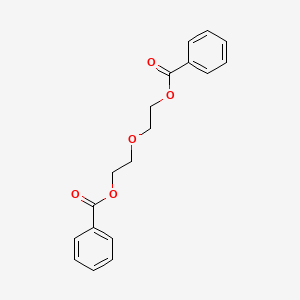
Di-O-benzoyldiethylene glycol
- IUPAC 명칭
- 2-(2-benzoyloxyethoxy)ethyl benzoate
- 분자식
- C18H18O5
- 분자량
- 314.3 g/mol
- 정확한 질량
- 314.11542367 Da
- XLogP3
- 3.4
- 위상 극성 표면적
- 61.8 Ų
- 수소 결합 공여체
- 0
- 수소 결합 수용체
- 5
- 공유결합 단위
- 1
- 정의된 입체중심
- 0
다른 이름
Diethylene glycol dibenzoateBenzo Flex 2-45Dibenzoyldiethyleneglycol esterDIETHYLENE GLYCOL, DIBENZOATEYAI66YDY1CBenzoflex 2-45Benzoyloxyethoxyethyl benzoateEthanol, 2,2'-oxybis-, dibenzoate
보고된 명칭 16개 더 보기
Benzoic acid, diester with diethylene glycolFLEXOL 2GBMONOCIZER PB 3VELSICOL 2-45204-407-6RefChem:587361Oxybis(ethane-2,1-diyl) dibenzoateDiglycol dibenzoateOxydiethylene dibenzoateEthanol, 2,2'-oxybis-, 1,1'-dibenzoate2-[2-(Benzoyloxy)ethoxy]ethyl benzoateTox21_201732CS-0435534D1522CAS-120-55-8Di(ethylene glycol) dibenzoate
외부 데이터베이스 식별자
- ChEMBL:CHEMBL2130591
- EPA DTXSID:DTXSID0026967
- PubMed:29723837
- PubMed:29410257
- PubMed:28843100
추가 과학 데이터베이스의 근거
NIH PubChem PUG-View
식별자 정확히 일치8437
Attributed physical-property, hazard, environmental and use annotations.
- Boiling Point: 225-227 °C @ 3 MM HG 출처: Hazardous Substances Data Bank (HSDB)
- Boiling Point: at 0.7kPa: 236 °C 출처: ILO-WHO International Chemical Safety Cards (ICSCs)
- Color/Form: LIQUID 출처: Hazardous Substances Data Bank (HSDB)
- Density: 1.2 @ 68 °F (20 °C) 출처: Hazardous Substances Data Bank (HSDB)
- Density: Relative density (water = 1): 1.2 출처: ILO-WHO International Chemical Safety Cards (ICSCs)
- Flash Point: 450 °F (232 °C) (CLOSED CUP) 출처: Hazardous Substances Data Bank (HSDB)
- Flash Point: 232 °C 출처: ILO-WHO International Chemical Safety Cards (ICSCs)
- Melting Point: -28 °C 출처: Hazardous Substances Data Bank (HSDB)
- Melting Point: 28 °C 출처: ILO-WHO International Chemical Safety Cards (ICSCs)
- Physical Description: Liquid 출처: EPA Chemical Data Reporting (CDR)
- Physical Description: Liquid; [Hawley] Solid; mp = 28 deg C; [ICSC] Liquid; mp = -28 deg C; [HSDB] 89.9% Diethylene glycol, dibenzoate freezing point = 24 deg C; [eChemPortal: HPVIS] Colorless to straw-colored viscous liquid; mp ~ 16 deg C; [MSDSonline] 출처: Haz-Map, Information on Hazardous Chemicals and Occupational Diseases
- Physical Description: CRYSTALS. 출처: ILO-WHO International Chemical Safety Cards (ICSCs)
- Refractive Index: Refractive index = 1.5424 출처: Hazardous Substances Data Bank (HSDB)
- Solubility: SOL IN WATER 출처: Hazardous Substances Data Bank (HSDB)
- Solubility: Solubility in water: miscible 출처: ILO-WHO International Chemical Safety Cards (ICSCs)
- Vapor Pressure: 0.09 [mmHg] 출처: Haz-Map, Information on Hazardous Chemicals and Occupational Diseases
- Viscosity: 110 mPa.s @ 20 °C 출처: Hazardous Substances Data Bank (HSDB)
- Exposure Routes: The substance can be absorbed into the body by inhalation. 출처: ILO-WHO International Chemical Safety Cards (ICSCs)
- Note: This chemical does not meet GHS hazard criteria for 78.4% (297 of 379) of all reports. 출처: European Chemicals Agency (ECHA)
- GHS Hazard Statements: H411 (21.1%): Toxic to aquatic life with long lasting effects [Hazardous to the aquatic environment, long-term hazard] 출처: European Chemicals Agency (ECHA)
- Precautionary Statement Codes: P273, P391, and P501 (click each P-code to see the statement) 출처: European Chemicals Agency (ECHA)
- ECHA C&L Notifications Summary: Aggregated GHS information provided per 379 reports by companies from 6 notifications to the ECHA C&L Inventory.; Reported as not meeting GHS hazard criteria per 297 of 379 reports by companies.; There are 3 notifications provided by 82 of 379 reports by companies with hazard statement code(s).; Information may vary between notifications depending on impurities, additives, and other factors. The percentage value in parenthesis indicates the notified classification ratio from companies that provide hazard codes. Only hazard codes with percentage values above 10% are shown. For more detailed information, please visit ECHA C&L website. 출처: European Chemicals Agency (ECHA)
- NFPA Health Rating: 0 - Materials that, under emergency conditions, would offer no hazard beyond that of ordinary combustible materials. 출처: Hazardous Substances Data Bank (HSDB)
- NFPA Fire Rating: 1 - Materials that must be preheated before ignition can occur. Materials require considerable preheating, under all ambient temperature conditions, before ignition and combustion can occur. 출처: Hazardous Substances Data Bank (HSDB)
- NFPA Instability Rating: 0 - Materials that in themselves are normally stable, even under fire conditions. 출처: Hazardous Substances Data Bank (HSDB)
- Environmental Bioconcentration: An estimated BCF value of 120 was calculated for diethylene glycol dibenzoate(SRC), using an estimated log Kow of 3.04(1,SRC) and a recommended regression-derived equation(2). According to a classification scheme(3), this BCF value suggests that bioconcentration in aquatic organisms is high(SRC). 출처: Hazardous Substances Data Bank (HSDB)
- Environmental Fate: TERRESTRIAL FATE: Based on a recommended classification scheme(1), an estimated Koc value of 540(SRC), determined from a structure estimation method(2), indicates that diethylene glycol dibenzoate will have low mobility in soil(SRC). Volatilization of diethylene glycol dibenzoate should not be important from moist soil surfaces(SRC) given an estimated Henry's Law constant of 3X10-12 atm-cu m/mole(SRC), using a recommended regression equation(3). Volatilization from dry soil surfaces(SRC) is not expected based on an estimated vapor pressure of 0.09 mm Hg(SRC), determined from a fragment constant method(4). No data are available to determine the rate or importance of biodegradation of diethylene glycol dibenzoate in soil(SRC). 출처: Hazardous Substances Data Bank (HSDB)
- Environmental Fate: AQUATIC FATE: Based on a recommended classification scheme(1), an estimated Koc value of 540(SRC), determined from a structure estimation method(2), indicates that diethylene glycol dibenzoate should adsorb to suspended solids and sediment in the water(SRC). Diethylene glycol dibenzoate will be essentially non-volatile from water surfaces(1,SRC) based on an estimated Henry's Law constant of 3X10-12 atm-cu m/mole(SRC), developed using a fragment constant estimation method(3). According to a classification scheme(5), an estimated BCF value of 120(1,SRC), from an estimated log Kow(4,SRC), suggests that bioconcentration in aquatic organisms is high(SRC). Diethylene glycol dibenzoate has an estimated base-catalyzed hydrolysis rate of 0.16 L/mol-sec at a pH of 8, which corresponds to a half-life of 49 days at a pH of 8 and 1.3 years at a pH of 7(6,SRC). Insufficient data are available to determine the rate or importance of biodegradation of diethylene glycol dibenzoate in water(SRC). 출처: Hazardous Substances Data Bank (HSDB)
- Environmental Fate: ATMOSPHERIC FATE: According to a model of gas/particle partitioning of semivolatile organic compounds in the atmosphere(1), diethylene glycol dibenzoate, which has an estimated vapor pressure of 0.09 mm Hg at 25 °C(2,SRC), will exist solely as a vapor in the ambient atmosphere. Vapor-phase diethylene glycol dibenzoate is degraded in the atmosphere by reaction with photochemically produced hydroxyl radicals(SRC); the half-life for this reaction in air is estimated to be about 20 hours(3,SRC). Particulate-phase diethylene glycol dibenzoate may be physically removed from the air by wet and dry deposition(SRC). 출처: Hazardous Substances Data Bank (HSDB)
- Consumer Uses: Plasticizer; Not Known or Reasonably Ascertainable 출처: EPA Chemical Data Reporting (CDR)
- Industry Uses: Plasticizer; Not Known or Reasonably Ascertainable 출처: EPA Chemical Data Reporting (CDR)
- Sources/Uses: Used as plasticizer for resins (cellulose acetate butyrate, polyvinyl acetate, cellulose nitrate, ethyl cellulose, and polymethyl methacrylate) and a stabilizer for perfumes; [HSDB] 출처: Haz-Map, Information on Hazardous Chemicals and Occupational Diseases
- Uses: PLASTICIZER 출처: Hazardous Substances Data Bank (HSDB)
- Uses: PLASTICIZER FOR CELLULOSE ACETATE BUTYRATE RESINS 출처: Hazardous Substances Data Bank (HSDB)
- Uses: PLASTICIZER FOR CELLULOSE NITRATE RESINS 출처: Hazardous Substances Data Bank (HSDB)
- Uses: PLASTICIZER FOR ETHYL CELLULOSE RESINS 출처: Hazardous Substances Data Bank (HSDB)
- Uses: For more Uses (Complete) data for DIETHYLENE GLYCOL, DIBENZOATE (6 total), please visit the HSDB record page. 출처: Hazardous Substances Data Bank (HSDB)
매핑 기준: Existing checksum-valid CAS to unique PubChem CID match. 가져온 시각: 2026-08-31. 출처 기록 열기
과학적 분류와 유해성 주석은 맥락을 제공할 뿐이며, 위에 표시된 시장별 규제 판단을 대체하지 않습니다.
추가 출처 적용 범위 및 일치 상태
| 출처 | 결과 | 확인됨 |
|---|---|---|
| NIH PubChem PUG-View | 정확히 일치 | 2026-08-31 |
기록된 불일치는 출처를 확인했다는 유용한 근거이며, 해당 물질이 다른 곳에 존재하지 않는다는 주장이 아닙니다.
체크섬이 유효한 CAS 일치를 통해 2026-08-31에 NIH PubChem에서 가져왔습니다. 화학적 특성은 이 페이지의 규제 판단을 대체하지 않습니다.