
CAS
기록 1건
CAS 1120-71-4
CAS 1120-71-4은(는) 규정 1223/2009의 부속서 II–VI에 걸쳐 EU 부속서 기록 1건과 일치합니다.
CAS 1120-71-4의 기록
1 총화학적 정체 및 특성
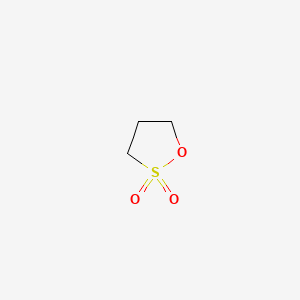
- IUPAC 명칭
- oxathiolane 2,2-dioxide
- 분자식
- C3H6O3S
- 분자량
- 122.15 g/mol
- 정확한 질량
- 122.00376522 Da
- XLogP3
- -0.2
- 위상 극성 표면적
- 51.8 Ų
- 수소 결합 공여체
- 0
- 수소 결합 수용체
- 3
- 공유결합 단위
- 1
- 정의된 입체중심
- 0
다른 이름
1,3-PROPANE SULTONE1,2-oxathiolane 2,2-dioxidePropanesultone1,2-Oxathiolane, 2,2-dioxideRCRA waste number U1933-Hydroxy-1-propanesulfonic acid gamma-sultone1,2-Oxathrolane 2,2-dioxide3-Hydroxy-1-propanesulphonic acid sultone
보고된 명칭 16개 더 보기
L6NTK7VJX93-HYDROXY-1-PROPANESULFONIC ACID SULTONENSC-423861-Propanesulfonic acid, 3-hydroxy-, gamma-sultonegamma-Propane sultoneRefChem:729061-Propanesulfonic acid-3-hydroxy-gamma-sultone214-317-93-Hydroxythietane-1,1-Dioxide1,3-Propanesultone.gamma.-Propane sultoneNSC 423861,3-Propanesulfonate1,3-TRIMETHYLENE SULTONE1,2lambda6-oxathiolane-2,2-dione3-Hydroxy-1-propanesulfonic acid .gamma.-sultone
외부 데이터베이스 식별자
- ChEBI:CHEBI:82370
- ChEMBL:CHEMBL3185243
- EPA DTXSID:DTXSID8021195
- PubMed:32659469
- PubMed:27931811
- PubMed:22923490
- PubMed:22873558
- PubMed:22686314
- PubMed:22567565
- PubMed:22498463
- PubMed:22488562
- PubMed:22052433
- PubMed:21863088
- PubMed:21730499
- PubMed:21580354
추가 과학 데이터베이스의 근거
NIH PubChem PUG-View
식별자 정확히 일치14264
Attributed physical-property, hazard, environmental and use annotations.
- Boiling Point: 180 °C at 0.039 atm. 출처: Hazardous Substances Data Bank (HSDB)
- Color/Form: COLORLESS LIQ OR WHITE CRYSTALS 출처: Hazardous Substances Data Bank (HSDB)
- Color/Form: White, crystalline solid or a colorless liquid (above 86 degrees F). 출처: Hazardous Substances Data Bank (HSDB)
- Density: 1.39 (NIOSH, 2024) - Denser than water; will sink 출처: CAMEO Chemicals
- Density: SPECIFIC GRAVITY: 1.393 @ 40 °C/4 °C 출처: Hazardous Substances Data Bank (HSDB)
- Density: Density (at 25 °C): 1.392 g/cm³ 출처: ILO-WHO International Chemical Safety Cards (ICSCs)
- Density: 1.393 @ 40°C 출처: PAC Chemical Database, U.S. Department of Energy
- Density: 1.39 출처: The National Institute for Occupational Safety and Health (NIOSH)
- Flash Point: greater than 235 °F (NIOSH, 2024) 출처: CAMEO Chemicals
- Flash Point: Flash point > 235 °F 출처: Haz-Map, Information on Hazardous Chemicals and Occupational Diseases
- Flash Point: >110 °C 출처: ILO-WHO International Chemical Safety Cards (ICSCs)
- Flash Point: >235 °F 출처: The National Institute for Occupational Safety and Health (NIOSH)
- Melting Point: 86 °F (NIOSH, 2024) 출처: CAMEO Chemicals
- Melting Point: 31 °C 출처: Hazardous Substances Data Bank (HSDB)
- Melting Point: 31 °C 출처: ILO-WHO International Chemical Safety Cards (ICSCs)
- Melting Point: 31 °C 출처: PAC Chemical Database, U.S. Department of Energy
- Melting Point: 86 °F 출처: The National Institute for Occupational Safety and Health (NIOSH)
- Odor: Foul odor above 31.11 °C. 출처: Hazardous Substances Data Bank (HSDB)
- Odor: Releases a fould odor as it melts. 출처: Hazardous Substances Data Bank (HSDB)
- Physical Description: Propane sultone appears as white crystalline solid or a colorless liquid (above 86 °F). Releases a foul odor when melting. (NIOSH, 2024) 출처: CAMEO Chemicals
- Physical Description: Liquid 출처: EPA Chemical Data Reporting (CDR)
- Physical Description: White, crystalline solid or a colorless liquid (above 86 degrees F). [Note: Releases a foul odor as it melts.]; [NIOSH] 출처: Haz-Map, Information on Hazardous Chemicals and Occupational Diseases
- Physical Description: WHITE CRYSTALS OR COLOURLESS LIQUID WITH CHARACTERISTIC ODOUR. 출처: ILO-WHO International Chemical Safety Cards (ICSCs)
- Physical Description: White, crystalline solid or a colorless liquid (above 86 °F). [Note: Releases a foul odor as it melts.] 출처: The National Institute for Occupational Safety and Health (NIOSH)
- Refractive Index: INDEX OF REFRACTION: 1.450 @ 40 °C/D 출처: Hazardous Substances Data Bank (HSDB)
- Solubility: 10 % (NIOSH, 2024) 출처: CAMEO Chemicals
- Solubility: READILY SOL IN KETONES, ESTERS & AROMATIC HYDROCARBONS 출처: Hazardous Substances Data Bank (HSDB)
- Solubility: INSOL IN ALIPHATIC HYDROCARBONS 출처: Hazardous Substances Data Bank (HSDB)
- Solubility: SOL IN WATER (100 G/L) 출처: Hazardous Substances Data Bank (HSDB)
- Solubility: Solubility in water, g/100ml: 10 (moderate) 출처: ILO-WHO International Chemical Safety Cards (ICSCs)
- Solubility: 10% 출처: The National Institute for Occupational Safety and Health (NIOSH)
- Vapor Pressure: 0.27 [mmHg] 출처: Haz-Map, Information on Hazardous Chemicals and Occupational Diseases
- IARC Carcinogenic Agent: 1,3-Propane sultone 출처: International Agency for Research on Cancer (IARC)
- IARC Carcinogenic Classes: Group 2A: Probably carcinogenic to humans 출처: International Agency for Research on Cancer (IARC)
- IARC Monographs: Volume 4: (1974) Some Aromatic Amines, Hydrazine and Related Substances, N-Nitroso Compounds and Miscellaneous Alkylating Agents; Volume Sup 7: Overall Evaluations of Carcinogenicity: An Updating of IARC Monographs Volumes 1 to 42, 1987; 440 pages; ISBN 92-832-1411-0 (out of print); Volume 71: (1999) Re-evaluation of Some Organic Chemicals, Hydrazine and Hydrogen Peroxide (Part 1, Part 2, Part 3); Volume 110: (2017) Some Chemicals Used as Solvents and in Polymer Manufacture 출처: International Agency for Research on Cancer (IARC)
- Publication Year: 2017 출처: International Agency for Research on Cancer (IARC)
- Evaluation Year: 2014 출처: International Agency for Research on Cancer (IARC)
- Additional information: NB Overall evaluation upgraded to Group 2A with supporting evidence from other relevant data 출처: International Agency for Research on Cancer (IARC)
- Exposure Routes: The substance can be absorbed into the body by inhalation, through the skin and by ingestion. 출처: ILO-WHO International Chemical Safety Cards (ICSCs)
- Exposure Routes: inhalation, skin absorption, ingestion, skin and/or eye contact 출처: The National Institute for Occupational Safety and Health (NIOSH)
- First Aid: Excerpt from NIOSH Pocket Guide for Propane sultone:; Eye: IRRIGATE IMMEDIATELY - If this chemical contacts the eyes, immediately wash (irrigate) the eyes with large amounts of water, occasionally lifting the lower and upper lids. Get medical attention immediately.; Skin: WATER FLUSH IMMEDIATELY - If this chemical contacts the skin, immediately flush the contaminated skin with water. If this chemical penetrates the clothing, immediately remove the clothing and flush the skin with water. Get medical attention promptly.; Breathing: RESPIRATORY SUPPORT - If a person breathes large amounts of this chemical, move the exposed person to fresh air at once. If breathing has stopped, perform artificial respiration. Keep the affected person warm and at rest. Get medical attention as soon as possible.; Swallow: MEDICAL ATTENTION IMMEDIATELY - If this chemical has been swallowed, get medical attention immediately. (NIOSH, 2024) 출처: CAMEO Chemicals
- First Aid: (General first aid procedures); Eye: Irrigate immediately - If this chemical contacts the eyes, immediately wash (irrigate) the eyes with large amounts of water, occasionally lifting the lower and upper lids. Get medical attention immediately.; Skin: Water flush immediately - If this chemical contacts the skin, immediately flush the contaminated skin with water. If this chemical penetrates the clothing, immediately remove the clothing and flush the skin with water. Get medical attention promptly.; Breathing: Respiratory support; Swallow: Medical attention immediately - If this chemical has been swallowed, get medical attention immediately. 출처: The National Institute for Occupational Safety and Health (NIOSH)
- Signal: Danger 출처: Regulation (EC) No 1272/2008 of the European Parliament and of the Council
- GHS Hazard Statements: H302: Harmful if swallowed [Warning Acute toxicity, oral]; H312: Harmful in contact with skin [Warning Acute toxicity, dermal]; H350: May cause cancer [Danger Carcinogenicity] 출처: Regulation (EC) No 1272/2008 of the European Parliament and of the Council
- Precautionary Statement Codes: P203, P264, P270, P280, P301+P317, P302+P352, P317, P318, P321, P330, P362+P364, P405, and P501 (click each P-code to see the statement) 출처: Regulation (EC) No 1272/2008 of the European Parliament and of the Council
- Signal: Danger 출처: European Chemicals Agency (ECHA)
- GHS Hazard Statements: H301+H311 (21.2%): Toxic if swallowed or in contact with skin [Danger Acute toxicity, oral; acute toxicity, dermal]; H301 (65.1%): Toxic if swallowed [Danger Acute toxicity, oral]; H302 (34.9%): Harmful if swallowed [Warning Acute toxicity, oral]; H311 (64.7%): Toxic in contact with skin [Danger Acute toxicity, dermal]; H312 (35.3%): Harmful in contact with skin [Warning Acute toxicity, dermal]; H315 (64.7%): Causes skin irritation [Warning Skin corrosion/irritation]; H318 (64.7%): Causes serious eye damage [Danger Serious eye damage/eye irritation]; H319 (16.6%): Causes serious eye irritation [Warning Serious eye damage/eye irritation]; H332 (64.7%): Harmful if inhaled [Warning Acute toxicity, inhalation]; H341 (64.7%): Suspected of causing genetic defects [Warning Germ cell mutagenicity]; H350 (100%): May cause cancer [Danger Carcinogenicity]; H412 (43.2%): Harmful to aquatic life with long lasting effects [Hazardous to the aquatic environment, long-term hazard] 출처: European Chemicals Agency (ECHA)
- Precautionary Statement Codes: P203, P261, P262, P264, P264+P265, P270, P271, P273, P280, P301+P316, P301+P317, P302+P352, P304+P340, P305+P351+P338, P305+P354+P338, P316, P317, P318, P321, P330, P332+P317, P337+P317, P361+P364, P362+P364, P405, and P501 (click each P-code to see the statement) 출처: European Chemicals Agency (ECHA)
- ECHA C&L Notifications Summary: Aggregated GHS information provided per 241 reports by companies from 12 notifications to the ECHA C&L Inventory. Each notification may be associated with multiple companies.; Information may vary between notifications depending on impurities, additives, and other factors. The percentage value in parenthesis indicates the notified classification ratio from companies that provide hazard codes. Only hazard codes with percentage values above 10% are shown. For more detailed information, please visit ECHA C&L website. 출처: European Chemicals Agency (ECHA)
- Signal: Danger 출처: NITE-CMC
- GHS Hazard Statements: H301: Toxic if swallowed [Danger Acute toxicity, oral]; H311: Toxic in contact with skin [Danger Acute toxicity, dermal]; H315: Causes skin irritation [Warning Skin corrosion/irritation]; H319: Causes serious eye irritation [Warning Serious eye damage/eye irritation]; H332: Harmful if inhaled [Warning Acute toxicity, inhalation]; H341: Suspected of causing genetic defects [Warning Germ cell mutagenicity]; H350: May cause cancer [Danger Carcinogenicity]; H370: Causes damage to organs [Danger Specific target organ toxicity, single exposure]; H402: Harmful to aquatic life [Hazardous to the aquatic environment, acute hazard]; H412: Harmful to aquatic life with long lasting effects [Hazardous to the aquatic environment, long-term hazard] 출처: NITE-CMC
- Precautionary Statement Codes: P203, P260, P261, P262, P264, P264+P265, P270, P271, P273, P280, P301+P316, P302+P352, P304+P340, P305+P351+P338, P308+P316, P316, P317, P318, P321, P330, P332+P317, P337+P317, P361+P364, P362+P364, P405, and P501 (click each P-code to see the statement) 출처: NITE-CMC
- GHS Hazard Statements: H301: Toxic if swallowed [Danger Acute toxicity, oral]; H311: Toxic in contact with skin [Danger Acute toxicity, dermal]; H341: Suspected of causing genetic defects [Warning Germ cell mutagenicity]; H350: May cause cancer [Danger Carcinogenicity] 출처: NITE-CMC
- Precautionary Statement Codes: P203, P262, P264, P270, P280, P301+P316, P302+P352, P316, P318, P321, P330, P361+P364, P405, and P501 (click each P-code to see the statement) 출처: NITE-CMC
- Target Organs: Eyes, skin, respiratory system 출처: The National Institute for Occupational Safety and Health (NIOSH)
- Environmental Bioconcentration: Since 1,3-propane sultone hydrolyzes rapidly in water(1,2), bioconcentration in aquatic organisms is not expected to be a significant process(SRC). 출처: Hazardous Substances Data Bank (HSDB)
- Environmental Fate: TERRESTRIAL FATE: If 1,3-propane sultone is released to soil, it will be expected to rapidly hydrolyze if the soil is moist, based upon the rapid hydrolysis observed in aqueous solution(1,2,SRC). Since it rapidly hydrolyzes, adsorption to and volatilization from moist soil are not expected to be significant processes, although no data specifically regarding the fate of 1,3-propane sultone in soil were located(SRC). 출처: Hazardous Substances Data Bank (HSDB)
- Environmental Fate: AQUATIC FATE: If 1,3-propane sultone is released to water, it will be expected to rapidly hydrolyze, based upon a measured rate constant of 8.2X10⁻² hr-1 for hydrolysis in aqueous solution at 25 °C(1) which corresponds to a half-life of 8.5 hr(SRC). The product of hydrolysis is 3-hydroxy-1-propanesulphonic acid(2). Since it rapidly hydrolyzes, bioconcentration, volatilization, and adsorption to sediment and suspended solids are not expected to be significant processes((SRC). No data were located concerning biodegradation, but 1,3-propane sultone will probably abiotically hydrolyze significantly faster than biodegradation(SRC). 출처: Hazardous Substances Data Bank (HSDB)
- Environmental Fate: ATMOSPHERIC FATE: If 1,3-propane sultone is released to the atmosphere, it will be susceptible to photooxidation via vapor phase reaction with photochemically produced hydroxyl radicals. An atmospheric half-life of 8 days at an atmospheric concentration of 5X10+5 hydroxyl radicals per cu cm has been calculated for this process based upon an estimated rate constant(1,SRC). 출처: Hazardous Substances Data Bank (HSDB)
- Consumer Uses: Ion exchange agent; Conductive agent 출처: EPA Chemical Data Reporting (CDR)
- Industry Uses: Ion exchange agent; Conductive agent 출처: EPA Chemical Data Reporting (CDR)
- Uses: 1,3-Propane sultone is used as a chemical intermediate to introduce sulfopropyl groups into molecules and to confer water solubility and anionic character. 출처: EPA Hazardous Air Pollutants
- Sources/Uses: Used as a chemical intermediate in the production of organic chemicals; [HSDB] 출처: Haz-Map, Information on Hazardous Chemicals and Occupational Diseases
- Uses: 1,3-PROPANE SULTONE IS USED AS CHEMICAL INTERMEDIATE TO INTRODUCE SULFOPROPYL GROUP ... INTO MOLECULES, & TO CONFER WATER SOLUBILITY & ANIONIC CHARACTER. 출처: Hazardous Substances Data Bank (HSDB)
- Uses: CHEM INT, EG, A SULFOALKYLATING AGENT (FORMER USE) 출처: Hazardous Substances Data Bank (HSDB)
매핑 기준: Existing checksum-valid CAS to unique PubChem CID match. 가져온 시각: 2026-08-31. 출처 기록 열기
과학적 분류와 유해성 주석은 맥락을 제공할 뿐이며, 위에 표시된 시장별 규제 판단을 대체하지 않습니다.
추가 출처 적용 범위 및 일치 상태
| 출처 | 결과 | 확인됨 |
|---|---|---|
| NIH PubChem PUG-View | 정확히 일치 | 2026-08-31 |
기록된 불일치는 출처를 확인했다는 유용한 근거이며, 해당 물질이 다른 곳에 존재하지 않는다는 주장이 아닙니다.
체크섬이 유효한 CAS 일치를 통해 2026-09-02에 NIH PubChem에서 가져왔습니다. 화학적 특성은 이 페이지의 규제 판단을 대체하지 않습니다.
이 사이트에서 CAS 1120-71-4을(를) 사용하는 방식
CAS 1120-71-4은(는) 이 페이지를 특정 물질에 고정하는 데 사용하는 Chemical Abstracts Service 식별자입니다. 현재 데이터세트에서는 EU 부속서 기록 1건이 이 식별자를 공유하며, 같은 물질이 하나의 규제 맥락에 나타나는지 여러 맥락에 나타나는지 교차 확인하는 데 도움이 됩니다.
공급업체 규격서, SDS 또는 원료 문서에 CAS 1120-71-4이(가) 제시되어 있고 연결된 모든 부속서 II–VI 기록을 한곳에서 확인해야 할 때 이 페이지를 이용하세요. 위의 항목 카드는 농도 한도, 경고 문구, 부속서 위치 및 제품 유형 조건을 가장 빠르게 확인하는 방법입니다.
자주 묻는 질문
CAS 1120-71-4로 식별되는 물질은 맥락에 따라 다른 조건이 적용되는 경우 EU 화장품 규정의 여러 부속서에 나타날 수 있습니다. 예를 들어 어떤 물질이 부속서 III에서 특정 조건으로 사용제한될 수 있고, 같은 CAS가 부속서 IV에서 별도의 항목 조건에 따라 허용 색소로 나타날 수도 있습니다. 각 항목은 개별적으로 검토해야 합니다.
CAS 번호를 원료 규격서 및 CoA 문서와 대조하세요. CAS가 부속서 II에 있으면 해당 물질이 없는지 확인하세요. 부속서 III에 있으면 처방에서 농도 한도와 제품 유형 조건이 충족되는지 확인하세요. 이 CAS 번호를 공유하는 모든 부속서 항목이 위에 나열되어 있습니다.
CAS 번호는 미국의 Chemical Abstracts Service가 부여하며 전 세계적으로 통용됩니다. EC 번호는 EINECS, ELINCS 또는 NLP 목록 같은 목록에 수록된 유럽연합 집행위원회 식별자입니다. 두 식별자 모두 EU 화장품 부속서 항목에 나타날 수 있습니다. 두 가지를 모두 가진 물질도 있고, 하나만 가진 물질도 있으며, 일부 오래된 항목은 둘 다 없을 수도 있습니다.
INCI 검사기는 원료명, CAS 번호 및 EC 번호를 받습니다. 이 CAS 번호를 직접 확인한 다음, 결과를 공급업체 규격서 및 연결된 모든 부속서 조건과 대조하세요.