
CAS 112-86-7PubChem CID 5281116
Erucic Acid
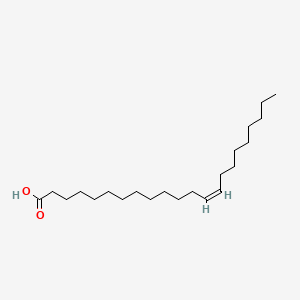
Erucic acid is a docosenoic acid having a cis- double bond at C-13. It is found particularly in brassicas - it is a major component of mustard and rapeseed oils and is produced by broccoli, Brussels sprouts, kale, and wallflowers. It is a conjugate acid of an erucate. — ChEBI
- IUPAC 명칭
- (Z)-docos-13-enoic acid
- 분자식
- C22H42O2
- 분자량
- 338.6 g/mol
- 정확한 질량
- 338.318480578 Da
- XLogP3
- 8.7
- 위상 극성 표면적
- 37.3 Ų
- 수소 결합 공여체
- 1
- 수소 결합 수용체
- 2
- 공유결합 단위
- 1
- 정의된 입체중심
- 0
다른 이름
cis-13-Docosenoic acid13-cis-Docosenoic acidHystrene 229013-Docosenoic acid, (Z)-13-Docosenoic acid, (13Z)-13Z-docosenoic acidPrifrac 2990Z-13-Docosenoic acid
보고된 명칭 16개 더 보기
delta13-cis-Docosenoic acid(13Z)-Docosenoic acidC22:1n-9CHEBI:28792docos-13c-enoic acidNSC-6814C22:1,n-9 cis22:1(N-9)RefChem:5801Cis 13-docosaenoic AcidCis-docos-13-enoic AcidFatty Acid 22:1 n-9 cisFatty Acid cis 22:1 n-922:1 n-9204-011-3(Z)-13-Docosenoic acid
외부 데이터베이스 식별자
- ChEBI:CHEBI:28792
- ChEMBL:CHEMBL1173380
- EPA DTXSID:DTXSID8026931
- PubMed:20671299
- PubMed:6517562
추가 과학 데이터베이스의 근거
NIH PubChem PUG-View
식별자 정확히 일치5281116
Attributed physical-property, hazard, environmental and use annotations.
- Boiling Point: 265 °C at 15 mm Hg 출처: Hazardous Substances Data Bank (HSDB)
- Boiling Point: Iodine value 74.98; neutralization value 165.72; bp: 381.5 °C (decomp) at 760 mm hg; 358.8 °C at 400 mm Hg; 314.4 °C at 100 mm Hg; 206.7 °C at 1.0 mm Hg 출처: Hazardous Substances Data Bank (HSDB)
- Color/Form: Needles from alcohol 출처: Hazardous Substances Data Bank (HSDB)
- Density: 0.860 at 55 °C/4 °C 출처: Hazardous Substances Data Bank (HSDB)
- Melting Point: 33.8 °C 출처: Hazardous Substances Data Bank (HSDB)
- Melting Point: 33.5 °C 출처: Human Metabolome Database (HMDB)
- Physical Description: Large Crystals; Other Solid; Liquid 출처: EPA Chemical Data Reporting (CDR)
- Physical Description: Solid; mp = 33.8 deg C; [Merck Index] Fine white crystals; [MSDSonline] 출처: Haz-Map, Information on Hazardous Chemicals and Occupational Diseases
- Physical Description: Liquid 출처: Human Metabolome Database (HMDB)
- Refractive Index: Index of refraction: 1.4534 at 45 °C/D; 1.44794 at 65 °C/D 출처: Hazardous Substances Data Bank (HSDB)
- Solubility: Soluble in ethanol, carbon tetrachloride; very soluble in ethyl ether, methanol 출처: Hazardous Substances Data Bank (HSDB)
- Solubility: Insol in water; about 175 g dissolve in 100 ml ethanol; about 160 g dissolve in 100 ml methanol; very sol in ether 출처: Hazardous Substances Data Bank (HSDB)
- Vapor Pressure: 0.00000115 [mmHg] 출처: Haz-Map, Information on Hazardous Chemicals and Occupational Diseases
- Note: This chemical does not meet GHS hazard criteria for 38.9% (28 of 72) of reports. 출처: European Chemicals Agency (ECHA)
- Signal: Warning 출처: European Chemicals Agency (ECHA)
- GHS Hazard Statements: H315 (61.1%): Causes skin irritation [Warning Skin corrosion/irritation]; H319 (59.7%): Causes serious eye irritation [Warning Serious eye damage/eye irritation]; H335 (56.9%): May cause respiratory irritation [Warning Specific target organ toxicity, single exposure; Respiratory tract irritation] 출처: European Chemicals Agency (ECHA)
- Precautionary Statement Codes: P261, P264, P264+P265, P271, P280, P302+P352, P304+P340, P305+P351+P338, P319, P321, P332+P317, P337+P317, P362+P364, P403+P233, P405, and P501 (click each P-code to see the statement) 출처: European Chemicals Agency (ECHA)
- ECHA C&L Notifications Summary: Aggregated GHS information provided per 72 reports by companies from 6 notifications to the ECHA C&L Inventory. Each notification may be associated with multiple companies.; Reported as not meeting GHS hazard criteria per 28 of 72 reports by companies.; There are 5 notifications provided by 44 of 72 reports by companies with hazard statement code(s).; Information may vary between notifications depending on impurities, additives, and other factors. The percentage value in parenthesis indicates the notified classification ratio from companies that provide hazard codes. Only hazard codes with percentage values above 10% are shown. For more detailed information, please visit ECHA C&L website. 출처: European Chemicals Agency (ECHA)
- Cosmetic Ingredient Review Conclusion: The CIR Expert Panel concluded that the following ingredients are safe in the present practices of use andconcentration described in the safety assessment when formulated to be non-irritating and non-sensitizing, which may be basedon a QRA...Erucic Acid... 출처: Cosmetic Ingredient Review (CIR)
- Cosmetic Ingredient Review Finding(s): Safe for use in cosmetics, with qualifications 출처: Cosmetic Ingredient Review (CIR)
- Environmental Bioconcentration: An estimated BCF of 3 was calculated in fish for erucic acid(SRC), using an estimated log Kow of 9.69(1) and a regression-derived equation(2). According to a classification scheme(3), this BCF suggests the potential for bioconcentration in aquatic organisms is low(SRC). 출처: Hazardous Substances Data Bank (HSDB)
- Environmental Fate: TERRESTRIAL FATE: Based on a classification scheme(1), an estimated Koc value of 135,000 for the free acid(SRC), determined from a structure estimation method(2), indicates that undissociated erucic acid is expected to be immobile in soil(SRC). The estimated pKa of erucic acid is 4.7(3), indicating that this compound will almost entirely exist in the anion form in the environment and anions generally do not adsorb more strongly to soils containing organic carbon and clay than their neutral counterparts(4). Volatilization from moist soil is not an important environmental fate process as the acid is in the anion form and anions do not volatilize. Erucic acid is not expected to volatilize from dry soil surfaces(SRC) based upon an estimated vapor pressure of 1.2X10⁻⁶ mm Hg(SRC), determined from a fragment constant method(5). A 4.2-11% of the theoretical BOD using an activated sludge inoculum and the Warburg test (6), suggests that biodegradation may be an important environmental fate process in soil(SRC). 출처: Hazardous Substances Data Bank (HSDB)
- Environmental Fate: AQUATIC FATE: Based on a classification scheme(1), an estimated Koc value of 135,000 for the free acid(SRC), determined from a structure estimation method(2), indicates that undissociated erucic acid is expected to adsorb to suspended solids and sediment(SRC). The estimated pKa of 4.7(3) indicates erucic acid will exist almost entirely in the anion form at pH values of 5 to 9 and therefore volatilization from water surfaces is not expected to be an important fate process(4). According to a classification scheme(5), an estimated BCF of 3(SRC), from an estimated log Kow of 9.69(6) and a regression-derived equation(7), suggests the potential for bioconcentration in aquatic organisms is low(SRC). A 4.2-11% of the theoretical BOD using an activated sludge inoculum and the Warburg test (8), suggests that biodegradation may be an important environmental fate process in water(SRC). 출처: Hazardous Substances Data Bank (HSDB)
- Environmental Fate: ATMOSPHERIC FATE: According to a model of gas/particle partitioning of semivolatile organic compounds in the atmosphere(1), erucic acid, which has an estimated vapor pressure of 1.2X10⁻⁶ mm Hg at 25 °C(SRC), determined from a fragment constant method(2), will exist in both the vapor and particulate phases in the ambient atmosphere. Vapor-phase cis- and trans-erucic acid are degraded in the atmosphere by reaction with photochemically-produced hydroxyl radicals(SRC); the half-lives for these reactions in air are estimated to be 4.7 and 4.3 hours(SRC), calculated from rate constants of 8.1X10⁻¹¹ and 8.9X10⁻¹¹ cu cm/molecule-sec at 25 °C(SRC) that were derived using a structure estimation method(3). Vapor-phase erucic acid is also degraded in the atmosphere by reaction with ozone(SRC); the half-life for cis-erucic acid and trans-erucic acid reactions in air are estimated to be 2.1 and 1.4 hours(SRC), respectively, calculated from rate constants of 1.3X10⁻¹⁶ and 2.0X10⁻¹⁶ cu cm/molecule-sec at 25 °C(SRC) that were derived using a structure estimation method(3). Particulate-phase erucic acid may be removed from the air by wet or dry deposition(SRC). Erucic acid does not contain chromopho 출처: Hazardous Substances Data Bank (HSDB)
- Consumer Uses: Lubricating agent 출처: EPA Chemical Data Reporting (CDR)
- Industry Uses: Intermediate; Processing aids not otherwise specified; Lubricating agent 출처: EPA Chemical Data Reporting (CDR)
- Cosmetic Ingredient Review Link: CIR ingredient: Erucic Acid 출처: Cosmetic Ingredient Review (CIR)
- Sources/Uses: Isolated from the fats and oils of mustard seed, rapeseed, and crambe seed; [Hawley] Used as lubricant additive and chemical intermediate; [HSDB] 출처: Haz-Map, Information on Hazardous Chemicals and Occupational Diseases
- Industrial Processes with risk of exposure: Textiles (Fiber & Fabric Manufacturing) [Category: Industry] 출처: Haz-Map, Information on Hazardous Chemicals and Occupational Diseases
- Uses: LUBRICANT ADDITIVE; CHEM INT FOR EURCAMIDE, STEARYLEURCAMIDE & DIBASIC ACIDS; POLYETHYLENE FILM ADDITIVE; WATER RESISTANT NYLON ADDITIVE 출처: Hazardous Substances Data Bank (HSDB)
- Uses: Preparation of dibasic acids and other chemicals, polyethylene-film additive, water-resistant nylon. 출처: Hazardous Substances Data Bank (HSDB)
- Uses: Paints, lacquers and varnishes industry, polymer industry, textile processing industry ... 출처: Hazardous Substances Data Bank (HSDB)
매핑 기준: Existing checksum-valid CAS to unique PubChem CID match. 가져온 시각: 2026-08-31. 출처 기록 열기
과학적 분류와 유해성 주석은 맥락을 제공할 뿐이며, 위에 표시된 시장별 규제 판단을 대체하지 않습니다.
추가 출처 적용 범위 및 일치 상태
| 출처 | 결과 | 확인됨 |
|---|---|---|
| NIH PubChem PUG-View | 정확히 일치 | 2026-08-31 |
기록된 불일치는 출처를 확인했다는 유용한 근거이며, 해당 물질이 다른 곳에 존재하지 않는다는 주장이 아닙니다.
체크섬이 유효한 CAS 일치를 통해 2026-08-31에 NIH PubChem에서 가져왔습니다. 화학적 특성은 이 페이지의 규제 판단을 대체하지 않습니다.