
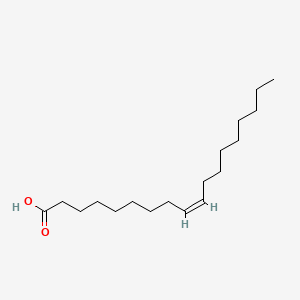
Oleic Acid
Oleic acid is an octadec-9-enoic acid in which the double bond at C-9 has Z (cis) stereochemistry. It has a role as an antioxidant, a solvent, a mouse metabolite, a plant metabolite, an Escherichia coli metabolite, an EC 3.1.1.1 (carboxylesterase) inhibitor and a Daphnia galeata metabolite. It is a conjugate acid of an oleate. It derives from a hydride of a cis-octadec-9-ene. — ChEBI
- IUPAC 명칭
- (Z)-octadec-9-enoic acid
- 분자식
- C18H34O2
- 분자량
- 282.5 g/mol
- 정확한 질량
- 282.255880323 Da
- XLogP3
- 6.5
- 위상 극성 표면적
- 37.3 Ų
- 수소 결합 공여체
- 1
- 수소 결합 수용체
- 2
- 공유결합 단위
- 1
- 정의된 입체중심
- 0
다른 이름
보고된 명칭 16개 더 보기
외부 데이터베이스 식별자
- ChEBI:CHEBI:16196
- ChEMBL:CHEMBL8659
- EPA DTXSID:DTXSID1025809
- PubMed:29968805
- PubMed:22282525
- PubMed:21170321
- PubMed:20671299
- PubMed:20541177
- PubMed:16638535
- PubMed:15619630
- PubMed:15550674
- PubMed:12629551
- PubMed:12565875
- PubMed:12556534
- PubMed:12496284
추가 과학 데이터베이스의 근거
NIH PubChem PUG-View
Attributed physical-property, hazard, environmental and use annotations.
- Autoignition Temperature: 685 °F (USCG, 1999) 출처: CAMEO Chemicals
- Autoignition Temperature: 685 °F (363 °C) 출처: Hazardous Substances Data Bank (HSDB)
- Autoignition Temperature: 363 °C 출처: ILO-WHO International Chemical Safety Cards (ICSCs)
- Boiling Point: 547 °F at 100 mmHg (NTP, 1992) 출처: CAMEO Chemicals
- Boiling Point: 360 °C 출처: DrugBank
- Boiling Point: 286 °C at 100 mm Hg 출처: Hazardous Substances Data Bank (HSDB)
- Boiling Point: Boiling Point - Decomposes at 360 °C and 1 atm 출처: Hazardous Substances Data Bank (HSDB)
- Boiling Point: 194-195 °C (1.2 mm Hg) 출처: Joint FAO/WHO Expert Committee on Food Additives (JECFA)
- Color/Form: Colorless or nearly colorless liq (above 5-7 °C) 출처: Hazardous Substances Data Bank (HSDB)
- Color/Form: YELLOWISH, OILY LIQUID 출처: Hazardous Substances Data Bank (HSDB)
- Color/Form: WATER-WHITE LIQUID 출처: Hazardous Substances Data Bank (HSDB)
- Density: 0.89 at 77 °F (USCG, 1999) - Less dense than water; will float 출처: CAMEO Chemicals
- Density: 0.895 at 25 °C/25 °C 출처: Hazardous Substances Data Bank (HSDB)
- Density: Yellowish, oily liquid; density 0.87; bp 205-206 °C (some decomposition). Insoluble in water; miscible with alcohol, ether /Ethyl ester/ 출처: Hazardous Substances Data Bank (HSDB)
- Density: Relative density (water = 1): 0.89 출처: ILO-WHO International Chemical Safety Cards (ICSCs)
- Density: 0.892-0.898 출처: Joint FAO/WHO Expert Committee on Food Additives (JECFA)
- Density: ~0.895 @25 °C 출처: PAC Chemical Database, U.S. Department of Energy
- Dissociation Constants: pKa = 5.02 in aqueous solution at 25 °C 출처: Hazardous Substances Data Bank (HSDB)
- Flash Point: 372 °F (NTP, 1992) 출처: CAMEO Chemicals
- Flash Point: 189 °C 출처: Haz-Map, Information on Hazardous Chemicals and Occupational Diseases
- Flash Point: 390-425 °F (open cup) 출처: Hazardous Substances Data Bank (HSDB)
- Flash Point: 372 °F (189 °C) (closed cup) 출처: Hazardous Substances Data Bank (HSDB)
- Flash Point: 189 °C c.c. 출처: ILO-WHO International Chemical Safety Cards (ICSCs)
- LogP: log Kow = 7.64 출처: Hazardous Substances Data Bank (HSDB)
- LogP: 7.73 (estimated) 출처: ILO-WHO International Chemical Safety Cards (ICSCs)
- Melting Point: 61.3 °F (NTP, 1992) 출처: CAMEO Chemicals
- Melting Point: 13.4 °C 출처: DrugBank
- Melting Point: 16.3 °C 출처: Hazardous Substances Data Bank (HSDB)
- Melting Point: 13.4 °C 출처: Human Metabolome Database (HMDB)
- Melting Point: 13.4 °C 출처: ILO-WHO International Chemical Safety Cards (ICSCs)
- Odor: PECULIAR LARD-LIKE ODOR 출처: Hazardous Substances Data Bank (HSDB)
- Physical Description: Oleic acid is a colorless to pale yellow liquid with a mild odor. Floats on water. (USCG, 1999) 출처: CAMEO Chemicals
- Physical Description: Other Solid; CBI; Liquid; Wet Solid; Liquid; Liquid; Other Solid 출처: EPA Chemical Data Reporting (CDR)
- Physical Description: Liquid with odor of lard; Darkens with air exposure; Purified grades: White liquid; Commercial grades: Yellow to red liquid; [Hawley] Colorless or light yellow liquid; mp = 4 deg C; [MSDSonline] 출처: Haz-Map, Information on Hazardous Chemicals and Occupational Diseases
- Physical Description: Liquid 출처: Human Metabolome Database (HMDB)
- Physical Description: COLOURLESS LIQUID. TURNS YELLOW-TO-BROWN ON EXPOSURE TO AIR. 출처: ILO-WHO International Chemical Safety Cards (ICSCs)
- Physical Description: colourless to pale yellow, oily liquid with a characteristic lard-like odour 출처: Joint FAO/WHO Expert Committee on Food Additives (JECFA)
- Refractive Index: Index of refraction: 1.463 at 18 °C/D; 1.4585 at 26 °C/D 출처: Hazardous Substances Data Bank (HSDB)
- Refractive Index: 1.46 출처: Joint FAO/WHO Expert Committee on Food Additives (JECFA)
- Solubility: Insoluble (NTP, 1992) 출처: CAMEO Chemicals
- Solubility: Practically insol in water; sol in chloroform; ether; fixed & volatile oils; alcohol; benzene 출처: Hazardous Substances Data Bank (HSDB)
- Solubility: Miscible with ethanol, ether, acetone, benzene, chloroform, carbon tetrachloride 출처: Hazardous Substances Data Bank (HSDB)
- Solubility: Miscible with methanol 출처: Hazardous Substances Data Bank (HSDB)
- Solubility: Solubility in water: none 출처: ILO-WHO International Chemical Safety Cards (ICSCs)
- Solubility: insoluble in water; miscible in alcohol, ether, fixed oils 출처: Joint FAO/WHO Expert Committee on Food Additives (JECFA)
- Solubility: (in ethanol) 출처: Joint FAO/WHO Expert Committee on Food Additives (JECFA)
- Vapor Pressure: 0.00000055 [mmHg] 출처: Haz-Map, Information on Hazardous Chemicals and Occupational Diseases
- Vapor Pressure: 5.46X10⁻⁷ mm Hg at 25 °C 출처: Hazardous Substances Data Bank (HSDB)
- Vapor Pressure: 1 [mm Hg] @176.5 °C 출처: PAC Chemical Database, U.S. Department of Energy
- Viscosity: 25.6 cP at 30 °C 출처: Hazardous Substances Data Bank (HSDB)
- Carcinogen Classification: No indication of carcinogenicity to humans (not listed by IARC). 출처: Toxin and Toxin Target Database (T3DB)
- First Aid: EYES: First check the victim for contact lenses and remove if present. Flush victim's eyes with water or normal saline solution for 20 to 30 minutes while simultaneously calling a hospital or poison control center. Do not put any ointments, oils, or medication in the victim's eyes without specific instructions from a physician. IMMEDIATELY transport the victim after flushing eyes to a hospital even if no symptoms (such as redness or irritation) develop.; SKIN: IMMEDIATELY flood affected skin with water while removing and isolating all contaminated clothing. Gently wash all affected skin areas thoroughly with soap and water. If symptoms such as redness or irritation develop, IMMEDIATELY call a physician and be prepared to transport the victim to a hospital for treatment.; INHALATION: IMMEDIATELY leave the contaminated area; take deep breaths of fresh air. If symptoms (such as wheezing, coughing, shortness of breath, or burning in the mouth, throat, or chest) develop, call a physician and be prepared to transport the victim to a hospital. Provide proper respiratory protection to rescuers entering an unknown atmosphere. Whenever possible, Self-Contained Breathing Apparatus (SCBA) shou 출처: CAMEO Chemicals
- Note: This chemical does not meet GHS hazard criteria for 65.4% (1368 of 2091) of all reports. 출처: European Chemicals Agency (ECHA)
- Signal: Warning 출처: European Chemicals Agency (ECHA)
- GHS Hazard Statements: H315 (31.5%): Causes skin irritation [Warning Skin corrosion/irritation]; H319 (22%): Causes serious eye irritation [Warning Serious eye damage/eye irritation] 출처: European Chemicals Agency (ECHA)
- Precautionary Statement Codes: P264, P264+P265, P280, P302+P352, P305+P351+P338, P321, P332+P317, P337+P317, and P362+P364 (click each P-code to see the statement) 출처: European Chemicals Agency (ECHA)
- ECHA C&L Notifications Summary: Aggregated GHS information provided per 2091 reports by companies from 23 notifications to the ECHA C&L Inventory. Each notification may be associated with multiple companies.; Reported as not meeting GHS hazard criteria per 1368 of 2091 reports by companies.; There are 21 notifications provided by 723 of 2091 reports by companies with hazard statement code(s).; Information may vary between notifications depending on impurities, additives, and other factors. The percentage value in parenthesis indicates the notified classification ratio from companies that provide hazard codes. Only hazard codes with percentage values above 10% are shown. For more detailed information, please visit ECHA C&L website. 출처: European Chemicals Agency (ECHA)
- NFPA Health Rating: 1 - Materials that, under emergency conditions, can cause significant irritation. 출처: Hazardous Substances Data Bank (HSDB)
- NFPA Fire Rating: 1 - Materials that must be preheated before ignition can occur. Materials require considerable preheating, under all ambient temperature conditions, before ignition and combustion can occur. 출처: Hazardous Substances Data Bank (HSDB)
- NFPA Instability Rating: 0 - Materials that in themselves are normally stable, even under fire conditions. 출처: Hazardous Substances Data Bank (HSDB)
- Cosmetic Ingredient Review Conclusion: The CIR Expert Panel concluded that the following ingredients are safe in the present practices of use andconcentration described in the safety assessment when formulated to be non-irritating and non-sensitizing, which may be basedon a QRA...Oleic Acid... 출처: Cosmetic Ingredient Review (CIR)
- Cosmetic Ingredient Review Finding(s): Safe for use in cosmetics, with qualifications 출처: Cosmetic Ingredient Review (CIR)
- Environmental Bioconcentration: An estimated BCF of 10 was calculated in fish for oleic acid(SRC), using a log Kow of 7.64(1) and a regression-derived equation(2). According to a classification scheme(3), this BCF suggests the potential for bioconcentration in aquatic organisms is low(SRC). 출처: Hazardous Substances Data Bank (HSDB)
- Environmental Fate: TERRESTRIAL FATE: Based on a classification scheme(1), an estimated Koc value of 340,000 for the free acid(SRC), determined from a log Kow of 7.64(2) and a regression-derived equation(3), indicates that undissociated oleic acid is expected to be immobile in soil(SRC). The pKa of oleic acid is 5.02(4), indicating that this compound will exist almost entirely in anion form in the environment and anions generally do not adsorb more strongly to soils containing organic carbon and clay than their neutral counterparts(5). Volatilization of oleic acid from moist soil is not expected to be an important fate process because the acid is in the anion form and anions do not volatilize(SRC). Oleic acid is not expected to volatilize from dry soil surfaces(SRC) based upon a vapor pressure of 5.46X10⁻⁷ mm Hg(6). Biodegradation is expected to be an important fate process in soil based on half-lives of 0.2 and 0.66 days in screening tests(7,8). 출처: Hazardous Substances Data Bank (HSDB)
- Environmental Fate: AQUATIC FATE: Based on a classification scheme(1), an estimated Koc value of 340,000 for the free acid(SRC), determined from a log Kow of 7.64(2) and a regression-derived equation(3), indicates that undissociated oleic acid is expected to adsorb to suspended solids and sediment(SRC). A pKa of 5.02(4) indicates oleic acid will exist almost entirely in the anion form at pH values of 5 to 9 and therefore volatilization from water surfaces is not expected to be an important fate process(5). According to a classification scheme(6), an estimated BCF of 10(SRC), from its log Kow(2) and a regression-derived equation(7), suggests the potential for bioconcentration in aquatic organisms is low(SRC). A 47 and 52 theoretical %BOD for oleic acid measured over a period of 5 days using sewage inoculum(8) and a biodegradation half-life of 0.66 days using activated sludge inocula(9) suggest that biodegradation may be an important environmental fate process in aquatic ecosystems(SRC). 출처: Hazardous Substances Data Bank (HSDB)
- Environmental Fate: ATMOSPHERIC FATE: According to a model of gas/particle partitioning of semivolatile organic compounds in the atmosphere(1), oleic acid, which has a vapor pressure of 5.46X10⁻⁷ mm Hg at 25 °C(2), will exist in both the vapor and particulate phases in the ambient atmosphere. Vapor-phase oleic acid is degraded in the atmosphere by reaction with photochemically-produced hydroxyl radicals(SRC); the half-life for cis-oleic acid and trans-oleic acid reactions in air are estimated to be 5.1 and 4.6 hours(SRC), calculated from rate constants of 7.6X10⁻¹¹ and 8.3X10⁻¹¹cu cm/molecule-sec at 25 °C(SRC) that were derived using a structure estimation method(3). Vapor-phase oleic acid is also degraded in the atmosphere by reaction with ozone(SRC); the half-life for cis-oleic acid and trans-oleic acid reactions in air are estimated to be 2.1 and 1.4 hours(SRC), respectively, calculated from rate constants of 1.3X10⁻¹⁶ and 2.0X10⁻¹⁶ cu cm/molecule-sec at 25 °C(SRC) that were derived using a structure estimation method(3). Particulate-phase oleic acid may be removed from the air by wet or dry deposition(SRC). Oleic acid does not contain chromophores that absorb at wavelengths >290 nm and therefore i 출처: Hazardous Substances Data Bank (HSDB)
- Consumer Uses: Lubricating agent; Binder; Fuel agents; Emulsifier; Soil amendments (fertilizers); Not Known or Reasonably Ascertainable; Softener and conditioner; Intermediate 출처: EPA Chemical Data Reporting (CDR)
- Industry Uses: Viscosity modifiers; Soil amendments (fertilizers); Not Known or Reasonably Ascertainable; Intermediate; Pigment; Anti-static agent; Softener and conditioner; Surface modifier; Humectant; Lubricating agent; Binder; Surfactant (surface active agent); Fuel agents 출처: EPA Chemical Data Reporting (CDR)
- Cosmetic Ingredient Review Link: CIR ingredient: Oleic Acid 출처: Cosmetic Ingredient Review (CIR)
- Sources/Uses: Used to make soaps and detergents, to prepare turkey red oil, and to waterproof fabrics; Also used in polishing compounds, oiling wool, thickening lubricating oils, anionic and nonionic surfactants, plasticizers, waxes, ointments, cosmetics, and food-grade additives; Other uses are ore flotation, rodent extermination, and defoaming; [HSDB] 출처: Haz-Map, Information on Hazardous Chemicals and Occupational Diseases
- Industrial Processes with risk of exposure: Textiles (Fiber & Fabric Manufacturing) [Category: Industry]; Textiles (Printing, Dyeing, or Finishing) [Category: Industry]; Metal Extraction and Refining [Category: Industry] 출처: Haz-Map, Information on Hazardous Chemicals and Occupational Diseases
- Uses: For oleic acid (USEPA/OPP Pesticide Code: 031702) there are 0 labels match. /SRP: Not registered for current use in the U.S., but approved pesticide uses may change periodically and so federal, state and local authorities must be consulted for currently approved uses./ 출처: Hazardous Substances Data Bank (HSDB)
- Uses: The active ingredient is no longer contained in any registered pesticide products ... "cancelled." 출처: Hazardous Substances Data Bank (HSDB)
- Uses: Prepn of turkey red oil, soft soap and other oleates; used in polishing cmpd; waterproofing textiles; in oiling wool; mfr driers; thickening lubricating oils. Pharmaceutical aid (solvent). The barium salt in rodent extermination. 출처: Hazardous Substances Data Bank (HSDB)
- Uses: Defoaming agent in wet-process phosphoric acid process 출처: Hazardous Substances Data Bank (HSDB)
- Uses: For more Uses (Complete) data for OLEIC ACID (16 total), please visit the HSDB record page. 출처: Hazardous Substances Data Bank (HSDB)
- Uses: This is an endogenously produced metabolite found in the human body. It is used in metabolic reactions, catabolic reactions or waste generation. 출처: Toxin and Toxin Target Database (T3DB)
매핑 기준: Existing checksum-valid CAS to unique PubChem CID match. 가져온 시각: 2026-08-31. 출처 기록 열기
과학적 분류와 유해성 주석은 맥락을 제공할 뿐이며, 위에 표시된 시장별 규제 판단을 대체하지 않습니다.
추가 출처 적용 범위 및 일치 상태
| 출처 | 결과 | 확인됨 |
|---|---|---|
| NIH PubChem PUG-View | 정확히 일치 | 2026-08-31 |
기록된 불일치는 출처를 확인했다는 유용한 근거이며, 해당 물질이 다른 곳에 존재하지 않는다는 주장이 아닙니다.
체크섬이 유효한 CAS 일치를 통해 2026-08-31에 NIH PubChem에서 가져왔습니다. 화학적 특성은 이 페이지의 규제 판단을 대체하지 않습니다.