본문으로 건너뛰기
CAS 기록 1건

CAS 111-90-0

CAS 111-90-0은(는) 규정 1223/2009의 부속서 II–VI에 걸쳐 EU 부속서 기록 1건과 일치합니다.

CAS 111-90-0의 기록

1 총
부속서
III
항목
297

ETHOXYDIGLYCOL

2-(2-ethoxyethoxy)ethanol Diethylene Glycol Monoethyl Ether (DEGEE), Ethoxydiglycol

(a) to (e): The level of ethylene glycol impurity in Ethoxydiglycol must be ≤ 0,1 %. Not to be used in eye products and oral products
EC
최대 농도

화학적 정체 및 특성

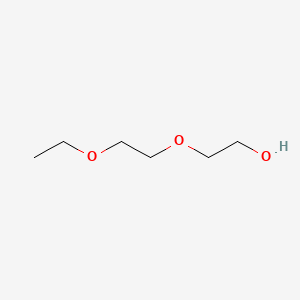
CAS 111-90-0의 PubChem 2D 화학 구조
CAS 111-90-0PubChem CID 8146

Diethylene Glycol Monoethyl Ether

Diethylene glycol monoethyl ether is a primary alcohol that is ethanol substituted by a 2-ethoxyethoxy group at position 2. It has a role as a protic solvent. It is a primary alcohol, a glycol ether, a diether and a hydroxypolyether. It is functionally related to a diethylene glycol. — ChEBI

IUPAC 명칭
2-(2-ethoxyethoxy)ethanol
분자식
C6H14O3
분자량
134.17 g/mol
정확한 질량
134.094294304 Da
XLogP3
-0.5
위상 극성 표면적
38.7 Ų
수소 결합 공여체
1
수소 결합 수용체
3
공유결합 단위
1
정의된 입체중심
0

다른 이름

CARBITOLTranscutolEthoxydiglycolEthyl carbitolDioxitolEthoxy diglycolCarbitol solventSolvolsol
보고된 명칭 16개 더 보기
Ethyl digolDiethylene glycol ethyl etherCarbitol cellosolveEthanol, 2-(2-ethoxyethoxy)-Losungsmittel apvDowanol DEEthyl diethylene glycolDiglycol monoethyl ether3,6-Dioxa-1-octanolDEGMEEEktasolve DEDowanol 17KarbitolEthylene diglycol monoethyl ether2-(2-Ethoxyethoxy) ethanolDiethyleneglycol monoethyl ether
외부 데이터베이스 식별자

추가 과학 데이터베이스의 근거

NIH PubChem PUG-View
식별자 정확히 일치8146

Attributed physical-property, hazard, environmental and use annotations.

  • First Aid: EYES: First check the victim for contact lenses and remove if present. Flush victim's eyes with water or normal saline solution for 20 to 30 minutes while simultaneously calling a hospital or poison control center. Do not put any ointments, oils, or medication in the victim's eyes without specific instructions from a physician. IMMEDIATELY transport the victim after flushing eyes to a hospital even if no symptoms (such as redness or irritation) develop.; SKIN: IMMEDIATELY flood affected skin with water while removing and isolating all contaminated clothing. Gently wash all affected skin areas thoroughly with soap and water. If symptoms such as redness or irritation develop, IMMEDIATELY call a physician and be prepared to transport the victim to a hospital for treatment.; INHALATION: IMMEDIATELY leave the contaminated area; take deep breaths of fresh air. If symptoms (such as wheezing, coughing, shortness of breath, or burning in the mouth, throat, or chest) develop, call a physician and be prepared to transport the victim to a hospital. Provide proper respiratory protection to rescuers entering an unknown atmosphere. Whenever possible, Self-Contained Breathing Apparatus (SCBA) shou 출처: CAMEO Chemicals
  • Note: This chemical does not meet GHS hazard criteria for 90.4% (4397 of 4862) of all reports. 출처: European Chemicals Agency (ECHA)
  • GHS Hazard Statements: Not Classified; Reported as not meeting GHS hazard criteria by 4397 of 4862 companies (only 9.6% companies provided GHS information). For more detailed information, please visit ECHA C&L website. 출처: European Chemicals Agency (ECHA)
  • ECHA C&L Notifications Summary: Aggregated GHS information provided per 4862 reports by companies from 13 notifications to the ECHA C&L Inventory.; Reported as not meeting GHS hazard criteria per 4397 of 4862 reports by companies.; There are 11 notifications provided by 465 of 4862 reports by companies with hazard statement code(s).; Information may vary between notifications depending on impurities, additives, and other factors. The percentage value in parenthesis indicates the notified classification ratio from companies that provide hazard codes. Only hazard codes with percentage values above 10% are shown. For more detailed information, please visit ECHA C&L website. 출처: European Chemicals Agency (ECHA)
  • Signal: Danger 출처: NITE-CMC
  • GHS Hazard Statements: H227: Combustible liquid [Warning Flammable liquids]; H320: Causes eye irritation [Warning Serious eye damage/eye irritation]; H372: Causes damage to organs through prolonged or repeated exposure [Danger Specific target organ toxicity, repeated exposure] 출처: NITE-CMC
  • Precautionary Statement Codes: P210, P260, P264, P264+P265, P270, P280, P305+P351+P338, P319, P337+P317, P370+P378, P403, and P501 (click each P-code to see the statement) 출처: NITE-CMC
  • NFPA Health Rating: 2 - Materials that, under emergency conditions, can cause temporary incapacitation or residual injury. 출처: Hazardous Substances Data Bank (HSDB)
  • NFPA Fire Rating: 2 - Materials that must be moderately heated or exposed to relatively high ambient temperatures before ignition can occur. Materials would not under normal conditions form hazardous atmospheres with air, but under high ambient temperatures or under moderate heating could release vapor in sufficient quantities to produce hazardous atmospheres with air. 출처: Hazardous Substances Data Bank (HSDB)
  • NFPA Instability Rating: 0 - Materials that in themselves are normally stable, even under fire conditions. 출처: Hazardous Substances Data Bank (HSDB)
  • Cosmetic Ingredient Review Finding(s): Safe in the present practices of use and concentration. Ingredient, concentration, and use information are available in documents discoverable at https://cir-reports.cir-safety.org 출처: Cosmetic Ingredient Review (CIR)
  • Environmental Bioconcentration: An estimated BCF of 3 was calculated in fish for diethylene glycol monoethyl ether(SRC), using a log Kow of -0.54(1) and a regression-derived equation(2). According to a classification scheme(3), this BCF suggests the potential for bioconcentration in aquatic organisms is low(SRC). 출처: Hazardous Substances Data Bank (HSDB)
  • Environmental Fate: TERRESTRIAL FATE: Based on a classification scheme(1), an estimated Koc value of 12(SRC), determined from a log Kow of -0.54(2) and a regression-derived equation(3), indicates that diethylene glycol monoethyl ether is expected to have very high mobility in soil(SRC). Volatilization of diethylene glycol monoethyl ether from moist soil surfaces is not expected to be an important fate process(SRC) given an estimated Henry's Law constant of 2.2X10⁻⁸ atm-cu m/mole(SRC), derived from its vapor pressure, 0.126 mm Hg(4), and assigned value for water solubility of 1X10+6 mg/L (miscible)(5). Diethylene glycol monoethyl ether is expected to volatilize from dry soil surfaces(SRC) based upon its vapor pressure(4). Aerobic screening test data(6-11) indicate that rapid aerobic biodegradation is likely to be the most important mechanism for the removal of diethylene glycol monoethyl ether from soil. Biodegradation of 48%(6) to 87%(7) were reported in non-acclimated cultures incubated for 20 days. 출처: Hazardous Substances Data Bank (HSDB)
  • Environmental Fate: AQUATIC FATE: Based on a classification scheme(1), an estimated Koc value of 12(SRC), determined from a log Kow of -0.54(2) and a regression-derived equation(3), indicates that diethylene glycol monoethyl ether is not expected to adsorb to suspended solids and sediment(SRC). Volatilization from water surfaces is not expected(3) based upon an estimated Henry's Law constant of 2.2X10⁻⁸ atm-cu m/mole(SRC), derived from its vapor pressure, 0.126 mm Hg(4), and assigned value for water solubility of 1X10+6 mg/L (5)(miscible). According to a classification scheme(6), an estimated BCF of 3(SRC), from its log Kow(2) and a regression-derived equation(7), suggests the potential for bioconcentration in aquatic organisms is low(SRC). Diethylene glycol monoethyl ether is not expected to undergo hydrolysis or direct photolysis in aquatic environments(SRC). Alcohols and ethers are generally resistant to hydrolysis(3). They do not absorb UV light in the environmental range of >290 nm and are commonly used as solvents for obtaining UV spectra(14). Aerobic screening test data(8-13) indicate that rapid aerobic biodegradation is likely to be the most important mechanism for the removal of diethylene gl 출처: Hazardous Substances Data Bank (HSDB)
  • Environmental Fate: ATMOSPHERIC FATE: According to a model of gas/particle partitioning of semivolatile organic compounds in the atmosphere(1), diethylene glycol monoethyl ether, which has a vapor pressure of 0.126 mm Hg at 25 °C(2), is expected to exist solely as a vapor in the ambient atmosphere. Vapor-phase diethylene glycol monoethyl ether is degraded in the atmosphere by reaction with photochemically-produced hydroxyl radicals(SRC); the half-life for this reaction in air is estimated to be 6.7 hours(SRC), calculated from its rate constant of 5.72X10⁻¹¹ cu cm/molecule-sec at 23 °C(3). Diethylene glycol monoethyl ether does not contain chromophores that absorb at wavelengths >290 nm and therefore is not expected to be susceptible to direct photolysis by sunlight(4). 출처: Hazardous Substances Data Bank (HSDB)
  • Industry Uses: Cleaning agent; Not Known or Reasonably Ascertainable; Coalescing agent; Laboratory chemicals; Solvent; Other; Solubility enhancer 출처: EPA Chemical Data Reporting (CDR)
  • Cosmetic Ingredient Review Link: CIR ingredient: Ethoxydiglycol 출처: Cosmetic Ingredient Review (CIR)
  • Sources/Uses: Used in lubricating oil and braking fluid; [ChemIDplus] Used as a solvent for cellulose esters, lacquers, varnishes, enamels, dyestuffs, wood stains, gums, and resins; [Merck Index, 1800] Used in textile printing; [CHEMINFO] Used in photography (solvent for color processing); [www.ci.tucson.az.us/arthazards/medium.html] 출처: Haz-Map, Information on Hazardous Chemicals and Occupational Diseases
  • Industrial Processes with risk of exposure: Painting (Solvents) [Category: Paint]; Photographic Processing [Category: Other]; Textiles (Printing, Dyeing, or Finishing) [Category: Industry] 출처: Haz-Map, Information on Hazardous Chemicals and Occupational Diseases
  • Uses: AS SOLVENT FOR CELLULOSE ESTERS, IN LACQUER & THINNER FORMULATIONS; IN QUICK DRYING VARNISHES AND ENAMELS, FOR DYESTUFFS AND WOOD STAINS. 출처: Hazardous Substances Data Bank (HSDB)
  • Uses: A DILUENT FOR HYDRAULIC BRAKE FLUIDS; SOLVENT IN PROTECTIVE COATINGS, TEXTILE DYEING & PRINTING; SOLVENT IN COSMETICS, TOILETRIES 출처: Hazardous Substances Data Bank (HSDB)
  • Uses: Used as a chemical intermediate for the synthesis of 2-(2-ethoxyethoxy)ethyl acrylate. 출처: Hazardous Substances Data Bank (HSDB)
  • Uses: Solvent for dyes, nitrocellulose, and resins; mutual solvent for mineral-oil-soap and mineral-oil-sulfonated-oil mixtures; nonaqueous stains for wood, for setting the twist and conditioning yarns and cloth; textile printing, textile soaps, lacquers, organic synthesis; brake fluid diluent. 출처: Hazardous Substances Data Bank (HSDB)
  • Uses: Inert ingredient in pesticide products. Diethylene glycol monoethyl ether is found on List 2: potentially toxic other ingredients/high priority for testing inerts. ... List 2 inert ingredients are structurally similar to chemicals known to be toxic; some have data suggesting a concern. 출처: Hazardous Substances Data Bank (HSDB)

매핑 기준: Existing checksum-valid CAS to unique PubChem CID match. 가져온 시각: 2026-08-31. 출처 기록 열기

과학적 분류와 유해성 주석은 맥락을 제공할 뿐이며, 위에 표시된 시장별 규제 판단을 대체하지 않습니다.

추가 출처 적용 범위 및 일치 상태
출처결과확인됨
NIH PubChem PUG-View정확히 일치2026-08-31

기록된 불일치는 출처를 확인했다는 유용한 근거이며, 해당 물질이 다른 곳에 존재하지 않는다는 주장이 아닙니다.

체크섬이 유효한 CAS 일치를 통해 2026-09-02에 NIH PubChem에서 가져왔습니다. 화학적 특성은 이 페이지의 규제 판단을 대체하지 않습니다.

이 사이트에서 CAS 111-90-0을(를) 사용하는 방식

CAS 111-90-0은(는) 이 페이지를 특정 물질에 고정하는 데 사용하는 Chemical Abstracts Service 식별자입니다. 현재 데이터세트에서는 EU 부속서 기록 1건이 이 식별자를 공유하며, 같은 물질이 하나의 규제 맥락에 나타나는지 여러 맥락에 나타나는지 교차 확인하는 데 도움이 됩니다.

공급업체 규격서, SDS 또는 원료 문서에 CAS 111-90-0이(가) 제시되어 있고 연결된 모든 부속서 II–VI 기록을 한곳에서 확인해야 할 때 이 페이지를 이용하세요. 위의 항목 카드는 농도 한도, 경고 문구, 부속서 위치 및 제품 유형 조건을 가장 빠르게 확인하는 방법입니다.

자주 묻는 질문

CAS 111-90-0로 식별되는 물질은 맥락에 따라 다른 조건이 적용되는 경우 EU 화장품 규정의 여러 부속서에 나타날 수 있습니다. 예를 들어 어떤 물질이 부속서 III에서 특정 조건으로 사용제한될 수 있고, 같은 CAS가 부속서 IV에서 별도의 항목 조건에 따라 허용 색소로 나타날 수도 있습니다. 각 항목은 개별적으로 검토해야 합니다.

CAS 번호를 원료 규격서 및 CoA 문서와 대조하세요. CAS가 부속서 II에 있으면 해당 물질이 없는지 확인하세요. 부속서 III에 있으면 처방에서 농도 한도와 제품 유형 조건이 충족되는지 확인하세요. 이 CAS 번호를 공유하는 모든 부속서 항목이 위에 나열되어 있습니다.

CAS 번호는 미국의 Chemical Abstracts Service가 부여하며 전 세계적으로 통용됩니다. EC 번호는 EINECS, ELINCS 또는 NLP 목록 같은 목록에 수록된 유럽연합 집행위원회 식별자입니다. 두 식별자 모두 EU 화장품 부속서 항목에 나타날 수 있습니다. 두 가지를 모두 가진 물질도 있고, 하나만 가진 물질도 있으며, 일부 오래된 항목은 둘 다 없을 수도 있습니다.

INCI 검사기는 원료명, CAS 번호 및 EC 번호를 받습니다. 이 CAS 번호를 직접 확인한 다음, 결과를 공급업체 규격서 및 연결된 모든 부속서 조건과 대조하세요.

도구 및 다음 단계

처방 확인

전체 INCI 목록을 검사한 다음, CAS 111-90-0을(를) 사용하여 일치한 물질의 공급업체 문서를 교차 확인하세요.

INCI 검사기

부속서 둘러보기

카테고리별로 모든 EU 화장품 규정 부속서를 둘러보세요.

모든 부속서

명칭으로 검색

문서에서 CAS 111-90-0과(와) 함께 나오는 INCI 명칭, 별칭 또는 관련 식별자를 검색하세요.

검색