
CAS 111-61-5PubChem CID 8122
Ethyl stearate
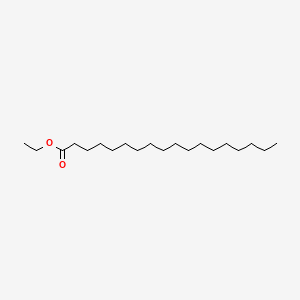
Ethyl octadecanoate is an octadecanoate ester obtained by formal condensation between the carboxy group of octadecanoic (stearic) acid and the hydroxy group of ethanol. It has a role as a plant metabolite. It is a long-chain fatty acid ethyl ester and an octadecanoate ester. — ChEBI
- IUPAC 명칭
- ethyl octadecanoate
- 분자식
- C20H40O2
- 분자량
- 312.5 g/mol
- 정확한 질량
- 312.302830514 Da
- XLogP3
- 8.9
- 위상 극성 표면적
- 26.3 Ų
- 수소 결합 공여체
- 0
- 수소 결합 수용체
- 2
- 공유결합 단위
- 1
- 정의된 입체중심
- 0
다른 이름
Stearic acid ethyl esterOctadecanoic acid, ethyl esterEthyl n-octadecanoateStearic acid, ethyl esterFEMA No. 3490octadecanoic acid ethyl esterC64RTC734WNSC-8919
보고된 명칭 16개 더 보기
CHEBI:84936RefChem:139058203-887-4Dicyclohexylammonium sulfateDicyclohexylammonium sulphateOctadecanoic acid-ethyl esterQSPL 080ETHYL STEARATE [USP-RS]ETHYL OCTADECANOATE [FHFI]HMS3650O05Ethyl stearate, >=99% (capillary GC)Ethyl Stearate; Octadecanoic acid ethyl esterOctadecanoic acid ethylNSC 8919EINECS 203-887-4BRN 1788183
외부 데이터베이스 식별자
추가 과학 데이터베이스의 근거
NIH PubChem PUG-View
식별자 정확히 일치8122
Attributed physical-property, hazard, environmental and use annotations.
- Boiling Point: 213.00 to 215.00 °C. @ 15.00 mm Hg 출처: Human Metabolome Database (HMDB)
- Boiling Point: 105 °C at 11mm Hg 출처: Joint FAO/WHO Expert Committee on Food Additives (JECFA)
- Density: 0.880-0.900 출처: Joint FAO/WHO Expert Committee on Food Additives (JECFA)
- Melting Point: 33.4 °C 출처: Human Metabolome Database (HMDB)
- Physical Description: Solid 출처: Human Metabolome Database (HMDB)
- Physical Description: Colourless, odourless mass 출처: Joint FAO/WHO Expert Committee on Food Additives (JECFA)
- Refractive Index: 1.420-1.440 출처: Joint FAO/WHO Expert Committee on Food Additives (JECFA)
- Solubility: Soluble in ethanol and oils, insoluble in water 출처: Joint FAO/WHO Expert Committee on Food Additives (JECFA)
- Solubility: (in ethanol) 출처: Joint FAO/WHO Expert Committee on Food Additives (JECFA)
- Note: This chemical does not meet GHS hazard criteria for 0.7% (1 of 138) of reports. 출처: European Chemicals Agency (ECHA)
- Signal: Warning 출처: European Chemicals Agency (ECHA)
- GHS Hazard Statements: H315 (99.3%): Causes skin irritation [Warning Skin corrosion/irritation]; H319 (99.3%): Causes serious eye irritation [Warning Serious eye damage/eye irritation]; H335 (39.9%): May cause respiratory irritation [Warning Specific target organ toxicity, single exposure; Respiratory tract irritation] 출처: European Chemicals Agency (ECHA)
- Precautionary Statement Codes: P261, P264, P264+P265, P271, P280, P302+P352, P304+P340, P305+P351+P338, P319, P321, P332+P317, P337+P317, P362+P364, P403+P233, P405, and P501 (click each P-code to see the statement) 출처: European Chemicals Agency (ECHA)
- ECHA C&L Notifications Summary: Aggregated GHS information provided per 138 reports by companies from 8 notifications to the ECHA C&L Inventory. Each notification may be associated with multiple companies.; Reported as not meeting GHS hazard criteria per 1 of 138 reports by companies.; There are 7 notifications provided by 137 of 138 reports by companies with hazard statement code(s).; Information may vary between notifications depending on impurities, additives, and other factors. The percentage value in parenthesis indicates the notified classification ratio from companies that provide hazard codes. Only hazard codes with percentage values above 10% are shown. For more detailed information, please visit ECHA C&L website. 출처: European Chemicals Agency (ECHA)
매핑 기준: Existing checksum-valid CAS to unique PubChem CID match. 가져온 시각: 2026-08-31. 출처 기록 열기
과학적 분류와 유해성 주석은 맥락을 제공할 뿐이며, 위에 표시된 시장별 규제 판단을 대체하지 않습니다.
추가 출처 적용 범위 및 일치 상태
| 출처 | 결과 | 확인됨 |
|---|---|---|
| NIH PubChem PUG-View | 정확히 일치 | 2026-08-31 |
기록된 불일치는 출처를 확인했다는 유용한 근거이며, 해당 물질이 다른 곳에 존재하지 않는다는 주장이 아닙니다.
체크섬이 유효한 CAS 일치를 통해 2026-08-31에 NIH PubChem에서 가져왔습니다. 화학적 특성은 이 페이지의 규제 판단을 대체하지 않습니다.